
Views: 220 Author: Youti Clothing Publish Time: 2026-09-08 Origin: Site


Content Menu
● What Is the Difference Between Pleated and Flat Front Trousers?
● Which Trouser Style Is More Comfortable for Office Workers?
● Why Sitting Changes Trouser Comfort
● Pleated Trousers: Comfort Advantages and Limitations
>> Why Pleated Trousers Often Feel Better
>> Where Pleated Trousers Can Go Wrong
● Flat Front Trousers: Comfort Advantages and Limitations
>> Why Flat Front Trousers Remain Popular
● Pleated vs Flat Front Trousers for Different Body Types
● The Four Factors That Matter More Than Pleats
>> 4. Pattern Engineering and Size Grading
● A Practical Comfort Test for Office Trousers
● Expert Recommendation for Uniform Buyers
● Final Verdict: Pleated or Flat Front for Office Comfort?
● FAQs
>> 1. Are pleated trousers more comfortable than flat front trousers?
>> 2. Are flat front trousers suitable for long office hours?
>> 3. Which trousers are better for employees with larger thighs?
>> 4. Do pleated trousers look less modern than flat front trousers?
>> 5. What fabric is best for comfortable office trousers?
>> 6. Should office uniform trousers include elastic waistbands?
>> 7. How should buyers test office trousers before bulk ordering?
For office workers, the answer is not simply that pleated trousers are more comfortable or that flat front trousers look sharper. The better choice depends on body shape, sitting time, fabric performance, waistband construction, and how much movement the wearer needs throughout the day.
In our experience developing OEM uniforms and work clothes for overseas brands, wholesalers, and professional apparel businesses, comfort problems usually appear at the waist, hips, thighs, seat, and knees—not because one trouser style is automatically wrong, but because the pattern, fabric, and fit have not been designed for the wearer's real working posture. For employees who spend long hours sitting, standing in meetings, commuting, or moving between departments, the right trouser construction can make a noticeable difference in daily comfort and professional appearance.

Pleated trousers have one or more folded sections of fabric at the front waistband. These pleats create extra volume through the upper hip and thigh area. They open when the wearer sits, bends, walks, or uses the front pockets, then fall back toward a cleaner shape when standing still.
Flat front trousers have a smooth, uninterrupted front panel. They are usually cut closer through the waist, hips, and thighs, creating a more streamlined and contemporary office silhouette.
The visible difference is simple. The practical difference is more important.
| Feature | Pleated Trousers | Flat Front Trousers |
|---|---|---|
| Front construction | Folded fabric near the waistband | Smooth, clean front panel |
| Room at hips and thighs | Usually greater | Usually more controlled |
| Sitting comfort | Often better for fuller hips or thighs | Depends heavily on stretch and fit |
| Visual effect | Relaxed, tailored, classic | Sleek, modern, minimal |
| Best for | Long sitting hours, broader builds, formal uniforms | Slim or regular builds, contemporary office uniforms |
| Pocket usability | More space when pockets are used | Can pull more when pockets are full |
| Pattern priority | Upper-body mobility and ease | Clean shape and close fit |
Pleats were originally designed to provide more room where trousers need it most: around the hips and upper thighs. Tailoring specialists note that the extra fabric can expand when required while maintaining a tidy appearance when the wearer is standing. This is especially useful in higher-rise trousers, where the garment has to transition from a smaller waist to fuller hips and thighs.
Flat front trousers, by comparison, became strongly associated with a cleaner and more contemporary business look. They can work very well in office uniform programs, particularly when the wearer prefers a close but not restrictive fit. However, a flat-front design needs more precise pattern engineering to avoid tension lines across the lap, front rise, and seat.
For many office workers, pleated trousers provide better comfort during long periods of sitting, especially for people with fuller thighs, a stronger seat, or a wider midsection. The pleats can release extra volume when the hips bend at a desk chair, reducing pulling at the waistband and strain across the upper leg.
However, this does not mean pleated trousers are always the most comfortable option.
A well-designed flat front trouser made with suitable stretch fabric, a properly shaped waistband, and enough rise can feel equally comfortable for many employees. In fact, a poorly cut pleated trouser may still feel bulky, loose, or restrictive if the rise is too short, the seat is too tight, or the fabric has little give.
The most accurate conclusion is this:
- Choose pleated trousers when the priority is ease through the waist, hips, and thighs.
- Choose flat front trousers when the priority is a neat visual profile and the wearer has a slim-to-regular build.
- Choose a stretch flat front trouser when a modern appearance is required without sacrificing reasonable mobility.
- Choose a high-rise or mid-rise pleated trouser when employees sit for long periods and need more room through the front and upper leg.
Comfort is not only about "loose" versus "slim." It is about whether the trousers allow the wearer to sit, stand, walk, bend, and reach without pressure, bunching, or loss of professional shape.
Office trousers must perform in a position that traditional fitting often overlooks: sitting.
When a person sits, the hips flex, the thighs spread slightly, the waistband circumference increases, and the fabric at the front rise and seat must accommodate the body's movement. A trouser that looks excellent during a standing fitting can become uncomfortable after one hour at a desk.
Workplace health guidance consistently emphasizes the importance of changing positions rather than remaining seated continuously. One occupational health resource describes prolonged sitting as sedentary behavior and recommends allowing workers to vary among sitting, standing, and movement throughout the day. European workplace guidance also advises getting up regularly, with microbreaks every 20–30 minutes and avoiding continuous sitting for more than two hours.
For uniform designers and buyers, this creates an important product-development lesson: office trousers should be tested in motion, not only in front of a mirror.
A wearer should be able to:
- Sit with the waistband resting naturally rather than digging into the abdomen.
- Cross or reposition the legs without tightness at the thighs.
- Stand after prolonged sitting without excessive wrinkling or knee bagging.
- Walk between workstations, meeting rooms, elevators, and transport stations comfortably.
- Use front pockets without pulling the trouser front out of shape.
- Bend slightly to retrieve documents or connect equipment without exposing the back waist.
Pleated trousers naturally create extra functional ease at the upper front. Flat front trousers need that ease to be built into the pattern in other ways, such as a deeper rise, shaped waistband, stretch fabric, or a slightly more relaxed thigh specification.
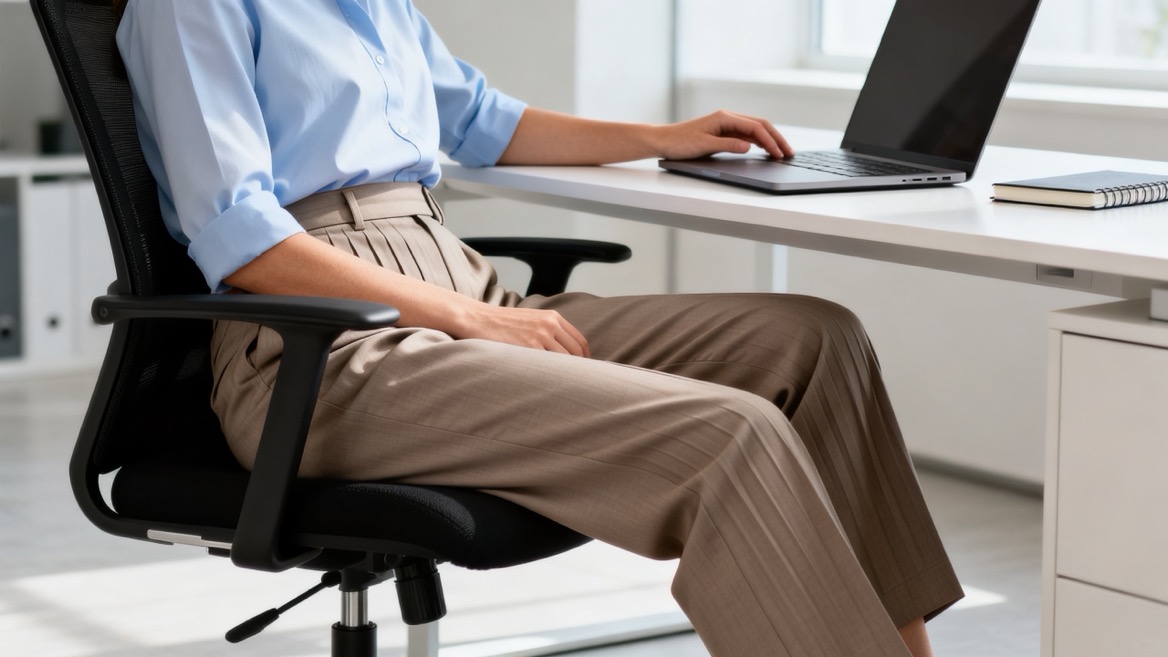
A pleat acts as controlled reserve fabric. When the wearer sits or bends, the fold can open to create additional room. When the wearer returns to a standing position, the fabric can settle back into place.
This makes pleated trousers particularly useful for office workers who:
- Sit at a desk for most of the day.
- Frequently attend meetings or travel between client sites.
- Carry a phone, key card, notebook, or other light items in front pockets.
- Have athletic thighs, fuller hips, or a broader waist-to-hip proportion.
- Prefer a classic business or hospitality-uniform appearance.
- Need a more forgiving fit across a multi-size employee group.
Pleats can also help trousers drape more naturally over the hips. In professional settings, this can reduce the horizontal stress lines often seen when flat front trousers are cut too narrowly across the upper thigh.
Pleats are not a cure for poor fit. If they are too deep, too numerous, or placed incorrectly, they can create unwanted fullness. If the fabric is too heavy, the front may look bulky. If the trouser is too large overall, the wearer may feel that the garment shifts or gathers while seated.
For office uniforms, a single forward pleat or restrained single reverse pleat is often the most balanced solution. It provides visible tailoring detail and useful movement space without producing an overly voluminous silhouette.
The best pleated office trousers should have:
- A stable waistband that does not roll or collapse.
- Sufficient rise for seated comfort.
- Controlled hip ease rather than excessive bagginess.
- A taper that maintains a professional line below the knee.
- Fabric with enough recovery to prevent stretching out after repeated wear.
- Pocket construction that remains flat when empty.
Flat front trousers are widely used in corporate uniforms because they create a clean, polished, and modern appearance. The uninterrupted front works especially well with tucked-in shirts, fitted blazers, polo shirts, and contemporary office dress codes.
For employees with a slim or regular lower-body shape, flat front trousers can provide excellent comfort when the fit is correct. The key is that "slim" should not mean "tight."
A flat front design works well for office workers who:
- Prefer a minimal, streamlined business look.
- Have relatively narrow hips and moderate thighs.
- Spend part of the day standing, greeting customers, or moving around the workplace.
- Need a versatile style for office, retail, reception, sales, or service settings.
- Want a uniform trouser that pairs easily with modern shirts and jackets.
A flat front trouser can also look more consistent across large uniform programs when the brand wants a sharp, youthful, and contemporary visual identity.
The main risk is insufficient ease.
Because flat front trousers do not have pleats to release extra space at the waistband, a close-fitting design can pull across the hips and thighs when the wearer sits. This can lead to waistband pressure, wrinkling at the front rise, tightness around the seat, and discomfort during extended desk work.
The answer is not simply to make the trousers larger. Oversizing creates a loose waist, dropped seat, and untidy appearance. Instead, OEM product developers should adjust the trouser pattern strategically.
For a more comfortable flat front office trouser, consider:
- A mid-rise or slightly higher rise.
- Additional thigh ease in the grading specification.
- Mechanical stretch or elastane-blend fabric.
- A curved or contoured waistband.
- A discreet elasticated back waistband for selected uniform programs.
- A gusset or improved seat-shape construction where greater mobility is needed.
- Fabric with good stretch recovery, so knees and seat do not become baggy after a full day.
Stretch and recovery are not the same thing. Stretch refers to how far a fabric can extend, while recovery describes how effectively it returns to its original dimensions after being stretched. For office trousers, strong recovery matters because it helps the garment retain a tailored appearance after sitting, walking, and repeated wear.
The most comfortable office trouser is the one that respects the wearer's body proportions. A uniform supplier should never assume that one block will suit every employee.
| Wearer Profile | More Suitable Option | Why |
|---|---|---|
| Slim build with narrow hips | Flat front trousers | A clean front can sit smoothly without excess fabric |
| Regular build | Either style | Fabric, rise, and thigh ease should guide the decision |
| Athletic thighs | Pleated trousers or relaxed flat front | Extra upper-leg room prevents pulling when seated |
| Fuller waist or midsection | Pleated trousers | Pleats can provide more comfort around the waist and hips |
| Fuller hips and seat | Pleated or shaped flat front | Better seat shaping and front ease reduce restriction |
| Customer-facing employees | Flat front trousers | Offers a crisp, modern visual profile |
| Senior management or formal hospitality teams | Pleated trousers | Creates a more traditional tailored appearance |
| Mixed-size workforce | Both options or adaptive fit program | Different blocks improve employee satisfaction and fit consistency |
For large corporate clothing programs, offering both a pleated and flat front option can be a practical solution. The two styles can use the same fabric, color, trims, and branding elements while giving employees a choice that better suits their body shape and work routine.
That approach supports a more inclusive uniform strategy without compromising brand consistency.
When evaluating pleated trousers vs flat front trousers, buyers should avoid focusing only on the front appearance. Four technical factors have a greater influence on all-day office comfort.
The rise is the distance from the crotch seam to the top of the waistband.
A very low rise may look fashionable when standing, but it can press into the abdomen when sitting. A mid-rise or higher-rise construction generally gives better support and stability for office work.
For pleated trousers, a higher rise often works especially well because it allows the pleats to function naturally from the waist through the hips. Tailoring guidance similarly notes that pleats are particularly useful in higher-waisted trousers, where more shaping is needed between the waist and hip area.
Fabric affects heat, flexibility, drape, durability, and visual appearance.
For office uniform trousers, common performance directions include:
- Polyester-viscose blends for durability, color retention, and easy care.
- Polyester-rayon-elastane blends for a softer hand feel and added stretch.
- Wool-blend suiting for premium corporate programs and formal environments.
- Recycled polyester blends for brands with material-responsibility targets.
- Four-way stretch fabrics for roles involving frequent movement.
Workwear brands often prioritize freedom of movement alongside durability and useful functional design. In office trousers, the balance is different from industrial workwear, but the principle remains valuable: fabric and construction must support the wearer's movements rather than resist them.
The waistband is where many office trouser complaints begin.
A comfortable waistband should remain stable while seated, avoid excessive pressure, and return to position after standing. Depending on the market and dress code, useful options include:
- Standard belt-loop waistband.
- Side adjusters for a more tailored formal style.
- Half-elastic back waistband for discreet flexibility.
- Internal comfort waistband with soft facing.
- Silicone or grip tape to help tucked shirts stay in place.
- Extended waistband tab for a secure closure.
A hidden elastic insert can be particularly effective in flat front office trousers. It preserves a neat front while giving the wearer a small amount of additional comfort during sitting, meals, travel, and long meetings.
A trouser sample that fits one model perfectly may not fit an entire workforce.
Professional OEM development should include size grading that considers changing body proportions, not just increased waist measurement. As sizes increase, hips, thighs, front rise, back rise, knee width, and seat shape often need proportionate adjustments.
This is where experienced uniform manufacturers add real value. A commercial trouser must work across many employees, washes, climates, and daily activities. The goal is not simply to produce a garment that looks correct on a hanger. The goal is to reduce returns, alterations, wearer complaints, and inconsistent brand presentation.
Before approving bulk production, brands and uniform buyers should conduct a real wear test.
Use a representative group of employees with different heights, body shapes, genders, job roles, and movement patterns. Ask each person to test both pleated and flat front trousers in the actual workplace.
A practical test should include these steps:
1. Stand naturally for five minutes. Check waistband level, front balance, side seams, and hem appearance.
2. Sit at a standard desk chair for at least 30 minutes. Check pressure at the waist, front rise, hips, thighs, and back waistband.
3. Walk, climb stairs, and bend lightly. Observe mobility through the seat, thigh, knee, and crotch area.
4. Use the pockets. Insert a phone, access card, or small notebook to see whether the front pulls or the pockets gape.
5. Stand after sitting. Look for knee bagging, seat stretching, deep creases, and poor fabric recovery.
6. Wash-test the garment. Evaluate shrinkage, color retention, seam stability, and whether the shape remains professional after laundering.
7. Collect wearer feedback. Use direct questions: Does the waistband pinch? Is there enough thigh room? Does the trouser look professional after a full workday? Would you choose this style again?
The best workwear tests evaluate not only appearance but also fit, mobility, durability, and value. For office uniforms, this same multi-factor approach helps brands choose trousers that employees will genuinely want to wear.
For a traditional corporate environment, hotel team, financial office, executive uniform, or formal service role, pleated trousers often offer the strongest combination of seated comfort and tailored appearance. A restrained single-pleat design is usually more versatile than a deep double-pleat style.
For a modern office, showroom, retail team, technology company, or younger customer-facing workforce, flat front trousers are often the better visual choice. To protect comfort, specify a mid-rise fit, sufficient thigh ease, and fabric with controlled stretch and recovery.
For the broadest employee satisfaction, consider developing a coordinated range:
- Pleated trousers for employees who value room through the waist and thigh.
- Flat front trousers for employees who prefer a sharper silhouette.
- Stretch flat front trousers for active office roles and hybrid workdays.
- Inclusive fit blocks that account for different body proportions rather than relying on a single unisex pattern.
This strategy creates a more functional uniform collection while keeping color, fabric, branding, and visual identity consistent.

Pleated trousers generally provide better comfort for office workers who sit for long periods, have fuller hips or thighs, or need more room through the waist. The pleats offer controlled expansion during movement and can reduce pressure in the upper leg area.
Flat front trousers can be equally comfortable for slim-to-regular builds when they are designed with the correct rise, appropriate thigh allowance, flexible fabric, and a well-constructed waistband. They remain the stronger choice when a sleek, modern, minimal business appearance is the main priority.
The best decision is not based on fashion alone. It should be based on the employee's movement, body shape, climate, role, brand image, and expected wearing time.
For businesses sourcing professional uniforms, the most successful trouser program is one that combines appearance with real workplace performance. At Shanghai Youti Clothing Co., Ltd., we support overseas brands, wholesalers, and apparel businesses with OEM development for uniforms and work clothes, including fabric selection, pattern adjustment, sample development, size grading, private labeling, and bulk production. Contact our team to discuss pleated trousers, flat front trousers, or a complete office uniform collection designed for your target market.
Pleated trousers are often more comfortable for people who need additional room around the waist, hips, and thighs. The pleats can open when sitting or moving, which helps reduce restriction. However, a well-made stretch flat front trouser can also be very comfortable when the rise and fit are correct.
Yes. Flat front trousers can work well for long office hours when they have adequate thigh ease, a mid-rise waistband, and fabric with stretch and recovery. A very slim, low-rise flat front trouser is more likely to feel restrictive during prolonged sitting.
Pleated trousers are usually the safer option because they provide extra room through the upper thigh. A relaxed-fit flat front trouser with stretch fabric can also work, but the pattern should be carefully tested while sitting and walking.
Not necessarily. Modern pleated trousers can look refined and contemporary when they use a single restrained pleat, clean waistband construction, quality fabric, and a tapered leg. The overall fit and styling matter more than the presence of a pleat.
A polyester-viscose-elastane blend is often a practical choice because it can combine durability, easy care, softness, and moderate stretch. Premium programs may use wool blends, while active office roles may benefit from stronger stretch fabrics with good recovery.
A fully elastic waistband may be too casual for formal office uniforms, but a hidden or partial elastic section can improve comfort without changing the professional appearance. This feature is especially useful for flat front trousers and multi-size employee programs.
Buyers should arrange a real wear test with employees of different body shapes and job roles. Test standing, sitting, walking, stair climbing, pocket use, laundering, and end-of-day appearance before confirming bulk production.
1. [Permanent Style — A Guide to Pleats on Trousers]
2. [Pant Project — Pleated Pants vs Flat Front Pants]
4. [European Agency for Safety and Health at Work — Prolonged Static Sitting at Work Executive Summary]
5. [CDC — Physical Activity Breaks for the Workplace Resource Guide]
7. [GearJunkie — The Best Work Pants]
8. [Canadian Centre for Occupational Health and Safety — Working in a Sitting Position]


