
Views: 222 Author: Youti Clothing Publish Time: 2026-05-31 Origin: Site


Content Menu
● What Is Sustainable Clothing?
● Why Sustainable Clothing Matters Today
● Key Pillars of Sustainable Clothing
>> 1. Sustainable Materials and Fabrics
>> 2. Responsible Manufacturing and Labor Practices
>> 3. Energy, Water, and Chemical Management
● How OEM Suit and Shirt Brands Can Implement Sustainability
>> 1. Start with a Material and Product Audit
>> 2. Choose the Right OEM Manufacturing Partner
>> 3. Integrate Certification and Documentation
● Common Misconceptions About Sustainable Clothing
● Latest Trends in Sustainable Fashion Relevant to OEM Buyers
● Practical Checklist: How to Develop Sustainable OEM Suit and Shirt Programs
>> Step 1: Define Sustainability Goals
>> Step 2: Select Priority Product Lines
>> Step 3: Co‑Develop Fabrics with OEM Partner
>> Step 4: Optimize Patterns and Construction
>> Step 5: Align Packaging and Logistics
>> Step 6: Communicate Clearly with End Customers
● How Shanghai Youti Clothing Supports Sustainable OEM Partnerships
● Frequently Asked Questions (FAQ)
>> 1. Is sustainable clothing only about using organic cotton?
>> 2. How can OEM manufacturers in China prove they are sustainable?
>> 3. Are sustainable suits and shirts less durable?
>> 4. What is circular fashion and how does it relate to suits and shirts?
>> 5. How should brands prioritize sustainability if they are just starting?
Sustainable clothing refers to garments designed, manufactured, and used in ways that minimize negative environmental and social impact across the entire lifecycle, from fiber and fabric to production, logistics, use, and end-of-life. In practice, this means choosing lower‑impact materials, energy‑efficient and ethical manufacturing, and business models that extend garment life and reduce waste. [mintel]
For international brands and wholesalers sourcing from Chinese OEM manufacturers, sustainable clothing is no longer a "nice to have"—it is a core requirement driven by evolving regulations, buyer expectations, and the rapid growth of the sustainable fashion market. As an OEM suit and shirt supplier, Shanghai Youti Clothing Co., Ltd. positions sustainability not just as a marketing claim, but as a practical framework for long‑term partnerships and compliant, future‑ready collections. [gminsights]

Global demand for sustainable fashion is accelerating quickly. Recent market reports estimate that the sustainable clothing market is growing at around 10 percent CAGR, with forecasts pointing to a several‑fold increase in value between 2026 and the early 2030s. For brands, this growth reflects a structural shift, not a short‑term trend. [coherentmarketinsights]
From a brand and buyer perspective, sustainable clothing matters because:
- Consumers expect transparency and responsibility: Shoppers increasingly ask where fabrics come from, how workers are treated, and what happens to clothes after use. [nomidesigns]
- Regulation is tightening: The EU's *Strategy for Sustainable and Circular Textiles* and similar frameworks push brands toward circularity, extended producer responsibility, and stricter reporting. [mintel]
- Risk and cost management: Resource‑efficient, compliant supply chains can reduce energy, water, and waste costs while lowering reputational and regulatory risks. [fortunebusinessinsights]
For international suit and shirt brands, embracing sustainability now means future‑proofing your product portfolios and avoiding expensive redesigns or rushed compliance later.
Sustainable clothing starts with better fiber and fabric choices. For tailored suits and shirts, this includes: [customteesnow]
- Organic and better‑cotton options (e.g. organic cotton, BCI cotton) that reduce pesticide and water use compared with conventional cotton. [customteesnow]
- Recycled fibers, such as recycled polyester or blended yarns that give a second life to plastic bottles or textile waste. [fortunebusinessinsights]
- Low‑impact blends, including viscose or TENCEL‑type fibers produced with more responsible chemistry and closed‑loop systems. [customteesnow]
Shanghai Youti Clothing can help buyers balance hand‑feel, performance, and sustainability by recommending fabric combinations that support breathable business shirts, wrinkle‑resistant travel suits, or stretch‑enhanced corporate wear, while integrating recycled or certified fibers where feasible.
Sustainable clothing is not only about fabric—it is equally about how garments are made. Ethical manufacturing covers:
- Safe, fair working conditions and adherence to local labor laws and international norms.
- Formalized manufacturing systems supported by audits, certifications, and third‑party inspections. [hqts]
- Transparent documentation, including social compliance reports and factory audit summaries for buyers. [sinofinetex]
Best‑practice OEM manufacturers in China invest in formal systems, factory audits, and testing to ensure that garments meet both quality and compliance requirements, from stitching durability to restricted substances. At Shanghai Youti, this translates into clear Standard Operating Procedures (SOPs), traceable production records, and open communication with brand partners regarding audit results and corrective actions. [hqts]
The environmental footprint of a suit or dress shirt can be significantly influenced by dyeing, finishing, and washing processes. Sustainable clothing practices in this area include: [blog.stahls]
- Low‑impact dyeing technologies that reduce water, heat, and chemical use. [nomidesigns]
- Efficient washing and finishing, such as optimized washing recipes, reduced rinse cycles, and heat recovery systems. [blog.stahls]
- Chemistry management aligned with standards like OEKO‑TEX or Bluesign, minimizing hazardous chemicals in fabrics and finishes. [blog.stahls]
When brands partner with OEM factories that track these parameters, they can quantify improvements and communicate them clearly in ESG reports or product storytelling.
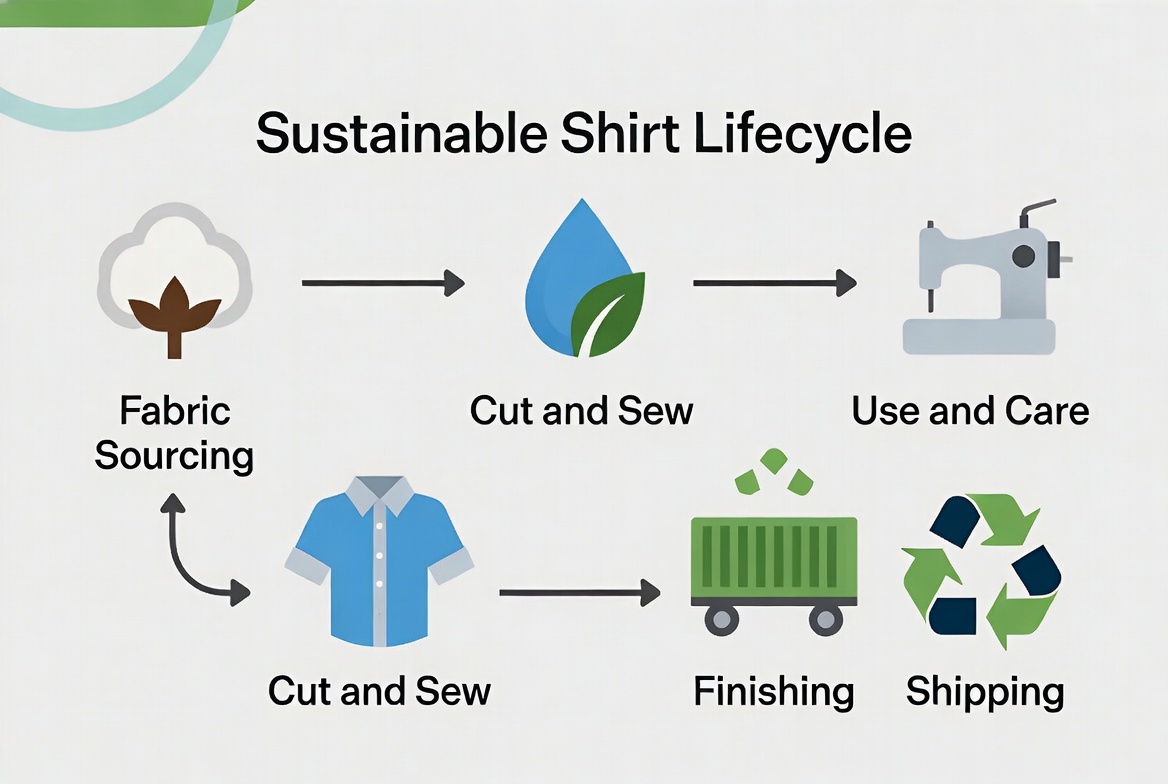
For many brands and wholesalers, the first step is understanding where they stand today. A practical sustainability audit for suits and shirts usually includes:
1. Mapping main fabric types (e.g. wool blends, cotton shirting, polyester linings) and their current certifications or lack thereof.
2. Reviewing trims and accessories, such as interlinings, buttons, and threads, to identify opportunities for recycled or bio‑based replacements. [customteesnow]
3. Prioritizing high‑volume products, such as best‑selling business shirts or corporate suiting ranges, where switching to better materials has the largest impact.
Shanghai Youti can support by preparing bill‑of‑materials (BOM) summaries and suggesting tiered alternatives—for example, basic, mid‑level, and premium sustainable fabric options tailored to different price points and markets.
Selecting an OEM factory is a crucial sustainability decision. Buyers should evaluate: [sinofinetex]
- Experience with your category (e.g. tailored menswear, corporate uniforms, hospitality wear) to ensure consistent quality. [hqts]
- Certification portfolio (e.g. factory audits, environmental management, social compliance) that demonstrates formal systems. [sinofinetex]
- Minimum order quantities (MOQs) and flexibility, especially for brands piloting sustainable lines or capsule collections. [hqts]
China hosts tens of thousands of garment manufacturers, many of which specialize in particular product types such as shirts, trousers, or outerwear. Shanghai Youti focuses on professional suits and shirts, offering OEM services for international brands that require precision tailoring, stable quality, and scalable capacity aligned with sustainability objectives. [hqts]
To align with regulatory and retailer requirements, brands often need evidence of sustainability claims. Key elements include:
- Material certifications such as GOTS, OEKO‑TEX, or equivalent labels for specific fabrics. [customteesnow]
- Chain‑of‑custody documentation that proves recycled or organic content from fiber to finished garment. [fortunebusinessinsights]
- Factory audit reports that confirm social, environmental, and quality management systems. [sinofinetex]
OEM partners like Shanghai Youti can help maintain this documentation and package it in buyer‑friendly formats, making it easier for brands to respond to retailer questionnaires or third‑party assessments.
Despite growing awareness, several myths still surround sustainable clothing:
- "Sustainable means low style or limited design." In reality, modern sustainable fabrics and manufacturing techniques allow for crisp tailoring, rich colors, and premium hand‑feels that match or exceed conventional garments. [nomidesigns]
- "Sustainable suits and shirts are always more expensive." While some inputs cost more, efficiencies in energy, water, and waste, as well as reduced returns through higher quality, can offset or even lower total cost over time. [mintel]
- "One small brand cannot make a difference." Aggregated demand—from multiple brands and wholesalers asking for better materials and processes—drives large‑scale change in upstream textile and manufacturing sectors. [mintel]
Clarifying these misconceptions in B2B buyer education materials helps procurement teams secure internal approval for sustainable product lines.
Recent insights into sustainable fashion and circular textiles highlight several trends that directly affect sourcing decisions. [projectcece]
- Circular and resale models: Brands increasingly design garments with resale, rental, and repair in mind, requiring durable construction and timeless styling. [nomidesigns]
- Preference for natural and safe materials: There is a renewed focus on natural fibers and safe chemical profiles, especially in categories worn close to the skin, such as shirts. [projectcece]
- Individual style over fast trends: Slow fashion emphasizes long‑lasting silhouettes and quality, which fits naturally with classic business suits and shirts. [projectcece]
These trends align well with Shanghai Youti's core product strengths: classic tailoring, long‑term wearability, and consistent quality suitable for premium, corporate, and uniform applications.
To make this actionable, here is a step‑by‑step framework brands can follow with their OEM partners.
- Set clear objectives (e.g. "30 percent of suit fabrics to be recycled or certified by 2028").
- Align goals with major markets' regulations (EU, US, Japan, etc.). [fortunebusinessinsights]
- Focus first on high‑volume SKUs such as core business shirts, black and navy suits, or corporate uniforms.
- Choose items with stable demand to maximize impact per style.
- Request 2–3 fabric options per style: for example, a standard blend, a partially recycled option, and a premium organic or low‑impact blend. [fortunebusinessinsights]
- Test comfort, crease recovery, and colorfastness under real use scenarios (e.g. office wear, frequent washing).
- Design for repairability and durability, such as reinforced seams, replaceable buttons, and spare fabric or thread.
- Standardize components (e.g. linings, buttons) across collections to reduce waste and complexity. [blog.stahls]
- Switch to biodegradable or recycled packaging and minimize single‑use plastics in polybags and hangers. [blog.stahls]
- Work with logistics providers to consolidate shipments and explore lower‑emission transport options where feasible. [mintel]
- Provide care labels and digital content that explain how to wash, dry, and store suits and shirts to extend their lifespan. [static1.squarespace]
- Share verifiable claims (e.g. "contains 30 percent recycled polyester") rather than vague slogans, to build trust and avoid greenwashing. [static1.squarespace]

As a Chinese OEM supplier focusing on suits and shirts, Shanghai Youti Clothing offers specific advantages for brands seeking sustainable collections:
- Category specialization: Deep experience in tailored products and professional wear ensures pattern accuracy, consistent sizing, and high finishing quality. [sinofinetex]
- Flexible OEM collaboration: Support for small pilot runs through to large, multi‑market programs, helping brands test sustainable lines before full roll‑out. [hqts]
- Quality and compliance focus: Structured manufacturing systems, factory inspections, and collaboration with testing labs contribute to stable quality and compliance with buyer standards. [sinofinetex]
By combining technical tailoring expertise with evolving sustainability practices, Shanghai Youti helps international partners translate sustainability strategies into tangible products: from eco‑enhanced corporate uniforms to premium suit collections with better material stories.
Contact our OEM sustainability team to discuss your next suit or shirt collection!
No. While organic cotton is important, sustainable clothing also involves recycled fibers, responsible wool and viscose, efficient dyeing and finishing, ethical labor practices, and thoughtful product design across the full lifecycle. [mintel]
OEM factories can provide audit reports, material certifications, testing results, and documented policies on labor, environment, and quality. Brands should request these documents and, where possible, conduct third‑party audits or video/facility tours to verify performance. [fashionweekonline]
Typically, no. When implemented correctly, sustainable materials and improved process controls often lead to equal or better durability, especially when combined with strong quality management and careful pattern engineering. [nomidesigns]
Circular fashion focuses on keeping garments and materials in use for as long as possible through design, reuse, repair, resale, and recycling. For suits and shirts, this means choosing durable fabrics, replaceable components, and designs that remain stylish over multiple seasons, as well as exploring resale or rental programs. [projectcece]
Begin with a material and product audit, choose a few high‑volume styles to pilot sustainable fabrics and processes, and work closely with OEM partners to test and refine. From there, gradually expand successful approaches across the broader collection. [customteesnow]
1. McKinsey & Company – *The State of Fashion* (latest editions).
2. Global Market Insights – *Sustainable Clothing Market Size, Growth Outlook 2026–2035*: <https://www.gminsights.com/industry-analysis/sustainable-clothing-market> [gminsights]
3. Coherent Market Insights – *Sustainable Fashion Market YoY Growth*: <https://www.coherentmarketinsights.com/industry-reports/global-sustainable-fashion-market> [coherentmarketinsights]
4. Fortune Business Insights – *Sustainable Fashion Market Size, Share, Forecast*: <https://www.fortunebusinessinsights.com/sustainable-fashion-market-110575> [fortunebusinessinsights]
5. Mintel – *The Future of Fashion: Circular and Sustainable Fashion Trends*: <https://www.mintel.com/insights/retail/the-growth-of-circular-and-sustainable-fashion-trends/> [mintel]
6. HQTS – *How to Source Clothing from China: Tips to Find the Best Manufacturer*: <https://www.hqts.com/sourcing-clothing-china-manufacturer/> [hqts]
7. Custom Tees Now – *Eco‑Friendly Custom T‑Shirts: Sustainable Choices for Conscious Consumers*: <https://customteesnow.com/eco-friendly-custom-t-shirts-sustainable-choices-for-conscious-consumers/> [customteesnow]
8. Ethix Merch – *How Eco‑friendly T‑Shirt Printing Works*: <https://ethixmerch.com/blog/eco-friendly-tshirt-printing/> [ethixmerch]
9. Project Cece – *Sustainable Fashion Trends and Predictions*: <https://www.projectcece.com/blog/774/sustainable-fashion-trends-and-predictions/> [projectcece]
10. Nomi Designs – *Why Sustainable, Slow Fashion Matters*: <https://www.nomidesigns.net/blog/why-slow-fashion-matters> [nomidesigns]
11. FashionWeekOnline – *Top China Clothing Manufacturer: Your Ultimate Guide to Quality, Affordability and Scalability*: <https://fashionweekonline.com/top-china-clothing-manufacturer-your-ultimate-guide-to-quality-affordability-and-scalability> [fashionweekonline]
12. Sino Finetex – *What Are the Best Clothing Factories in China for OEM and Wholesale?*: <https://sinofinetex.com/what-are-the-best-clothing-factories-in-china-for-oem-and-wholesale/> [sinofinetex]
13. Redress – *打造可持续时装业 (Building a Sustainable Fashion Industry)*: <https://static1.squarespace.com/static/582d0d16440243165eb756db/t/5dca265e92a7e01852f61dba/1573529189554/LEARN_Business_SIM_Nov2> [static1.squarespace]


