
Views: 222 Author: Youti Clothing Publish Time: 2026-06-07 Origin: Site


Content Menu
● Introduction: Why Hotel Uniforms Matter More Than Ever
● What Makes a "Best" Hotel Uniform in 2026?
>> 1. Aligned With Your Brand Story
>> 3. Reflecting Global Trends: Style, Sustainability, and Inclusivity
● Lessons From Iconic Hotel Uniform Programs
>> Hotel Uniform Examples and Takeaways
● How to Choose the Right Hotel Uniform Style (Step-by-Step)
>> Step 1: Conduct a Uniform Audit
>> Step 2: Map Roles and Uniform "Families"
>> Step 3: Clarify Design Principles and Color System
>> Step 4: Involve Staff Early
● Fabric, Fit, and Durability: What to Specify to Your OEM
>> Fabric Choices for Key Departments
>> Getting Fit and Size Runs Right
● Sustainability and Ethical Sourcing in Hotel Uniforms
● Working With a China OEM Partner for Hotel Uniforms
● Practical Checklist: Planning Your Next Hotel Uniform Program
● Call to Action: Design Hotel Uniforms That Work in the Real World
● FAQ: Hotel Uniforms and OEM Manufacturing
In today's hospitality market, hotel uniforms are no longer "just clothes" – they are branded touchpoints that shape guest perception, operational efficiency, and even staff morale. As a hotelier or procurement manager, your uniform program has to balance brand storytelling, comfort, and durability while staying on budget and on trend. [cargocrew]
As a China-based OEM supplier specializing in Uniforms and Work Clothes, Shanghai Youti Clothing Co., Ltd. works with international hotels, resorts, and hospitality brands to design and manufacture custom programs that actually work in daily operations – not just in mood boards.
In this guide, we will:
- Break down what makes the best hotel uniforms in 2026 and beyond
- Analyze real-world hotel uniform examples and what you can learn from them [cargocrew]
- Share practical steps to plan, design, and source your next uniform program globally [buttercupsuniforms]

The strongest hotel uniform programs are built from brand strategy, not from a fabric swatch book. At brands like Ace Hotel or Aman Resorts, uniforms visually extend the interior design and brand narrative – guests can "read" the brand just by looking at staff. [binnarcreativestudios]
Ask three questions before you look at any styles:
- Who are our core guests (business, leisure, family, luxury, lifestyle)?
- What emotions should our staff uniforms communicate (relaxed, elite, creative, classic)?
- How should uniforms relate to architecture, lobby design, and F&B concepts? [hotelmanagement]
Hotels such as Ace Hotel use eclectic, locally inspired pieces (like denim vests and aprons) to reinforce a hip, community-focused identity, while The Plaza or Savoy lean into heritage tailoring to showcase history and prestige. [cargocrew]
A uniform that photographs well but fails in a busy Saturday night shift will not survive more than one season. Functionality has to match each role's daily tasks. [binnarcreativestudios]
Key performance factors to consider:
- Breathable, easy-care fabrics for housekeeping and F&B teams
- Stretch and ergonomic cuts for front desk and concierge who stand for long hours
- Stain-resistant, heat-tolerant fabrics for kitchen and banqueting staff
- Layering options for outdoor roles (valet, bell staff, doormen) across seasons [prince-international]
In Icehotel, staff uniforms must maintain insulation and mobility at sub-zero temperatures while visually echoing icy architecture. This is an extreme example, but the principle is universal: design for the job, not just the photo. [cargocrew]
Recent hospitality uniform trends emphasize modern tailoring, relaxed fits, neutral or earthy palettes, and sustainable materials like organic cotton and recycled polyester. Hotels such as 1 Hotels make sustainability a visible part of their brand story through eco-friendly fabrics. [ssdesigns]
Leading trends you should pay attention to:
- Modern, relaxed tailoring instead of rigid formalwear [robertouniform]
- Earthy, muted, or neutral colour palettes that photograph well and age slowly [prince-international]
- Sustainable and performance fabrics that balance comfort and CSR objectives [linkedin]
- Subtle cultural references that respect local traditions in a contemporary way (for example, Burj Al Arab and Hoshinoya). [ssdesigns]
Many hotels now also allow modular systems (mix‑and‑match jackets, tunics, trousers, aprons) so staff can adapt to temperature, role, and personal comfort without breaking visual consistency. [buttercupsuniforms]
Below is a condensed view of what several well-known hotel brands are doing with uniforms – and what you can take away when planning your own program. [cargocrew]
| Hotel / Brand | Core Style Signal | Key Design Features (What Works) | What You Can Learn |
|---|---|---|---|
| Ace Hotel (Worldwide) (cargocrew) | Hip, local, creative | Denim vests, aprons, minimalist tees that mirror interior styling | Use local, casual elements if you target creative or younger guests |
| The Plaza Hotel (USA) (cargocrew) | Grand, historic luxury | Formal, dark uniforms with gold accents reflecting classical architecture | For heritage hotels, keep uniforms consistent with historic interiors |
| Aman Resorts (Worldwide) (cargocrew) | Serene, local, understated | Simple, high-quality designs inspired by local attire and natural surroundings | Understated uniforms can still look premium when fabrics and cuts are elevated |
| 1 Hotels (USA) (cargocrew) | Sustainable luxury | Organic, recycled materials with relaxed, natural colour tones | Make sustainability visible in fabric choices and palette |
| Icehotel (Sweden) (cargocrew) | Extreme environment, experiential | Insulating layers, Arctic colour palette, motif details reminiscent of ice | Design for climate and operational reality first, then layer in aesthetics |
| Giraffe Manor (Kenya) (cargocrew) | Safari heritage, boutique | Earth-toned safari-inspired looks with local pattern accents | Use subtle local patterns to differentiate without overwhelming |
You don't need the same budget as a global luxury brand, but you can borrow the logic: design from your story, environment, and guests, then execute with the right OEM partner. [binnarcreativestudios]
Before redesigning, audit what you already have. [buttercupsuniforms]
Evaluate:
- Which current pieces staff actually like and wear
- Where complaints cluster (too hot, poor fit, fades quickly, no pockets)
- How well each role is visually distinguishable to guests
- How your uniforms photograph in real-life lighting (lobby, restaurant, outdoor)
A structured audit reduces waste and helps you upgrade strategically instead of replacing everything at once. [uniformmarket]
List all departments and roles: front office, concierge, housekeeping, F&B, kitchen, spa, security, maintenance, events, and management. [binnarcreativestudios]
Then define uniform families:
- Front-of-house (guest-facing, brand-heavy, visually polished)
- Back-of-house (high-performance, safety and hygiene focused)
- Event/banquet (flexible and modular for different event concepts)
Many modern hotels use a shared base (for example, one shirt fabric) with different aprons, jackets, or accessories to signal role while controlling cost and stock complexity. [buttercupsuniforms]
Define three to five non-negotiable design principles, such as:
- Comfort first for high-movement roles
- Minimum two pockets for F&B and housekeeping
- Colour system aligned with interiors (for example, earthy greens and sand tones for a nature resort) [prince-international]
A clear system allows your OEM partner to propose consistent collections instead of disconnected individual pieces.
Hotels that survey staff before finalizing uniforms enjoy higher adoption and fewer complaints once uniforms roll out. Ask for feedback on: [buttercupsuniforms]
- Fit preferences (slim, regular, more relaxed)
- Pain points with current items (buttons, closures, weight)
- Climate needs by shift time (early morning, midday, evening)
This not only improves the final design but also supports staff morale, which guests notice. [hotelmanagement]
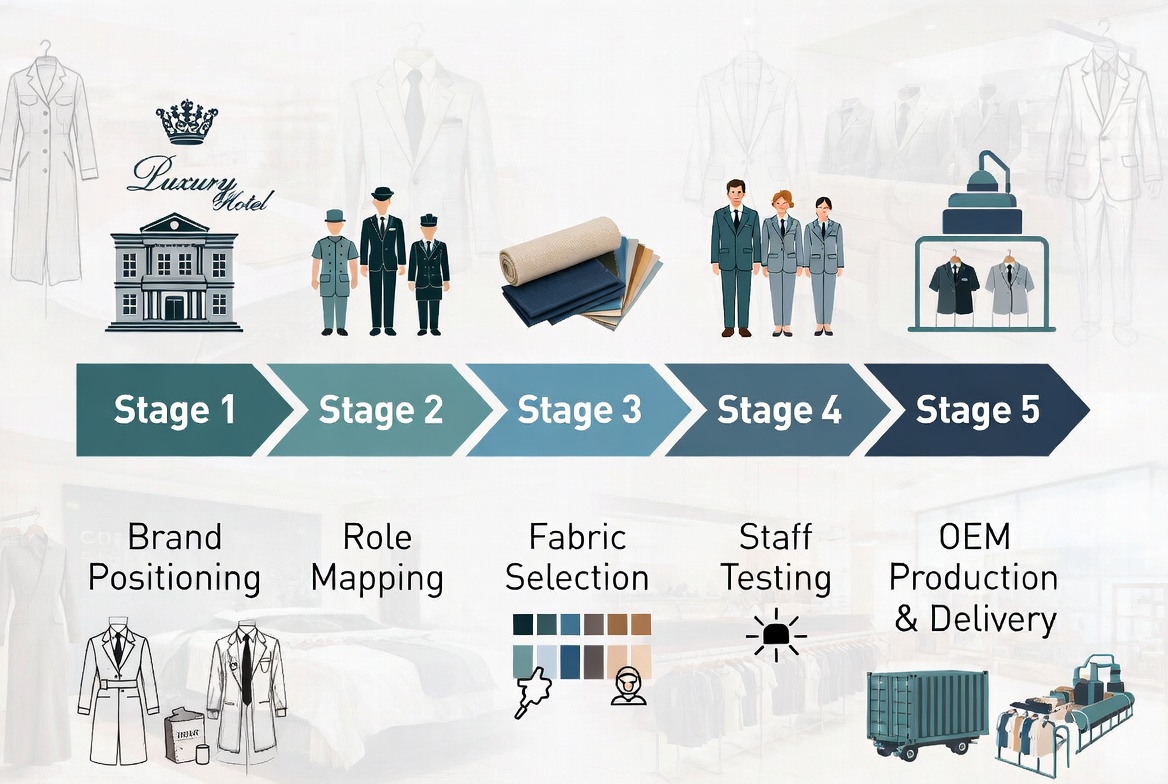
As an OEM-focused uniform manufacturer, fabric decisions are where long-term cost and guest perception meet. (Manufacturer project experience, 2016–2025)
- Front desk and concierge: Blends of polyester, viscose, and a small percentage of elastane for crease resistance and stretch. [prince-international]
- Housekeeping: Lightweight, breathable, easy‑wash fabrics that resist frequent laundering and staining. [ssdesigns]
- F&B service: Performance fabrics with stain release, quick drying, and moisture wicking for comfort over long shifts. [hotelmanagement]
- Kitchen: Flame‑resistant or at least flame‑retardant materials, with dark options for open kitchens and lighter options for back‑of‑house to highlight hygiene. [binnarcreativestudios]
To avoid costly reorders, you should:
- Collect size data per role and gender (or offer gender‑neutral options where brand-appropriate)
- Provide graded size runs (for example XS–4XL) with fit guidelines
- Test prototypes with staff over several shifts, not just for five minutes in a fitting room [buttercupsuniforms]
An experienced OEM partner can also adjust patterns based on your region's body type distribution and your brand's desired silhouette (relaxed vs tailored).
Global hospitality brands increasingly use uniforms to support their ESG and sustainability narrative. The hotel uniform market is forecast to continue growing at around 6.6% annually through 2033, with sustainable materials and custom design as notable growth drivers. [linkedin]
You can integrate sustainability into uniforms by:
- Using organic cotton, recycled polyester, or bamboo blends where performance requirements allow [hotelmanagement]
- Specifying eco‑friendly dyes and finishing processes
- Prioritizing durable fabrics to reduce replacement frequency
- Working with OEM suppliers who comply with international labour and safety standards
For international buyers, China-based OEM manufacturers with export experience can provide competitive pricing while still meeting global compliance and testing requirements (for example, colour fastness, pilling resistance, AZO‑free dyes).
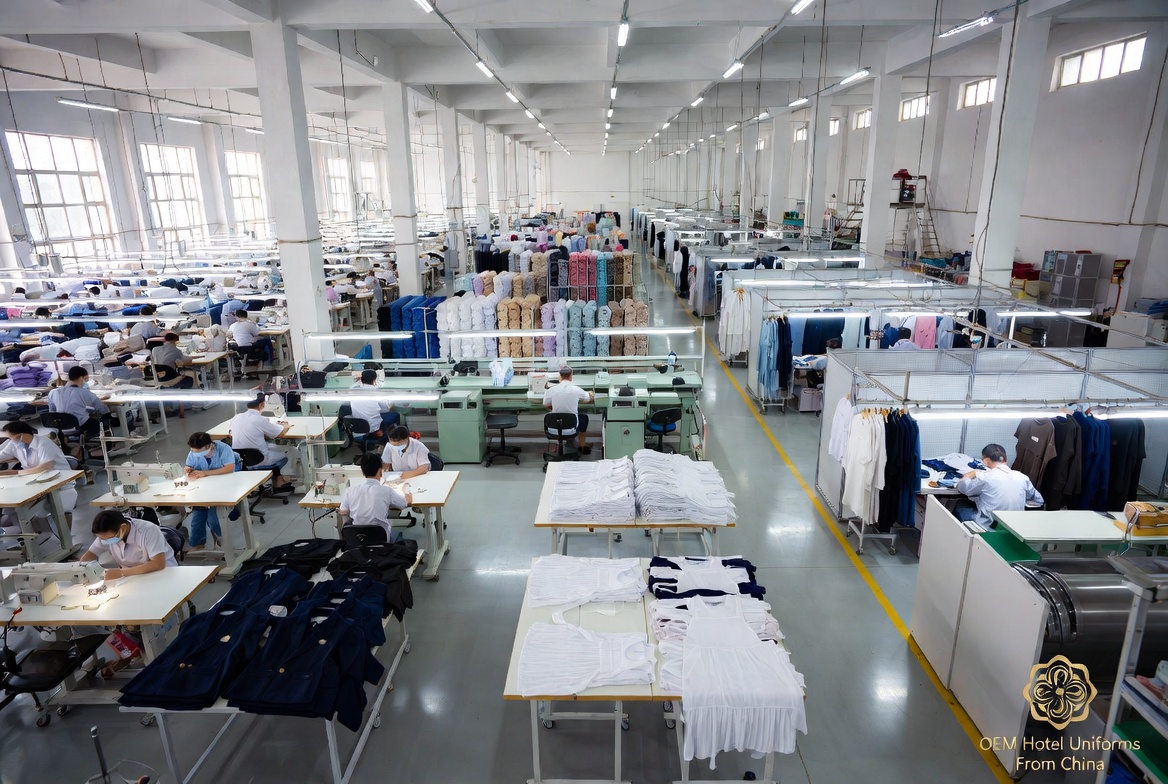
For international hotel chains, dealing directly with an OEM in China offers more control over quality, customization, and pricing compared to generic catalog suppliers. (Shanghai Youti OEM experience)
A professional OEM partner can support you with:
- End‑to‑end development: sketches, fabric sourcing, pattern making, samples, bulk production, and logistics
- Custom branding: embroidery, woven labels, branded buttons, and packaging aligned to your brand standards
- Flexible MOQs: different order quantities for flagship properties vs. new openings or pilot concepts
When you partner with a manufacturer like Shanghai Youti Clothing Co., Ltd., you can design a global uniform system that adapts to different properties while maintaining a consistent brand core.
Use this simple checklist as a working template when you brief your internal team or supplier. [ssdesigns]
1. Define your brand positioning and guest segments.
2. Audit current uniforms for strengths and pain points.
3. List all staff roles and group them into uniform families.
4. Select a colour palette tied to interiors and brand assets.
5. Choose fabrics role‑by‑role, balancing performance and sustainability.
6. Survey staff for fit, comfort needs, and functional details.
7. Develop design concepts, then prototype with real‑shift testing.
8. Confirm branding applications (logo, name badges, accessories).
9. Plan stock levels, re‑order strategy, and size curves.
10. Document care instructions and replacement cycles.
If you need support at any of these stages, a specialized OEM manufacturer can step in with patterns, sampling, and technical guidance.
Your uniforms are one of the most visible, controllable brand signals in your property – and one that directly impacts operational performance. By aligning design, fabric, and sourcing with your brand strategy, you can create hotel uniforms that guests remember and staff actually love to wear. [hotelmanagement]
If you are planning a new hotel opening, rebrand, or chain‑wide uniform refresh, consider partnering with Shanghai Youti Clothing Co., Ltd. for:
- Custom, OEM hotel uniforms tailored to your brand story
- Scalable manufacturing for international chains and groups
- Support with design, sampling, and export logistics
Contact our team to discuss your project brief, share mood boards, or request sample fabrics – and turn your next hotel uniform program into a core part of your hospitality experience.
1. How often should hotels update their uniform program?
Most hotels refresh their uniforms every 3–5 years, or sooner when rebranding or changing target segments. However, small seasonal updates (for example, new aprons or accessories) can keep the look current without a full redesign. [prince-international]
2. Which hotel departments benefit most from custom uniforms?
Front desk, concierge, F&B, and doormen benefit the most because they are in constant contact with guests and represent the hotel's brand visually. However, custom kitchen and housekeeping uniforms can also reduce wear‑and‑tear costs and improve safety. [ssdesigns]
3. Are sustainable hotel uniforms more expensive?
Eco‑friendly fabrics typically cost more per unit, but longer durability and stronger alignment with brand values can offset this over the life cycle of the program. Many hotels use a blend approach, investing in sustainable fabrics for guest‑facing roles first. [linkedin]
4. How can we keep uniforms consistent across multiple countries?
Create a global "core" design system (silhouettes, colours, fabrics) and then add local variations in accessories or cultural details. Work with an OEM partner experienced in multi‑country production and quality control to keep specifications consistent. [cargocrew]
5. What information should I send to an OEM to get an accurate quote?
At minimum, share brand guidelines, role list, target quantities, fabric preferences, reference photos, expected delivery dates, and any required certifications. (Shanghai Youti OEM project experience) The more precise your brief, the more accurate lead times and pricing you will receive.
1. Stock Mfg. Co. "19 Best Hotel Uniforms From the US and Around the World." [Link]. [cargocrew]
2. Hotel Management. "Hotel uniforms blend style and functionality." July 10, 2024. [Link]. [hotelmanagement]
3. Prince International. "Hotel Uniform Trends for 2026." [Link]. [prince-international]
4. SS Designs. "7 Leading Hospitality Uniform Trends for 2024." March 17, 2025. [Link]. [ssdesigns]
5. Buttercups Uniforms. "Uniform Trends to Watch in 2026." November 4, 2025. [Link]. [buttercupsuniforms]
6. Sellers Commerce. "The Unique Opportunities for SEO in the Uniform Industry." April 27, 2025. [Link]. [sellerscommerce]
7. UniformMarket. "SEO & Content for Uniform Companies: Are Keyword Lists Enough?" November 20, 2024. [Link]. [uniformmarket]
8. 8020 (Eight Oh Two). "SEO Tips for Clothing & Apparel Brands." September 11, 2024. [Link]. [eightohtwo]
9. Binnar Creative Studios. "5 Tips to Choose the Right Hotel Uniform Style." August 25, 2025. [Link]. [binnarcreativestudios]
10. LinkedIn. "Exploring the 6.6% Growth in Hotel Uniform Market by 2033." April 18, 2026. [Link]. [linkedin]


