
Views: 222 Author: Youti Clothing Publish Time: 2026-05-23 Origin: Site


A high-performing work uniform today must do three things at once: express your brand, support employees on the job, and stay practical to produce and maintain at scale. For global buyers working with an OEM supplier in China, a smart uniform strategy connects design decisions directly to sourcing, materials, and long-term costs. [anbusafety]
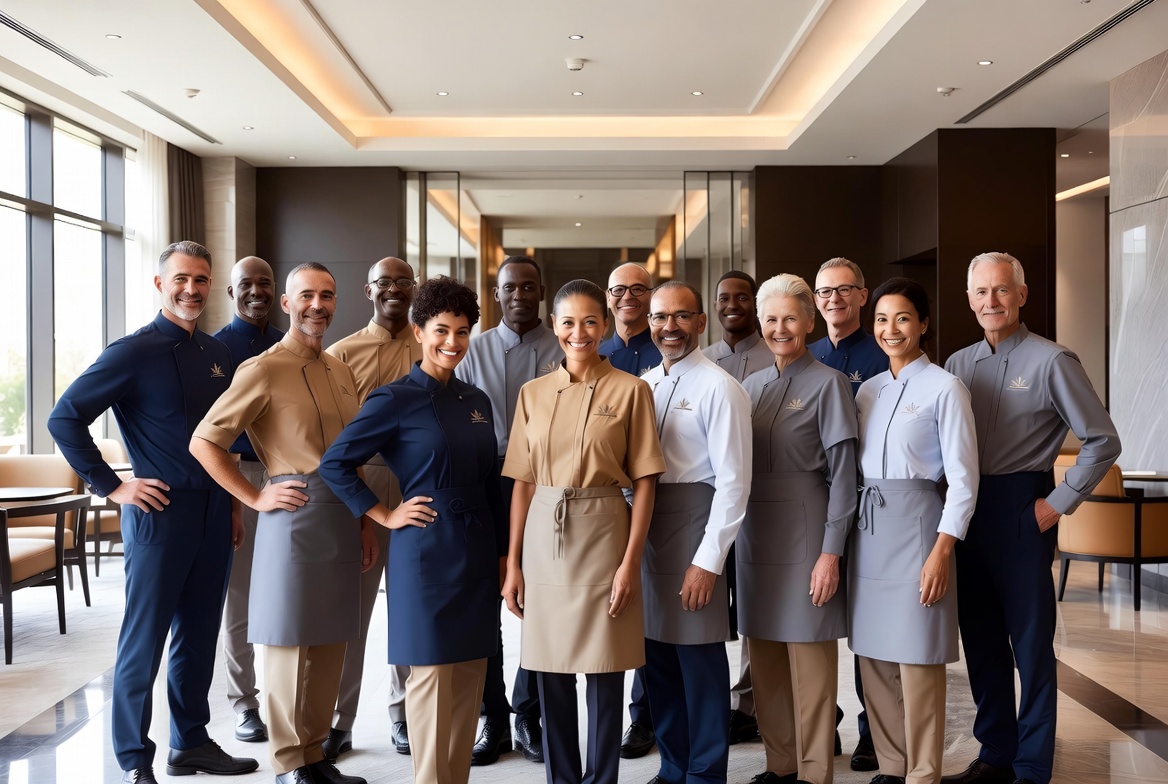
A well-designed work uniform is no longer just "company clothing"; it is a moving brand asset that your customers see before they interact with your website or advertising. Uniforms and work clothes influence: [themerchlist]
- First impressions and brand trust – A consistent, polished look signals reliability and professionalism. [themerchlist]
- Employee comfort and performance – Thoughtful fabrics and fits reduce fatigue and make it easier to do the job well. [linkedin]
- Team morale and cohesion – Staff feel part of something bigger when they wear a uniform they're proud of. [linkedin]
For overseas brands, choosing a capable OEM uniforms supplier in China means you can turn this strategy into scalable production with consistent quality, from first prototype to repeat orders. [alibaba]
Before selecting shirts or fabrics, start with three strategic questions.
1. Where and how will staff wear the uniform?
- Hospitality, retail, industrial sites, clinics, logistics, or corporate offices all require very different performance standards. [linkedin]
- Consider climate (hot kitchen vs. air‑conditioned store), safety risks, and how much movement the job requires. [linkedin]
2. What brand story should your uniforms tell?
- Colors, silhouettes, and accessories should reflect whether you want to feel luxury, casual, technical, or eco‑conscious. [linkedin]
- Uniforms should visually match your logo, interiors, and marketing materials. [themerchlist]
3. Who is your global supply partner?
- A Chinese workwear OEM can help balance cost, quality, and MOQs, but you must define quality standards, lead times, and compliance early. [anbusafety]
Doing this upfront makes the later choices on tops, bottoms, and fabrics much faster and more consistent.
A complete work uniform usually combines tops, bottoms, layers, footwear, and accessories, each optimized for both performance and appearance.
The work uniform top is what customers notice first, so it has to carry both branding and comfort.
- Button‑down shirts
- Ideal for hospitality, reception, and management roles where a polished look is essential.
- Choose wrinkle‑resistant blends so staff look sharp even after long shifts and frequent washing.
- Options include different sleeve lengths, collar styles, and subtle embroidery for logos or staff names.
- Polo shirts
- Perfect for relaxed but professional environments such as casual dining, retail, or light service roles.
- Reinforced collars and plackets prevent the polo from collapsing into a "weekend T‑shirt" look.
- Finer piqué fabrics handle embroidery and print better and feel more premium.
- Tunics and camp shirts
- Looser-fitting tops suit housekeeping, spa staff, or healthcare roles where freedom of movement is critical.
When working with a China OEM, provide clear tech packs (fabric weight, fiber content, collar dimensions, logo position) so the production result matches your original design intent. [alibaba]
Bottoms should never restrict how people work. Poorly designed work pants are one of the top complaints in uniform rollouts.
- Work pants / chinos
- Use flexible or stretch fabrics and consider hidden elastic waistbands for a neat look with real comfort.
- Double or triple stitching in high‑stress areas significantly improves durability and reduces replacement rates.
- Uniform skirts
- Back vents, side pockets, and knee pleats can keep the look formal while still allowing staff to walk, climb stairs, and carry items comfortably.
- Work shorts
- Useful for outdoor, hot climate, or physical roles, but length and coverage must still feel professional and modest.
- Moisture‑wicking inner layers can increase comfort and confidence for active staff.
A good OEM partner will suggest suitable twill, linen, or blended fabrics for your climate and industry, and can grade patterns for different body types across global size ranges. [anbusafety]
Layer pieces help your uniforms adapt to seasons, interior temperatures, and different customer‑facing situations.
- Blazers and suit jackets
- Use stretch fabrics to maintain a tailored look that still allows staff to reach, lift, and move.
- Details like notched collars and welt pockets add polish while remaining functional.
- Vests
- Adjustable backs accommodate different body shapes and allow layering over shirts or polos.
- Sweaters and knit layers
- A sleek black turtleneck or fine‑gauge sweater maintains a professional image while adding warmth.
For brand owners, consider offering employees a core base uniform plus optional layers (e.g., blazer, vest, cardigan) for different roles or climates within the same location.
Even if you don't manufacture shoes yourself, your work uniform guidelines should specify recommended footwear standards.
- Clogs
- Widely used in kitchens and healthcare due to roomy toe boxes and cushioned heels.
- Oxford shoes
- Suitable for formal hospitality or corporate settings; look for padded collars and slip‑resistant soles.
- Sneakers
- Best for roles requiring constant movement, such as servers or retail associates.
- Choose designs with flexible soles, shock‑absorbing heels, and moisture‑wicking linings.
Standardizing footwear guidelines reduces accidents and ensures a consistent silhouette from head to toe.
Accessories are where uniforms and work clothes become job‑specific tools.
- Aprons
- Full‑length or waist aprons protect clothing from spills and provide storage for pens, openers, or small tools.
- Adjustable necks and long ties ensure a good fit for different body types.
- Name tags and patches
- Durable, scratch‑resistant name tags with clear fonts improve communication and customer trust.
- Embroidered patches on sleeves or chest panels are an effective way to show brand or department.
- Belts, ties, scarves
- Small accessories in your brand colors can define different departments or seniority levels without changing the entire uniform.
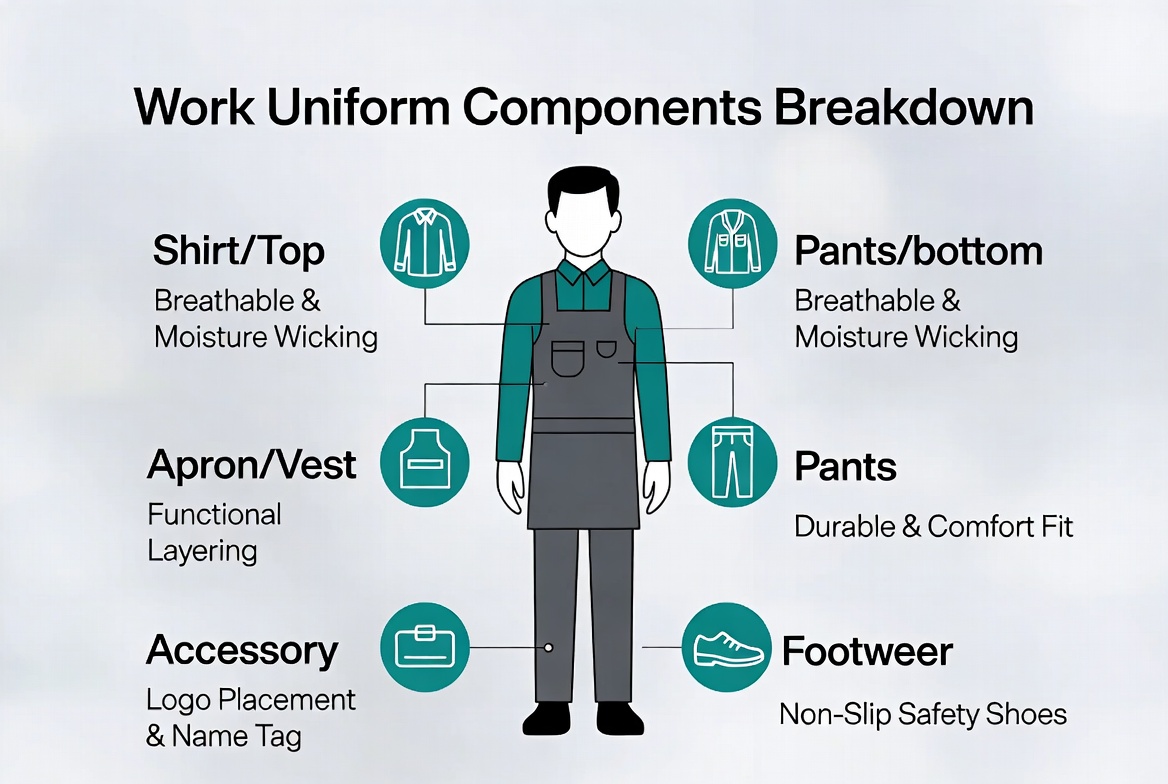
Different teams require different work uniform solutions, even within the same brand.
Hospitality is the core use case in the original article, and its logic also applies to restaurants, cafes, hotels, and events.
- Front desk & concierge
- Focus: professional, approachable, "brand ambassador" appearance.
- Uniform: unstructured blazer, stretch chinos or skirts, neutral colors (navy, black, gray), discreet lapel pins and name tags.
- Waitstaff & bartenders
- Focus: mobility, stain resistance, and easy cleaning.
- Uniform: button‑up shirts, dark pants, and twill aprons with multiple pockets, plus non‑slip shoes.
- Housekeeping
- Focus: durability and freedom to bend, lift, and walk long distances.
- Uniform: looser camp shirts or polos with stretch jeans or pants, easy‑care, wrinkle‑resistant fabrics.
- Chefs & kitchen staff
- Focus: safety, heat management, and hygiene.
- Uniform: double‑breasted jackets, checkered or dark pants, protective aprons, slip‑resistant shoes, and head coverings.
- Spa and wellness staff
- Focus: calm, clean, and comfortable clothing that supports gentle movement.
- Uniform: soft neutral polos or tunics with relaxed pants, minimal accessories, quiet footwear.
- Event and banquet teams
- Focus: elevated, often formal styling that aligns with the event theme.
- Uniform: tailored suits or dresses, ties, polished shoes, discreet communication devices.
These principles adapt easily to other industries like retail, clinics, logistics warehouses, and corporate offices, using the same framework: appearance, uniforms, footwear, and accessories tuned to each role. [linkedin]
Fabric selection is one of the most important decisions in creating a successful work uniform program.
Key fabric criteria:
- Durability – Synthetic blends generally withstand more wash cycles and abrasion than pure natural fibers, crucial for daily wear.
- Breathability – Lightweight, moisture‑wicking materials prevent overheating in kitchens, outdoor roles, and non‑air‑conditioned environments. [linkedin]
- Stretch – Four‑way stretch or stretch‑woven fabrics allow bending, lifting, and reaching without tearing or discomfort.
- Easy care – Antimicrobial and stain‑resistant finishes reduce odor and simplify laundry.
- Functionality – Where needed, use technical fabrics for flame resistance, high visibility, or fluid resistance. [anbusafety]
For international buyers, collaborating with an experienced China workwear manufacturer lets you combine performance fabrics with cost‑effective production and consistent quality control. [anbusafety]
The best work uniforms feel cohesive at a glance but still give employees room for subtle individuality.
- Provide identical base sets (e.g., 3 tops + 2 bottoms) to every employee for a unified look.
- Allow small personal touches, such as monogramming, colored name badges, or optional accessories within brand guidelines.
- Keep backup sizes on site so staff can quickly change after spills or when new employees join.
This balance supports brand control while improving morale and sense of ownership.
Trends change quickly, but a well-planned uniform and work clothes program may stay in use for 3–5 years or more.
Focus on:
- Flattering, simple silhouettes – straight‑leg pants, crisp button‑downs, tailored outerwear.
- Neutral base colors – black, navy, and gray are safe, timeless choices, with accent colors used sparingly.
- Quality fibers – cotton, wool, and blended fabrics that hold their shape and resist pilling.
You can always refresh the look over time through new accessories, updated aprons, or revised color accents, without redesigning the full program.
Recent industry trends show that uniforms are evolving into strategic brand tools, not just dress codes. [uniformbucket]
Key trends to consider:
- Comfort‑driven design – Stretch fabrics, ergonomic cuts, and lighter materials are now standard expectations. [linkedin]
- Performance features – Moisture‑wicking, anti‑odor, UV protection, and wrinkle resistance boost function and comfort. [linkedin]
- Sustainable materials – Recycled polyester, organic cotton, and low‑impact dyes reflect environmental responsibility. [linkedin]
- Inclusivity and fit – Gender‑neutral options, extended sizing, and adjustable cuts create a more inclusive workforce image. [linkedin]
- Digital design & 3D visualization – Brands increasingly use 3D tools to preview uniform designs, shortening approval cycles and reducing sampling rounds. [linkedin]
When you work with a specialized OEM workwear factory, you can integrate these trends into your program early—especially sustainable fabrics and inclusive size runs. [alibaba]
If you are a foreign brand owner, wholesaler, or producer, OEM cooperation is the bridge between uniform concept and reliable mass production. [alibaba]
What a strong OEM partner offers:
- Wide product range – From safety coveralls, chef coats, and lab coats to corporate shirts and jackets. [anbusafety]
- Custom logo and branding – Embroidery, printing, patches, labels, and packaging tailored to your brand. [alibaba]
- Export experience – Familiarity with shipping, documentation, and quality standards for markets in North America, Europe, and the Middle East. [anbusafety]
As a Chinese supplier specializing in uniforms and work clothes, Shanghai Youti Clothing Co., Ltd. can:
- Support OEM and private label projects for international buyers needing custom employee uniforms.
- Help optimize fabric choices and pattern grading for your climate, brand positioning, and budget.
- Coordinate sampling, bulk production, and quality checks to keep your workwear program consistent season after season. [work-jacket]
For large rollouts, align early on MOQ, lead times, inspection standards, and labeling requirements to avoid surprises downstream. [anbusafety]
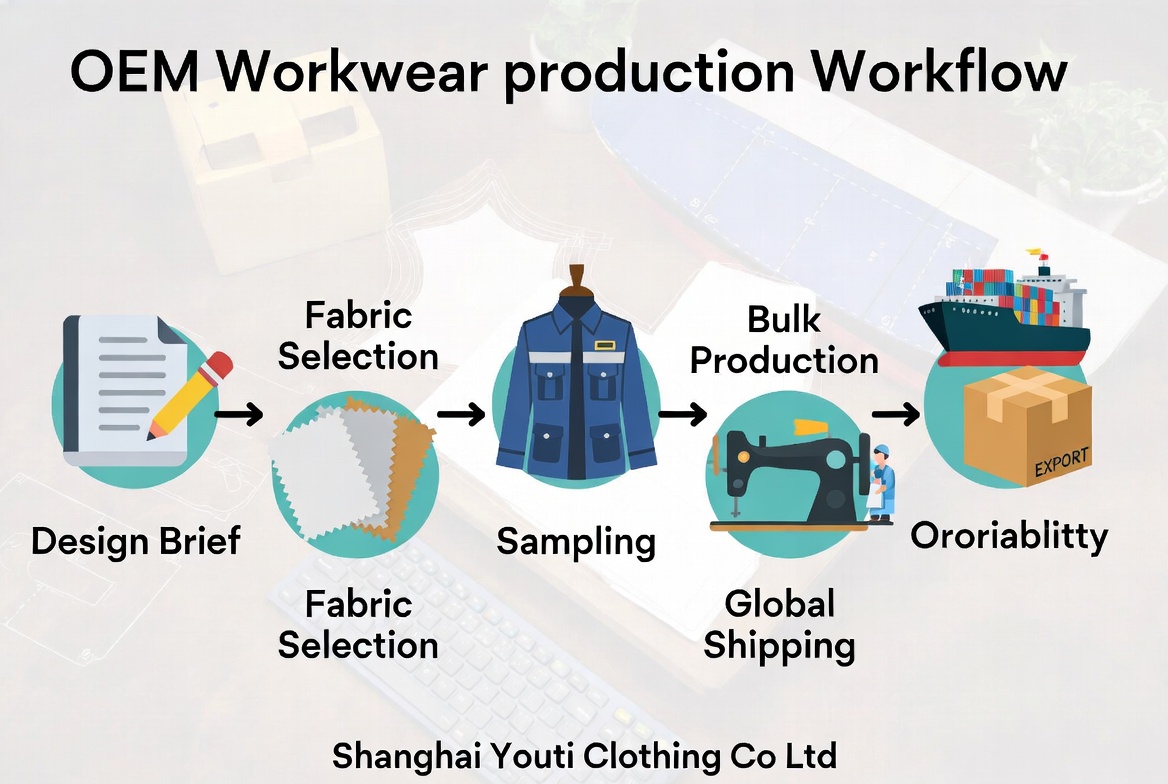
Use this quick checklist when planning or redesigning your work uniform program:
1. Define brand goals and role requirements.
2. Map roles and environments (front desk, kitchen, warehouse, clinic, factory, etc.).
3. Select tops, bottoms, and layers for each role.
4. Choose fabrics for durability, safety, and comfort.
5. Standardize footwear and accessories guidelines.
6. Align sizing strategy, inclusivity, and fit policies.
7. Decide which elements are timeless and which can change seasonally.
8. Choose your OEM workwear partner and confirm specs, MOQs, and timelines.
9. Produce samples, test with staff, then refine based on feedback.
10. Roll out gradually, measure staff satisfaction and replacement rates, and optimize.
If you are planning a new work uniform program or upgrading your current uniforms and work clothes, consider partnering with a specialized OEM workwear supplier in China that understands both branding and real‑world performance. [alibaba]
You can share your brand guidelines, target roles, and budget with a manufacturer like Shanghai Youti Clothing Co., Ltd. to receive tailored fabric proposals, design suggestions, and OEM sampling options for your global uniform rollout. [work-jacket]
1. How do I choose the right fabric for my employee uniforms?
Look at how and where your staff work: high‑heat kitchens, outdoor sites, or air‑conditioned offices all demand different performance. Combine durability, breathability, and easy care, and ask your OEM partner for tested fabric options used in similar industries. [anbusafety]
2. What is the minimum order quantity (MOQ) for OEM work uniforms from China?
Many Chinese workwear manufacturers set MOQs around a few hundred pieces per style, though this varies by factory and product complexity. For multi‑location brands, consolidating styles and colors can help you reach MOQ while keeping the program flexible. [anbusafety]
3. How can I keep uniforms consistent across global locations?
Create detailed spec sheets and brand guidelines covering colors, fabrics, measurements, branding placements, and packaging. Then work with one core OEM supplier (or a small group of vetted partners) to centralize quality control and repeat orders. [alibaba]
4. How often should I refresh or redesign my work uniforms?
Most brands keep a uniform concept for 3–5 years, updating accessories or color accents more frequently. You should consider a redesign when your brand identity changes, performance issues appear, or staff feedback shows discomfort or dissatisfaction. [linkedin]
5. Why should I use an OEM uniforms manufacturer instead of buying off‑the‑shelf work clothes?
OEM partnerships allow you to align uniforms precisely with your brand, role requirements, and budget, from fabric and fit to logo placement. This creates higher perceived value, better staff comfort, and a more coherent identity than generic off‑the‑shelf options. [alibaba]
1. Stock Mfg. Co. – "How To Create A Work Uniform" (accessed 2026)
<https://stockmfgco.com/blogs/stories/how-to-create-a-work-uniform>
2. Anbu Safety – "Workwear Manufacturer and Supplier in China – OEM Services"
<https://www.anbusafety.com/workwear-manufacturer/> [anbusafety]
3. UniformMarket – "Search Engine Success: SEO Basics For Uniform Retailers"
<https://www.uniformmarket.com/blog/seo-basics-for-uniform-retailers> [uniformmarket]
4. LinkedIn – "2026 Uniform Trends: Modern Corporate Identity Meets Comfort"
<https://www.linkedin.com/pulse/2026-uniform-trends-modern-corporate-identity-meets-comfort-8kkff> [linkedin]
5. UniformBucket – "Top Trends in Corporate Uniform Design"
<https://www.uniformbucket.com/blog/top-trends-in-corporate-uniform-design> [uniformbucket]
6. Merchlist – Article on the importance of company uniforms and workwear for branding
<https://themerchlist.com/> [themerchlist]
7. Alibaba – "OEM Work Clothes – Customized Solutions for Every Task"
<https://www.alibaba.com/showroom/oem-work-clothes.html> [alibaba]
8. Bottle – "7 ways to optimise your content strategy for SEO"
<https://www.wearebottle.com/blog/seo-content-strategy-tips> [wearebottle]
9. Mokoworkwear – Corporate orders and work uniform manufacturing in Indonesia
<https://mokoworkwear.com/en/pages/corporate-order> [mokoworkwear]
10. Work‑Jacket.com – Manufacturer information related to Shanghai Youti Apparel
<https://www.work-jacket.com> [work-jacket]


