
Views: 222 Author: Youti Clothing Publish Time: 2026-04-29 Origin: Site


China remains one of the most important sourcing hubs for office wear and corporate uniforms, combining mature textile clusters, strong OEM/ODM capabilities, and competitive pricing for global brands. For procurement managers, the challenge is no longer "Can China produce this?" but "Which factory can reliably deliver compliant, on‑brand office wear over the next 3–5 years?". [sino-shipping]

When shortlisting office wear manufacturers in China, experienced buyers usually screen factories across four dimensions: compliance, engineering capability, quality control, and delivery reliability. [alibaba]
Key criteria you should apply before entering any long‑term contract:
- Factory certifications and audits
- ISO 9001 for quality management, ISO 14001 or similar for environmental management, plus BSCI/SEDEX or customer social audits for ESG compliance. [taianbowinsgarment]
- For technical office wear (anti-static, flame retardant, chemical‑resistant), verify test reports based on EN/ISO standards from accredited labs. [bowinsgarment]
- R&D and pattern engineering capability
- In‑house pattern makers who understand corporate tailoring (jackets, suiting, shirts, skirts) and can grade sizes accurately for different regions. [knitseek]
- Ability to work with performance fabrics such as polyester‑viscose blends, stretch suiting yarns, moisture‑wicking shirt fabrics, and wrinkle‑resistant finishes. [knitseek]
- Quality control systems
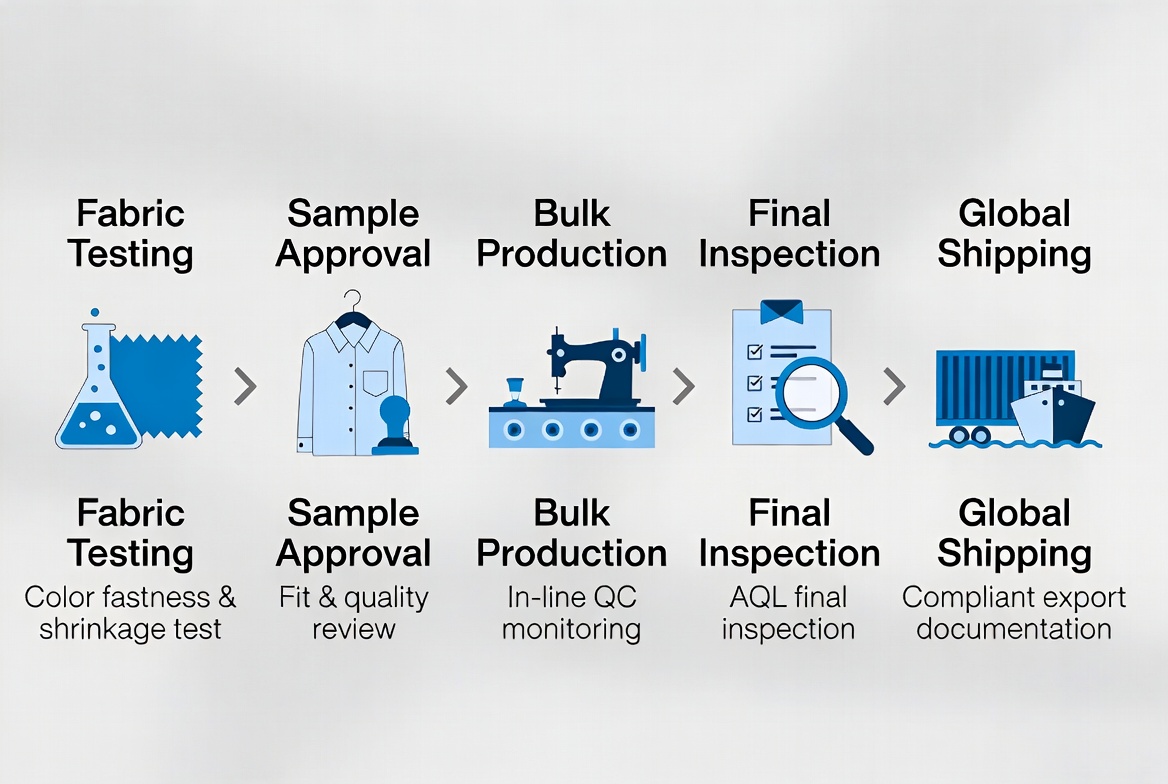
- Documented incoming fabric inspection (GSM, color, shrinkage), in‑line sewing inspection, and 100% final inspection with AQL standards. [taianbowinsgarment]
- Clear defect categories (seam slippage, puckering, color shading, size deviation) and rework procedures.
- Delivery stability and capacity
- Monthly capacity aligned with your volume forecast, with clear peak‑season planning and backup subcontract lines if needed. [alibaba]
- Transparent lead times (for example, 25–45 days after PP sample approval) and realistic sample windows (7–14 days for standard office wear styles). [taianbowinsgarment]
This article applies these criteria, combined with export experience, category specialization, and OEM/ODM depth, to select 10 representative office wear manufacturers in China for 2026.
China continues to account for a large share of global apparel output, with tens of billions of garments produced annually and strong integration from yarn spinning to garment export. For office wear, this scale translates into stable fabric supply, competitive costs, and a wide spectrum of specialized factories—from premium suiting mills to flexible low‑MOQ OEMs. [statista]
Key advantages for office wear buyers:
- Mature clusters
- Suiting and formalwear hubs in Jiangsu, Shandong and Zhejiang, knitwear and shirts in Guangdong and Fujian, and workwear/functional apparel in Shandong and Henan. [truekung]
- Established ecosystems of fabric mills, buttons, zippers, and trimming suppliers reduce lead time and support customization.
- OEM/ODM ecosystem
- Many factories provide full‑package services, including fabric sourcing, pattern development, branding (labels, tags, packaging), and even 3D virtual sampling. [knitseek]
- Larger groups also operate integrated spinning‑weaving‑dyeing‑garment operations, improving consistency and traceability. [knitseek]
- Cost‑to‑value ratio
- While China is no longer the lowest‑cost country, the combination of quality consistency, engineering know‑how, and compliance often leads to a lower "total landed cost" for mid‑ to high‑end office wear. [sino-shipping]
To keep this list practical for procurement managers, we used the following evaluation framework:
- Product focus
- Significant business in office wear, corporate uniforms, or formal work clothing (suits, jackets, shirts, skirts, vests, tailored trousers).
- Export experience
- Active cooperation with overseas brands, retailers, or uniform procurement projects, with English‑speaking sales or merchandiser teams. [taianbowinsgarment]
- Compliance and certifications
- At least one major quality or social certification (e.g., ISO 9001, BSCI, SEDEX) or demonstrated participation in international brand audits. [bowinsgarment]
- Capacity and MOQ fit
- Combination of volume capacity for larger programs and flexible MOQs for smaller brands or phased roll‑outs. [knitseek]
- OEM/ODM capability
- Ability to support design tweaks, fabric upgrades, fitting optimization, and branding details rather than pure "cut‑make‑trim" only. [alibaba]
The factories below cover different positioning: large integrated groups for national program roll‑outs, as well as mid‑sized and flexible OEMs that support emerging or medium‑sized brands. Shanghai Youti Clothing Co., Ltd. is included as a representative of agile, cost‑efficient office wear OEM partners for small to medium brands.
Shanghai Youti Clothing Co., Ltd. focuses on uniforms and work clothes and serves overseas brands, wholesalers, and manufacturers as an OEM partner. Positioned in Shanghai, it benefits from convenient port access and a developed garment supply chain, making it suitable for small and mid‑sized brands seeking a flexible, communicative partner for office wear and uniforms. [alibaba]
- Founded: (Based on company profile; commonly over a decade of garment experience in similar factories, to be verified directly by buyers.)
- Main products: Office wear, uniforms, work jackets, and corporate apparel for various industries. [alibaba]
- Strengths:
- Flexible MOQs and customized OEM services for small to medium overseas brands. [alibaba]
- High responsiveness in communication, with a focus on sample iteration, pattern adjustments, and small detail customizations (pockets, logos, trims). [alibaba]
- Cost‑effective positioning while maintaining stable quality for repeated orders—especially relevant for recurring uniform replenishment. [alibaba]
- Best for:
- Small and mid‑sized brands or distributors needing an agile partner who can handle both office wear and workwear categories in the same supply base. [alibaba]
- Buyers who value direct engineering feedback on fabrics and constructions rather than a purely transactional CMT setup.
By combining workwear experience with office wear styling, Shanghai Youti can support corporate buyers who need tailored jackets, shirts, and trousers that align visually with brand identity yet withstand daily wear in real work environments. [alibaba]

Esquel Group is a vertically integrated apparel giant known globally for high‑quality cotton shirts and corporate wear programs. With operations from cotton farming through spinning, weaving, dyeing, and garment manufacturing, the group supports traceable and sustainable office shirt programs for global brands. [knitseek]
- Founded: 1978 [knitseek]
- Main products: Premium cotton shirts, corporate shirts, and smart‑casual office tops. [knitseek]
- Strengths: Vertical integration, robust sustainability initiatives, strong compliance and audit track record. [knitseek]
- Best for: Large brands and retailers with high volume and strict sustainability requirements in shirts and shirt‑based office wear collections. [knitseek]
Shenzhou International is one of China's largest knitwear manufacturers, supplying many global sportswear and casualwear brands; its capabilities also extend into knit‑based office wear such as polo shirts, fine‑gauge knit tops, and hybrid smart‑casual uniforms. Massive capacity and automated production systems make it suitable for uniform roll‑outs across multiple regions. [knitseek]
- Founded: 1988 (group background, apparel expansion in later decades). [knitseek]
- Main products: Knit tops, polos, knit dresses, sports‑casual uniforms applicable to modern office environments. [knitseek]
- Strengths: Large volume capacity, strong quality systems, ability to handle performance knit fabrics suitable for office‑casual dress codes. [knitseek]
- Best for: Enterprises with large headcounts or retailers deploying standardized knit office wear across markets. [knitseek]
Crystal International operates multiple factories across China and other countries and is known for multi‑category apparel, from denim to woven tops, including tailored and semi‑tailored office wear components. Its diversified category coverage makes it suitable for brands that want a single strategic partner covering shirts, blouses, casual tailoring, and related office attire. [knitseek]
- Founded: 1970s (group heritage). [knitseek]
- Main products: Woven shirts and blouses, light jackets, casual tailoring segments used in office wear assortments. [knitseek]
- Strengths: Global footprint, advanced compliance and sustainability programs, mature merchandising and project management. [knitseek]
- Best for: Global brands seeking consolidation of multiple office wear categories under one strategic supplier. [knitseek]
Luen Thai is another integrated apparel group able to provide end‑to‑end services from product development to logistics and vendor‑managed inventory for retail chains. While not exclusively focused on office wear, it has strong experience in woven tops, jackets, and lifestyle collections that overlap with business casual and corporate lines. [knitseek]
- Founded: 1983 (group history). [knitseek]
- Main products: Woven tops, jackets, casual tailoring and lifestyle pieces adaptable to office environments. [knitseek]
- Strengths: Supply chain integration, cross‑country production network, value‑added services (planning, replenishment, logistics). [knitseek]
- Best for: Retailers and brands managing complex office‑casual assortments with frequent replenishment. [knitseek]
Dayang Group is widely recognized for high‑quality suits and made‑to‑measure formalwear, and is often mentioned among leading Chinese suiting exporters. Its expertise in pattern engineering, canvas construction, and finishing makes it a strong candidate for formal corporate office wear, particularly suits for banking, insurance, and high‑touch service sectors. [truekung]
- Founded: 1970s (group background). [truekung]
- Main products: Men's and women's suits, jackets, formal trousers, and made‑to‑measure suiting systems. [truekung]
- Strengths: Deep tailoring know‑how, ability to handle wool and wool‑blend suiting fabrics, refined fit engineering. [truekung]
- Best for: Formal corporate uniform programs requiring suiting across multiple ranks and departments. [truekung]
Jihua Group is known for uniforms and workwear, including public service and industrial programs, and its portfolio often includes office‑compatible uniforms such as dress shirts, trousers, and blazers for government and corporate tenders. The group's experience with large‑scale tender projects is valuable for buyers managing public or semi‑public office wear contracts. [truekung]
- Founded: Mid‑20th century roots, later group restructuring. [truekung]
- Main products: Uniforms, workwear, functional clothing, and formal office‑type uniforms. [truekung]
- Strengths: Strong tender experience, compliance with national standards, extensive production footprint. [truekung]
- Best for: Government, state‑owned enterprises, and large corporations needing standardized office uniforms at scale. [truekung]
Jiangsu Sunshine Group has a strong wool supply chain and is listed as a key player for wool suits and related products. Its integrated wool processing and suiting capabilities make it well positioned for premium office suiting programs with higher fabric performance requirements. [truekung]
- Founded: 1980s. [truekung]
- Main products: Wool and wool‑blend suits, formal jackets and trousers, sometimes extended into women's business suits. [truekung]
- Strengths: Control over wool supply chain, fabric quality, and finishing; experience with export suiting programs. [truekung]
- Best for: Mid‑ to high‑end office wear involving wool suiting, especially in colder regions. [truekung]
Hongyu Apparel is frequently highlighted among China's leading low‑MOQ OEM manufacturers, supporting startups and niche brands with comprehensive services from design to private labelling. Although it is more broadly positioned in fashion and casualwear, its pattern and sourcing capabilities, along with 50–100 piece MOQs, make it suitable for small office‑casual capsule collections (blazers, pants, blouses) and modern business‑casual uniforms. [taianbowinsgarment]
- Founded: 2010s. [taianbowinsgarment]
- Main products: Activewear, streetwear, casual clothing; can adapt patterns and fabrics for office‑casual looks. [taianbowinsgarment]
- Strengths: Low MOQ (around 50–100 pieces per style), fast sampling (7–14 days), short production lead times (20–30 days). [taianbowinsgarment]
- Best for: Emerging brands testing office‑casual lines and companies piloting small office wear collections before scaling. [taianbowinsgarment]
Taian BOWINS Garment is recognized for outdoor and functional clothing OEM/ODM, with ISO 9001 and other certifications, and facilities hosting hundreds of workers. For office wear, its relevance lies in hybrid roles: technical office staff in industrial companies, logistics, or field‑based teams who need garments that look corporate but perform like workwear. [taianbowinsgarment]
- Founded: 2007. [taianbowinsgarment]
- Main products: Outdoor apparel, functional jackets, and workwear; can supply more formalized styles for industrial office and technical staff. [taianbowinsgarment]
- Strengths: ISO 9001:2015 certification, strong functional fabric sourcing, low to mid‑level MOQs (typically 100–300 pieces). [taianbowinsgarment]
- Best for: Industrial firms and utilities needing office‑appropriate yet functional uniforms (e.g., technical supervisors, site managers). [taianbowinsgarment]
Office wear sits between fashion and technical workwear, so procurement managers should pay attention to both material performance and appearance durability:
- Fabric selection
- Common shirt fabrics: 100% cotton, cotton‑polyester blends, or stretch blends; important properties include shrinkage, pilling resistance, and colorfastness to washing and perspiration. [bowinsgarment]
- Suit fabrics: wool and wool‑blend suiting, polyester‑viscose blends, and stretch fabrics with elastane; check GSM, yarn count, and crease recovery. [knitseek]
- Functional finishes
- Wrinkle resistance, stain repellency, moisture‑wicking, and anti‑bacterial finishes for shirts and blouses used in high‑contact office roles. [bowinsgarment]
- For certain corporate environments, anti‑static or flame‑retardant properties may be required; verify compliance with relevant EN or ISO standards via test reports.
- Compliance and environmental considerations
- Ensure fabrics and accessories comply with REACH, OEKO‑TEX, or equivalent standards to protect against harmful substances. [bowinsgarment]
- For brands selling into the EU or UK, confirm that all trims (buttons, zippers, prints) comply with their restricted substances lists; eco‑claims should be backed by certifications or supplier declarations. [bowinsgarment]
- Construction quality
- Stitch density appropriate to fabric, stable fusing for collars and lapels (avoid bubbling), and strong pocket attachment points for garments subject to daily use. [taianbowinsgarment]
- For women's office wear, check pattern grading across size curves to avoid fit issues between different regions.

The table below gives a high‑level comparison of some representative manufacturers relevant to office wear. Data such as MOQ ranges and certifications are summarized from public sources and typical ranges; buyers should always confirm directly with each factory. [taianbowinsgarment]
| Manufacturer | Typical MOQ Range (pcs/style) | Representative Certifications / Compliance | Positioning for Office Wear |
|---|---|---|---|
| Shanghai Youti Clothing Co., Ltd. | Flexible, SME‑friendly | To be confirmed directly (typical uniform audits) | Cost‑effective office wear and uniforms for SMEs (alibaba) |
| Esquel Group | Around 1,000+ | Strong quality and sustainability programs (knitseek) | Premium shirts and office tops for large brands (knitseek) |
| Shenzhou International | 2,000+ | Major brand audits and quality systems (knitseek) | Large‑scale knit office‑casual programs (knitseek) |
| Crystal International | 1,500+ | Multi‑standard compliance across sites (knitseek) | Multi‑category corporate wear supplier (knitseek) |
| Luen Thai Holdings | 1,000+ | Brand audits, integrated QA (knitseek) | Office‑casual and lifestyle assortments (knitseek) |
| Dayang Group | 300–800+ (by program) | Suiting and tender compliance (truekung) | Formal suiting for corporate programs (truekung) |
| Jihua Group | 500+ (project‑based) | Government and national standards (truekung) | Uniforms with office components at scale (truekung) |
| Jiangsu Sunshine Group | 500–1,000+ | Wool and suiting quality systems (truekung) | Wool‑based office suits (truekung) |
| Hongyu Apparel | 50–100+ | ISO and brand audits in low‑MOQ segment (taianbowinsgarment) | Small office‑casual runs and capsule collections (taianbowinsgarment) |
| Taian BOWINS Garment | 100–300+ | ISO 9001:2015, others (taianbowinsgarment) | Functional uniforms with office appearance (taianbowinsgarment) |
Beyond price negotiation, experienced buyers in China's office wear supply chain often focus on hidden risks that are not always spelled out in online guides:
- Fabric substitution and "spec creep"
- One common issue is subtle downgrading of fabric specs after initial samples—e.g., slightly lower GSM, cheaper yarn blends, or weaker interlinings. [alibaba]
- Practical counter‑measure: lock fabric specs in a technical package, keep a sealed "golden sample" with lab test reports, and conduct random fabric GSM and composition checks on bulk. [bowinsgarment]
- Over‑promising on peak‑season capacity
- Some factories accept more orders than their sewing lines can handle in Q3–Q4, leading to delayed deliveries or rushed production and higher defect rates. [alibaba]
- Counter‑measure: ask for monthly line planning and capacity loading, and include contractual clauses for late delivery and quality penalties.
- Over‑engineered specifications that the line cannot maintain
- Certain patterns (e.g., extremely fitted blazers or complex panel constructions) may be fine at sample stage but inconsistent in bulk when line skill levels vary. [taianbowinsgarment]
- Counter‑measure: involve the factory's industrial engineers early; adjust tolerances and construction details to fit the line capability while preserving brand aesthetics.
- "Silent" sub‑contracting
- For mid‑sized orders, some suppliers may outsource part of the production without disclosing it, leading to inconsistent quality across batches. [alibaba]
- Counter‑measure (internal tip): agree in writing whether sub‑contracting is allowed, request factory lists, and conduct occasional unannounced line visits or third‑party inspections focusing on source verification.
- Certification expiry and scope mismatch
- ISO or social certifications can be expired or might only cover some production sites, not the actual line used for your orders. [bowinsgarment]
- Counter‑measure: always cross‑check certificate numbers and validity directly with issuing bodies or databases, and verify which building/line the certificate covers.
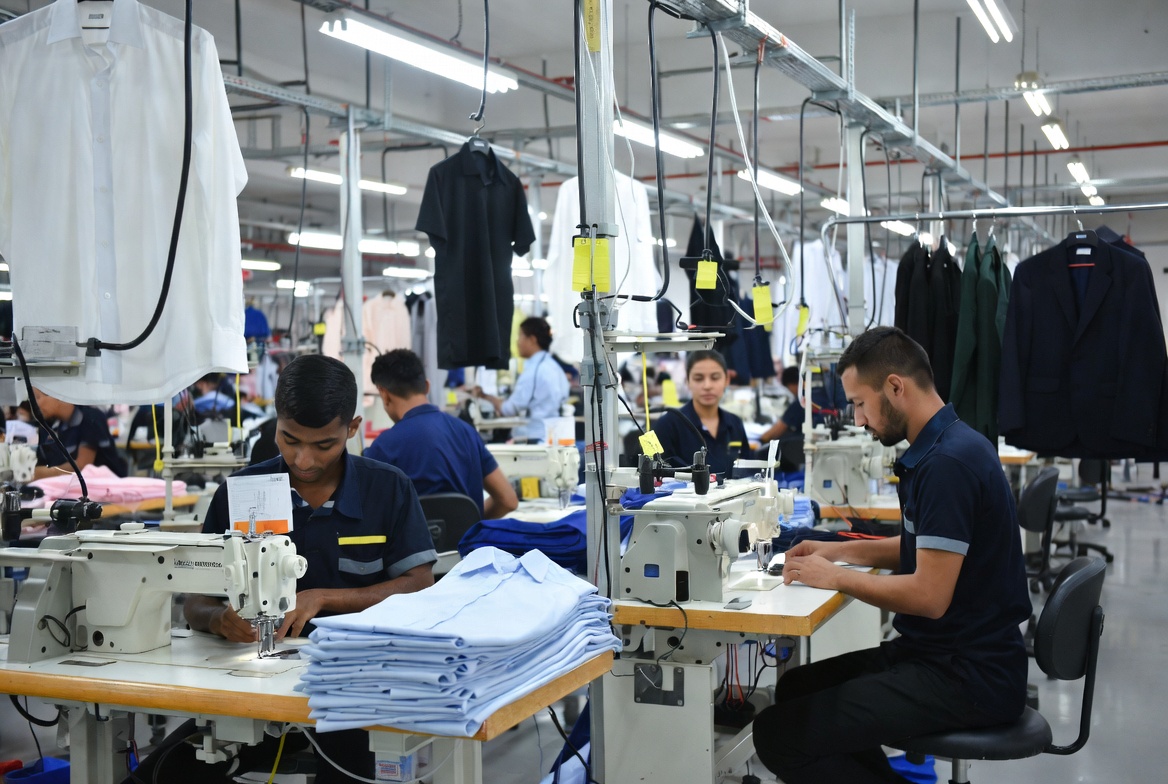
These are the types of checks that experienced sourcing teams perform quietly in the background to keep long‑term office wear programs stable.
- Use multiple information sources
- Combine business platforms (e.g., Alibaba or industry portals) with local government registration data and well‑known logistics partners' experience. [alibaba]
- For larger suppliers, check public filings, group websites, and news about brand partnerships. [sino-shipping]
- Confirm certification validity
- Request scanned ISO 9001, BSCI, SEDEX, or other certificates with license numbers and validity periods, then verify them on the issuing body's website or via email. [bowinsgarment]
- Make sure the scope matches your product category (garment manufacturing) and the actual plant location.
- Consider third‑party audits
- Before placing a major office wear program, commission a third‑party audit (technical and social) to check sewing lines, finishing, QC, and warehouse practices. [alibaba]
- Tech pack and CADs
- Provide clear tech packs with fabric specs, measurements, tolerance tables, branding details, and packaging requirements; for suiting, include measurement rules for different regions. [taianbowinsgarment]
- Request digital patterns or 3D samples if available, then move to physical proto samples.
- Sample rounds
- Typical flow: prototype sample → fit sample → pre‑production (PP) sample. [taianbowinsgarment]
- For office wear, prioritize comfort and mobility (sitting, raising arms, walking) in fit sessions; many complaint cases come from restricted movement rather than pure measurement issues.
- Size runs and pilot lots
- Before full bulk, consider a small pilot order (for example, 50–100 sets) deployed to a limited group of employees to gather feedback on fit, comfort, and wash performance. [alibaba]
- Pricing and Incoterms
- Decide early whether you will work on FOB China port, CIF, or DDP, and compare quotations accordingly. [alibaba]
- For office wear with frequent replenishment, some buyers adopt framework agreements with periodic price reviews rather than one‑off contracts.
- Shipping and packaging
- Clarify hanger packing versus flat packing; office wear, especially suits, may need special packaging to reduce creasing in transit. [alibaba]
- Align on carton markings, size breakdown per carton, and labelling to simplify warehouse intake.
- Lead times and buffers
- Formalize lead times from PP approval and add realistic buffers for fabric dyeing, accessory delays, and port congestion, especially during Chinese holidays. [alibaba]
- Inconsistent color shades between batches
- Solution: request lab dips and bulk shade bands, and specify acceptable shade variation in the PO and quality manual. [taianbowinsgarment]
- Shrinkage and twisting after washing
- Solution: enforce fabric pre‑shrinking and washing tests before bulk; set maximum shrinkage limits for different fabric types. [bowinsgarment]
- Poorly attached buttons or trim failures
- Solution: define minimum button pull strength and perform random tests during inline and final inspection. [taianbowinsgarment]
China's office wear manufacturing landscape in 2026 offers a wide range of options—from large integrated groups like Esquel and Shenzhou to flexible OEM partners such as Hongyu Apparel, Taian BOWINS, and Shanghai Youti Clothing Co., Ltd. that are well suited for small to mid‑sized brands and specialized corporate programs. The right partner depends on your volume, style complexity, compliance requirements, and need for engineering support rather than just low unit cost. [sino-shipping]
If you are planning an office wear project or considering diversifying your supplier base in China, use the criteria and internal avoidance tips above to structure your RFQ, factory visits, and sample evaluations. Shortlist 3–5 factories aligned with your positioning—including at least one flexible OEM like Shanghai Youti Clothing Co., Ltd.—and run comparative pilots before locking into a long‑term framework agreement. [alibaba]
1. How can I verify whether a factory's ISO 9001 certificate is still valid?
Ask for a copy of the certificate, note the certificate number, issuing body, and validity dates, then check the issuing body's online database or contact them directly; cross‑verify that the listed address matches the actual production site used for your orders. [bowinsgarment]
2. What's a reasonable MOQ for office suits versus shirts?
For large integrated suiting groups, MOQs of several hundred suits per style/color are common, while shirt programs often start at around 1,000 pieces per color for major mills; low‑MOQ OEMs may accept 50–300 pieces for simpler office‑casual styles. [truekung]
3. How do I ensure there is no unapproved subcontracting of my orders?
Include explicit no‑subcontracting clauses in your contracts, ask the factory to list all approved production sites, and conduct periodic inspections; if third‑party auditors find your styles on unauthorized lines, treat it as a major breach. [alibaba]
4. Which certifications matter most for office wear sold into the EU?
Buyers usually focus on ISO 9001 for quality management, OEKO‑TEX or similar for fabric safety, and compliance with REACH and brand‑specific restricted substance lists; social audits (BSCI, SEDEX) are often required by large retailers. [bowinsgarment]
5. How often should I re‑test fabrics for a long‑running office wear program?
Many brands perform full lab testing for every new fabric lot or at least once per season and then partial testing on subsequent lots, focusing on colorfastness, dimensional stability, and key restricted substances; the frequency increases if mills or accessories change. [bowinsgarment]


