
Views: 251 Author: Youti Clothing Publish Time: 2026-07-01 Origin: Site


Content Menu
● Understanding the Two Core Concepts
>> What "Measuring Yourself for a Custom Suit" Really Means
>> What OEM Suit Manufacturing with a Chinese Supplier Means
● Measuring Yourself for a Custom Suit: Expert Checklist
>> Key Measurements for an Ideal Custom Suit
● Typical Mistakes in Self-Measurement and Their Consequences
● From Personal Measurement to Factory-Ready Data
>> How OEM Manufacturers Use Measurement Data
● Comparing Self-Measurement Custom Suit vs OEM Suit Manufacturing
>> Custom Self-Measurement vs OEM Suit Production
● Why Global Brands Choose OEM Suit Manufacturing in China
>> Strategic Advantages of Chinese OEM Suit Suppliers
● Case Insight: From Custom Fit Concept to OEM Collection
● How Shanghai Youti Clothing Co., Ltd. Supports Global OEM Clients
>> OEM Service Capabilities for International Brands
● Practical Steps: From Measurement to OEM Production
>> Step-by-Step Workflow for B2B Buyers
● Why Combining Custom Measurement Knowledge with OEM Manufacturing Creates an Advantage
● Actionable Takeaways for Brands, Wholesalers and Retailers
● Call to Action: Turn Your Fit Standards into a Scalable OEM Solution
● FAQs
A well-fitted suit starts long before production—it begins with how precisely you measure and with who manufactures your suit behind the scenes. In this article, we compare self-measurement for custom suits and OEM suit manufacturing with a professional Chinese supplier, helping global brands, wholesalers and retailers make smarter, data-backed decisions for their next collection.
Before diving into details, it is important to clarify the two main concepts we will compare in this article.
Measuring yourself for a custom suit usually refers to an end-customer or retail client taking body measurements (chest, waist, shoulders, sleeve length, etc.) in order to order a made-to-measure or fully custom suit from a brand or tailoring platform. This process is typically guided by a step-by-step online tutorial, sometimes supported by videos or measurement diagrams. [jy-uniform]
In this model:
- The individual wearer is the focal point.
- Suit patterns are adjusted based on a single person's dimensions.
- The goal is one perfect suit for one person, optimized for fit and comfort.
By contrast, OEM suit manufacturing refers to a B2B model where a professional factory—for example, a Chinese manufacturer like Shanghai Youti Clothing Co., Ltd.—produces suits under your own label based on your brand's specifications, patterns and quality standards. [alibaba]
In this model:
- The brand, wholesaler or retailer is the focal point.
- Suits are produced in bulk with standardized size sets or graded patterns.
- The goal is to deliver consistent, scalable quality across many customers and markets.
Both approaches are closely related to measurement and fit, but they respond to very different needs: one is personal, the other is industrial and scalable.

If you are an individual buying a custom suit online, precise self-measurement is critical to avoid costly alterations or returns. Based on industry practice and tailor guidelines, the most important measurements typically include: [sohu]
Upper Body Measurements
- Neck circumference: Measured at the base of the neck, where the collar sits.
- Shoulder width: From the end of one shoulder bone to the other, across the back.
- Chest circumference: Around the fullest part of the chest, tape kept level and snug.
- Waist circumference: Usually 2–3 cm above the navel, avoiding "holding in" the stomach.
Sleeve, Jacket and Torso Measurements
- Sleeve length: From the shoulder seam down to the wrist bone, along a slightly bent arm.
- Jacket length: From the base of the neck down to the point where you want the jacket to end.
- Back length & half back: Important to ensure the jacket does not pull or create wrinkles at the back.
Trouser Measurements
- Waist (trouser level): Sometimes slightly different from jacket waist.
- Hip circumference: Around the fullest part of the hips.
- Inseam length: From the crotch to the desired trouser length.
- Outseam length: From waist to the bottom hem.
Professional tailors often recommend having another person help you, using a soft measuring tape and checking each measurement at least two or three times for accuracy. [jy-uniform]
While self-measurement enables convenient online ordering, even small mistakes can create noticeable problems in the final garment.
Common mistakes include:
- Tape too tight or too loose, especially around chest and waist.
- Uneven posture during measurement (shoulders raised or slouched).
- Wrong reference points, such as measuring sleeve length from the neckline instead of shoulder.
- Not accounting for preferred fit (slim vs regular vs relaxed).
These errors can lead to issues such as:
- Jacket pulling across the chest or forming wrinkles at the back.
- Sleeves that are too short or too long.
- Trousers that feel tight at the thigh or loose at the waist.
From a UX perspective, this explains why many brands combine self-measurement guides with fit questionnaires (e.g., "Do you prefer a slim or classic fit?") to correct for typical user errors.
For an OEM manufacturer like Shanghai Youti Clothing Co., Ltd., the key challenge is to translate individual-level measurements into repeatable, scalable size charts and grading rules.
In a typical OEM cooperation, a brand will:
1. Provide base size specifications (e.g., a master size M).
2. Submit size charts for all target sizes (XS–XXXL or equivalent).
3. Communicate style preferences (slim, tailored, regular, relaxed).
4. Share measurement tolerances (acceptable deviations in cm or inches).
The factory then:
- Develops or adjusts patterns based on these inputs.
- Applies grading rules to scale patterns across sizes.
- Integrates quality control standards to keep each batch consistent.
In other words, where a single consumer focuses on "How do I measure myself?", a professional OEM focuses on "How do we codify measurement and fit in a way that is repeatable across hundreds or thousands of suits?"
The table below highlights the key differences between these two approaches in terms of goal, process and outcomes.
| Dimension | Self-Measured Custom Suit (B2C) | OEM Suit Manufacturing with Chinese Supplier (B2B) |
|---|---|---|
| Primary user | Individual wearer | Brand, wholesaler, retailer |
| Objective | Perfect fit for one person | Consistent quality across many units |
| Measurement source | Customer self-measurement, sometimes assisted by a friend | Brand size chart, base patterns, technical packs |
| Volume | 1–2 suits per order | Dozens to thousands of suits per order |
| Fit control | Customer feedback & alterations | Sampling, grading, factory QC |
| Lead time | Often 2–4 weeks | Depends on order size, usually several weeks |
| Risk | Measurement errors by individuals | Pattern or grading errors if specifications unclear |
| Best suited for | Weddings, business events, personal wardrobes | Brand collections, wholesale lines, uniforms, corporate wear |
This comparison shows that self-measurement and OEM manufacturing are not competitors—they are different levels of the same value chain, from individual fit to industrial production. [made-in-china]
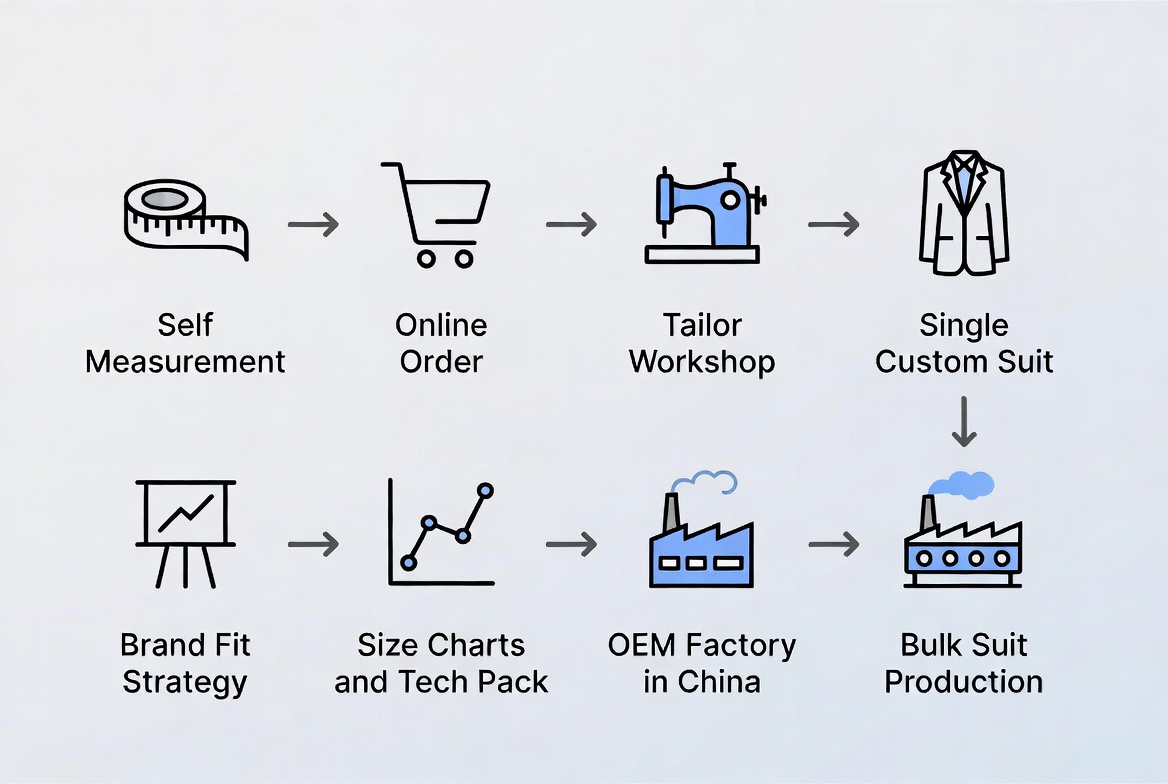
From a global sourcing perspective, China remains a major hub for tailored suits, uniforms and professional apparel thanks to its mature supply chain, experienced workforce and competitive pricing. [accio]
Cost and Scale Efficiency
- Optimized labor and production costs, especially for mid- to large-volume orders.
- Established supply chains for wool blends, synthetic fabrics, linings and accessories.
- Ability to produce small trial runs and then scale up quickly when designs succeed.
Technical Expertise and Pattern Engineering
Many Chinese factories have years of experience in pattern-making, grading and industrial tailoring, allowing them to:
- Translate complex style requirements into production-ready patterns.
- Adjust fits for different regions (e.g., European, American, Asian size profiles).
- Handle uniform projects, corporate wear and niche segments such as hospitality or security apparel.
For brands that start from custom suit concepts, working with a skilled OEM partner means those high standards of fit and structure can be implemented on a mass scale.
Imagine a European menswear brand that built its reputation on precise custom fit, allowing customers to measure themselves online and order one-of-a-kind suits. At some point, the brand decides to:
- Launch a ready-to-wear collection that mirrors its custom fit philosophy.
- Enter new markets via wholesale partners, department stores or B2B clients.
To achieve this, the brand can:
1. Analyze data from thousands of customer measurements and orders.
2. Identify common size patterns and typical deviations.
3. Design a size run that covers the majority of target customers.
4. Partner with an OEM manufacturer such as Shanghai Youti Clothing Co., Ltd. to translate these insights into production-ready size charts and patterns.
This approach bridges the gap between individual measurement intelligence and efficient, large-scale manufacturing—creating a competitive advantage that many purely "off-the-rack" brands lack.
As a Chinese OEM supplier specialized in suits and professional clothing, a company like Shanghai Youti Clothing Co., Ltd. typically offers an integrated service model tailored for international brands.
OEM Suit and Professional Wear Solutions
- Production of men's and women's suits, blazers, trousers and corporate uniforms.
- OEM services for brands, wholesalers, importers and uniform suppliers.
- Flexible order quantities, supporting both pilot runs and large-scale production.
Support for Global Sizing and Branding
- Development of custom size charts aligned with your target market (e.g., US, EU, UK, Asia).
- Integration of brand-specific details such as logo labels, hangtags, packaging and lining colors.
- Coordination with clients' tech packs, CAD patterns and measurement tolerances.
This combination of manufacturing expertise and OEM flexibility allows foreign brands to focus on design, branding and sales, while the factory handles the complex backend of production and quality control. [alibaba]
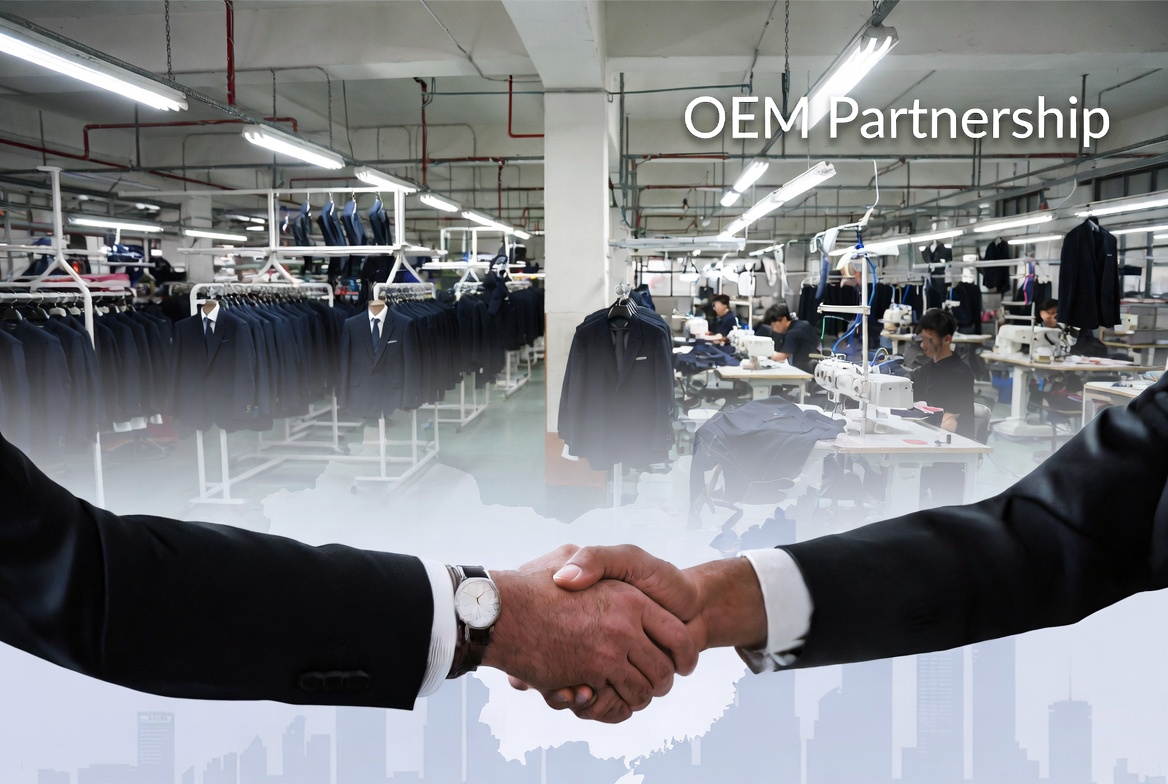
For brands, wholesalers and retailers, success lies in connecting the dots between individual fit expectations and factory-level specifications.
Step 1: Define Your Fit Philosophy
- Decide whether your line will be slim, modern tailored, or classic.
- Analyze customer feedback from existing tailored or custom programs.
Step 2: Build a Master Size Set
- Create detailed specs for a base size (e.g., 38R or 48 EU).
- Develop a size run that covers your core market (e.g., 44–56 EU).
Step 3: Prepare Technical Documentation
- Combine size charts, tolerances, style measurements and construction details.
- Add clear notes about shoulder structure, lapel width, vent style and trouser rise.
Step 4: Work Closely with Your OEM Partner
- Send tech packs and measurement charts to your OEM supplier.
- Request sample suits to test fit and quality.
- Provide structured feedback: where to adjust chest, waist, shoulder or sleeve lengths.
Step 5: Scale Production with Controlled Quality
- Once samples are approved, proceed to bulk production.
- Implement random size checks per batch with documented measurement results.
This structured process converts what began as a few key measurements for a single customer into a robust, repeatable system ideal for sustained growth and brand consistency.
Brands that understand both individual measurement and industrial production can create collections that:
- Fit better out of the box, reducing returns and alterations.
- Align with the real dimensions of their target customers.
- Leverage OEM partners like Shanghai Youti Clothing Co., Ltd. to maintain that fit as production scales.
By integrating learnings from custom suit measurements, brands can refine size charts, grading rules and style details so that each suit not only looks good on a model but also works for real customers across different markets.
For decision-makers considering suits and professional wear, here are practical actions you can take now:
- Document your ideal fit based on existing custom or made-to-measure programs.
- Translate those insights into clear size charts and tolerances.
- Partner with a specialized OEM supplier in China that understands both fashion and technical fit.
- Pilot small batches to verify real-world fit before committing to large production runs.
By doing so, you transform what starts as a simple question—"How do I measure myself for a suit?"—into a powerful foundation for building a scalable, profitable suit and professional wear business.
If you are a brand owner, wholesaler or retailer planning your next suit or professional wear collection, now is the right time to:
- Consolidate your measurement standards.
- Clarify your fit philosophy.
- Collaborate with a professional OEM partner in China to bring your designs to life at scale.
By working with an experienced manufacturer such as Shanghai Youti Clothing Co., Ltd., you can bridge the gap between custom-level fit and mass production efficiency, ensuring that every piece in your collection reflects your brand's promise of quality, comfort and style.
1. What is the main difference between custom self-measured suits and OEM suits?
Custom self-measured suits focus on one individual's measurements, while OEM suits are produced in bulk based on standardized size charts created by brands and implemented by factories.
2. Can self-measurement data improve OEM suit production?
Yes. Aggregated self-measurement data helps brands understand real customer body profiles, which can be translated into better size charts, grading rules and fit standards for OEM production.
3. Why do many brands choose OEM suit manufacturers in China?
Chinese OEM manufacturers combine cost efficiency, pattern expertise and scalable production capacity, making them attractive partners for brands needing reliable, repeatable quality at volume. [accio]
4. How can a brand ensure consistent fit across different production batches?
Brands should provide clear technical specifications, approve pre-production samples and work with OEM partners that implement structured quality control and measurement checks for each batch.
5. What should I prepare before contacting an OEM suit supplier?
You should prepare size charts, base measurements, style details, target markets and expected order volumes, along with any existing patterns or tech packs that reflect your brand's preferred fit.
1. StudioSuits. "How to Measure Yourself to Get the Ideal Custom Suit". Available at:
https://www.studiosuits.com/blogs/articles/how-to-measure-yourself-to-get-the-ideal-custom-suit [reddit]
2. JY Uniform. How to Measure Suit – Precise Measurement Guide. Available at:
https://www.jy-uniform.com/knowledge/how-to-measure-suit [reddit]
3. Sohu. Available at:
https://www.sohu.com/a/461792486_120093182 [reddit]
4. Alibaba.com. "OEM Bespoke Tailored Suit / Men's Custom Made Suits – Chinese Manufacturers and Suppliers". Available at:
https://www.alibaba.com/supplier/suit-custom-made.html [reddit]
5. Made-in-China.com. "OEM Bespoke Tailored Suit / Made-to-Measure Custom Fit Men's Suit". Available at:
https://www.made-in-china.com/price/prodetail_Men-s-Formal-Suit_RahrNlXTbBci.html [reddit]
6. Suit Republic. "Suit Republic | China-Wide Custom Tailoring". Available at:
https://www.suit-republic.com/ [reddit]


