
Views: 263 Author: Youti Clothing Publish Time: 2026-09-27 Origin: Site


Content Menu
● Business Pants vs Work Trousers: Quick Comparison
>> Typical Strengths of Business Pants
● Why Work Trousers Usually Last Longer
>> 1. Stronger Fabric Construction
>> 2. Reinforced High-Wear Areas
>> 3. Better Seams and Stitching
>> 4. Functional Design Reduces Garment Damage
● Durability by Work Environment
● Fabric Comparison: Which Material Performs Best?
>> Polyester-Viscose Business Fabric
>> Cotton Canvas or Duck Fabric
● The Hidden Durability Factor: Fit
● How to Evaluate Trouser Durability Before Placing an OEM Order
>> 1. Define the Actual Work Conditions
>> 2. Confirm Fabric Specifications
>> 3. Review Reinforcement Placement
>> 4. Inspect Construction Details
>> 5. Test Samples in Real Conditions
● Industry Insight: Durability Is More Than Fabric Weight
● Business Pants vs Work Trousers: Which Should Your Brand Choose?
● FAQs
>> 1. Are work trousers more durable than business pants?
>> 2. What fabric is best for durable work trousers?
>> 3. Are cotton work trousers durable enough for construction?
>> 4. Do reinforced knees make work trousers last longer?
>> 5. Can business pants be used as work uniforms?
>> 6. What should I check before ordering OEM work trousers?
>> 7. How can a uniform brand reduce trouser replacement costs?
When buyers compare business pants vs work trousers, the real question is not simply which style looks better. It is which garment can maintain its shape, comfort, professional appearance, and functional performance after repeated wearing, movement, washing, and exposure to workplace friction.
For office teams, reception staff, hotel employees, retail associates, drivers, supervisors, and client-facing professionals, business pants may provide enough durability for everyday use. However, for construction crews, warehouse workers, technicians, logistics teams, maintenance personnel, manufacturing operators, and field-service staff, properly engineered work trousers usually offer significantly better long-term durability.
At Shanghai Youti Clothing Co., Ltd., we work with overseas uniform brands, wholesalers, and professional clothing buyers on OEM uniform and workwear projects. From fabric selection to reinforcement placement, our production experience shows that trouser durability depends on far more than fabric thickness. The final performance comes from the combination of material, weave, seam construction, fit, pocket design, stress-point reinforcement, washing requirements, and the wearer's daily job conditions.
This guide explains the practical differences between business pants and work trousers, helping brands choose the right product category for their uniform collection.
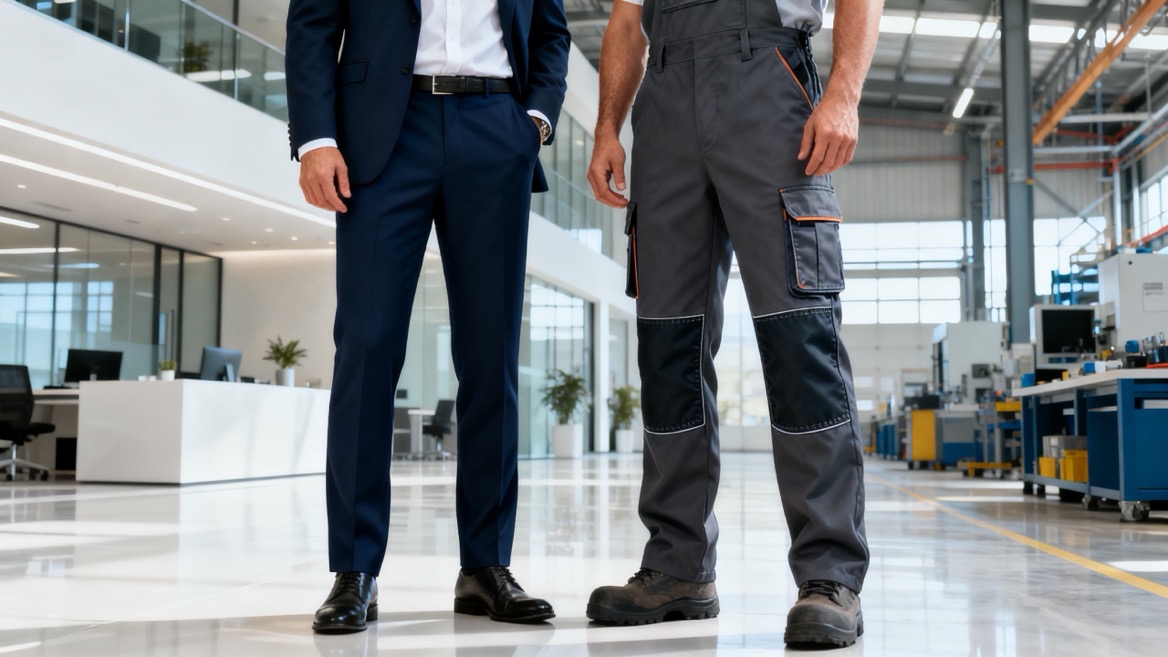
| Comparison Factor | Business Pants | Work Trousers |
|---|---|---|
| Primary purpose | Professional appearance, comfort, office wear | Protection, functionality, and durability in demanding work |
| Typical workplace | Offices, hotels, retail, reception, sales, administration | Construction, logistics, maintenance, factories, warehouses, outdoor work |
| Common fabrics | Polyester-viscose, polyester-rayon, cotton blends, stretch suiting | Polyester-cotton twill, canvas, ripstop, nylon blends, stretch workwear fabric |
| Fabric weight | Usually lightweight to mediumweight | Usually mediumweight to heavyweight |
| Abrasion resistance | Moderate | High, especially with reinforced panels |
| Pocket design | Minimal and appearance-focused | Utility pockets, cargo pockets, tool loops, secure closures |
| Knee reinforcement | Rare | Common in heavy-duty designs |
| Seam construction | Standard stitching | Double stitching, triple stitching, bar tacks, reinforced seams |
| Industrial washing suitability | Varies by fabric and finish | Often designed for frequent laundering |
| Best for daily heavy labor | Usually not recommended | Strongly recommended |
| Professional appearance | Excellent | Can be professional with modern workwear styling |
| Overall durability | Good for low-friction environments | Better for high-friction and physically demanding work |
The short answer: work trousers generally provide better durability for daily use when employees kneel, climb, carry tools, work outdoors, handle materials, or experience frequent friction. Business pants are more suitable when a polished appearance, lightweight comfort, and office-friendly styling are the main priorities.
Business pants are trousers designed primarily for a neat, professional, and polished appearance. They are widely used in corporate offices, hotels, banks, customer-service teams, restaurants, airlines, retail stores, showrooms, and sales departments.
They are often part of a coordinated uniform program that includes shirts, blazers, vests, dresses, or knitwear.
Typical business pants focus on:
- Clean lines and tailored silhouettes
- Comfort for sitting, walking, and customer interaction
- Wrinkle resistance
- Color consistency
- Easy matching with formal uniform tops
- A professional visual identity
Common fabrics include polyester-viscose blends, polyester-rayon blends, polyester-spandex fabrics, cotton blends, and lightweight stretch woven materials. These fabrics can create a refined appearance while maintaining practical comfort for long shifts.
However, business pants are generally not developed for repeated contact with rough surfaces, sharp tools, concrete, machinery, pallets, ladders, or heavy equipment.
Business pants can be an excellent choice when employees need to look professional throughout the day. They are especially useful for staff members who work in climate-controlled spaces and have limited exposure to physical abrasion.
Their advantages include:
- A sharper and more formal appearance
- Better drape and silhouette
- Lower garment weight
- Greater comfort for office-based positions
- Easy coordination with blazers and formal shirts
- Suitable options for men's and women's corporate uniforms
- Professional colors such as black, navy, charcoal, grey, beige, and dark brown
For example, a hotel front-desk employee may walk, stand, sit, and assist guests all day. Their trousers should remain smooth, comfortable, and visually polished. In this setting, a high-quality stretch business pant can deliver the right balance of comfort and appearance.
But the same garment would likely wear out much faster if used by a maintenance technician who kneels on floors, carries equipment, climbs ladders, and moves through mechanical rooms.
Work trousers are designed for employees whose daily tasks create higher physical stress on garments. They are made to handle friction, repeated movement, tool carrying, outdoor exposure, more frequent washing, and contact with industrial surfaces.
A well-designed pair of work trousers is not just a pair of pants with extra pockets. It is a functional workwear product engineered around the wearer's job requirements.
Common users include:
- Construction workers
- Warehouse staff
- Delivery teams
- Factory operators
- Mechanics
- Electricians
- Plumbers
- Carpenters
- Facility-management teams
- Security personnel
- Landscapers
- Field technicians
- Logistics employees
- Maintenance crews
Work trousers often include reinforced knees, cargo pockets, tool pockets, hammer loops, utility loops, phone pockets, adjustable waistbands, gusseted crotches, stronger zippers, bar-tacked stress points, and high-density stitching.
Many workwear fabrics are engineered to provide better resistance to abrasion, tearing, pilling, fading, and repeated laundering. Abrasion resistance is particularly important because it measures how well a textile withstands surface rubbing and wear before thinning, damage, or holes develop.
The main durability advantage of work trousers comes from their purpose-built construction. They are designed around predictable failure points that appear during physical work.
These failure points commonly include:
- Knees
- Seat area
- Inner thighs
- Crotch seams
- Pocket openings
- Hem edges
- Belt loops
- Tool-carrying areas
- Side seams
- Areas exposed to repeated rubbing
Business pants may use fine fabrics and attractive tailoring, but they often prioritize appearance over reinforcement. Work trousers take the opposite approach: they prioritize performance under stress.
Work trousers commonly use fabrics such as polyester-cotton twill, cotton canvas, duck fabric, ripstop, nylon blends, and stretch woven workwear fabrics.
A polyester-cotton blend is popular because it combines the natural comfort of cotton with the strength, shape retention, quick-drying performance, and color stability of polyester. This blend can be particularly useful for uniforms that must maintain a clean appearance after repeated commercial laundering.
For heavier-duty work, brands may choose canvas, duck fabric, ripstop fabric, or nylon-reinforced fabric.
- Canvas and duck fabrics offer strong abrasion resistance but may feel stiffer.
- Ripstop fabrics use reinforcement yarns in a grid pattern to help limit the spread of tears.
- Nylon blends can improve abrasion resistance and drying performance.
- Stretch workwear fabrics can improve mobility without sacrificing essential durability when properly engineered.
A durable garment should not be evaluated by fabric weight alone. A heavier fabric may resist abrasion well, but poor seam construction, weak thread, low-quality zippers, or an unsuitable fit can still shorten the garment's service life.
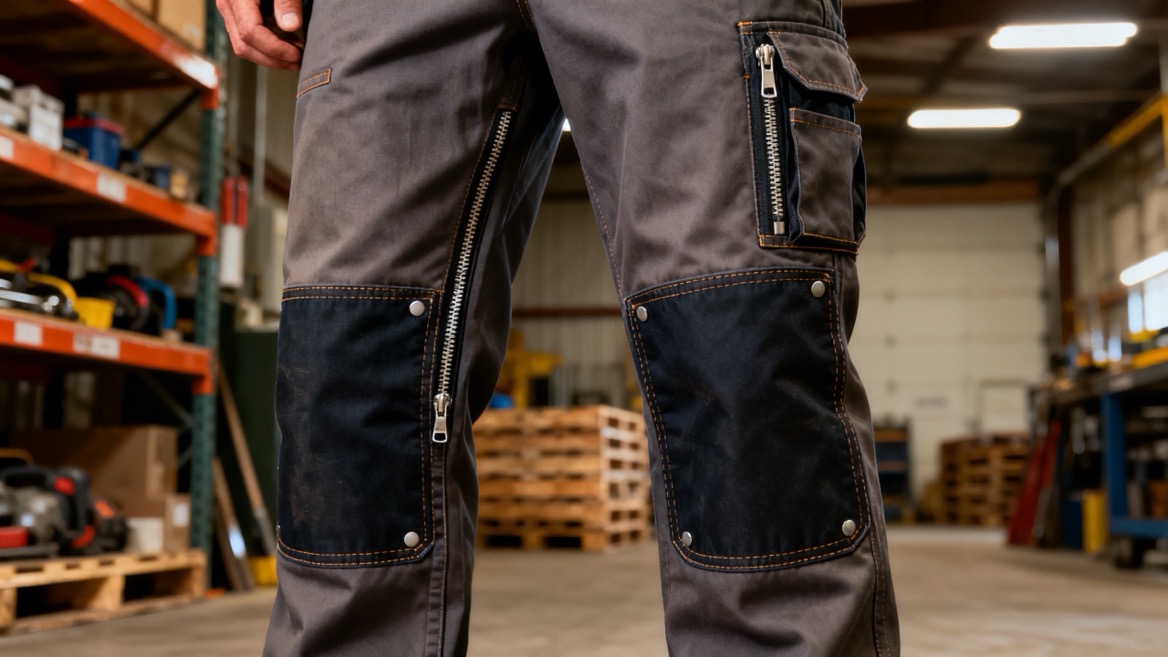
The knees are one of the first areas to fail in physically demanding jobs. Employees who install flooring, repair machinery, stock shelves, handle goods, or perform maintenance may kneel dozens of times every day.
That is why durable work trousers often include:
- Double-layer knee panels
- Knee-pad pockets
- Abrasion-resistant knee overlays
- Reinforced seat panels
- Cordura-style reinforcement fabrics
- Extra bartacks at pocket corners
- Strengthened crotch construction
Reinforced knee areas are especially important for construction, installation, warehouse, and maintenance uniforms. They help reduce premature fabric thinning and can improve wearer comfort when knee pads are required.
A strong fabric can still fail if the seams are weak.
From a garment manufacturing perspective, seams deserve as much attention as fabric. Work trousers often benefit from:
- Double-needle stitching
- Triple-needle stitching
- Bar tacks at stress points
- Reinforced inseams
- Bound or overlocked seam finishes
- Heavy-duty thread
- Stronger zipper tapes and zipper pulls
- Secure pocket attachment methods
Triple stitching is often used in high-stress areas because it provides more seam strength than a standard single-needle seam. Bar tacks are short, dense stitch patterns that reinforce areas under concentrated stress, such as pocket corners, belt loops, fly openings, and tool-pocket edges.
For OEM buyers, this is a crucial sourcing point. A trouser can look durable in a product photo but fail quickly if its seam specifications are not aligned with the actual work environment.
A worker who has nowhere to store tools may overload a standard pocket. A worker without sufficient stretch or crotch mobility may repeatedly strain the inseam. A worker without reinforced knees may wear through the fabric quickly.
In other words, functionality supports durability.
Well-designed work trousers reduce unnecessary stress through features such as:
- Dedicated mobile-phone pockets
- Deep cargo pockets
- Tool pockets
- Hammer loops
- Elastic waist inserts
- Gusseted crotches
- Articulated knees
- Adjustable hems
- Hidden zip pockets
- Water-repellent finishes where appropriate
The right design helps the garment work with the wearer's movement rather than against it.
Not every employee needs heavy-duty work trousers. The best choice depends on daily movement, workplace hazards, washing frequency, appearance standards, and expected wear life.
| Work Environment | Better Choice | Why |
|---|---|---|
| Corporate office | Business pants | Professional style and comfort are more important than abrasion resistance |
| Hotel front desk | Business pants | A polished appearance supports guest-facing service |
| Retail store | Business pants or lightweight work trousers | Depends on lifting frequency and required brand image |
| Restaurant service | Business pants | Suitable for customer-facing roles, especially in formal venues |
| Warehouse | Work trousers | Frequent bending, lifting, pallet contact, and walking increase garment stress |
| Construction site | Work trousers | Requires abrasion resistance, reinforced knees, and secure tool storage |
| Mechanical workshop | Work trousers | Exposure to grease, tools, kneeling, and repeated movement |
| Delivery and logistics | Work trousers | Requires mobility, pocket utility, and resistance to repeated use |
| Facility maintenance | Work trousers | Workers often kneel, climb, carry tools, and work in varied conditions |
| Security team | Depends on duty type | Formal business pants for reception; work trousers for patrol or outdoor duty |
| Manufacturing plant | Work trousers | Better suited to movement, machinery environments, and frequent laundering |
For mixed workforces, a brand may need more than one trouser category. For example, a property-management company may select business pants for reception staff, stretch work trousers for maintenance employees, and lightweight cargo trousers for cleaning or logistics teams.
Choosing between business pants and work trousers becomes easier when buyers understand how the fabric affects performance.
Polyester-viscose fabric is common in corporate uniforms because it can look refined, drape well, resist wrinkling, and maintain a neat visual structure.
It is suitable for:
- Office uniforms
- Hospitality uniforms
- Reception staff
- Sales teams
- Retail associates
- Airline or transport-service uniforms
However, it is not the best option for heavy abrasion, frequent kneeling, or carrying tools.
Best use: professional, customer-facing, low-friction work environments.
Polyester-cotton twill is one of the most versatile workwear fabrics. It offers a good balance between comfort, durability, washability, and cost control.
Its strengths include:
- Good abrasion resistance
- Better shape retention than pure cotton
- Reliable color performance
- Comfortable hand feel
- Commercial laundering suitability
- Practical cost for large uniform programs
This makes poly-cotton twill an excellent option for warehouse, facility-management, manufacturing, delivery, and general industrial uniforms.
Canvas and duck fabrics are strong, dense, and abrasion resistant. They are suitable for jobs involving rough surfaces, outdoor conditions, tools, and physical labor.
Their limitations include:
- Higher garment weight
- Reduced softness
- Slower drying
- Potential stiffness before washing
- Less formal appearance
Best use: construction, landscaping, carpentry, heavy logistics, and outdoor labor.
Ripstop fabric includes reinforcement yarns arranged in a visible or subtle grid. When the fabric catches or tears, the structure can help prevent the damage from spreading quickly.
It is useful for:
- Outdoor workwear
- Utility uniforms
- Technical trousers
- Lightweight yet durable work pants
- Field-service teams
Ripstop is commonly valued for its balance between low weight, tear resistance, and practical mobility.
Stretch work trousers often use elastane, spandex, mechanical stretch yarns, or four-way stretch constructions. They can improve mobility for workers who climb, bend, squat, kneel, or drive for long periods.
But stretch must be selected carefully.
Too much elastane can reduce long-term shape retention or increase fabric stress in certain applications. For demanding workwear, many buyers choose controlled stretch panels or durable stretch-woven constructions instead of using high-stretch fabric across the entire garment.
Poor fit can shorten a trouser's usable life.
This is often overlooked during uniform development. If trousers are too tight across the thighs, seat, or crotch, the fabric and seams experience greater stress every time the wearer sits, squats, climbs, or bends. If trousers are too long, hems may drag against the ground and wear out quickly. If the rise is too low, the inseam and back seam may become vulnerable.
A durable work trouser should allow natural movement without excessive fabric tension.
For OEM uniform projects, key fit points should include:
- Waist comfort
- Hip ease
- Thigh ease
- Knee mobility
- Crotch depth
- Rise length
- Hem circumference
- Inseam length options
- Gender-specific grading
- Size range coverage
A well-fitted garment does not only improve comfort. It also reduces the risk of seam splitting, fabric strain, and early replacement.
Uniform buyers should avoid choosing trousers only by appearance, sample feel, or price. A better evaluation process helps prevent costly quality claims later.
Use this five-step durability checklist before confirming production.
Ask practical questions:
- Will workers kneel regularly?
- Do they carry tools or devices?
- Are they working indoors or outdoors?
- Will trousers contact concrete, metal, pallets, machinery, or rough surfaces?
- How often will the garments be washed?
- Is industrial laundry involved?
- Are employees required to maintain a formal appearance?
- Does the job require water resistance, flame resistance, high visibility, or anti-static performance?
The more physically demanding the job, the more likely work trousers are the correct solution.
Request clear information about:
- Fiber content
- Fabric construction
- Fabric weight
- Fabric weave
- Stretch percentage
- Colorfastness requirements
- Shrinkage allowance
- Pilling performance
- Abrasion resistance
- Tear strength
- Water-repellent treatment, if required
Fabric durability includes resistance to abrasion, tearing, pilling, and laundering-related degradation. Repeated washing can significantly affect a garment's long-term performance, so testing should consider both new fabric and fabric after maintenance cycles.
Ask where reinforcement is included and why.
For demanding work trousers, evaluate:
- Knee panels
- Seat panels
- Pocket openings
- Tool-pocket corners
- Belt loops
- Crotch seams
- Hem guards
- Side seams
- Zipper areas
The reinforcement should match the worker's movements. Adding heavy reinforcement in the wrong place can create unnecessary bulk without improving useful durability.
Look beyond the outer fabric.
Check:
- Stitch density
- Thread quality
- Bartack locations
- Seam allowances
- Zipper strength
- Button attachment
- Pocket construction
- Waistband stability
- Label attachment
- Hem finishing
For heavy-duty workwear, construction quality can determine whether trousers last several months or remain serviceable through a much longer uniform cycle.
The most valuable durability test is a controlled wear trial.
Before large-scale production, provide samples to actual wearers. Ask them to use the trousers during normal work for a defined period, then collect feedback on:
- Comfort
- Mobility
- Pocket usability
- Knee wear
- Seam strength
- Waist stability
- Fabric appearance after washing
- Color retention
- Shrinkage
- Zipper performance
- Overall satisfaction
A field trial often reveals issues that laboratory testing alone may not identify.
Many buyers assume that a heavier fabric automatically means a more durable work trouser. In practice, this is incomplete.
A 300 GSM fabric may be strong, but if the crotch seam is weak, the trouser can still fail during repeated squatting. A lightweight ripstop fabric may perform better in certain field-service roles because it resists tearing while allowing better movement. A polyester-cotton twill trouser may outlast a heavier cotton trouser if it receives better reinforcement, stitching, and laundering control.
The best durable uniform is the one designed for the actual task.
For example:
- A construction worker may need canvas work trousers with reinforced knees.
- A warehouse picker may need flexible poly-cotton stretch trousers with utility pockets.
- A hotel concierge may need tailored business pants with crease retention.
- A maintenance technician may need ripstop trousers with a gusseted crotch and tool pockets.
- A delivery driver may need lightweight stretch work trousers that remain comfortable during long periods of sitting and walking.
This is why uniform brands should develop product categories based on job roles instead of applying one trouser style to every employee.
Choose business pants when your customers need:
- A formal or semi-formal uniform appearance
- Lightweight comfort
- Smooth fabric drape
- Easy coordination with blazers or formal shirts
- A polished front-of-house image
- Lower exposure to abrasion and physical stress
Choose work trousers when your customers need:
- Stronger resistance to daily wear
- Reinforced knees and high-stress areas
- Tool storage and utility pockets
- Better performance during bending, kneeling, and lifting
- Durable seams and stronger construction
- Frequent washing capability
- Practical performance in warehouses, factories, maintenance, logistics, and outdoor settings
For brands serving several industries, the strongest approach is often to offer both.
A complete professional clothing collection may include:
- Tailored business pants for office and hospitality teams
- Stretch work trousers for service and maintenance teams
- Cargo work trousers for logistics and warehouse staff
- Heavy-duty reinforced trousers for construction and industrial work
- Seasonal options for hot weather, cold weather, and outdoor environments
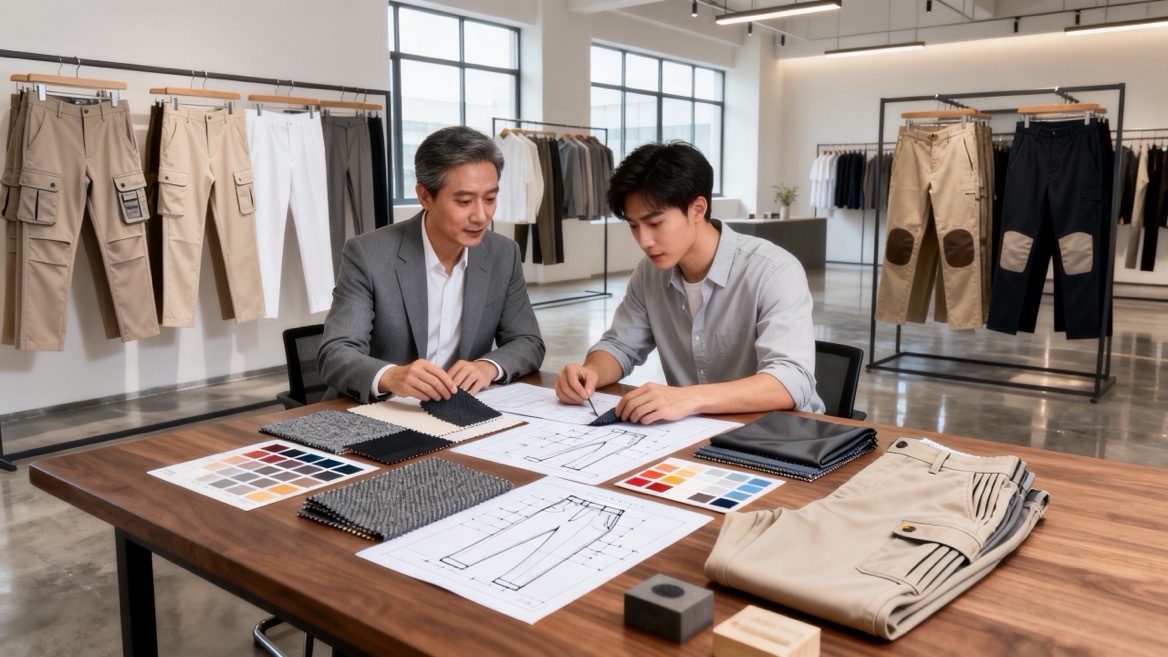
A stock trouser may not match your target market, customer sizing, branding, climate, or work environment. OEM development allows your brand to build trousers around real user needs.
At Shanghai Youti Clothing Co., Ltd., an OEM trouser development process can include:
- Fabric sourcing based on performance requirements
- Custom fabric composition and weight selection
- Corporate color matching
- Logo embroidery, printing, woven labels, and heat-transfer branding
- Customized pocket layouts
- Reinforced knee and seat construction
- Men's, women's, and unisex fit development
- Size grading for international markets
- Packaging customization
- Bulk production quality control
The right OEM partner should not only produce the garment. They should help identify where the garment is most likely to fail and recommend construction improvements before mass production.
For durability in physically demanding daily use, work trousers are the stronger choice. Their tougher fabrics, reinforced stress points, utility-focused design, stronger seams, and better resistance to repeated wear make them more suitable for industrial, warehouse, maintenance, logistics, construction, and field-service environments.
Business pants remain the better choice for corporate, retail, hospitality, and customer-facing teams that prioritize polished appearance, lighter weight, and professional styling over heavy-duty performance.
The smartest decision is not to ask, "Which trousers are better?" Instead, ask, "What does the wearer do every day, and where will the garment experience stress?"
A trouser that matches the real job will last longer, improve employee comfort, reduce replacement frequency, and strengthen the customer's perception of your uniform brand.
Looking for an OEM supplier for business pants, work trousers, cargo pants, or custom uniforms? Contact Shanghai Youti Clothing Co., Ltd. to develop professional trousers tailored to your target industry, brand positioning, fabric requirements, and durability standards.
Yes, in most physically demanding environments. Work trousers are generally made with stronger fabrics, reinforced seams, utility pockets, bartacks, and high-wear panels. Business pants are better suited to office, retail, hospitality, and other lower-friction workplaces.
Polyester-cotton twill is a versatile option for many workwear applications because it balances comfort, durability, washability, and cost. Canvas, duck fabric, ripstop, nylon blends, and reinforced stretch fabrics may be better for more demanding jobs.
Pure cotton work trousers can be comfortable, but they may not provide the same abrasion resistance, shape retention, or fast drying as polyester-cotton or nylon-reinforced alternatives. For construction, canvas, duck, ripstop, or reinforced poly-cotton work trousers are often more practical.
Yes. Reinforced knee panels can reduce wear caused by repeated kneeling, crawling, and contact with rough surfaces. They are especially useful for construction workers, installers, mechanics, floor layers, warehouse staff, and maintenance technicians.
Yes, when the job is low impact and customer-facing. Business pants are suitable for offices, hotels, banks, restaurants, retail stores, reception teams, and sales staff. They are not ideal for jobs involving heavy lifting, kneeling, tool carrying, or frequent contact with rough surfaces.
Confirm the fabric composition, fabric weight, seam construction, reinforcement placement, pocket design, stretch performance, washing requirements, sizing, branding method, and sample-testing process. Wear trials with real users are highly recommended before bulk production.
Choose trousers based on actual job conditions, not appearance alone. Use stronger fabrics, reinforce high-wear areas, improve seam specifications, provide the correct fit, and test samples through real working and washing conditions before placing a large order.
- [Refashion — A Framework for Measuring Physical Garment Durability]
- [Eco Standard — Deep Dive: Standards to Measure Textile Durability]
- [STRAUSS — The Ultimate Work Pants Buying Guide]
- [All Seasons Uniforms — The Complete Guide to Work Pants]
- [Hi Vis Supply — Tips for Choosing Work Pants on a Job Site]
- [MDPI Fibers — Durability Assessment of Elastolefin-Based Workwear Fabrics]
- [Mitti Supply — What Is Workwear?]
- [Ripstop Fabric — Workwear Fabric Stress and Testing Guide]


