
Views: 258 Author: Youti Clothing Publish Time: 2026-10-01 Origin: Site


Content Menu
● Understanding the Two Workwear Categories
>> What Are Women's Casual Work Clothes?
>> What Is Formal Workwear for Women?
● Women's Casual Work Clothes vs Formal Workwear at a Glance
● Why Flexible Office Culture Changes Women's Workwear
● The Case for Women's Casual Work Clothes
>> Comfort Improves Daily Wearability
>> Casual Does Not Mean Unprofessional
>> Casual Workwear Supports Inclusion
● The Enduring Value of Formal Workwear
>> Formal Workwear Strengthens First Impressions
>> Some Industries Still Need Structure
>> Formal Pieces Can Be Redesigned for Flexibility
● Which Option Better Supports a Flexible Office Culture?
>> The Recommended Workwear Model
● A Product Development Checklist for Workwear Buyers
>> Evaluate Fabric Before Style
>> Build a Capsule, Not a Single Uniform
● Expert Perspective: The Best Signal Is Appropriateness
● How Shanghai Youti Clothing Co., Ltd. Supports OEM Workwear Programs
● FAQs
>> 1. What is the difference between women's casual work clothes and formal workwear?
>> 2. Can women wear jeans in a flexible office?
>> 3. Is business casual appropriate for client meetings?
>> 4. What fabrics are best for women's flexible office workwear?
>> 5. How can employers make casual workwear look more professional?
>> 6. Why should workwear brands offer both casual and formal options?
>> 7. What should buyers check when sourcing women's office uniforms from China?
>> 8. Can formal workwear be comfortable enough for hybrid work?
Women's casual work clothes are generally the stronger fit for a flexible office culture—but only when "casual" is interpreted as polished, functional, and role-appropriate. Formal workwear remains essential for client-facing moments, leadership settings, regulated industries, and occasions where visual authority matters.
For brands, wholesalers, and corporate buyers, the best answer is not choosing one category over the other. It is building a coordinated women's workwear collection that lets employees move naturally between focused desk work, hybrid meetings, client visits, travel, and team events. At Shanghai Youti Clothing Co., Ltd., we see this shift clearly in OEM workwear development: buyers increasingly want garments that look credible in a meeting, feel comfortable through a commute, and remain appropriate when the workday changes without warning.
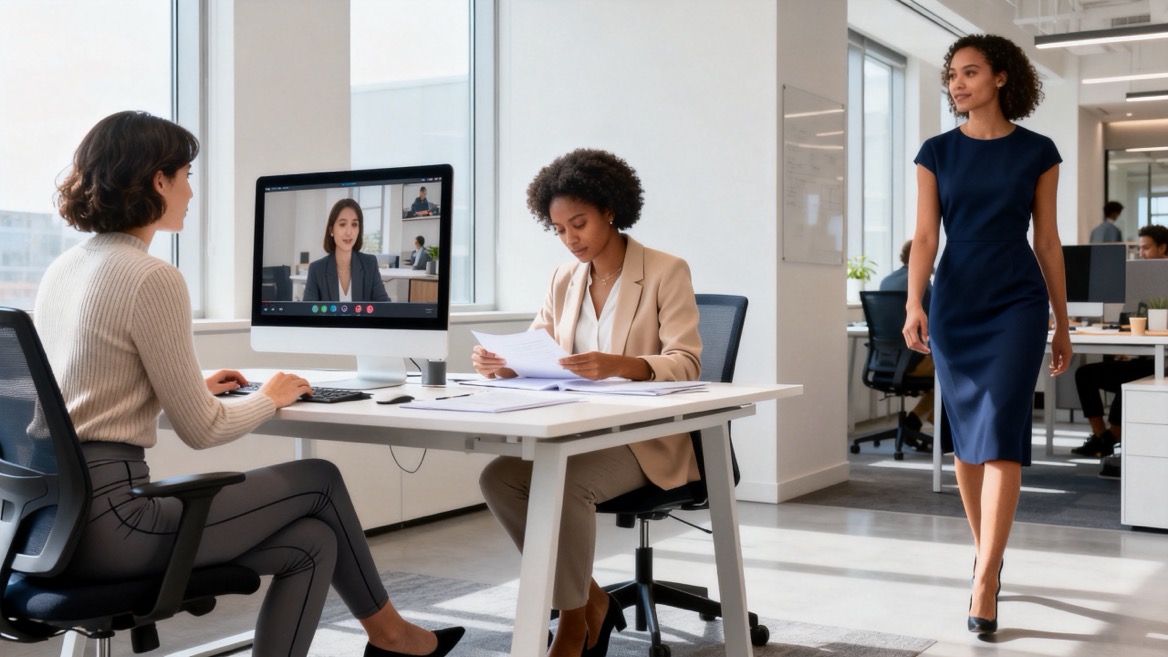
The comparison between women's casual work clothes and formal workwear is often oversimplified. One is not simply "relaxed," while the other is not automatically "professional." The real difference lies in structure, styling, material choice, and the message each garment sends.
Women's casual work clothes usually sit between everyday leisurewear and traditional office suiting. They are often described as business casual, smart casual, contemporary officewear, or hybrid workwear.
Typical garments include:
- Tailored knit tops and fine-gauge cardigans
- Relaxed-fit blouses and overshirts
- Stretch trousers, ankle pants, and tapered pants
- Knit dresses and shirt dresses
- Structured polo shirts
- Soft blazers and unlined jackets
- Midi skirts and practical skorts
- Coordinated tops and trousers in comfort-stretch fabrics
- Clean sneakers, loafers, flats, or low-profile footwear
The strongest casual office garments are not sloppy or overly trend-driven. They use clean silhouettes, suitable coverage, durable fabrics, and refined details. For example, a woman may wear a wrinkle-resistant blouse, stretch ankle trousers, and a lightweight unstructured blazer. The outfit feels easy, but it still signals readiness for a video call, a working lunch, or an unplanned presentation.
Formal workwear is more structured and more visually traditional. It is designed to project authority, consistency, and a higher level of ceremonial professionalism.
Typical examples include:
- Matching skirt suits and pantsuits
- Tailored blazers with lined construction
- Formal sheath dresses
- Structured blouses with dress trousers
- Conservative knee-length skirts
- Dark navy, charcoal, black, white, and muted neutral color palettes
- Closed-toe pumps, refined flats, or formal leather shoes
Formal workwear usually relies on sharper tailoring, smoother fabrics, stronger shoulder construction, and coordinated sets. It performs especially well where the wearer represents a company externally, handles sensitive transactions, leads senior meetings, or works in sectors where clients expect traditional visual cues.
A formal navy pantsuit, for instance, can immediately create a message of competence, discipline, and authority. That message is valuable. However, it may be unnecessarily restrictive for a product designer, a hybrid marketing team, a customer-success department, or a growing technology company with a highly collaborative culture.
| Comparison Area | Women's Casual Work Clothes | Formal Workwear |
|---|---|---|
| Primary purpose | Comfort, flexibility, modern professionalism | Authority, consistency, ceremonial professionalism |
| Best office environment | Hybrid offices, creative teams, tech companies, collaborative workplaces | Finance, law, executive teams, luxury retail, formal client settings |
| Typical silhouette | Relaxed tailoring, stretch, softer construction | Structured tailoring, coordinated suits, sharper lines |
| Mobility | High; suitable for commuting, standing, walking, and mixed workdays | Moderate; depends on fabric, fit, lining, and footwear |
| Visual message | Approachable, adaptable, contemporary | Credible, authoritative, established |
| Personal expression | Higher flexibility in color, layering, and styling | More controlled and standardized |
| Suitability for video calls | Very strong when neckline, color, and fit are well designed | Very strong, particularly for senior or external meetings |
| Comfort in long shifts | Usually higher | Can be lower if fabrics are rigid or the fit is too restrictive |
| Branding opportunity | Ideal for modern uniforms and employee wardrobe programs | Ideal for premium corporate identity and front-of-house uniforms |
| Main risk | Can look too informal without clear design standards | Can feel outdated, uncomfortable, or overly rigid in relaxed teams |
The right category depends less on fashion trends than on the actual moments employees experience during a working week.
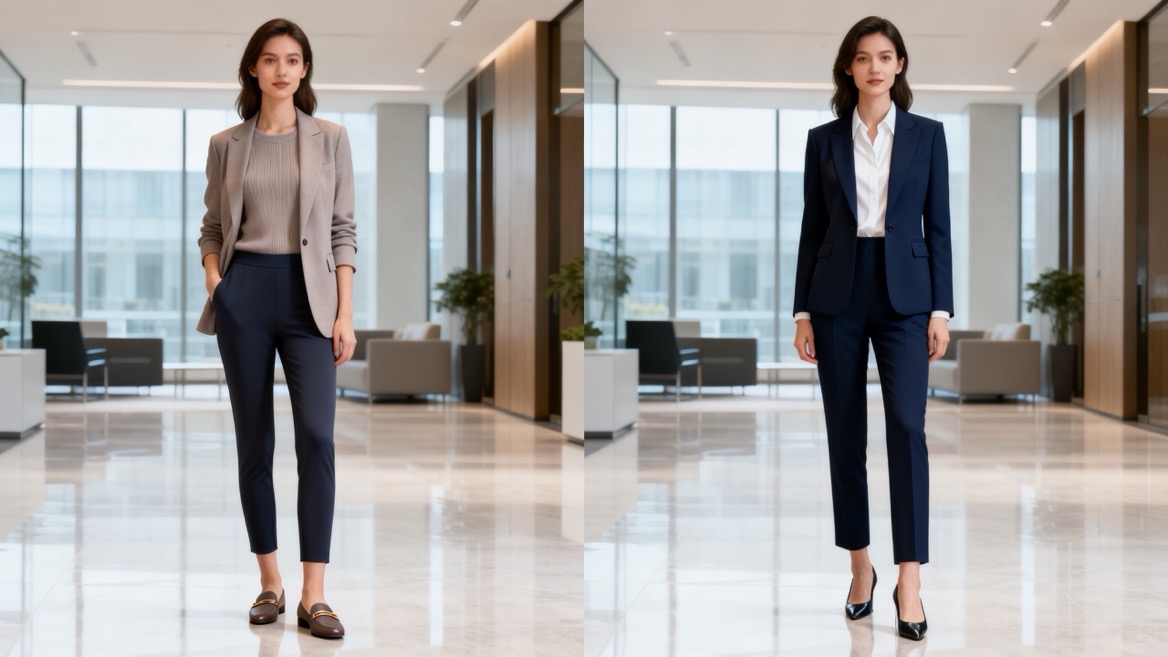
A flexible office culture is not only about working from home. It usually includes changing schedules, shared desks, cross-functional collaboration, online meetings, occasional in-person days, business travel, and more varied employee expectations.
This environment has changed what people need from work clothes.
A 2023 survey of 1,000 U.S. hybrid workers found that 79% said they dress differently because of flexible work arrangements. The study also reported that 53% prioritized comfort, while 35% said they blend casual and formal elements in their work outfits. These findings reflect an important commercial reality: employees are no longer building wardrobes for one fixed office routine. They need clothing that performs across several settings in a single day.
For a women's workwear brand, this means product development should consider the full workday:
1. Morning commute: Is the fabric breathable, wrinkle-resistant, and comfortable when seated?
2. Desk work: Can the wearer move freely without pulling, pinching, or overheating?
3. Video meetings: Does the garment look polished from the waist up?
4. Client interaction: Can the outfit be elevated with a blazer, scarf, or structured layer?
5. After-work transition: Does the employee still feel presentable for a team dinner or personal errand?
Women's casual work clothes often perform better across all five situations. However, they must still be engineered with professional standards in mind.
For most flexible office cultures, women's casual work clothes are the practical base layer. They support comfort, movement, individuality, and modern brand identity without requiring employees to abandon professional standards.
Comfort is not a minor styling detail. It affects whether employees can wear a garment for eight to ten hours, travel in it, work at a standing desk, or move between home and office.
Well-developed women's casual workwear often includes:
- Mechanical stretch or elastane-blend fabrics
- Breathable woven or knit constructions
- Soft waistbands or partial elastic inserts
- Lightweight layering pieces
- Lower-maintenance fabrics that resist wrinkles
- Wider armholes and movement-friendly sleeves
- Functional pockets
- Machine-washable fabric options
A rigid formal blazer may look impressive at 9:00 a.m., but it can become uncomfortable after a crowded commute, a long presentation, and an afternoon workshop. A soft structured blazer with stretch lining, by contrast, can preserve a professional outline while improving wear comfort.
The key distinction is between casual officewear and leisurewear. A polished knit dress, tailored stretch trousers, or branded overshirt can look entirely appropriate in a modern workplace. A faded graphic T-shirt, damaged denim, transparent fabric, or overly revealing silhouette usually cannot.
Research published in the *Journal of Business Ethics* found that clothing style affects workplace judgments, and that business casual attire was perceived more positively than casual attire in assessments related to ethicality. The research also emphasizes that perceived appropriateness depends heavily on workplace and industry context.
For apparel brands and uniform buyers, this supports a simple development principle:
> Design for comfort, but create clear visual boundaries between professional casualwear and off-duty clothing.
That means using better fabrics, better fit, controlled branding, and a consistent color palette.
A flexible office culture often aims to reduce unnecessary barriers. Formal dress requirements can create pressure around cost, body fit, climate, mobility, and personal identity. A well-planned casual workwear program gives employees more options while keeping the company image coherent.
For women, this can mean offering multiple acceptable silhouettes rather than enforcing one narrow uniform formula:
- Straight-leg and tapered-leg trousers
- Dresses and separates
- Long-sleeve and short-sleeve options
- Modest layering pieces
- Different lengths and fits
- Extended size ranges
- Adaptable garments for varying climates
This is especially important for multinational teams. Workwear expectations differ by market, industry, weather conditions, and cultural norms. A one-style-fits-all program often creates low adoption. A coordinated capsule collection creates more choice without losing recognition.
Formal workwear should not disappear from a flexible office wardrobe. Instead, it should become a strategic layer used when visual authority, trust, and brand presentation matter most.
People form judgments quickly, especially when they have limited information about the wearer. In client meetings, interviews, investor presentations, legal consultations, financial services, hospitality leadership, and high-value sales situations, formal workwear can make the message clearer.
A tailored blazer, coordinated trousers, and structured blouse can communicate:
- Attention to detail
- Readiness for responsibility
- Respect for the audience
- Confidence in a high-stakes setting
- Alignment with established professional norms
The same academic research on attire perception found that professional attire can influence evaluations of credibility, trustworthiness, authority, and appropriateness. The strongest effect is not necessarily "more formal is always better." Instead, the garment must match the setting.
Formal workwear is especially relevant when employees regularly interact with conservative clients or represent a premium brand. In these settings, an overly casual appearance can create uncertainty about standards and service quality.
Formal women's workwear remains highly suitable for:
- Banking and financial services
- Legal and consulting firms
- Executive administration
- Luxury hotels and premium retail
- Corporate real estate
- International trade negotiations
- High-end customer reception
- Government and public-sector functions
- Medical administration and private clinics
- Formal ceremonies and corporate events
Harvard's professional attire guide makes the same context-based distinction: technology startups may operate in casual clothing, while corporate finance often expects formal suits. It also identifies business casual as a practical default for many networking settings, while reserving formal attire for interviews and more traditional expectations.
Formal workwear does not need to be uncomfortable. The best contemporary formal collections now borrow performance features from casual clothing.
OEM buyers should consider:
- Stretch suiting fabrics
- Recycled polyester-viscose-elastane blends
- Lightweight tropical-weight wool blends
- Half-lined or unlined blazers
- Adjustable waist construction
- Easy-care, wrinkle-resistant fabric finishes
- Machine-washable suiting options
- Separates that mix across several outfits
- Stretch linings and ergonomic sleeve construction
A modern formal blazer can still look refined while offering the mobility required by a flexible workplace. The goal is not to remove structure. It is to remove unnecessary restriction.
For most flexible workplaces, women's casual work clothes are the better everyday solution. They align with hybrid schedules, changing work locations, comfort needs, and the growing demand for personal expression.
However, the most successful workplace clothing strategy is usually a smart-casual core with formal escalation options.
Instead of asking employees to choose between fully casual and fully formal clothing, employers can create a three-level system.
| Work Situation | Recommended Dress Level | Example Women's Workwear |
|---|---|---|
| Focus work, internal meetings, hybrid days | Polished casual | Knit top, tailored stretch pants, cardigan, clean flats |
| Team presentations, office visitors, networking | Business casual | Blouse, ankle trousers, soft blazer, loafers |
| Client pitches, executive meetings, formal events | Formal workwear | Matching suit, tailored dress, structured blazer, formal shoes |
This model provides guidance without creating an overly rigid dress policy. It also gives brands and employers a more practical way to develop a uniform or corporate apparel program.
For brands, wholesalers, and uniform companies sourcing from China, selecting the right women's workwear collection requires more than reviewing a few sample photos. The product must perform after repeated wear, washing, travel, and real workplace use.
Fabric determines much of the garment's comfort, durability, and perceived quality. Ask suppliers about:
- Fiber composition
- Fabric weight in GSM
- Stretch percentage and recovery
- Pilling resistance
- Colorfastness
- Shrinkage after washing
- Wrinkle resistance
- Breathability
- Abrasion resistance
- Care instructions
- Compliance requirements for the destination market
For casual workwear, prioritize breathable fabrics with recovery and easy-care performance. For formal workwear, prioritize clean drape, shape retention, opacity, and a refined hand feel.
A factory sample can look excellent on a mannequin and still fail in daily use. Before bulk production, arrange wear testing with people who represent the target workforce.
Ask testers to assess:
1. Seated comfort during computer work and commuting.
2. Mobility when reaching, bending, walking, and carrying items.
3. Opacity under indoor and natural light.
4. Wrinkling after sitting for one to two hours.
5. Fit stability after washing.
6. Pocket usability for phones, access cards, and small work tools.
7. Layering compatibility with jackets, cardigans, and outerwear.
8. Professional appearance on video calls and in person.
This process helps brands reduce returns, improve repeat purchases, and build a more credible workwear collection.
A single women's uniform design may be easy to manage, but it rarely suits all employees or work situations. A capsule approach gives buyers more flexibility.
A practical women's workwear capsule may include:
- Two tailored trousers in different fits
- One knit top
- One woven blouse
- One polo or branded overshirt
- One soft blazer
- One structured blazer
- One dress or skirt option
- One outer layer for seasonal use
Use coordinated colors such as navy, charcoal, beige, white, black, olive, or muted brand colors. This allows employees to combine garments easily while keeping the company image consistent.
From an apparel development perspective, the strongest workwear programs are not the most formal or the most relaxed. They are the most appropriate.
A law firm receptionist, a field sales manager, a hotel host, a software designer, and a warehouse-office coordinator may all need professional clothing. Yet their clothing should not look identical. Their work involves different client expectations, movement needs, safety requirements, climate conditions, and brand roles.
That is why a successful women's corporate clothing program should answer four questions:
- What does the employee need to do while wearing the garment?
- Who will see the employee?
- What should the company image communicate?
- How can the clothing remain comfortable through a changing workday?
The answer may be a tailored blazer for one role, a branded stretch overshirt for another, and a washable knit dress for a third. Consistency does not require sameness.
Shanghai Youti Clothing Co., Ltd. works with overseas brands, wholesalers, and manufacturers seeking professional uniforms and work clothes through OEM production. For women's workwear collections, the most valuable supplier relationship is one that supports product decisions before bulk manufacturing begins.
A reliable development process should include:
- Brand-positioning and target-user discussion
- Fabric and trim recommendations
- Size specification support
- Logo application options
- Color development and lab dips
- Sampling and fit revisions
- Quality inspection standards
- Packaging customization
- Bulk production planning
For a flexible office culture, buyers can develop a collection that combines business casual comfort with formal workwear authority. This may include logo polos, tailored trousers, knit tops, lightweight blazers, dresses, overshirts, and premium suiting pieces in one coordinated range.
The commercial advantage is clear: instead of selling a single-purpose uniform, your brand can offer a workwear system that employees genuinely want to wear.
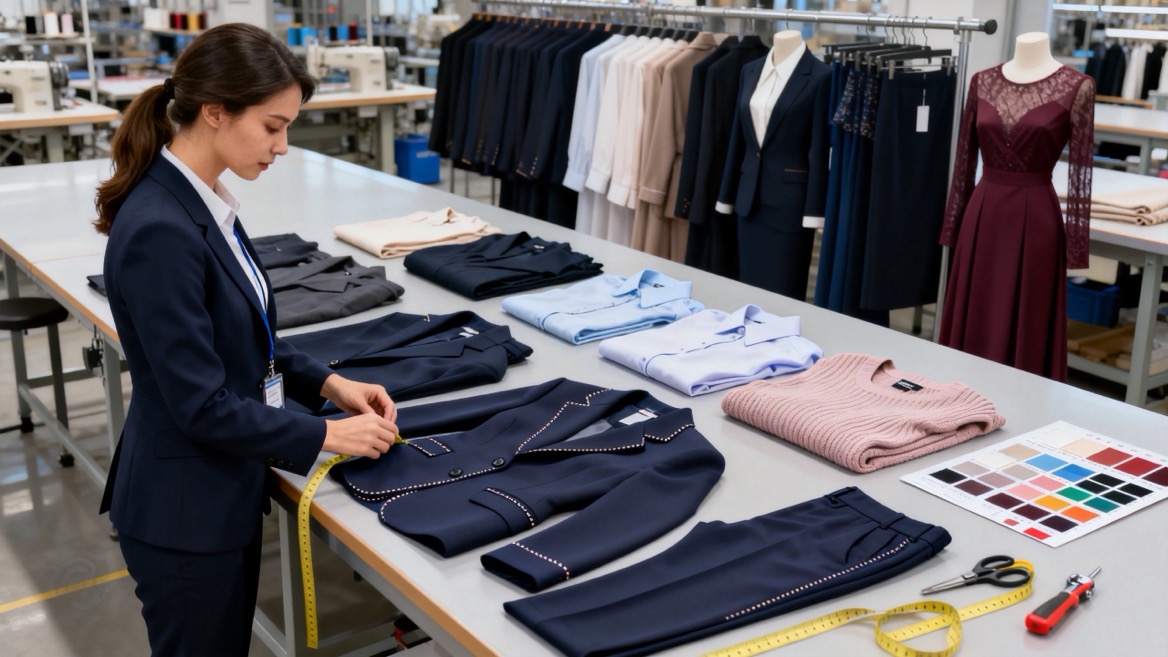
Women's casual work clothes best support flexible office culture when they are designed with professional details, reliable fabrics, and clear styling standards. They offer the comfort, mobility, and adaptability employees need across hybrid schedules and changing work environments.
Formal workwear still has an important place. It protects visual authority in high-stakes meetings, premium customer settings, conservative industries, and leadership moments. The strongest solution is a layered workwear strategy: polished casual pieces for daily flexibility, business-casual options for elevated interaction, and formal garments for occasions that demand a stronger professional signal.
For brands, wholesalers, and corporate apparel buyers, this creates a valuable opportunity. Develop women's workwear as a coordinated collection—not as a rigid dress rule. Choose performance fabrics, inclusive fits, practical details, and adaptable silhouettes. Then employees can look professional without feeling limited.
Ready to develop a women's workwear collection for a modern office culture? Partner with Shanghai Youti Clothing Co., Ltd. to create OEM uniforms, business-casual garments, and formal corporate apparel tailored to your brand identity, target market, and quality requirements.
Women's casual work clothes prioritize comfort and flexibility while maintaining a neat, professional appearance. Formal workwear uses more structured tailoring, conservative colors, and coordinated garments such as pantsuits, skirt suits, and formal dresses.
Yes, if the company policy and industry culture allow them. Choose dark-wash, clean, well-fitting jeans without rips, heavy fading, or distressed details. Pair them with a blouse, knit top, structured jacket, or polished footwear to maintain a professional appearance.
Business casual is appropriate for many client meetings, particularly in creative, technology, retail, and modern service industries. For conservative clients, executive presentations, or high-value negotiations, add a structured blazer or choose formal workwear.
Good choices include stretch polyester blends, polyester-viscose-elastane suiting, cotton blends, technical knits, Tencel blends, washable wool blends, and wrinkle-resistant woven fabrics. The ideal choice depends on climate, price point, care needs, and required appearance.
Employers can set clear guidelines around fit, coverage, fabric quality, color palette, footwear, and visible branding. They can also provide coordinated garments such as blazers, polos, tailored trousers, cardigans, and overshirts rather than allowing unrestricted leisurewear.
Different workdays create different needs. A blended collection allows employees to dress appropriately for internal collaboration, video meetings, customer visits, travel, presentations, and formal events without requiring completely separate wardrobes.
Buyers should review fabric specifications, size grading, workmanship, color consistency, logo quality, wash performance, shrinkage, lead time, quality-control procedures, packaging options, and the supplier's sampling and communication process.
Yes. Modern formal workwear can include stretch fabrics, lightweight construction, unlined or half-lined blazers, washable materials, flexible waistbands, and ergonomic pattern cutting. These features preserve a polished appearance while improving daily comfort.
1. IWG plc. "Workwear Re-imagined: IWG Study and Collaboration with Top Stylist Examines How Hybrid Working Has Re-invented Business Attire." [Read the study]
2. Sotak, Kristin Lee, Andra Serban, Barry A. Friedman, and Michael Palanski. "Perceptions of Ethicality: The Role of Attire Style, Attire Appropriateness, and Context." *Journal of Business Ethics*, 2023. [Read the research article]
3. Harvard Faculty of Arts and Sciences, Mignone Center for Career Success. "MCS Professional Attire Guide." [Read the attire guide]
4. Science of People. "Office Dress Code Guide: The 5 Levels." [Read the guide]
5. Central College Writing Anthology. "Dress Codes in the Workplace: Effects on Organizational Culture." [Read the article]
6. Forbes. "Your Style Choices Can Boost Or Hinder Work Performance, According to New Research." [Read the article]


