
Views: 210 Author: Youti Clothing Publish Time: 2026-09-29 Origin: Site


Content Menu
● Understanding the Difference Between Work Blouses and Dress Shirts
● Quick Comparison for Uniform Buyers
● When Work Blouses Are Better for Female Office Uniform Programs
>> A Better Choice for Modern Client-Facing Teams
>> More Comfortable for Long Office Hours
>> Stronger for Brand-Led Styling
● When Dress Shirts Are Better for Female Office Uniform Programs
>> Best for Formal Corporate Environments
>> Better for Structured Uniform Systems
>> Easy-Care Fabric Can Improve Daily Performance
● Fit Is the Most Important Decision
>> Practical Fit Checklist for Buyers
● The Best Strategy: Build a Role-Based Uniform Program
>> Example of a Female Office Uniform Matrix
● Fabric, Color, and Branding Considerations
>> Choose Fabric Based on Real Working Conditions
● OEM Development Steps for Work Blouses and Dress Shirts
>> Recommended Development Process
● FAQs
>> Are work blouses professional enough for corporate offices?
>> What is the main difference between a women's work blouse and a dress shirt?
>> Which fabric is best for women's office uniform shirts?
>> How can brands prevent button gaping on women's dress shirts?
>> Should female office uniforms include both blouses and dress shirts?
>> How many sizes should a female uniform program offer?
>> Can a work blouse carry an embroidered company logo?
For female office uniform programs, work blouses are often the stronger all-round choice when comfort, modern styling, inclusive fit, and role flexibility matter most. Dress shirts are usually the better option where a highly formal, structured, and client-facing corporate image is essential.
The right answer is rarely an either-or decision. In a well-planned female office uniform program, work blouses and dress shirts can serve different roles, departments, seasons, and customer touchpoints. At Shanghai Youti Clothing Co., Ltd., we work with overseas brands, wholesalers, and professional apparel buyers that need garments designed not only for appearance, but also for daily wear, repeat laundering, brand consistency, and scalable OEM production.
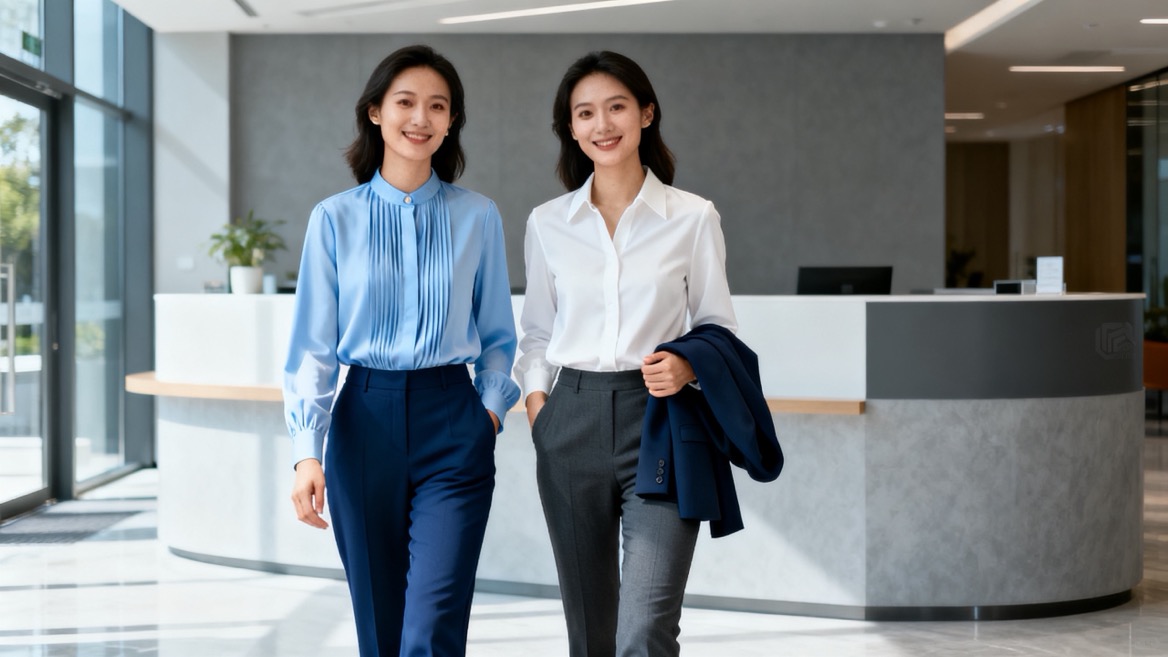
Although the two garment categories can look similar at first glance, they are built around different priorities.
A women's work blouse is generally designed for visual softness, versatility, and comfort. It may feature a relaxed or semi-fitted silhouette, a concealed placket, a V-neck, a soft collar, a tie neck, gathered shoulders, curved hems, or lightweight woven fabric. It often works well in modern offices, hospitality reception areas, retail environments, and customer-service teams.
A women's dress shirt usually has a more tailored structure. It commonly includes a pointed collar, front button closure, cuffs, yoke, darts, and a crisp woven construction. It is often selected for corporate reception teams, financial services, luxury retail, executive administration, aviation, and formal business settings.
From an OEM supplier's point of view, the key distinction is simple:
- Work blouses prioritize comfort and contemporary styling
- Dress shirts prioritize structure and business formality
- Both can support a professional branded uniform system
- The best option depends on employee role, working environment, and dress-code expectations
| Comparison Factor | Work Blouses | Dress Shirts |
|---|---|---|
| Overall appearance | Soft, modern, approachable | Crisp, formal, traditional |
| Best workplace use | Offices, reception, retail, hospitality, service teams | Finance, administration, executive offices, formal client meetings |
| Fit profile | Relaxed, semi-fitted, often more forgiving | Tailored, fitted, or regular structured fit |
| Comfort for long shifts | Usually high, especially in lightweight fabrics | Can be high, but depends strongly on fit and fabric |
| Movement | Often easier around the shoulders and waist | Can feel more restrictive if pattern design is too narrow |
| Brand presentation | Contemporary and welcoming | Authoritative and polished |
| Care requirements | Depends on fabric; some styles need careful finishing | Easy-care woven options are common |
| Logo placement | Embroidery, printed logo, woven badge, neck label | Embroidery, cuff detail, chest logo, collar branding |
| Cross-season use | Strong with layering options | Strong with jackets, vests, and blazers |
| OEM development complexity | Higher when draping, pleats, trims, or feminine details are used | Higher when fitted patterns, collars, cuffs, and plackets require precision |
Work blouses are often the best choice for organizations that want employees to look professional without appearing overly formal or rigid. They support a more contemporary workplace image while still providing a unified appearance.
This is especially valuable for companies whose employees interact with customers throughout the day but also need freedom of movement, warmth management, and a garment that feels comfortable during long shifts.
A work blouse can create a polished but welcoming impression. This is important for companies that want to appear capable, approachable, and current.
Suitable applications include:
- Hotel front-desk teams
- Retail associates
- Sales consultants
- Beauty and wellness reception teams
- Property-management staff
- Office administration teams
- Corporate showroom staff
- Customer-success and service teams
A blouse with a clean silhouette can look professional without looking severe. For example, a navy blouse with a subtle neck detail and embroidered chest logo may feel more contemporary than a traditional white button-front shirt, while still matching the company's visual identity.
For many female employees, fit is the deciding factor. A uniform may look excellent in a fitting room but become uncomfortable after several hours of computer work, standing, greeting visitors, or moving between departments.
Well-developed work blouses can provide:
- More room across the bust and upper back
- Less pulling when reaching or typing
- A softer feel at the neckline
- Better drape around the waist and hips
- More flexible options for different body shapes
- A less restrictive alternative to rigid collars and cuffs
Uniform research has shown that employees believe their uniforms influence happiness, workplace behavior, suitability, practicality, personal tailoring, visibility, and brand perception. A survey involving 2,560 uniform wearers found that employee responses differed by age and gender, reinforcing the need for uniform programs that account for real wearer needs rather than relying on a single generic pattern.
For female office uniform programs, this means a "one cut fits all" approach is often a poor commercial decision.
Work blouses provide more opportunities to express brand personality through shape, color, trim, fabric texture, and neckline design.
For example:
- A hospitality brand may select a soft ivory blouse with navy piping.
- A premium beauty retailer may use a satin-touch blouse in muted rose or charcoal.
- A technology company may prefer a clean collarless blouse in blue-gray stretch fabric.
- A property consultancy may choose a long-sleeve blouse with a subtle geometric print inside the cuff.
- A corporate service provider may develop a branded blouse in deep teal with concealed buttons.
These details can make an employee uniform look less generic. They can also help international brands create a recognizable visual system that is difficult for competitors to copy.
Women's dress shirts remain a core product for formal corporate apparel. They create an immediate sense of structure, order, and professionalism. For certain industries, that visual authority is more important than fashion versatility.
A dress shirt is often the better selection when employees represent the company in high-trust, formal, or highly visible situations.
Dress shirts work especially well in environments where employees need to look consistently polished in front of senior clients, investors, guests, or business partners.
They are commonly selected for:
- Banking and financial services
- Legal and consulting firms
- Executive reception areas
- Corporate headquarters
- Aviation and transport administration
- Real estate sales offices
- Government service counters
- Luxury automotive showrooms
- Business event and conference teams
A well-fitted female dress shirt communicates reliability. It pairs easily with tailored trousers, pencil skirts, blazers, waistcoats, scarves, and name badges.
Dress shirts are highly compatible with multi-layer uniform programs. This makes them practical for businesses that need one central garment to work across multiple seasons and job roles.
A typical corporate uniform wardrobe may include:
1. Long-sleeve dress shirt for formal meetings and colder weather
2. Short-sleeve dress shirt for warm climates or active reception work
3. Blazer or vest for managerial roles
4. Tailored trousers or skirt options
5. Branded scarf, tie, or neck accessory
6. Outerwear for travel or field visits
This modular approach makes it easier to create a consistent identity across different departments. The shirt remains the visual foundation, while outer layers and accessories adapt to role and climate.
A common concern is that dress shirts require more ironing and careful handling than blouses. This can be true with traditional cotton fabrics. However, modern uniform dress shirts can be developed with practical blends and finishes.
Common fabric options include:
| Fabric Type | Typical Benefit | Suitable Use |
|---|---|---|
| Cotton-polyester poplin | Crisp appearance and easier care | Reception, office, finance |
| Cotton-rich stretch poplin | Better comfort with a structured look | Sales, administration, management |
| Polyester-viscose blend | Smooth drape and stable color | Hospitality, corporate service |
| Recycled polyester blend | Lower-impact material option with durability | Brand-led uniform programs |
| Mechanical-stretch woven fabric | Better movement without visible elastane | Active office and showroom teams |
Some women's uniform shirt collections also use bust-gap prevention features, fitted pattern engineering, and easy-care finishes to improve daily performance.
For buyers, the important point is not simply choosing "a dress shirt." It is specifying a dress shirt that has the right fabric weight, fit allowance, button spacing, collar structure, sleeve length, and shrinkage standard.
The most expensive mistake in a female office uniform program is choosing a visually attractive garment that employees do not want to wear.
Female fit should not be treated as a smaller version of men's sizing. Women's professional apparel requires dedicated pattern development. Bust shaping, shoulder width, waist position, hip allowance, armhole depth, sleeve circumference, and garment length must all be considered.
A shirt that fits a standing model may still fail during daily work activities such as:
- Typing at a desk
- Reaching for files
- Welcoming guests
- Carrying documents
- Sitting through long meetings
- Moving between workstations
- Wearing a cardigan, vest, or blazer over the shirt
Research on uniform clothing fit highlights that routine workplace movements affect perceived comfort and fit. Employee needs should therefore be evaluated in real work settings, not only through static fitting sessions.
Before approving bulk production, evaluate each sample against the following questions:
- Does the garment pull across the bust when the wearer reaches forward?
- Is there enough shoulder mobility for desk work and standing service?
- Does the button placket remain flat when seated?
- Does the collar sit comfortably around the neck?
- Does the blouse or shirt maintain a professional shape after several washes?
- Is the sleeve opening comfortable for different arm sizes?
- Does the hem length remain appropriate when employees bend or sit?
- Are petite, regular, and extended sizes available where needed?
- Can the garment be worn with a blazer, vest, or outerwear layer?
- Does the fit support the brand image without making employees feel restricted?
For many companies, choosing only work blouses or only dress shirts creates unnecessary limitations. A stronger approach is to build a role-based uniform program.
This gives employees the correct level of formality for their jobs while keeping the overall visual identity consistent.
| Employee Role | Recommended Garment | Why It Works |
|---|---|---|
| Executive assistant | Dress shirt with tailored trousers | Formal, polished, meeting-ready |
| Front-desk receptionist | Work blouse with scarf or neck detail | Welcoming, professional, brand-friendly |
| Financial consultant | Dress shirt with blazer | High-trust, structured corporate image |
| Retail advisor | Soft work blouse with stretch trousers | Comfortable and customer approachable |
| Sales representative | Blouse or dress shirt based on client profile | Flexible for meetings and travel |
| Hotel office staff | Branded blouse with vest option | Hospitality-focused and easy to identify |
| Showroom host | Premium blouse with refined accessories | Strong visual presentation and comfort |
| Operations coordinator | Easy-care blouse or stretch dress shirt | Suitable for desk work and active movement |
This model allows a company to use the same color palette, logo treatment, buttons, trims, and fabric family across several garments. The result is a uniform program that feels coordinated rather than repetitive.
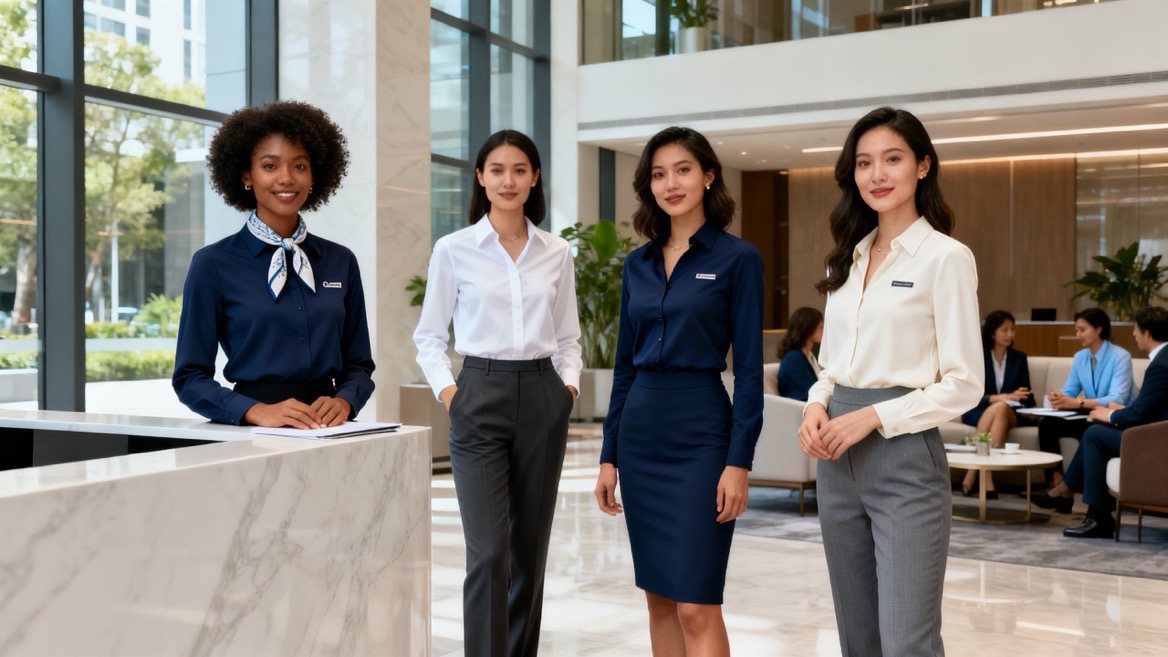
The garment silhouette matters, but fabric and branding determine how well the uniform performs after delivery.
For indoor office use, buyers should consider:
- Breathability for warm offices and long commutes
- Opacity under bright lighting
- Wrinkle resistance for professional presentation
- Color fastness after repeated laundering
- Soft hand feel for all-day comfort
- Stretch or movement allowance for active roles
- Low pilling performance for frequent use
- Easy-care requirements for employees and uniform managers
A field experiment involving construction uniforms found that improved uniform design enhanced wearer comfort and reduced perceived interference with work performance. Although office environments differ from construction sites, the core lesson remains relevant: comfort and functional design matter because employees wear uniforms in real conditions for extended periods.
For work blouses, softer tones can create a modern and approachable look:
- Light blue
- Ivory
- Warm gray
- Dusty pink
- Soft green
- Powder blue
- Deep teal
- Burgundy
For dress shirts, classic corporate colors remain effective:
- White
- Pale blue
- Navy
- Charcoal
- Black
- Fine stripe patterns
- Brand-color accent trims
Avoid selecting colors only from a digital screen. Fabric swatches should be reviewed under daylight, office lighting, hotel lighting, and retail lighting where relevant.
For female office shirts and blouses, branding can be applied through:
- Small chest embroidery
- Tonal logo embroidery
- Woven sleeve label
- Branded buttons
- Inside-collar print
- Contrast piping
- Custom neck scarves
- Coordinated name badges
- Printed care and size labels
- Custom packaging for retail or wholesale programs
The most effective branding is usually visible enough to be consistent, but subtle enough to remain professional.
For overseas brands, wholesalers, and manufacturers, a successful office uniform project depends on clear technical communication before mass production.
At Shanghai Youti Clothing Co., Ltd., the development process should focus on garment performance as well as appearance.
1. Define the employee roles
Identify who will wear the garments, how long they will wear them, and what tasks they perform.
2. Select the garment category
Decide whether each role needs a work blouse, dress shirt, or a coordinated range of both.
3. Choose fabrics and colors
Compare fabric weight, composition, stretch, care requirements, color approval, and seasonal suitability.
4. Develop technical specifications
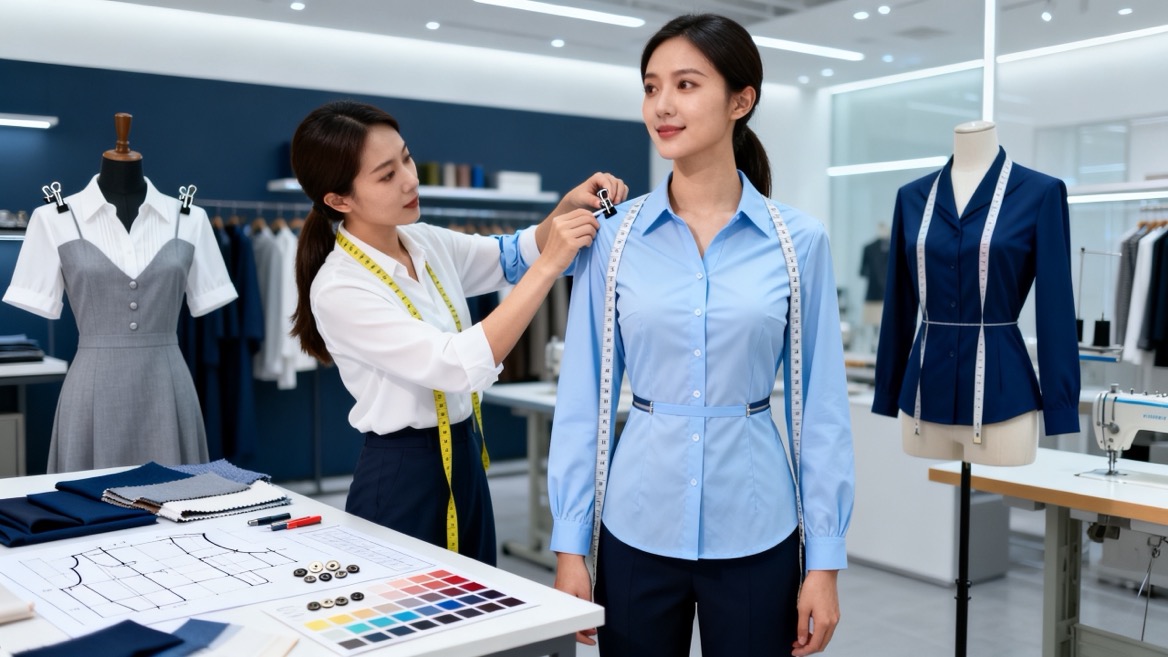
Confirm measurements, fit grading, buttons, collars, cuffs, pockets, embroidery placement, labels, and packaging.
5. Create a pre-production sample
Test the garment on real wearers from different size groups and departments.
6. Review wash and wear performance
Assess shrinkage, color durability, seam strength, wrinkle behavior, and shape retention.
7. Approve bulk production standards
Establish inspection requirements, acceptable tolerances, carton details, and delivery expectations.
8. Plan replenishment and continuity
Maintain approved fabric, color, and trim information for future reorders.
Choose work blouses when your female office uniform program needs a modern appearance, flexible fit, comfort, and a warm customer-facing image.
Choose dress shirts when your company requires a formal, structured, and highly professional corporate look.
For many international uniform buyers, the strongest solution is a coordinated collection that includes both. Dress shirts can support leadership, formal reception, and client meetings. Work blouses can support daily office wear, hospitality, retail, and service-focused teams.
Shanghai Youti Clothing Co., Ltd. supports overseas brands, wholesalers, and professional apparel buyers with OEM development for custom work blouses, women's dress shirts, corporate uniforms, and work clothes. Share your target market, garment specifications, branding requirements, and estimated order volume to begin building a practical female office uniform collection.
Yes. A well-designed work blouse can look highly professional when it uses quality fabric, appropriate fit, refined color, and subtle branding. It is especially suitable for modern offices, reception areas, retail teams, and client-service roles.
A work blouse usually has a softer, more flexible, and fashion-oriented design. A dress shirt typically has a structured collar, button front, cuffs, and a more formal tailored appearance.
Cotton-polyester poplin, cotton-rich stretch fabric, polyester-viscose blends, and mechanical-stretch woven fabrics are common options. The best choice depends on climate, job activity, laundering method, and desired appearance.
Brands can reduce button gaping by using dedicated women's patterns, correct bust allowance, optimized button spacing, appropriate fabric stretch, hidden internal fastening, and wearer testing before bulk production.
In many cases, yes. A dual-product program gives companies greater flexibility. Blouses can support comfort and customer service, while dress shirts can support formal meetings, executive roles, and professional events.
The size range should reflect the workforce and target market. Buyers should provide enough sizes to avoid forcing employees into unsuitable fits. Extended sizes, different lengths, and clear grading are often valuable for inclusive uniform programs.
Yes. Work blouses can carry chest embroidery, sleeve embroidery, tonal branding, custom labels, branded buttons, or coordinated accessories. Placement should be selected carefully to maintain a refined appearance.
1. Coventry University. "[Exploring the Relationship Between Uniform and Perceived Employee Happiness and Productivity]." Study based on an online survey of 2,560 uniform wearers examining perceived links between uniform design, workplace experience, happiness, practicality, individual tailoring, visibility, and brand.
2. ScienceDirect. "[Exploring the Relationship Between Uniform and Perceived Employee Happiness and Productivity]." Journal article discussing how wearers perceive the effect of uniforms on happiness and workplace behavior.
3. National Center for Biotechnology Information. "[Role of Work Uniform in Alleviating Perceptual Strain Among Construction Workers]." Field research assessing comfort and work-performance effects of improved work uniform design.
4. Taylor & Francis Online. "[The Impacts of Daily Movements on Uniform Clothing Fit]." Research exploring how routine workplace movement affects perceived fit and comfort in uniforms and workwear.
5. Lands' End Business. "[Work Clothes for Women]." Product and design reference covering women's uniform shirts, dress shirts, no-gap features, and easy-care garment characteristics.
6. Red Kap. "[Women's Workwear and Uniforms]." Product reference illustrating the importance of fit, function, stretch, and all-day comfort in women's workwear.


