
Views: 298 Author: Youti Clothing Publish Time: 2026-09-28 Origin: Site


Content Menu
● Why Source Corporate Uniforms From China?
● China's Uniform Manufacturing Clusters
● How We Evaluated Manufacturers
● 1. Shanghai Youti Clothing Co., Ltd.
>> Why It Fits Corporate Uniform Buyers
● 2. Taian BOWINS Garment Co., Ltd.
● 3. Shijiazhuang Haiyuan Labor Security Supplies Co., Ltd.
● 4. Jihua Group Corporation Limited
● 5. Fuzhou Smart Wear Manufactory
● 7. Shenzhen Xinhongyuan Fashion Dress Co., Ltd.
● 8. Zhengzhou Anbu Safety Industrial Co., Ltd.
● 9. Wuhan Kinglong Protective Products
● 10. Dongguan and Guangdong Custom Uniform Suppliers
● Corporate Uniform Material and Construction Requirements
>> Business and Office Uniforms
● The Most Common Sourcing Risks
>> Color Variation Between Lots
>> Compliance Claims That Do Not Match the Product
● An Internal Sourcing Tip Few Buyers Discuss
● Buyer's Guide: How to Verify a Supplier
>> Step 1: Send a Complete RFQ
>> Step 2: Audit the Factory's Documents
>> Step 3: Develop Samples Properly
>> Step 5: Protect Delivery and Logistics
>> 1. How can I check whether an ISO certificate is expired or invalid?
>> 2. Does ISO 9001 prove that a corporate uniform factory will deliver high-quality products?
>> 3. What is a realistic MOQ for custom corporate uniforms in China?
>> 4. How do I prevent a supplier from using lower-grade fabric in bulk production?
>> 5. Should I choose FOB, CIF, or DDP for uniform orders?
China remains one of the world's most important sourcing bases for corporate uniforms, combining fabric supply-chain depth, skilled garment production, export experience, and flexible OEM manufacturing. For procurement managers, the real question is not simply where to find a low quotation—it is how to identify a supplier that can reproduce approved samples consistently, control fabric and trim quality, meet delivery dates, and provide the documentation required by your market.
This guide reviews 10 representative corporate uniforms manufacturers in China for overseas brands, wholesalers, distributors, hotel groups, facility-management companies, and industrial buyers. The companies are presented as potential sourcing options rather than interchangeable suppliers; each is better suited to a different project profile, order volume, uniform category, and compliance requirement.
China's apparel and accessories exports reached approximately US$151.18 billion in 2025, with export volume increasing even while average export prices declined. This matters to uniform buyers: competitive pricing remains available, but stronger procurement controls are increasingly necessary to prevent material substitution, inconsistent workmanship, and delivery risk.
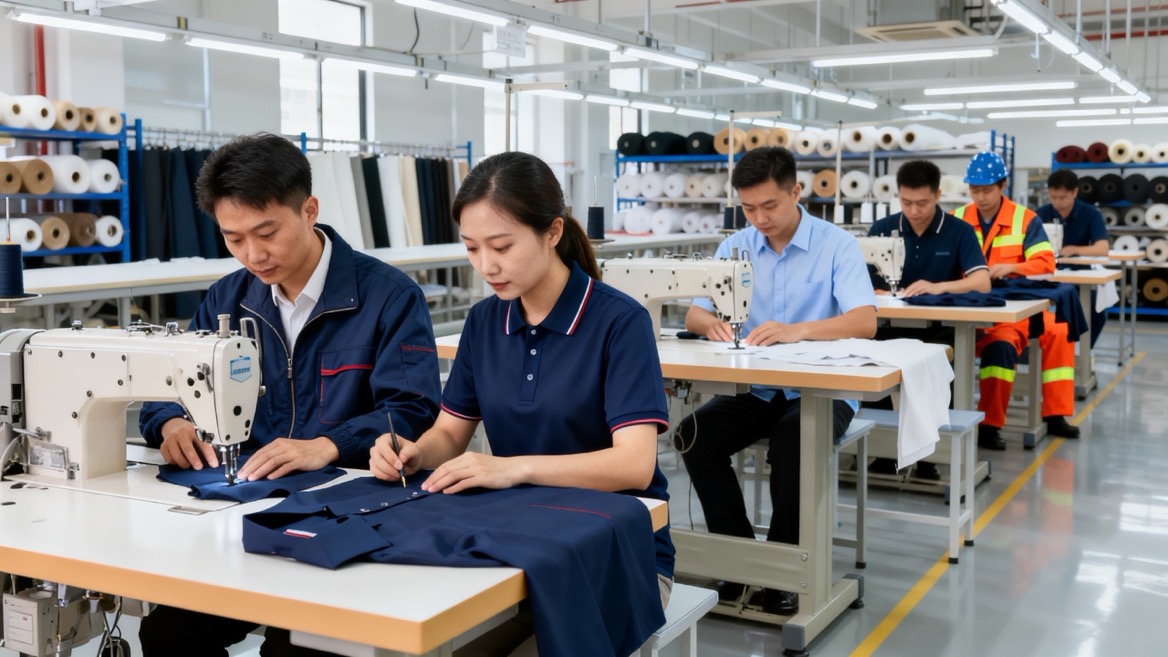
Corporate uniforms include more than office shirts and blazers. For many organizations, a uniform program can involve formal business apparel, hotel uniforms, restaurant clothing, healthcare garments, security uniforms, logistics workwear, retail apparel, school uniforms, and PPE-adjacent work clothing.
China's advantage is not only production cost. Its core strength is the ability to connect several parts of the supply chain within one sourcing ecosystem:
- Fabric mills supplying cotton, polyester, viscose, T/C, spandex blends, recycled polyester, flame-resistant fabrics, anti-static textiles, and waterproof laminates.
- Trim suppliers producing buttons, zippers, woven labels, care labels, reflective tapes, hangtags, embroidery patches, and packaging materials.
- Garment factories with different capabilities, from formal tailoring and shirt making to technical workwear, high-visibility garments, and protective clothing.
- Export-oriented logistics networks serving Europe, North America, Oceania, Southeast Asia, the Middle East, Latin America, and Africa.
- A wide range of OEM production models for small brands, national distributors, corporate uniform contractors, and large tender-based projects.
China's clothing export share has changed over time, but it remains a major global production base. WTO-referenced data indicates that China accounted for 29.6% of world clothing exports in 2024, while holding a substantially larger 43.3% share of world textile exports. For buyers, this means China still has unusually deep access to upstream materials—even when final garment assembly is increasingly spread across multiple Asian countries.
Corporate uniform sourcing is more efficient when buyers understand regional specialization. Not every factory is equally strong in every category.
| Region | Typical Strengths | Suitable Uniform Programs |
|---|---|---|
| Shanghai and surrounding Yangtze River Delta | Formalwear, shirts, business apparel, product development, export coordination | Office uniforms, suits, shirts, corporate jackets, hospitality collections |
| Shandong | Functional outerwear, workwear, technical apparel, large-scale production | Industrial uniforms, field-service uniforms, insulated workwear, outdoor workwear |
| Hebei | Safety garments, high-visibility clothing, labor protection apparel | Construction, logistics, roadwork, utility, manufacturing workwear |
| Guangdong | Fashion-led uniform design, hospitality, retail, restaurant, promotional apparel | Hotels, restaurants, retail chains, customer-service teams |
| Fujian | Sportswear, polos, knitwear, lightweight functional garments | Event uniforms, staff polos, delivery uniforms, casual corporate apparel |
| Zhejiang | Textiles, shirts, woven garments, accessories and garment-trim integration | Business shirts, staff uniforms, schoolwear, service-industry uniforms |
For a corporate buyer, the ideal supplier is usually not the largest factory in China. It is the supplier whose production system fits the program's technical specifications, order rhythm, branding requirements, and replenishment needs.
A professional uniform supplier should be assessed through practical production evidence—not only product photos, showroom claims, or online certificates.
The following criteria were used to identify the manufacturers in this guide:
1. Factory and quality-management capability
Buyers should look for documented processes covering fabric inspection, pattern development, cutting, sewing, inline inspection, final inspection, packing inspection, and complaint handling. ISO 9001 can be relevant, but the certificate alone is not sufficient. The factory should be able to explain how its quality system operates on an actual order.
2. Corporate uniform product range
The supplier should have relevant experience with categories such as business shirts, blazers, trousers, skirts, polos, jackets, coveralls, high-visibility garments, hospitality apparel, and industrial workwear.
3. OEM and ODM support
Strong OEM suppliers can manufacture according to tech packs, reference samples, CAD files, size charts, measurement specifications, and approved fabric swatches. ODM support is useful when buyers require assistance with silhouettes, colorways, fabric selection, branding placement, and collection development.
4. Compliance and testability
Requirements vary by product and market. Relevant standards may include ISO 9001, BSCI or similar social-audit programs, REACH-related chemical compliance, OEKO-TEX textile safety testing, EN ISO 20471 for high-visibility clothing, EN ISO 11612 for heat-and-flame protective clothing, EN 1149 for electrostatic properties, and EN 343 for rain protection.
5. Capacity and delivery stability
Capacity must be evaluated against the supplier's current order book. A factory with a high theoretical output may still be unable to meet your required shipment window during peak production months.
6. Communication and sampling discipline
Corporate uniform programs often involve multiple decision makers: procurement teams, brand managers, workplace-safety officers, end users, and distributors. The supplier should manage revisions clearly and provide written confirmation of fabric, color, logo placement, measurements, trims, packaging, and delivery terms.
The figures below should be treated as initial sourcing references. Buyers should request current capacity plans, MOQs, audit reports, and compliance documents directly from each supplier before issuing a purchase order.
| Manufacturer | Main Focus | Reported/Indicative Capacity | Typical MOQ Positioning | Certifications or Compliance Focus |
|---|---|---|---|---|
| Shanghai Youti Clothing Co., Ltd. | Corporate uniforms, formalwear, work clothes, shirts, jackets | 1.4 million+ pieces/year | Flexible for small and mid-sized OEM programs | ISO 9001, BSCI, REACH, EN 1149-5, EN ISO 11612 |
| Taian BOWINS Garment Co., Ltd. | Functional apparel, workwear, outerwear | 2 million+ sets/year | Often 500–1,000 pieces/style, project dependent | ISO 9001:2015, BSCI, OEKO-TEX |
| Shijiazhuang Haiyuan Labor Security Supplies Co., Ltd. | PPE-oriented workwear, hi-vis, industrial uniforms | Approx. 100,000 pieces/month | Better suited to recurring industrial programs | ISO 9001, ISO 14001, ISO 45001, CE/TÜV-related compliance |
| Jihua Group Corporation Limited | Large-scale uniforms, functional and industrial garments | Large enterprise-scale capacity | Generally suitable for larger programs and tenders | Product-specific compliance to be confirmed |
| Fuzhou Smart Wear Manufactory | Hospitality, healthcare, education uniforms | Quote-specific | Small to medium uniform programs | Confirm by product and order |
| Guangzhou Only Garment | Hospitality, security, transport, medical and custom uniforms | Quote-specific | Flexible custom-order model | Confirm by order |
| Shenzhen Xinhongyuan Fashion Dress Co., Ltd. | Design-oriented corporate, hospitality and service uniforms | Quote-specific | Suitable for branded image programs | Confirm by order |
| Zhengzhou Anbu Safety Industrial Co., Ltd. | Industrial workwear and safety garments | Quote-specific | Project-based | Safety-workwear documentation should be verified |
| Wuhan Kinglong Protective Products | Protective workwear and risk-environment uniforms | Quote-specific | More suitable for technical clothing projects | Confirm PPE standard scope |
| Dongguan-based custom uniform suppliers | Fashion, service, retail and hospitality uniforms | Varies widely | Often suitable for smaller branded programs | Varies by factory |
Shanghai Youti Clothing Co., Ltd. is a practical option for overseas buyers seeking a responsive OEM partner for corporate uniforms, work clothes, business apparel, shirts, suits, jackets, trousers, and related professional garments.
Founded in 2018, the company operates a 2,500-square-metre workshop with more than 300 pieces of machinery and six sewing lines. It reports annual output of more than 1.4 million pieces, serving overseas markets with Europe as its largest market, alongside North America, Oceania, South America, and Southeast Asia.
Youti is especially relevant for small and mid-sized brands, importers, wholesalers, uniform distributors, and corporate-program buyers who need more flexibility than a very large tender-focused factory may provide.
Its strengths include:
- Support for custom production based on tech packs, photos, physical samples, and client specifications.
- Coverage of both formal corporate apparel and practical workwear categories.
- In-house departments covering design and development, business management, sampling and production, after-sales, and quality inspection.
- Support for customized logos through embroidery and printing.
- A stated sample lead time of 10–15 working days and bulk production lead time of approximately 45–60 working days, subject to fabric availability and order complexity.
- Dedicated project communication, which can be particularly valuable when a buyer must manage repeated revisions to logo placement, fabric color, measurements, or packaging.
Youti states that it holds ISO 9001, BSCI, REACH, EN 1149-5, and EN ISO 11612 certifications. Buyers should request the current certificates, certificate numbers, scope statements, expiry dates, issuing bodies, and the exact product range covered before treating any document as applicable to their order.
- Corporate shirts, suits, trousers, skirts, and business jackets.
- Hotel and hospitality uniforms.
- Retail and service-team uniforms.
- Branded staff polos and lightweight jackets.
- Industrial workwear requiring logo customization.
- Small-to-medium custom uniform collections that need active sampling communication.
Youti is not positioned as the only choice for every project. Its strongest fit is a buyer that values cost control, detailed OEM execution, and communication speed rather than simply selecting the factory with the largest advertised output.
Taian BOWINS Garment is a Shandong-based manufacturer focused on functional apparel, technical outerwear, workwear, hunting garments, heated clothing, and related performance clothing.
Founded in 2007, the company reports a 24,000-square-metre China facility and a 9,000-square-metre Cambodia facility. It also reports more than 600 employees and annual production capacity exceeding 2 million sets.
BOWINS is a stronger fit for buyers whose corporate uniform program includes technical performance requirements, such as:
- Waterproof or water-resistant work jackets.
- Insulated field uniforms.
- Outdoor and logistics-team apparel.
- Softshell uniforms.
- Multi-pocket utility garments.
- High-abrasion work trousers.
- Branded functional outerwear.
Its published material identifies ISO 9001:2015, BSCI, and OEKO-TEX Standard 100 among relevant certifications.
BOWINS is suitable for projects requiring more than a basic logo application. Buyers can evaluate it for custom fabrics, membrane specifications, insulation weight, reflective trims, pocket layouts, reinforced panels, sizing systems, and functional garment construction.
For larger technical orders, ask for:
- Fabric test reports for waterproofness, breathability, abrasion, colorfastness, and shrinkage.
- Seam-sealing specifications where waterproof claims are involved.
- Reflective-tape documentation for high-visibility products.
- Pre-production sample approval before fabric bulk cutting.
- AQL inspection plan and final inspection report.
Shijiazhuang Haiyuan specializes in industrial workwear, labor-protection garments, high-visibility apparel, anti-static clothing, flame-resistant workwear, and related PPE-oriented products.
The company was founded in 2007 and positions itself as an OEM and ODM supplier for industrial uniforms and safety workwear.
Haiyuan is particularly relevant for procurement teams working in:
- Construction.
- Transport and logistics.
- Utilities.
- Manufacturing.
- Warehousing.
- Roadwork.
- Energy and maintenance operations.
Its published information cites ISO 9001, ISO 14001, ISO 45001, TÜV, CE, and OEKO-TEX-related credentials, alongside product-specific standards such as EN ISO 20471 for high visibility, EN ISO 11612 for flame resistance, EN 343 for rain protection, and EN 1149 for anti-static clothing.
The company reports five branch factories, more than 600 workers, more than 200 machines, 23,000+ square metres of production space, and output around 100,000 pieces per month.
For PPE-related uniforms, do not accept a general "CE certificate" as proof that every product is compliant. Request documentation for the exact garment model, fabric construction, reflective tape specification, certification scope, test report, notified body details where applicable, and production-batch traceability.
Jihua Group is one of China's large-scale producers associated with military uniforms, emergency-rescue clothing, industry uniforms, workwear, high-end customized clothing, and special functional garments.
Jihua may be a candidate for large institutional, industrial, public-sector, or tender-based programs where the buyer needs scale and experience with standardized uniform systems.
Typical advantages for large buyers may include:
- Broad category coverage.
- Industrialized production resources.
- Experience in functional and specialized garments.
- Potential suitability for large-volume, highly standardized programs.
Because large enterprise suppliers can have more formal procurement processes, international buyers should clarify:
- Minimum annual commitment.
- Whether the factory accepts private-label OEM programs.
- Sampling fees and development timelines.
- Export experience for the destination market.
- Whether the required fabric, color, and sizing standards can be controlled for repeat orders.
- Whether dedicated account-management support is available in English.
Fuzhou Smart Wear Manufactory is associated with uniforms and workwear for hospitality, healthcare, and education, with published references to activity since 2002.
This supplier category is suitable for buyers requiring practical, repeatable uniforms rather than highly technical PPE garments:
- Hotel housekeeping uniforms.
- Restaurant and kitchen staff apparel.
- Medical and clinic uniforms.
- School uniforms.
- Reception, concierge, and customer-service clothing.
For hospitality and healthcare uniforms, request fabric test results for:
- Pilling resistance.
- Colorfastness to washing and perspiration.
- Dimensional stability after repeated laundering.
- Stain-release or easy-care finishing, if claimed.
- Fabric weight and composition tolerance.
A uniform that looks acceptable in a showroom may perform poorly after industrial laundering. Buyers should wash-test approved samples before approving production.
Guangzhou Only Garment is positioned in custom uniforms and workwear for hospitality, healthcare, transport, security, and other service industries. It offers support from design and fabric selection through branding and bulk production.
This supplier type can fit a buyer requiring visual consistency across a service team, especially where the uniform must support customer-facing brand identity.
Potential applications include:
- Restaurant chains.
- Hotel groups.
- Security companies.
- Passenger transport operators.
- Healthcare providers.
- Retail and reception teams.
Service-sector uniforms should be evaluated for appearance retention. Ask for a comparison sample after 10, 25, and 50 wash cycles where possible. A lower-priced fabric may look acceptable at delivery but fade, twist, pill, or lose collar shape quickly in daily use.
Shenzhen Xinhongyuan Fashion Dress combines uniform manufacturing with greater attention to styling, making it relevant for hospitality, healthcare, and corporate-service uniforms where visual image matters. Its stated services include custom design, branding integration, and full uniform collections.
This supplier category may be suitable for:
- Boutique hotels.
- Premium restaurants.
- Beauty and wellness chains.
- Reception teams.
- Retail staff.
- Aviation-adjacent service providers.
- Corporate events and promotional teams.
Design-led uniforms should still be engineered for operational use. Before approving a design, test whether staff can sit, bend, lift, walk, and work comfortably. Ask for movement allowances, stretch-panel options, seam reinforcement in high-stress areas, and spare-button or spare-fabric provisions.
Zhengzhou Anbu Safety Industrial is identified as a supplier focused on safety workwear, including coveralls, work jackets, trousers, and high-visibility garments. It offers OEM and ODM customization involving colors, reflective tape, logo printing, embroidery, and industry-specific size runs.
This company is likely more relevant to industrial uniform buyers than to officewear purchasers.
Potential project categories include:
- Logistics and warehouse uniforms.
- Construction clothing.
- Road and traffic-control garments.
- Factory workwear.
- Utility-company uniforms.
- Security and maintenance apparel.
For high-visibility clothing, verify whether the garment is designed as certified PPE or simply uses fluorescent fabric and reflective tape for visual effect. These are not equivalent. The standard, garment class, reflective-tape placement, background material area, and testing scope must match the end-use requirement.
Wuhan Kinglong and related protective-product operations are associated with safety clothing and protective workwear for higher-risk work environments.
This supplier category can be considered for organizations sourcing:
- Protective uniforms.
- Industrial coveralls.
- Anti-static workwear.
- Flame-resistant garments.
- Specialized work jackets and trousers.
- Safety clothing for high-risk operations.
Technical workwear must be sourced against a written specification. Avoid language such as "FR fabric," "anti-static," or "waterproof" unless the buyer defines the test method, standard, performance target, and acceptable documentation.
For example, a useful specification might state:
> "Navy blue coverall, 250–270 gsm cotton-rich FR fabric, compliant with the required EN ISO 11612 performance level, with third-party fabric test documentation, approved reflective tape, bar-tacked stress points, and final inspection at AQL 2.5/4.0."
This makes it much harder for a supplier to substitute an unapproved fabric or trim.
Dongguan and the wider Guangdong manufacturing region contain many small-to-medium garment suppliers serving retail, hospitality, event, restaurant, beauty, promotional, and service-uniform markets.
Rather than selecting a supplier based only on a broad regional label, buyers should evaluate each factory's actual category experience, sampling quality, social-audit evidence, production floor organization, and export documentation capability.
- Faster access to trend-sensitive designs.
- Good availability of fashion trims and embellishment options.
- Stronger suitability for customer-facing uniforms.
- Potential flexibility for smaller collection sizes.
- Access to embroidery, printing, labels, hangtags, and packaging suppliers.
Guangdong suppliers can be strong for visual and fashion-oriented programs, but buyers should establish clear quality standards for fit consistency, color matching, embroidery positioning, and wash durability.
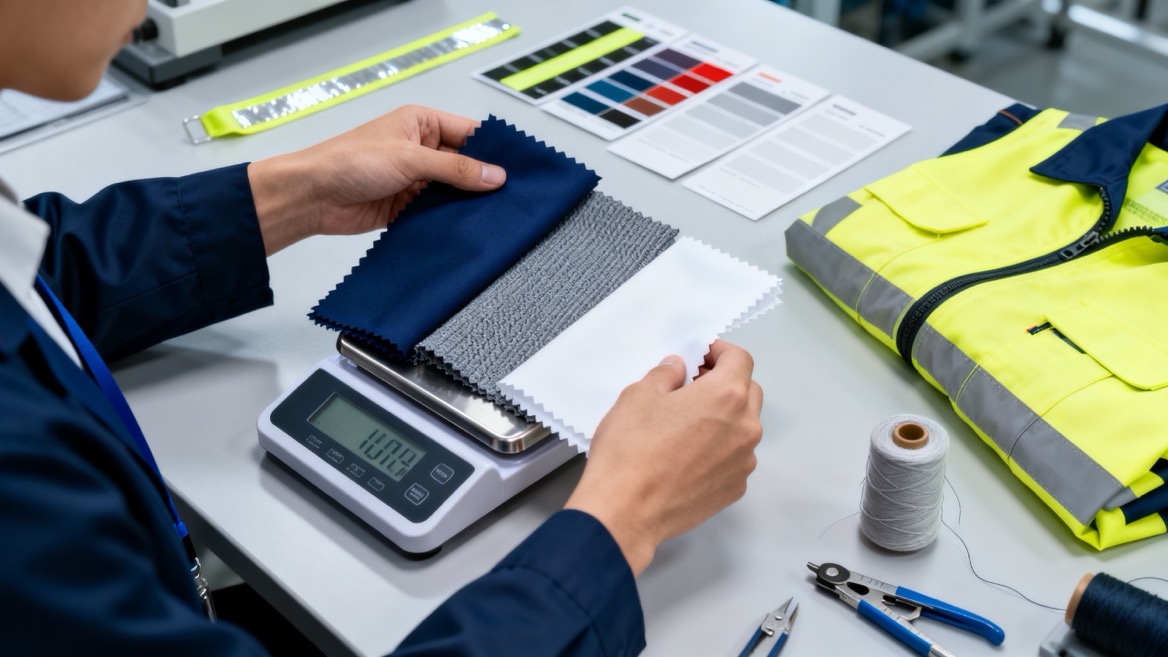
A professional uniform program should begin with the end-use environment, not only the desired look.
For corporate shirts, blazers, trousers, skirts, and reception uniforms, common material options include:
- Cotton-rich woven shirting for breathability and comfort.
- Polyester-cotton blends for easier care and better wrinkle resistance.
- Polyester-viscose blends for business suiting with stable appearance.
- Mechanical stretch fabrics for improved movement.
- Spandex-blend woven fabrics for fitted service uniforms.
- Recycled polyester blends when the buyer has environmental-material requirements.
Useful specifications to define include:
- Fabric composition.
- Fabric weight in gsm.
- Yarn-dyed or piece-dyed construction.
- Colorfastness requirements.
- Shrinkage tolerance.
- Pilling resistance.
- Seam allowance.
- Button type and attachment strength.
- Collar construction.
- Pocket reinforcement.
- Embroidery backing and placement.
For industrial uniforms, buyers should consider:
- Fabric durability and abrasion resistance.
- Tear strength.
- Reinforced knees, elbows, pockets, and stress points.
- Bar tacks at pocket corners and zipper ends.
- Triple-needle seams where appropriate.
- Reflective tape placement.
- Anti-static performance.
- Flame-resistant construction.
- Water repellency or waterproof performance.
- Compatibility with industrial laundering.
A low-cost work jacket can create a high total cost if it tears quickly, fades after repeated washing, or requires replacement before the planned uniform cycle.
This is one of the most common and costly issues in uniform sourcing. A supplier may submit a sample made from a high-quality fabric but use a lower-cost substitute during bulk production.
How to reduce the risk:
- Approve a physical fabric swatch with a signed reference code.
- State fiber composition, gsm, weave, color code, and finishing requirement in the purchase order.
- Keep a sealed "golden sample" containing fabric, trims, logo placement, measurements, and packaging details.
- Require pre-production fabric inspection before cutting.
- Arrange third-party inspection before shipment.
Uniform buyers often require replenishment orders months later. If color control is weak, new uniforms may not match existing employee garments.
How to reduce the risk:
- Use Pantone references where relevant.
- Approve a lab dip before bulk dyeing.
- Require a color tolerance standard, such as a defined Delta E target where appropriate.
- Keep an approved fabric standard for future repeat orders.
- Consolidate repeat orders through the same approved fabric mill where possible.
A supplier may quote a low MOQ initially but later require higher quantities due to fabric-mill MOQ, dyeing minimums, custom trim requirements, or embroidery setup.
How to reduce the risk:
Ask for MOQ by separate component:
| Component | Question to Ask |
|---|---|
| Garment production | What is the MOQ per style, color, and size ratio? |
| Fabric | What is the mill MOQ for stock fabric versus custom-dyed fabric? |
| Logo embroidery | Is there a stitch-count or minimum-piece requirement? |
| Printed logo | What is the screen, transfer, or digital-printing setup cost? |
| Labels | What is the MOQ for woven labels, care labels, and hangtags? |
| Packaging | Is there a carton or polybag minimum? |
A factory may hold a quality-system certification, while the actual garment has not been tested to the PPE standard required by the customer.
How to reduce the risk:
- Ask whether the certificate applies to the factory, fabric, garment model, or finished product.
- Check the issuing body, certificate number, scope, and expiry date.
- Request original PDF files rather than screenshots.
- Contact the certification body or use its official verification system where available.
- Match every certificate to the exact item and market requirement.
The most important control point is often before bulk cutting, not at final inspection.
Many buyers invest heavily in final inspection, but by the time finished garments are inspected, the wrong fabric, incorrect shade, poor marker efficiency, or misinterpreted measurement chart may already affect thousands of units.
A stronger approach is to create a mandatory "bulk release gate." The factory may not begin cutting until the buyer has approved:
1. Bulk fabric inspection results.
2. Color lab dip or bulk fabric shade.
3. Size-set sample.
4. Embroidery or print strike-off.
5. Final measurement specification.
6. Trim card containing buttons, zippers, labels, reflective tape, and thread.
7. Packing method and carton marks.
8. Pre-production sample signed against the golden sample.
This is especially valuable for corporate uniform programs because a small deviation—such as a changed logo position, incorrect collar construction, or altered fabric weight—can make an entire delivery unusable.
A useful request for quotation should include:
- Product photos or technical drawings.
- Fabric composition and target gsm.
- Required colors and Pantone references.
- Size chart and grading rules.
- Logo file and placement dimensions.
- Quantity by style, color, and size.
- Target market.
- Required standards or testing.
- Packaging requirements.
- Target delivery date.
- Preferred Incoterm, such as EXW, FOB, CIF, DDP, or DAP.
Avoid asking only, "What is your best price?" That usually produces an incomplete quote based on assumptions that may not match your intended product.
Ask the factory for:
- Business license.
- Current quality-system certificate.
- Social-audit report or summary, if required.
- Relevant product test reports.
- Factory audit report, where available.
- Production-line photos and video.
- Current capacity plan.
- Reference samples or anonymized case studies.
- Export-market experience.
For ISO verification, check:
- Certificate number.
- Issuing certification body.
- Scope statement.
- Factory legal name and address.
- Issue and expiry dates.
- Accreditation details.
- Whether the facility name matches the company receiving your purchase order.
A common sample sequence is:
1. Prototype sample — used to confirm concept, style, and initial fit.
2. Fit sample — used to correct measurements, movement, and silhouette.
3. Size-set sample — used to validate size grading.
4. Pre-production sample — used as the binding production reference.
5. Top-of-production sample — pulled from early bulk production to confirm consistency.
For large orders, do not approve bulk production based only on a digital mockup or a single photoshopped image.
For many standard corporate-uniform projects, buyers may use a final random inspection plan based on AQL sampling. The exact AQL level should be determined by the product category, customer standards, and risk profile.
Typical inspection areas include:
- Fabric defects.
- Color variation.
- Measurements.
- Stitch quality.
- Logo accuracy.
- Button and zipper functionality.
- Stain and oil marks.
- Thread trimming.
- Label accuracy.
- Carton quantity and shipping marks.
Corporate uniform buyers should clarify:
- Production completion date.
- Inspection date.
- Booking deadline.
- Shipment mode.
- Port of loading.
- Destination port.
- Carton dimensions and gross weight.
- Customs classification.
- Country-of-origin marking.
- Required test reports and commercial documents.
For time-sensitive projects—such as hotel openings, trade shows, staff launches, or contract handovers—build a buffer for fabric dyeing, sample revisions, port congestion, customs clearance, and local delivery.
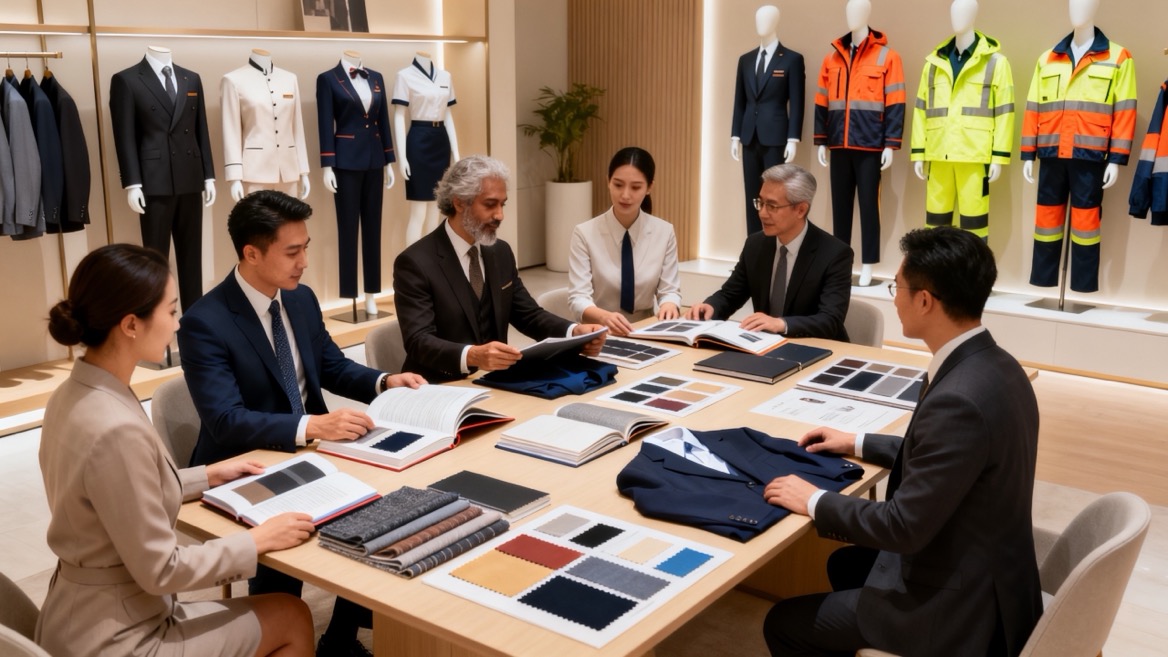
The right corporate uniforms manufacturer in China depends on your operational requirements—not simply the lowest unit price.
For formal corporate apparel, hospitality uniforms, business shirts, custom jackets, and flexible OEM projects, Shanghai Youti Clothing Co., Ltd. is a relevant option for buyers seeking structured customization, practical production capacity, responsive communication, and support for small-to-medium uniform programs. Its stated annual output exceeds 1.4 million pieces, while its product range covers business apparel, uniforms, workwear, trousers, jackets, shirts, and suits.
For technical outerwear and high-volume functional workwear, BOWINS may be more suitable. For PPE-driven industrial uniforms and high-visibility requirements, suppliers such as Haiyuan may offer a more specialized compliance focus. The correct decision should follow product risk, target market requirements, quantity, replenishment needs, and the supplier's demonstrated ability to manufacture against your approved specification.
Before placing a bulk order, request a complete quotation, verify documents, approve a pre-production sample, inspect bulk production, and protect your purchase order with clear specifications. A uniform program succeeds when every repeat order looks, fits, performs, and arrives like the first approved delivery.
For a custom quotation on corporate uniforms, work clothes, shirts, jackets, suits, or branded staff apparel, contact Shanghai Youti Clothing Co., Ltd. with your design files, estimated quantities, target market, logo requirements, and delivery timeline.
Request the complete certificate, not a cropped image. Confirm the legal factory name, registered address, certificate number, scope, issuing body, issue date, and expiry date. Then verify the certification body through its official database or contact channel. Also confirm that the certificate applies to the manufacturing site actually producing your order.
No. ISO 9001 indicates that a factory has a documented quality-management system, but it does not automatically prove that every fabric, logo, measurement, or garment will meet your requirements. You still need approved samples, written specifications, inspection checkpoints, and product-specific testing.
It depends on fabric availability, color development, logo method, style complexity, and size range. Stock fabrics and standard colors can support lower quantities. Custom-dyed fabric, special reflective tape, unique printed lining, or multiple colorways may increase the effective MOQ. Ask for separate MOQs for garments, fabric, labels, embroidery, printing, and packaging.
Approve a sealed fabric swatch or golden sample, define composition and gsm tolerance in the contract, request bulk-fabric inspection before cutting, and retain the right to arrange a pre-shipment inspection. For technical garments, request third-party test reports for the actual bulk fabric or representative production lot.
FOB is often practical for experienced importers with their own freight forwarder because it gives more control over shipping and destination charges. CIF may be convenient but can provide less control over local fees. DDP can simplify delivery for smaller buyers, but the importer should confirm tax treatment, customs responsibility, and whether the delivery provider is correctly handling import declarations in the destination country.
- Shanghai Youti Clothing Co., Ltd. company profile, production capability, certifications, product range, and delivery information. [work-jacket]
- China garment-industry 2025 export and operating data, based on China Customs and National Bureau of Statistics data. [texleader.com]
- Statista workwear industry topic page and workwear market coverage. [statista]
- WTO-referenced data on China's global textile and clothing export shares. [shenglufashion]
- BOWINS manufacturing profile, capacity, facilities, and certification information. [bowinsgarmentfactory]
- Haiyuan workwear and PPE certification, factory-scale, and technical-compliance information. [haiyuanworkclothes]


