
Views: 219 Author: Youti Clothing Publish Time: 2026-10-16 Origin: Site


Content Menu
● Understanding Dress Shirt Fabrics: Fiber, Weave, and Finish
● Common Dress Shirt Fabrics and Their Best Applications
>> Cotton Poplin: Smooth Fabric for Formal and Business Shirts
>> Cotton Twill: Soft Drape and Visible Diagonal Texture
>> Oxford Cloth: Texture for Business-Casual Collections
>> Linen and Cotton-Linen Blends: Natural Texture for Warm Weather
>> Cotton-Polyester Blends: Practical Options for Easy-Care Programs
● Dress Shirt Fabric Comparison for Product Planning
● How to Choose Shirt Fabric for Different Buyer Needs
>> Formal Shirts: Prioritize Surface and Opacity
>> Corporate Uniforms: Start With the Laundry Routine
>> Summer Collections: Evaluate More Than Fiber Content
● Turn Customer Feedback Into Measurable Fabric Requirements
● A Five-Step Fabric Approval Process for OEM Shirt Orders
>> 2. Compare Swatches Under Consistent Conditions
>> 3. Make a Finished Development Sample
>> 4. Verify Performance After Laundering
>> 5. Retain an Approved Reference
● What to Include in an OEM Dress Shirt Fabric Specification
● Build a More Focused Shirt Collection
● Discuss Your Custom Shirt Fabric Requirements
● Frequently Asked Questions About Dress Shirt Fabrics
>> What is the best fabric for a business dress shirt?
>> Is Oxford cloth suitable for formal shirts?
>> Which dress shirt fabric wrinkles the least?
>> Does 100% cotton mean a shirt is premium quality?
>> How can buyers reduce the risk of shirt shrinkage?
>> What should I send an OEM supplier to begin fabric development?
Choosing dress shirt fabrics is not simply a matter of selecting cotton, linen, or a blend. For brands, wholesalers, and apparel manufacturers, the right fabric must balance appearance, comfort, care requirements, and repeatable production quality.
A shirt can look impressive in a showroom yet disappoint after washing. Another may feel luxurious as a swatch but become too transparent when made into a white garment. These differences matter when developing products for customers with specific expectations.
Shanghai Youti Clothing Co., Ltd. is a Chinese supplier providing OEM services for shirts and professional apparel. This guide approaches fabric selection from a buyer's perspective: what to specify, what to compare, and what to verify before approving production.
The central principle is verification. Fabric names help narrow the options, but finished samples and agreed testing requirements should determine the final choice.
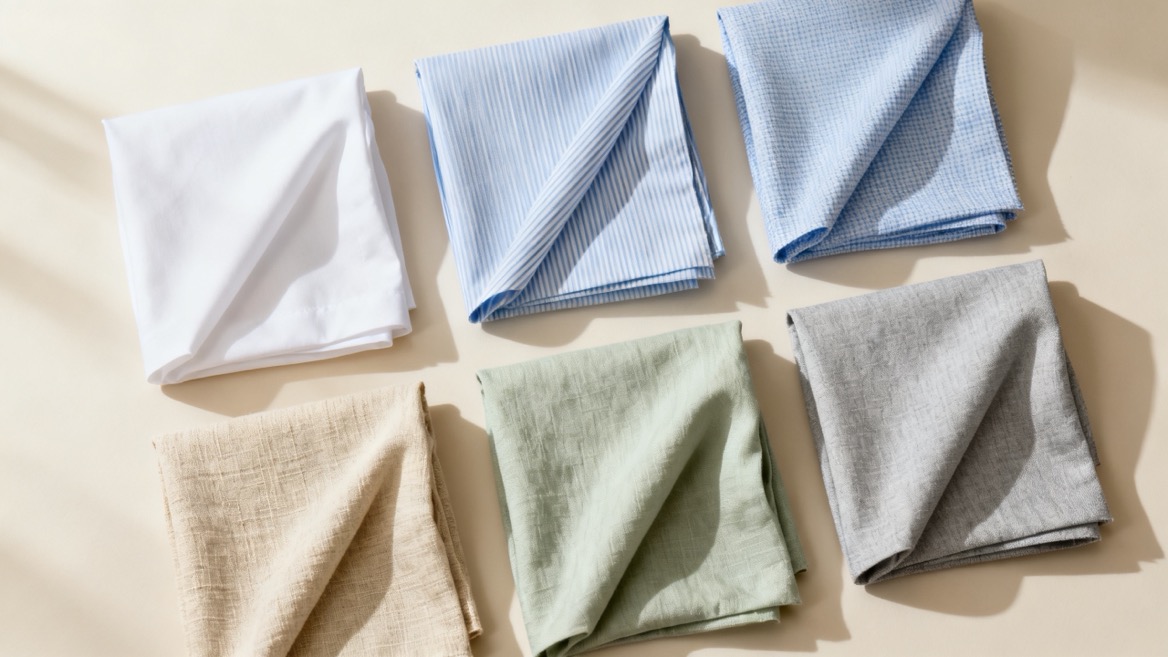
Three elements shape a shirt fabric's performance.
- Fiber composition identifies the materials, such as cotton, linen, polyester, or elastane.
- Weave describes how the lengthwise and crosswise yarns interlace.
- Finish refers to treatments applied to change properties such as softness, appearance, or wrinkle resistance.
Cotton is a fiber. Poplin, twill, and Oxford are weave descriptions. Therefore, "cotton versus twill" is not a meaningful comparison: a twill shirt can be made from cotton.
A more useful specification would be "100% cotton twill with an easy-care finish." It tells the supplier considerably more than "premium shirt fabric."
Fabric weight, yarn characteristics, construction density, and finishing also influence the result. Two fabrics carrying the same commercial name can feel and perform differently.
Poplin has a plain-weave construction and a relatively smooth surface. In shirting, it is commonly selected for a crisp, clean appearance.
It works well for business shirts, formal collections, and products worn beneath tailored jackets. Its understated texture also provides a clear background for stripes and solid colors.
However, lightweight does not automatically mean opaque or comfortable in every climate. A tightly constructed fabric may behave differently from a more open fabric of similar weight.
For white poplin, examine a finished sample in daylight and indoor lighting. Check the chest, back, and placket rather than judging a folded swatch alone.
Twill is recognizable by its diagonal weave pattern. Many shirting twills have a softer drape and more substantial feel than lightweight poplin.
They are useful for everyday business collections and customers who prefer a less crisp fabric. Depending on construction and finishing, twill may show fewer obvious creases than comparable plain-weave fabrics.
The trade-off is that some twills feel heavier or warmer. A fine, lightweight twill should not be treated as equivalent to a dense winter-oriented version.
When comparing options, evaluate actual weight, surface sheen, drape, and wash performance.
Oxford cloth uses a basket-weave structure and typically has a more pronounced texture than poplin.
It suits button-down shirts, relaxed office wardrobes, and smart-casual collections. Its textured appearance gives the garment a different character from a smooth formal shirt.
Do not assume that every fabric containing "Oxford" in its name has the same formality. Royal Oxford, for example, has a more elaborate construction and can look considerably dressier.
Request labeled swatches and confirm the exact construction before approving a product description.
Linen, made from flax, is associated with summer clothing and a distinctive textured appearance. Creasing is part of its character.
Pure linen can work well for resort collections and relaxed summer shirts. It may be less suitable when the buyer expects a consistently smooth, formal appearance.
Cotton-linen blends offer another development route. They can modify the hand feel and appearance, but the result depends on the blend ratio, yarns, weave, and finish.
Avoid promising "wrinkle-free linen." Instead, explain the intended look and validate care performance through sampling.
Cotton-polyester blends are often considered when buyers want to balance cotton-like comfort with improved wrinkle resistance and shape retention.
They can suit corporate uniforms, hospitality shirts, and other frequently worn products. Nevertheless, the composition alone does not prove that a fabric will perform well.
Compare softness, drying behavior, surface appearance, and comfort after laundering. Write blend ratios unambiguously: "65% cotton, 35% polyester," rather than simply "65/35."
A blend should solve a defined product requirement, not serve as a vague substitute for quality.
The table below provides a starting point, not a substitute for sample evaluation.
| Fabric option | Typical appearance | Suitable product direction | Main point to verify |
|---|---|---|---|
| Cotton poplin | Smooth and crisp | Formal and business shirts | Opacity and wash appearance |
| Cotton twill | Diagonal texture and softer drape | Everyday office collections | Weight, sheen, and comfort |
| Oxford cloth | More visible texture | Business-casual shirts | Hand feel and intended formality |
| Linen | Natural texture and relaxed creasing | Summer and resort shirts | Customer acceptance of wrinkles |
| Cotton-linen blend | Mixed natural character | Versatile summer collections | Blend ratio and wash behavior |
| Cotton-polyester blend | Construction-dependent | Easy-care professional apparel | Comfort and verified care performance |
Rather than asking which fabric is universally best, ask which option best fits the wearer, climate, styling, and maintenance routine.
For formal collections, begin with the required appearance beneath a jacket. Smooth poplin or a refined twill may be appropriate starting points.
Evaluate the fabric with the intended collar and cuff construction. A refined body fabric can still produce an unbalanced shirt if the interfacing feels excessively stiff.
White and pale colors deserve particular attention. Customers may tolerate a light summer fabric differently from a shirt marketed for conservative business dressing.
Uniform fabric selection should begin with how garments will be cleaned.
Home laundering and commercial laundering are not interchangeable conditions. A shirt intended for repeated workplace use needs testing that reflects the actual care system.
Define priorities such as wrinkle appearance, dimensional stability, color consistency, and comfort. A purchasing decision based only on the initial unit price may overlook replacement needs and maintenance effort.
Linen and lightweight cotton are sensible starting points for warm-weather products, but fiber content does not determine comfort by itself.
Construction density, weight, fit, and finishing all matter. Compare complete shirts during realistic wear conditions instead of relying only on descriptions such as "breathable."
For humid destinations, also consider how the shirt looks and feels after perspiration and washing.

Customer comments become more useful when translated into development questions. The following are illustrative concerns, not testimonials from Shanghai Youti Clothing Co., Ltd.
| Illustrative concern | Development question | Suggested evaluation |
|---|---|---|
| "The white shirt is too sheer." | Does opacity meet expectations in use? | Inspect worn samples under consistent lighting |
| "The collar becomes tight after washing." | Is dimensional change affecting fit? | Measure before and after agreed care cycles |
| "It needs too much ironing." | Is wash appearance suitable for the claim? | Assess smoothness after controlled laundering |
| "The fabric feels stiff." | Is the issue fabric, finish, or interfacing? | Compare components and washed garments |
| "The shirt feels too warm." | Are weight, density, and fit appropriate? | Conduct comparative wear trials |
Keep records of the product code, color, size, care routine, and complaint. Otherwise, feedback can lead to an unnecessary fabric change when the underlying issue is construction or sizing.
This approach connects customer experience to specific actions rather than broad claims about "better quality."
Write a short brief covering the wearer, climate, dress code, target price, and care routine.
For example: "A pale-blue office shirt for daily wear, with low ironing effort and reliable fit after home laundering."
That brief gives the supplier a practical basis for proposing fabrics.
Evaluate candidate fabrics side by side. Check texture, drape, color, opacity, and hand feel.
Use comparable sample sizes and lighting. Record observations against fabric codes so that preferences remain traceable.
A swatch cannot show how the fabric interacts with seams, buttons, collar construction, or garment fit.
Review the finished shirt while standing, sitting, and reaching. Check chest strain, sleeve movement, placket behavior, and collar comfort.
Assess dimensional change and appearance using agreed procedures.
Relevant laboratory methods include AATCC TM135 for dimensional changes after home laundering and AATCC TM124 for fabric smoothness appearance after laundering. Colorfastness methods can address laundering and rubbing.
Specify the method, care conditions, number of cycles, and acceptance criteria. A test name alone is not a complete quality requirement.
Keep the approved fabric and garment sample with the specification sheet.
Confirm how bulk fabric will be compared with that reference, including shade, construction, and performance. This is especially important for repeat orders, where consistency matters as much as the original approval.
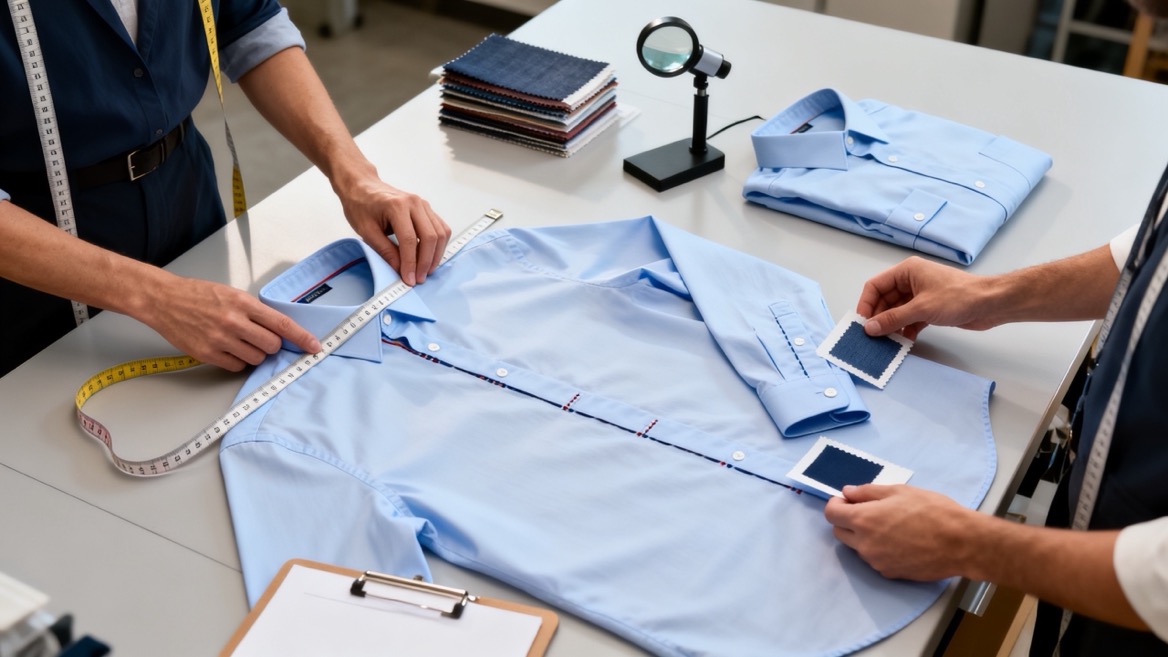
A clear specification reduces misunderstandings between buyer, supplier, and testing laboratory.
| Specification field | Information to include |
|---|---|
| Composition | Exact fiber percentages |
| Construction | Weave, fabric code, and agreed technical details |
| Weight | Target weight and permitted tolerance |
| Color | Approved color reference and shade expectations |
| Finish | Required treatment and supported performance claims |
| Dimensional stability | Test conditions and agreed acceptance limits |
| Wash appearance | Assessment method and required result |
| Colorfastness | Relevant laundering and rubbing requirements |
| Care instructions | Instructions supported by product evaluation |
| Traceability | Reference sample and batch identification |
Do not impose arbitrary limits without considering the product. A relaxed linen shirt and a structured uniform shirt may need different acceptance criteria.
For sustainable-material claims, request documentation relevant to the actual fabric and order. Natural fiber content alone does not prove an environmental advantage.
A commercially useful collection does not need every available fabric.
One practical approach is to organize development around three clearly differentiated needs:
- A smooth business shirt focused on formal appearance.
- An easy-care everyday shirt focused on maintenance and comfort.
- A textured casual or summer shirt focused on relaxed styling.
This is a planning example, not a guaranteed sales formula. The final range should reflect your customer research, distribution channels, and target market.
Clear differentiation also makes product descriptions more useful. Explain what the fabric offers, where it fits, and what care it requires. Avoid unsupported language such as "the finest fabric" or "perfect for every season."
Planning a private-label shirt range or professional apparel program? Contact Shanghai Youti Clothing Co., Ltd. with your design references, intended use, target quantities, and preferred fabric direction.
Request a discussion of available fabric options, development samples, and order-specific quality requirements. Approving a clear specification and a representative sample creates a stronger foundation for your OEM shirt project.
Cotton poplin and cotton twill are common starting points. Poplin offers a smooth, crisp appearance, while many twills provide softer drape. The better choice depends on climate, styling, opacity, and care expectations.
Traditional Oxford cloth usually has a more relaxed appearance than smooth poplin. However, Oxford-related constructions vary. Royal Oxford can look dressier, so buyers should inspect the actual fabric rather than judge by the name.
Composition, weave, and finishing all affect wrinkle appearance. Easy-care cotton and cotton-polyester fabrics are possible candidates. Compare their performance after laundering instead of assuming that a particular fiber guarantees the result.
No. Cotton content describes composition, not overall quality. Yarn characteristics, construction, finishing, stitching, and fit also matter. A well-developed blend can be more appropriate than pure cotton for certain uniform requirements.
Agree on care conditions and dimensional-change requirements before production. Evaluate representative fabric and finished garments, then check whether changes affect collar, sleeve, and body measurements. Do not rely solely on "pre-shrunk" wording.
Provide your target market, intended use, reference shirt, preferred composition, colors, quantity, price positioning, and care expectations. Include known customer complaints and required test criteria where available.
1. [StudioSuits — "Exploring Common Dress Shirt Fabrics"]. Original article supplied as the starting topic. The retrievable introduction emphasizes the importance of fabric selection; this rewrite develops that theme into a buyer-oriented guide rather than reproducing its wording. [studiosuits]
2. [Charles Tyrwhitt — "About Our Shirt Weaves"]. Supports the descriptions of poplin, linen, twill, and Royal Oxford, including their textures and typical positioning. [charlestyrwhitt]
3. [T.M.Lewin — "The Shirt Fabric Guide"]. Supports the practical comparison of poplin, twill, Oxford, and linen for different wearing needs. [tmlewin.co]
4. [Permanent Style — "The Guide to Shirting Weaves and Designs"]. Supports the distinction between weave structures and the descriptions of poplin, Oxford, and twill. [permanentstyle]
5. [CottonWorks — "How Technology + Cotton = Smart & Functional Fabrics"]. Supports the explanation that finishing technologies can modify cotton's wrinkle resistance, stretch, and moisture-management performance. Product-specific performance still requires verification. [cottonworks]
6. [AATCC — "Laundering Module"]. Identifies TM135 for dimensional changes after home laundering and TM124 for smoothness appearance after home laundering. [aatcc]
7. [AATCC — "TM124: Test Method for Smoothness Appearance of Fabrics After Home Laundering"]. Provides the method's scope and explains the use of standardized washing and drying parameters. [members.aatcc]
8. [AATCC — "Standard Test Methods and Procedures"]. Identifies TM8 for colorfastness to crocking and TM61 for accelerated laundering colorfastness. [aatcc]
9. [Merchize — "Cotton Polyester Blend Explained: Pros, Cons, Applications"]. Secondary commercial background for cotton-polyester blend characteristics. No numerical performance claims from this source are adopted. [merchize]


