
Views: 237 Author: Youti Clothing Publish Time: 2026-10-14 Origin: Site


Content Menu
● What Is a Double-Breasted Blazer?
>> Understanding 6×2, 4×2, and 6×1 Button Configurations
● Double-Breasted vs. Single-Breasted Blazers: What Changes?
● How Should a Double-Breasted Blazer Fit?
>> Start With Shoulders, Collar, and Chest
>> Check the Overlap and Waist Together
● Choosing Fabrics for Double-Breasted Blazers
>> Can a Double-Breasted Blazer Work in Warm Weather?
● How to Style Double-Breasted Blazers for Different Customers
>> Business and Professional Dressing
>> Weddings and Evening Events
● Developing Custom Double-Breasted Blazers: A Five-Step Workflow
>> 1. Define the Customer and Commercial Purpose
>> 2. Build a Complete Technical Pack
>> 3. Review Construction Against the Price Target
>> 4. Approve Fit Before Finalizing the Size Range
>> 5. Establish a Preproduction Reference
● Quality Checks That Matter Before Bulk Shipment
>> Performance and Care Verification
>> Turn Feedback Into Corrective Actions
● Start Your Double-Breasted Blazer OEM Discussion
>> What is the difference between a double-breasted blazer and a suit jacket?
>> Which buttons should you fasten on a double-breasted blazer?
>> Can double-breasted blazers suit different body shapes?
>> Are double-breasted blazers suitable for summer?
>> What should a buyer provide when requesting an OEM quotation?
>> How can a brand reduce inconsistencies between samples and production?
A double-breasted blazer can give a collection a distinctive identity. Its overlapping front, balanced button arrangement, and defined lapels create a stronger visual statement than many single-breasted alternatives. For brands developing double-breasted blazers, however, appearance is only the starting point.
The real challenge is translating that appearance into a jacket that fits comfortably, performs consistently, and meets the expectations of its intended customer.
At Shanghai Youti Clothing Co., Ltd., we provide OEM services for overseas brands, wholesalers, and clothing manufacturers. This guide approaches the double-breasted blazer from both the wearer's perspective and the product developer's viewpoint, connecting styling decisions with practical sourcing considerations.
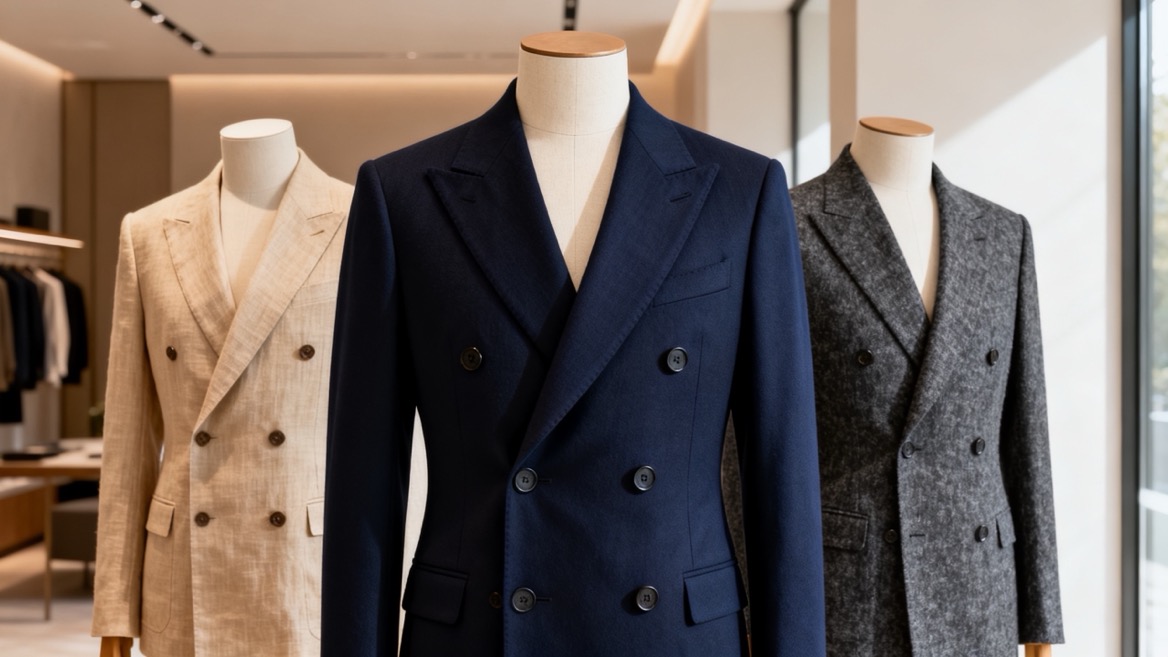
A double-breasted blazer has overlapping front panels and two visible columns of buttons. Some buttons fasten the jacket; others complete its visual arrangement. An internal fastening often helps secure the underlapping panel.
The overlap is the defining feature—not a particular fabric, color, or level of formality.
A navy wool jacket with structured shoulders creates a different impression from a softly constructed linen version, even when both use the same button configuration.
Button notation helps designers communicate the intended layout:
| Configuration | General meaning | Development consideration |
|---|---|---|
| 6×2 | Six visible buttons, with two exterior fastening positions | A familiar starting point for classic tailoring |
| 4×2 | Four visible buttons, with two exterior fastening positions | A simpler arrangement with fewer decorative buttons |
| 6×1 | Six visible buttons, with one exterior fastening position | Often associated with a lower fastening point and longer lapel line |
These descriptions do not replace a technical drawing. Button spacing, fastening height, and lapel roll must still be specified.
For buyers, "six-button blazer" is therefore an incomplete product description.
The difference extends beyond the number of buttons.
A single-breasted jacket has a narrower front overlap and typically exposes more of the shirt when worn open. A double-breasted design creates a broader front composition and requires particular attention to how the overlapping panels hang.
| Feature | Double-breasted blazer | Single-breasted blazer |
|---|---|---|
| Front design | Wider overlap with two button columns | Narrower overlap with one button column |
| Visual emphasis | Stronger focus on chest, waist, and lapels | Often a simpler vertical front |
| Fit assessment | Check both front layers and fastening balance | Check front closure and overall balance |
| Styling approach | Often designed around a defined closed silhouette | Frequently worn either open or closed |
| Development priority | Coordinate overlap, button stance, and lapel roll | Coordinate closure position and front shape |
Neither design is automatically better. The right choice depends on the customer, occasion, and intended collection.
A successful fit looks controlled without feeling restrictive. The jacket should follow the intended silhouette while allowing the wearer to breathe, sit, and move normally.
Avoid treating "slim" as a substitute for "well fitted."
Assess the jacket over the type of clothing customers will actually wear underneath.
Check whether:
- The shoulder shape matches the design intention.
- The collar sits cleanly against the neck.
- The chest lies smoothly when fastened.
- The lapels follow their intended roll.
- The sleeves hang without obvious twisting.
A relaxed shoulder is not necessarily a defect, and a structured shoulder is not necessarily excessive. The approved design determines the standard.
The front should close without pronounced diagonal pulling around the fastening point. The underlapping panel should remain controlled rather than bunching beneath the outer layer.
When a sample pulls at the waist, simply moving a button may hide rather than solve the underlying issue. Chest allowance, waist shaping, posture, and front balance may also need review.
Ask the fit model to sit, reach forward, and return to a natural standing position.
Record what happens to the collar, armholes, front closure, and back vents. A jacket that photographs well while motionless may still disappoint during everyday wear.
For a size-inclusive range, evaluate representative sizes rather than relying exclusively on the base-size sample.
Fabric selection should begin with the intended season, appearance, care requirements, and selling price.
Fiber composition matters, but it does not tell the whole story. Weave, weight, finishing, lining, and internal construction also influence how a jacket feels and performs.
| Fabric direction | Suitable collection concept | What to verify |
|---|---|---|
| Lightweight wool | Business and transitional tailoring | Drape, recovery, surface appearance, and care |
| Linen | Relaxed summer tailoring | Creasing, seam appearance, and customer expectations |
| Cotton | Casual and smart-casual jackets | Wrinkling, dimensional stability, and colorfastness |
| Wool–linen blends | Textured seasonal tailoring | Balance of structure, texture, and crease behavior |
| Heavier wool or tweed | Autumn and winter collections | Bulk at overlaps, comfort, and pressing results |
Yes, but the complete construction needs consideration.
Lightweight wool can be appropriate for summer tailoring; wool should not automatically be dismissed as a winter-only fiber. Linen and suitable blends offer additional options.
However, a lightweight outer fabric does not guarantee a comfortable finished jacket. Dense lining, substantial shoulder padding, or heavy internal materials can change the wearing experience.
Evaluate the assembled sample rather than approving the shell fabric alone.
For summer development, compare lining coverage and internal structure alongside the cloth. Any reduction in structure should still preserve the intended front shape.
Styling guidance helps brands explain the product clearly and create more useful product photography.
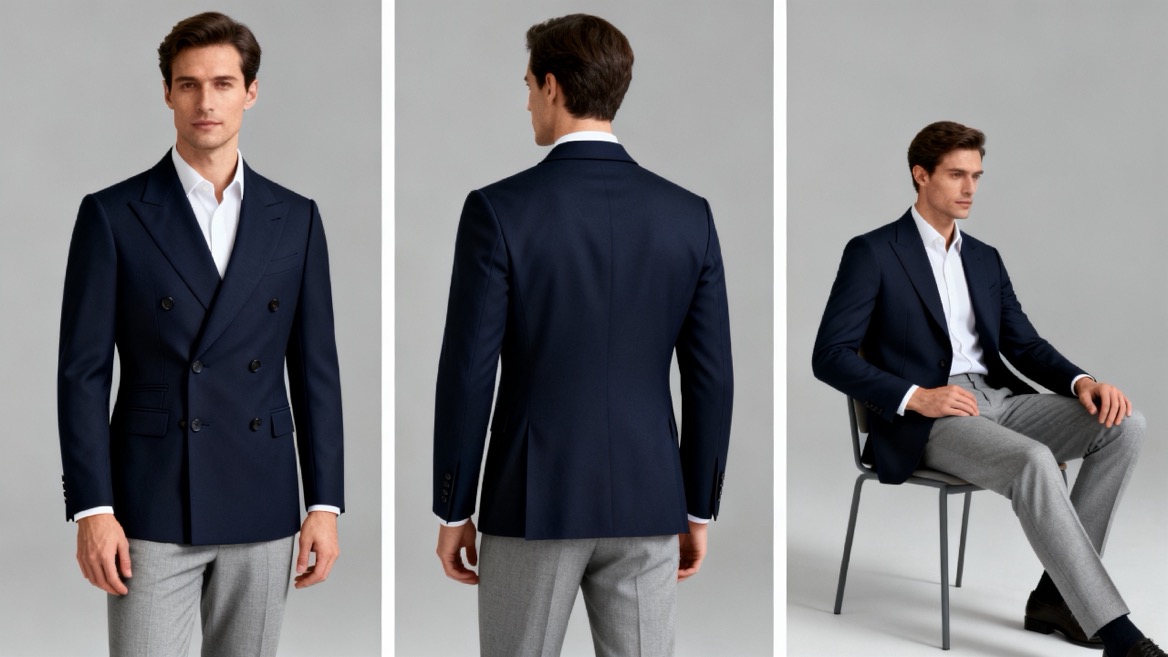
A navy double-breasted blazer can anchor a professional outfit with gray trousers, a light shirt, and restrained accessories.
For this direction, keep the jacket's texture, buttons, and trouser contrast aligned with the desired level of formality. Decorative metal buttons create a different impression from tonal buttons.
Pair a softer jacket with chinos, a fine-gauge knit, or a simple shirt.
A linen double-breasted blazer can suit this direction when its natural texture and creasing are presented as part of the design—not as unexpected imperfections.
Avoid assuming that an extremely narrow trouser always balances a broader jacket. Photograph alternative proportions before selecting the final merchandising look.
A blazer can suit some wedding settings, but the invitation determines what is appropriate.
Black tie is a separate category that normally calls for a tuxedo ensemble. An ordinary dark blazer does not become black-tie attire simply because it is double-breasted.
This distinction matters when naming products and writing occasion-based descriptions.
For an OEM project, a clear development sequence reduces avoidable interpretation.
Specify the target market, expected retail position, season, and intended use.
"Modern tailoring" is too broad on its own. Explain whether the customer needs office clothing, relaxed occasionwear, uniforms, or a fashion-led statement piece.
Include reference images, but identify the specific details that matter in each one.
A useful technical pack should include:
- Front, back, and internal construction drawings.
- Button configuration and fastening positions.
- Lapel shape and dimensions.
- Pocket, vent, cuff, and lining details.
- Fabric and trim specifications.
- Measurement points, tolerances, and size grading.
- Labeling, packaging, and care-label requirements.
State how each measurement is taken. A measurement value without a shared method can create unnecessary disputes.
Discuss whether fused, half-canvas, or full-canvas construction fits the intended product and budget.
These terms describe different construction approaches; they should not replace an assessment of the finished jacket.
Review front stability, lapel appearance, comfort, and pressing results. Also confirm the construction details rather than relying on a broad label such as "premium quality."
Review the first sample against both the measurement specification and the intended silhouette.
Keep comments specific: identify the issue, its location, and the required outcome. "Improve the fit" gives less direction than "reduce the visible pulling at the waist while preserving chest comfort."
Once the base fit is approved, review the agreed size set.
Before bulk production, confirm the final fabric, trims, measurements, labels, and workmanship expectations.
Retain an approved reference sample and a written record of accepted changes. Confirm order quantities, timing, inspection arrangements, and commercial terms directly with the supplier.
Do not assume that an early development sample represents every detail of the eventual order.
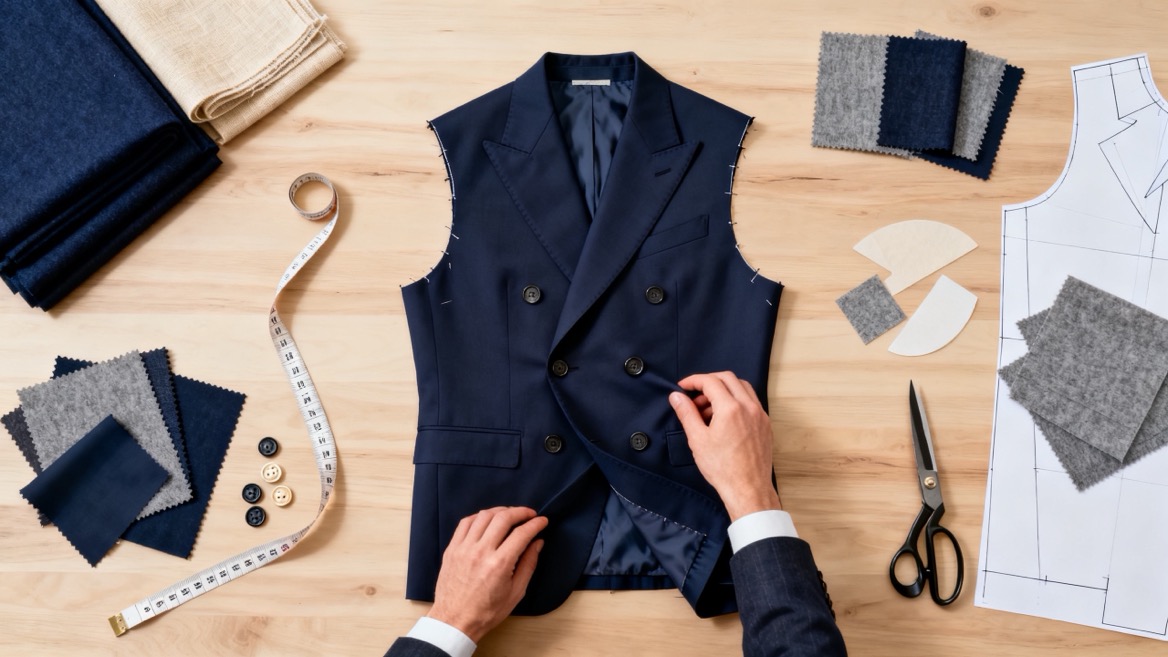
Quality inspection should evaluate the jacket as a finished product, not simply as a collection of measurements.
Review front symmetry, button alignment, pocket placement, lapel shape, seam appearance, lining behavior, and pressing.
For checked or striped fabrics, agree on pattern-matching expectations before production. The required matching positions should be explicit rather than left to interpretation.
Depending on the material and intended use, a testing plan may include:
- Dimensional stability after the specified care process.
- Colorfastness to rubbing and relevant cleaning methods.
- Pilling resistance.
- Fabric or seam strength.
- Appearance retention.
Testing providers offer these categories, but not every test is necessary for every blazer.
Agree on the methods, acceptance criteria, and applicable destination-market requirements before testing. A report is useful only when its scope matches the product and buyer's requirements.
No verified customer reviews were supplied for this article. For future product improvement, use actual feedback rather than invented testimonials.
For example, if customers report that a jacket feels tight when seated, investigate the fit and movement findings. If they report shape changes after cleaning, compare the care instructions with dimensional-stability results.
Treat these as investigation pathways, not automatic diagnoses.
A strong double-breasted blazer combines a clear design concept with disciplined sampling and measurable approval criteria.
Shanghai Youti Clothing Co., Ltd. provides OEM services for overseas brands, wholesalers, and clothing manufacturers. To discuss a project, send your reference images or technical pack together with your target market, fabric preferences, size range, estimated quantities, and required delivery window.
Ask for confirmation of development feasibility, sampling arrangements, quotation scope, and production terms before placing an order.
"Double-breasted" describes the front closure. A suit jacket belongs to a coordinated set with matching trousers, while a blazer is generally intended to be worn separately. Either can have a double-breasted front.
Follow the jacket's intended construction. On a conventional 6×2 design, the upper functional exterior button commonly establishes the main fastening point. Secure the internal fastening where provided. Different configurations can require different handling.
Yes, but results depend on proportions and fit. Shoulder shape, jacket length, button stance, and waist allowance should be assessed together. No single configuration guarantees a flattering result for every wearer.
They can be. Evaluate the fabric, weave, lining coverage, internal structure, and fit together. Lightweight wool, linen, and suitable blends are possible starting points rather than guarantees of comfort.
Provide design references, quantities, fabric requirements, size range, construction expectations, labeling, packaging, and delivery needs. Identify any unresolved details so the quotation states its assumptions clearly.
Use an approved preproduction reference, documented measurements and tolerances, confirmed materials, and agreed inspection criteria. Record changes in writing so both parties work from the same specification.
1. [StudioSuits — "Effortlessly Chic: Clinch on the Power of Double Breasted Blazers"]. Original article supplied for restructuring; used to identify the initial styling themes and content gaps. [studiosuits]
2. [Artefact London — "Double-Breasted Suits & Jackets Guide"]. Reference for overlapping-front construction, button notation, button stance, and proportion considerations. [theartefact]
3. [The Second Button — "How to Button a Double Breasted Jacket (Advanced)"]. Reference for the relationship between fastening position, lapel roll, and different double-breasted configurations. [thesecondbutton]
4. [The Woolmark Company — "Wool Tailoring and Suiting"]. Reference for lightweight wool, breathability, moisture-vapor absorption, and seasonal tailoring applications. [woolmark]
5. [Proper Cloth — "How to Measure Tailored Suit Jackets and Sport Coats"]. Reference for consistent garment-measurement procedures, including shoulder width, chest width, and center-back length. [propercloth]
6. [Intertek — "Textile Testing Solutions"]. Reference for dimensional stability, colorfastness, pilling, strength, and care-related textile testing categories. [intertek]
7. [The Emily Post Institute — "Black Tie Dress Code"]. Reference for distinguishing a blazer outfit from a black-tie tuxedo ensemble. [emilypost]


