
Views: 295 Author: Youti Clothing Publish Time: 2026-10-17 Origin: Site


Content Menu
● Welding FR Clothing vs Standard Workwear: The Essential Difference
>> What Is Welding FR Clothing?
● Why Flame Resistance Matters in Welding Operations
>> The Hazard Can Continue After Initial Contact
>> Welding Protection Requires More Than Flame Resistance
>> Requirements Depend on the Work
● Fabric Selection: Cotton, Treated FR Fabrics, and Protective Blends
>> Ordinary Cotton Is Not Automatically FR Cotton
>> Evaluate Protective Performance, Not Marketing Categories
>> Avoid Ordinary Synthetic Clothing in the Exposure Zone
● Welding Clothing Standards: What Buyers Should Verify
>> ISO 11611 Addresses Welding-Specific Clothing
>> Understand the Claimed Protection Class
>> Do Not Treat Different Standards as Substitutes
● Garment Design: Where Practical Protection Can Be Lost
>> Pockets and Cuffs Can Collect Hot Material
>> Fit Must Preserve Coverage During Movement
● An OEM Procurement Workflow for Welding Workwear
>> Step 1: Define the Intended Use
>> Step 2: Establish the Technical Acceptance Criteria
>> Step 3: Review the Complete Sample
>> Step 4: Make Care Instructions Part of Approval
>> Step 5: Control Changes Before Reordering
● A Practical Scenario: Why One Uniform May Not Suit Every Department
● Maintenance and Cost: Compare the Working Life, Not Just the Price
>> Cleaning Is Part of Protection
>> Build a Transparent Cost Comparison
● Develop a Welding Workwear Brief with Shanghai Youti Clothing Co., Ltd.
>> 1. Can Standard Cotton Workwear Replace Welding FR Clothing?
>> 2. Is Flame-Resistant Clothing Fireproof?
>> 3. Does Every Welder Need the Same Protective Clothing?
>> 4. Is ISO 11612 Equivalent to ISO 11611?
>> 5. Can Welding FR Clothing Be Washed Normally?
>> 6. What Should an OEM Buyer Request Before Approval?
Welding FR clothing vs standard workwear is not simply a comparison of heavier fabrics, stronger seams, or higher prices. It is a comparison between clothing selected for specific thermal hazards and clothing designed mainly for everyday industrial use. In welding operations, that difference matters because workers may encounter hot metal droplets, sparks, brief flame contact, and radiant heat.
For overseas brands, wholesalers, and manufacturers sourcing uniforms and work clothes, the purchasing question should therefore be: "What protection does this garment demonstrably provide?"—not merely, "Does it look suitable for a welder?"
From an OEM procurement perspective, protection should lead the specification. Fabric selection, garment construction, fit, laundering instructions, and supporting documentation must work together. This guide explains how to compare both clothing categories and build a more reliable welding workwear specification.

Welding flame-resistant clothing is protective apparel designed to limit flame spread and address relevant welding hazards. Depending on its verified performance, it can help protect against welding spatter, brief flame contact, and radiant heat.
Typical items include welding jackets, trousers, coveralls, sleeves, and aprons. However, an "FR" description alone does not establish welding suitability. Buyers need evidence covering the intended exposure, garment design, and applicable requirements. ISO 11611 specifically addresses protective clothing for welding and allied processes.
Standard workwear includes uniforms, trousers, shirts, and coveralls selected primarily for durability, appearance, comfort, and routine workplace use. Unless supported by relevant testing, these features do not establish thermal protection.
Cotton deserves particular attention. Heavyweight, tightly woven cotton can be appropriate in certain welding clothing selections, but ordinary cotton is not automatically equivalent to tested flame-resistant protective clothing. Likewise, conventional synthetic garments should not be confused with engineered protective fabrics. Material selection must consider the actual welding exposure.
| Selection factor | Welding FR clothing | Standard workwear |
|---|---|---|
| Primary purpose | Protection against specified welding and thermal hazards | General industrial wear and identification |
| Flame performance | Requires verified limited-flame-spread performance | Usually not demonstrated |
| Welding spatter | Addressed through relevant materials, testing, and design | Cannot be assumed from fabric thickness |
| Garment construction | Closures, pockets, coverage, and fit need protective consideration | Often prioritizes convenience and styling |
| Purchasing evidence | Relevant reports, markings, and user instructions | Commonly focuses on composition and workmanship |
| Maintenance | Care instructions are part of maintaining protective performance | Care generally focuses on cleanliness and appearance |
The decisive distinction is evidence, not appearance. A rugged-looking uniform is not necessarily welding protective clothing.
A spark landing on clothing is not always an isolated event. Clothing contaminated with oil, grease, or other combustible substances can ignite. Appropriate material selection and cleanliness therefore belong in the same safety discussion.
Flame-resistant clothing helps limit flame spread under specified conditions, but it is not fireproof. Workers can still suffer burns when exposure exceeds the garment's protective capability or when coverage is inadequate.
Welding exposes clothing to combinations of hazards. A garment may need to address molten-metal droplets, radiant heat, and brief flame contact—not just ignition.
This explains why a general FR fabric claim is insufficient for a welding collection. The completed product needs an appropriate protective specification. It also explains why protective clothing does not replace welding helmets, gloves, footwear, or other necessary equipment. ISO 11611 does not cover requirements for hand, face, eye, or foot protectors.
OSHA states that appropriate welding protective clothing varies with the size, nature, and location of the work. Its interpretation also explains that employers should provide and ensure the use of flame-resistant clothing when welders face flash-fire or short-duration flame exposures.
That is a risk-based requirement—not a universal claim that every garment bearing an FR label suits every welding operation.
"100% cotton" describes fibre composition. It does not, by itself, demonstrate limited flame spread, resistance to welding spatter, or suitability after repeated cleaning.
Heavyweight, tightly woven cotton may form part of an appropriate welding clothing selection. Buyers should nevertheless distinguish ordinary cotton from cotton-based fabrics with verified protective performance. Density and weight are useful specifications, but neither replaces relevant testing.
When comparing treated FR fabrics and other engineered protective materials, request evidence for the actual proposed fabric and garment.
Useful questions include:
- Which hazards and standards does the product address?
- What cleaning pretreatment was used before testing?
- Does the evidence match the proposed material and construction?
- What maintenance restrictions apply?
- What changes would require further technical review?
This approach avoids assuming that one fibre family is always superior. The better choice is the material system that meets the exposure requirements and remains practical to wear and maintain.
Conventional synthetic fabrics can create additional hazards during welding exposure. Workplace guidance warns against synthetic garments and recommends suitable protective materials instead.
However, "synthetic" is not a complete technical assessment of an engineered protective textile. Buyers should evaluate the finished material's documented performance rather than approving or rejecting it solely by a broad fibre description.
ISO 11611:2024 establishes minimum safety requirements and test methods for protective clothing used in welding and allied processes. Its scope includes garments and accessories such as hoods, aprons, sleeves, and gaiters.
For purchasing teams, the important lesson is to specify the exact standard and edition being claimed. A generic statement such as "meets international standards" provides too little information for an informed approval.
Welding clothing classifications distinguish different levels of exposure. Guidance associated with EN ISO 11611 describes Class 1 for lower welding-spatter and radiant-heat exposure, and Class 2 for more hazardous conditions.
These classes are not interchangeable wardrobe options. Buyers should ask a qualified safety professional to determine the necessary protection and confirm how the claimed class applies to the garment and standard edition offered.
ISO 11612 addresses a broader range of heat and flame exposures. It does not make every garment evaluated under it automatically suitable for welding.
Similarly, clothing selected for electrical arc-flash hazards requires a separate assessment and appropriate rated equipment. Welding protection and electrical arc-flash protection should not be treated as identical simply because both involve heat.
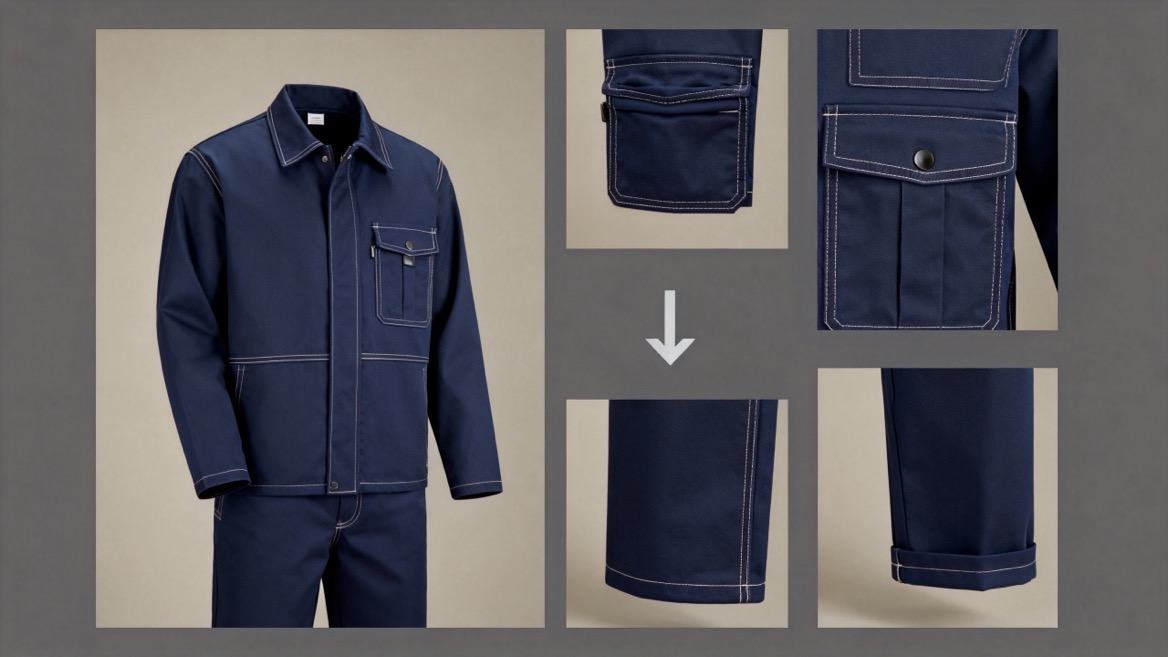
Fabric performance cannot compensate for every design weakness. Open pockets and trouser cuffs can collect sparks or hot debris.
CCOHS recommends trousers without cuffs and shirts with pocket flaps or pockets taped closed. For OEM development, this means reviewing pocket orientation, closures, and openings before approving the style—not after the fabric has been purchased.
Welding garments need to remain practical while workers bend, kneel, reach, and handle equipment. A useful development review checks sleeve coverage, jacket-and-trouser overlap, closure security, and compatibility with other protective equipment.
Treat the proposed garment as a complete working system. Evaluate representative sizes and realistic movements rather than approving fit solely from a flat measurement chart. Appropriate protective clothing must reflect the work being performed.
For Shanghai Youti Clothing Co., Ltd., a China-based OEM supplier serving overseas brands, wholesalers, and manufacturers, a useful purchasing brief should connect the commercial requirements with the protective specification.
The following workflow is a proposed procurement framework, not a claim that any particular company product is already certified.
Document the welding process, working position, expected spatter, radiant heat, environmental conditions, and any additional hazards.
Do not use "factory uniform" as the complete application description. The protective clothing requirement changes with the nature and location of the work.
Agree on the target market, applicable standards, required classification, material specification, and evidence needed before production approval.
Request documentation relevant to the proposed product rather than relying on an unrelated fabric brochure or an undefined FR claim. Welding-specific requirements address more than fibre composition.
Assess the proposed fabric alongside seams, closures, pockets, labels, and accessories. Conduct a practical wear review with the intended equipment.
Pay particular attention to openings that may collect hot material and to garment coverage during normal working movements.
Approve laundering and maintenance instructions before placing the order. These instructions should correspond to the supplied product.
CCOHS warns that certain chemicals, including chlorine bleach or hydrogen peroxide, may damage some flame-retardant fabrics or their properties. Therefore, a generic washing label is not an adequate substitute for product-specific guidance.
Create an agreed change-review process for replacement materials, trims, construction, and care instructions. When a change could affect protection, ask the relevant laboratory or certification body whether additional evaluation is needed.
This is a practical way to keep repeat orders aligned with the original technical acceptance criteria.
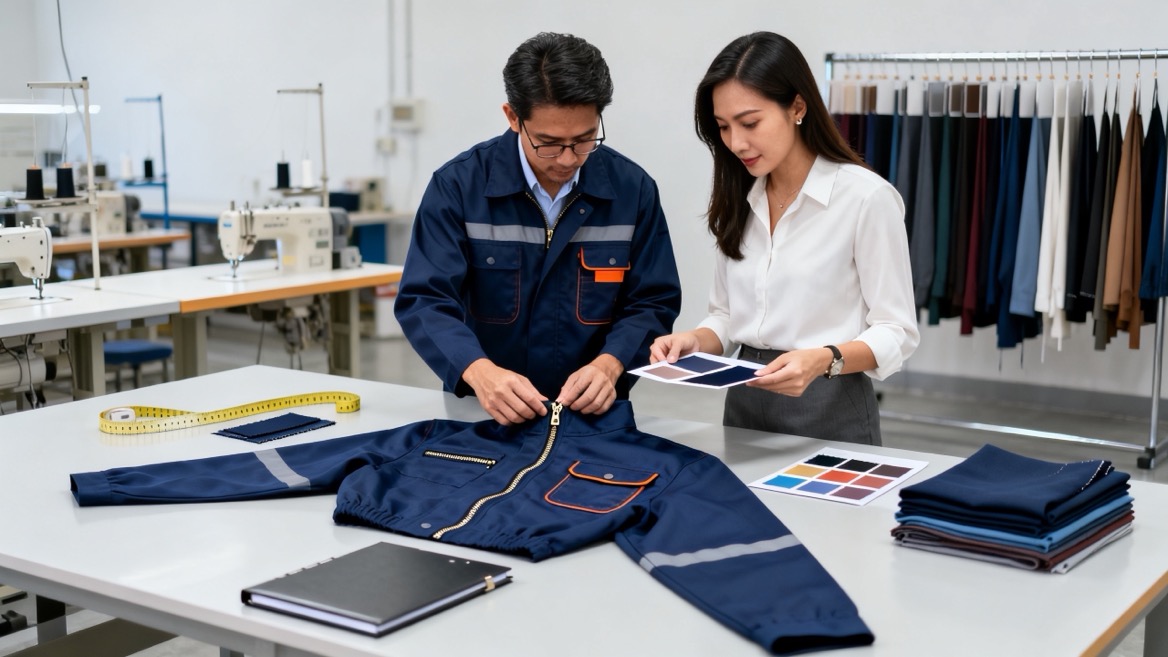
Consider a hypothetical metal-fabrication business with warehouse staff, intermittent welders, and employees performing more demanding welding tasks.
A single standard uniform may simplify purchasing, but it does not establish protection for all three groups. Conversely, issuing the same protective outfit everywhere may ignore differences in heat burden, movement, and exposure.
A more useful approach separates job roles, assesses their hazards, and specifies clothing accordingly. Welding teams receive appropriate verified protective garments, while other departments receive workwear suited to their own tasks. This scenario illustrates OSHA's task-dependent selection principle; it is not a reported customer case.
Oil, grease, and combustible contamination can undermine safe clothing use. Welding garments should remain clean and in good repair, with laundering performed according to the manufacturer's instructions.
Workers and supervisors should also inspect garments for damage, defective closures, and contamination. Repairs should follow appropriate product guidance rather than introducing unverified replacement materials.
For procurement planning, compare more than unit price:
1. Purchase and development costs.
2. Testing and documentation costs.
3. Laundering requirements.
4. Repair and replacement arrangements.
5. Inventory needed to maintain clean, serviceable garments.
This is a purchasing framework, not proof that FR clothing always delivers a particular financial saving. Avoid unsupported claims about accident reductions, replacement intervals, or payback periods.
If your brand, wholesale business, or manufacturing operation needs OEM welding apparel, approach Shanghai Youti Clothing Co., Ltd. with a defined technical brief.
Include your target market, intended welding applications, required standards and classifications, garment styles, size range, branding requirements, quantities, and documentation expectations.
Ask for confirmation of available materials, development options, testing arrangements, and supporting evidence before approving protective claims. The objective is not simply a branded uniform: it is a garment specification that connects your customers' working conditions with verifiable performance.
Not automatically. Heavyweight, tightly woven cotton may be appropriate in some welding clothing selections, but ordinary cotton does not establish verified FR or welding-specific performance. Selection must reflect the hazards.
No. It offers protection within specified performance limits. Excessive exposure, contamination, poor coverage, or unsuitable selection can still result in injury.
No. Appropriate clothing varies with the size, nature, and location of the work. Employers should assess the actual exposure before selecting garments.
No. ISO 11612 addresses broader heat and flame protection, while ISO 11611 specifically addresses welding and allied processes. Buyers should verify requirements relevant to the intended use.
Follow the garment manufacturer's instructions. Cleaning chemicals and methods suitable for ordinary uniforms may not suit protective clothing. Avoid assuming a universal washing temperature or detergent specification.
Request a defined application specification, relevant performance documentation, a reviewed garment sample, and product-specific care instructions. An FR label or fabric composition alone does not establish welding suitability.
1. Occupational Safety and Health Administration. [29 CFR 1910.252: General Requirements]. Basis for task-dependent welding protective-clothing requirements. [osha]
2. Occupational Safety and Health Administration. [Clarification of OSHA's Position on FR Clothing for Welders]. January 12, 2012. Basis for flame-exposure requirements and consideration of heat burden. [osha]
3. International Organization for Standardization. [ISO 11611:2024—Protective Clothing for Use in Welding and Allied Processes]. Basis for welding-protection scope and edition information. [iso]
4. Canadian Centre for Occupational Health and Safety. [Welding—Personal Protective Equipment and Clothing]. Basis for material selection, pockets, cuffs, contamination, and care guidance. [ccohs]
5. University of Tennessee, Environmental Health and Safety. [Welding, Cutting, and Brazing]. Basis for synthetic-clothing cautions and garment cleanliness. [ehs.utk]
6. Bierbaum-Proenen. [EN ISO 11611: Protective Clothing]. Supplementary manufacturer guidance on welding-clothing classifications. [bp-online]
7. International Organization for Standardization. [Protective Clothing—Clothing to Protect Against Heat and Flame]. Basis for the distinction between broader thermal protection and welding-specific protection. [iso]
8. Canadian Centre for Occupational Health and Safety. [Flame- and Heat-Protective Clothing]. Basis for distinguishing arc-rated protective systems. [ccohs]
9. Arcwear. [How to Properly Care for Flame-Resistant Garments]. Supplementary guidance on manufacturer-specific care and contamination. [arcwear]


