
Views: 231 Author: Youti Clothing Publish Time: 2026-10-19 Origin: Site


Content Menu
● How We Selected These Waiter Outfit Suppliers
>> 1. Relevant Product Experience
>> 2. OEM and Product Development Support
>> 4. Quality Control and Compliance Evidence
>> 5. Sampling and Delivery Planning
>> 6. Fit for the Buyer's Business Model
● Why Source Waiter Outfits from China?
>> A Connected Apparel Supply Chain
>> Large Export Capacity, but Continued Price Pressure
● Supplier Comparison: Capacity, MOQ, and Certification Evidence
● The Top 10 Waiter Outfit Manufacturers and Suppliers in China
>> 1. Shanghai Youti Clothing Co., Ltd.
>> 2. Hangzhou Workwell Textile & Apparel Co., Ltd.
>> 3. Beijing Duomilai Garments & Attire Co., Ltd. / CHECKEDOUT
>> 4. Guangzhou Jinhui Clothing Co., Ltd.
>> 5. Guangzhou Yuchen Clothing Co., Ltd.
>> 6. Guangzhou Xinxin Garments Co., Ltd.
>> 7. Guangzhou Nolai Garment Co., Ltd.
>> 8. Dongguan Hualingniao Apparel Co., Ltd. / UniformMfg
● Technical Buyer's Guide: What Defines a Reliable Waiter Outfit?
>> Specify Fabric by Measurable Properties
>> Test the Complete Garment, Not Only the Fabric
>> Use Relevant Compliance Requirements
● Common Sourcing Problems and How to Prevent Them
>> An Overlooked Procurement Trap: Approving the Sample but Not the Bulk Material
● How to Verify a Factory and Manage the First Order
>> Step 1: Verify the Contracting Entity
>> Step 2: Verify Production, Not Only the Sales Office
>> Step 3: Build a Controlled Sample Sequence
>> Step 4: Agree on Inspection and Remedy Terms
>> Step 5: Plan Logistics Around the Complete Timeline
● Conclusion: Select for Repeatable Performance, Not the Lowest Initial Quote
>> 1. How Can I Check Whether a Supplier's ISO Certificate Is Expired or Suspended?
>> 2. Does an OEKO-TEX-Certified Fabric Make the Finished Waiter Outfit Certified?
>> 3. How Can We Compare Capacity Figures Across Different Factories?
>> 4. How Do We Keep Repeat Orders Consistent When Fabric Lots Change?
>> 5. Can We Place a Small Trial Order Without Losing Full Customization?
Choosing a waiter outfit manufacturer is not simply a matter of comparing shirt prices. For hospitality brands, uniform wholesalers, and private-label businesses, the real challenge is finding a supplier that can reproduce approved fabrics, maintain consistent sizing, support repeat orders, and deliver garments that remain presentable after frequent laundering.
China offers a broad sourcing base for restaurant uniforms, from tailored waistcoats and formal shirts to café polos, aprons, and coordinated hospitality workwear. Its export scale remains substantial: a 2026 U.S. Department of Agriculture report, citing China Customs, places China's 2025 textile and apparel exports at approximately US$293.8 billion, including US$151.2 billion in apparel exports. These figures describe the wider industry—not the waiter uniform segment—but demonstrate the scale of the manufacturing ecosystem available to international buyers.
This guide examines ten China-based manufacturers and manufacturing-oriented suppliers worth evaluating for a waiter outfit program. It compares their publicly reported capabilities, identifies information that still requires verification, and explains how to move from a promising supplier profile to a controlled purchasing decision.

A credible shortlist needs more than attractive product photography. The companies below were evaluated against six practical purchasing criteria.
The starting point is evidence of hospitality uniforms or transferable garment capabilities: shirts, waistcoats, trousers, polos, aprons, and coordinated workwear.
A chef clothing specialist can be useful for a combined restaurant uniform program, but buyers should not assume that kitchen garment experience automatically translates into strong front-of-house tailoring.
For private-label sourcing, a supplier should be able to work from technical packs, reference garments, or design briefs.
The evaluation considers published support for fabric selection, sampling, custom branding, pattern development, and garment production. Where original design support is not clearly documented, buyers should request examples rather than infer capability from an "OEM/ODM" label.
Reported output, sewing lines, and workshop information help buyers prepare questions. However, total factory capacity is not the same as capacity available for a specific waiter outfit order.
A polo-shirt output figure cannot be directly compared with the production rate for lined waistcoats or multi-piece formal uniforms.
Useful evidence includes quality-management certification, social-audit records, product test reports, and documented inspection procedures.
These are different forms of assurance. An ISO certificate, a social audit, and a fabric laboratory report should never be treated as interchangeable.
Suppliers should explain when sampling starts, what approvals are needed, and whether bulk lead time begins after deposit, fabric arrival, or pre-production sample approval.
A short advertised delivery time is less valuable than a clear, achievable production schedule.
A small hospitality brand launching three styles needs different support from a distributor ordering thousands of identical shirts.
The shortlist therefore includes development-oriented suppliers, broader uniform producers, knitwear specialists, and chefwear manufacturers. Not every company is equally suitable for every waiter outfit category.
China's advantage extends beyond garment assembly. Buyers can access fabric sourcing, embroidery, printing, labels, trims, sampling, and export support within established apparel networks.
Guangzhou is particularly relevant to this shortlist because of its garment trading and manufacturing ecosystem. Research on South China's garment industry describes the central role of Guangzhou's concentrated wholesale markets in connecting participants across the supply chain. This is structural background rather than a current factory count.
The companies reviewed here also illustrate the geographic breadth of sourcing options: Shanghai for business apparel and workwear, Hangzhou for uniform production, Dongguan for custom uniform programs, and Beijing-linked production for chefwear. Their individual capabilities matter more than location alone.
China's 2025 apparel and accessories exports reached US$151.18 billion, down 5.0% year on year, according to an industry review citing China Customs. The same review reports increased garment export volume alongside lower average unit prices.
For buyers, the important implication is not that all uniforms should become cheaper. It is that quotation pressure can encourage suppliers to simplify construction, change fabrics, or reduce finishing costs.
A low quotation should therefore trigger a specification comparison—not an automatic purchasing decision.
The following table separates published information from missing information. Figures represent supplier or marketplace statements, not capacity independently verified for this article.
| Supplier | Relevant focus | Published capacity information | Published MOQ information | Certification or audit evidence to verify |
|---|---|---|---|---|
| Shanghai Youti Clothing Co., Ltd. | Shirts, suits, uniforms, trousers, and workwear | More than 1.4 million pieces annually; six sewing lines | Not published on reviewed About Us page | Website lists ISO 9001, BSCI, REACH, EN 1149-5, and EN ISO 11612; request underlying documents and scope. |
| Hangzhou Workwell Textile & Apparel Co., Ltd. | Restaurant shirts, aprons, chefwear, and broader uniforms | Approximately 100,000 garments monthly, according to its published article | Not established in reviewed sources | Published ISO 9001:2008 claim and BSCI/SEDEX audit statements; request current records. |
| Beijing Duomilai Garments & Attire Co., Ltd. / CHECKEDOUT | Chefwear and restaurant-related apparel | Reports annual sales above 7 million pieces; this is not a verified capacity figure | Project-specific; not established in reviewed sources | Claims OEKO-TEX STANDARD 100; verify certificate number and covered products. |
| Guangzhou Jinhui Clothing Co., Ltd. | Hotel uniforms, business suits, and workwear | Not established in reviewed sources | Selected hospitality listings show 50 pieces | Profile describes ISO 9001-certified quality control; certificate scope and status require checking. |
| Guangzhou Yuchen Clothing Co., Ltd. | Group apparel, shirts, polos, and hotel uniforms | Selected polo listing states 500,000 pieces monthly; not verified for waiter outfits | Confirm by style and fabric | No waiter-outfit-specific certification established in reviewed sources. |
| Guangzhou Xinxin Garments Co., Ltd. | Polos, shirts, workwear, vests, and custom branded apparel | Company website reports approximately 50,000 pieces monthly | Confirm by project | No applicable certification established in reviewed sources. |
| Guangzhou Nolai Garment Co., Ltd. | Hotel and corporate uniform systems | Marketplace profile lists 12 production lines; no verified piece output | Selected waiter uniform listing shows 100 pieces | No applicable certification established in reviewed sources. |
| Dongguan Hualingniao Apparel Co., Ltd. / UniformMfg | Waiter shirts, vests, polos, and coordinated uniforms | Website reports more than 300,000 pieces monthly | From 100 pieces per style; full custom projects quoted separately | Batch AZO-free reports advertised; explicitly does not offer certified protective clothing. |
| Standford Garment | Knitwear-led uniforms, polos, and casual workwear | Approximately 3,000 pieces daily | Not established in reviewed sources | No applicable certification established in reviewed sources. |
| Anbu Safety | Chef clothing and broader workwear supply | Not established for hospitality garments | Confirm by garment category | Verify garment-specific documentation; do not transfer PPE claims to ordinary waiter uniforms. |
Use this table to identify suppliers worth contacting—not to select a factory solely by its largest advertised output.
Shanghai Youti is a relevant starting point for buyers developing coordinated waiter outfits that combine shirts, trousers, waistcoat-style garments, or other business apparel.
According to its company page, Youti was founded in 2018 and operates a 2,500-square-meter workshop with more than 300 sets of machinery and equipment, six sewing lines, and annual output exceeding 1.4 million pieces. Its portfolio includes suits, shirts, uniforms, workwear, trousers, and jackets.
- Founded: 2018.
- Main markets: Europe is identified as its largest market, with North America and Oceania also described as core markets.
- OEM scope: Custom development from technical documents, images, and physical samples; embroidery and printing are available.
- Development support: Dedicated design and development, sampling and production, and quality inspection functions.
- Published timing: Samples in 10–15 working days; bulk production in 45–60 working days.
For small and medium-sized brands, its potential value lies in coordinated development rather than a price claim alone. The company describes fabric advice, rapid prototyping, a dedicated project manager, and multi-stage quality inspections—features relevant to buyers who need close communication during product development.
Its suitability as a cost-effective partner should be assessed through a like-for-like quotation, sample quality, and total landed cost. The reviewed page does not publish an MOQ, so buyers should confirm minimums by style, color, and fabric.
The website also lists several certification and standard claims. Buyers should request current documents and determine whether they concern the quality-management system, social auditing, chemical testing, or specific protective garments. None should be assumed to cover every ordinary waiter outfit.
Workwell offers directly relevant restaurant products, including wait-staff shirts, cook aprons, chef jackets, and chef trousers. This makes it worth evaluating for buyers consolidating front-of-house and kitchen uniforms under one supplier.
- Founded: Not reliably established in the reviewed sources.
- Main markets: A current market breakdown was not established.
- OEM/ODM scope: Restaurant and workwear manufacturing; confirm the precise private-label and design-development services in the quotation.
- Core strength: A published hospitality product range rather than generic uniform claims.
- Capacity statement: Approximately 100,000 garments monthly, according to a company-published article.
Workwell's website also publishes a Sedex company reference and site reference, offering buyers a starting point for requesting the relevant audit documentation.
One important verification issue is its published ISO 9001:2008 statement. Buyers should not treat this older edition reference as evidence of current certification. Request the latest certificate, scope, issuing body, and status before approval.
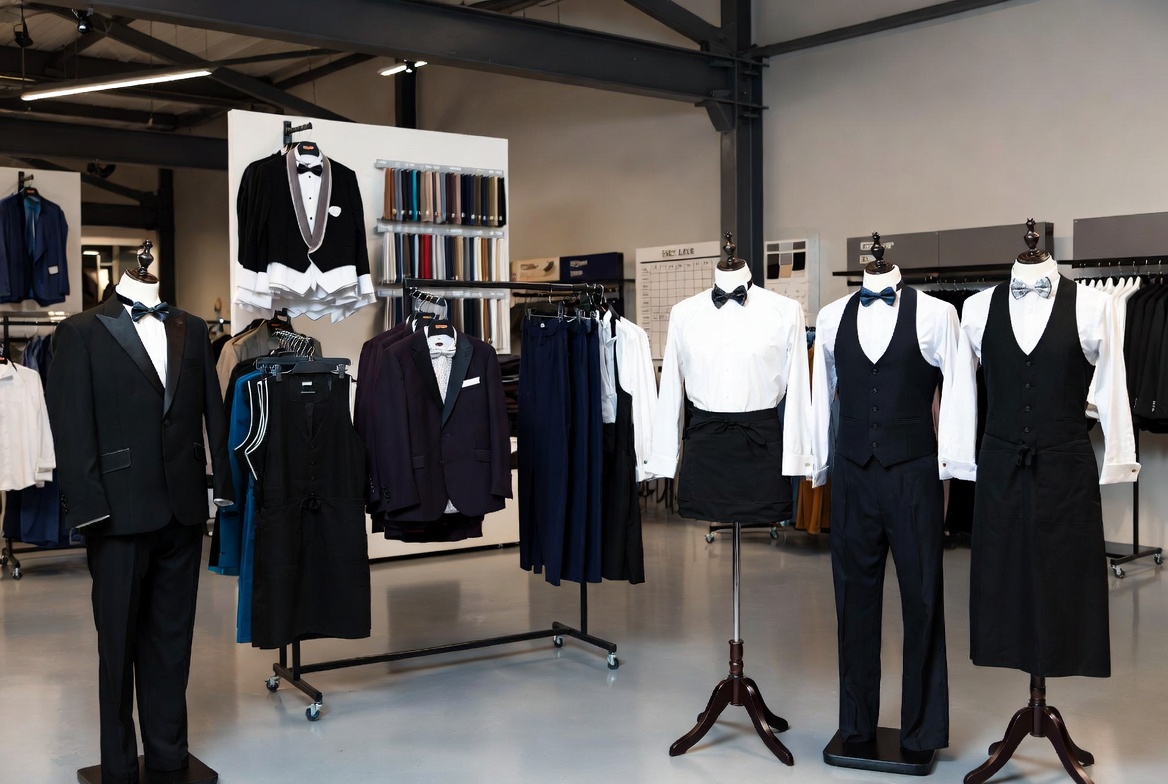
CHECKEDOUT is the brand identified on Beijing Duomilai's website. Its strongest documented specialization is chefwear, including chef coats, aprons, trousers, and hats for hotels, restaurants, bars, cafés, and bakeries.
- Established: The website states that CHECKEDOUT was established in 1995; buyers should separately confirm the legal entity's registration history.
- Main markets: The About Us page reports exports to more than 50 countries without a detailed regional breakdown.
- OEM/ODM scope: Confirm private-label terms and front-of-house product development directly.
- Core strength: Specialized culinary garments and a reported 20-person development team.
- Manufacturing footprint: Three reported production bases in Yanjiao, Qingxian, and Yuncheng.
This supplier is especially relevant when a restaurant uniform project includes both kitchen and service teams. However, buyers requiring tailored waiter waistcoats or formal server shirts should request specific examples.
The company claims OEKO-TEX STANDARD 100 credentials. Verify the certificate number, holder, product scope, and current validity rather than relying on the website's claim alone.
Jinhui's marketplace profile describes a uniform business covering tailored business suits, hotel uniform systems, and functional workwear. Its hospitality listings include waiter and waitress uniforms, making it a relevant candidate for formal restaurant attire.
- Founded: Not established in the reviewed sources; the profile's "15+ years" refers to team expertise, not necessarily company age.
- Main markets: A reliable regional breakdown was not established.
- OEM/ODM scope: Custom hospitality and workwear listings indicate both service models.
- Core strength: Coordinated hotel uniforms and business-apparel styling.
- MOQ signal: Selected hospitality listings show 50 pieces.
Buyers should reconcile the profile's use of "Jinhui Clothing" and "Jinhui Uniform" against the business license and contract entity.
Also confirm whether the quoted MOQ applies to existing designs, custom colors, or fully developed garments. A low listed minimum does not automatically include custom-woven fabric or extensive pattern development.
Yuchen is a broader enterprise-apparel supplier with published products covering T-shirts, work clothes, polos, windbreakers, business wear, and hotel uniforms. It is worth considering for casual restaurant uniform programs and branded staff apparel.
- Founded: 2015.
- Main markets: One reviewed marketplace listing identifies the domestic market; a verified export-market breakdown was not established.
- OEM/ODM scope: Custom group clothing and hospitality listings identify OEM and ODM services.
- Core strength: Broad branded-apparel development.
- Capacity statement: A selected polo listing reports 500,000 pieces monthly; this should not be interpreted as confirmed waiter outfit capacity.
The reviewed sources show different address descriptions. Buyers should confirm the current legal address, actual production site, and whether any operations are subcontracted.
For formal waiter outfits, request a complete sample set rather than evaluating the supplier through polo-shirt samples alone.
Xinxin is relevant for cafés, casual dining brands, and distributors sourcing polos, shirts, workwear, vests, and custom branded garments.
Its company website describes OEM and ODM services, two workshops, cutting and technical departments, printing and embroidery departments, more than 200 workers, and monthly output of approximately 50,000 pieces.
- Founded: A supplier-directory profile states 2009; confirm against registration documents.
- Main markets: Not reliably established in the reviewed sources.
- OEM/ODM scope: Customer-specific logos, styles, materials, sizing, and workmanship.
- Core strength: Integrated customization for branded apparel.
- Best-fit purchasing brief: Casual front-of-house uniforms and coordinated polo-based programs.
Buyers sourcing dress shirts or structured waistcoats should examine relevant production samples. A strong knitwear operation does not automatically have the same capability in tailored woven garments.
Nolai's marketplace profile identifies a business founded in 2012, integrating clothing design, production, and service, with hotel and corporate uniforms among its activities. The profile classifies it as both a manufacturer/factory and trading company.
- Founded: 2012.
- Main markets: Listed regions include North America, Western Europe, Southeast Asia, the Middle East, Eastern Europe, East Asia, Oceania, and South America.
- OEM/ODM scope: Both services are listed in the profile.
- Core strength: Broader hotel and corporate uniform programs.
- MOQ signal: A selected restaurant waiter uniform listing shows 100 pieces.
The profile lists 12 production lines, but buyers should verify how many are located at the contracted production site and how much production is allocated to outside partners.
The public sources use Nolai and Nuolai naming variations. Confirm the legal company name, exporter, payment beneficiary, and relationship to any affiliated business before placing a deposit.
UniformMfg identifies its operator as Dongguan Hualingniao Apparel Co., Ltd., established in 2006. Its website directly lists waiter, bar, café, and catering uniforms in shirts, vests, and polos.
- Established: 2006, according to its website.
- Main markets: Reports exports to 70 countries, without a detailed regional breakdown.
- OEM/ODM scope: Technical-pack development, fabric sourcing, private labels, embroidery, printing, size runs, and packing.
- Core strength: Clearly described routes for stock-style branding, custom colors, and full custom cut-and-sew projects.
- MOQ: From 100 pieces per style, with fully custom projects quoted separately.
The company's stated distinction between ordinary uniforms and certified protective clothing is useful: it explicitly says it does not manufacture certified PPE garments.
Buyers should verify its reported monthly capacity against the actual production site and obtain a project-specific schedule. Its website describes pre-production samples, laundering checks, and final inspection against a sealed sample.
Standford is a suitable candidate for buyers whose waiter outfit concept centers on polos, T-shirts, sweatshirts, or other casual knitwear-led uniforms.
Its About Us page states that it has operated since 2007 and specializes in knitted garments, workwear, and uniforms with OEM and ODM services. It reports daily output of approximately 3,000 pieces.
- Established: Since 2007, according to its website.
- Main markets: Not established in the reviewed source.
- OEM/ODM scope: Material selection, design, sampling, production, and shipping support.
- Core strength: Knitwear manufacturing and multiple fabric options.
- Fabric options: Cotton, cotton/polyester blends, polyester, cotton/spandex, and rayon/cotton blends.
Standford should be evaluated primarily against a casual hospitality brief. Buyers needing a formal waiter outfit should request evidence of woven shirting and tailored-garment capability before moving forward.
Anbu Safety's workwear page includes chef coats and custom workwear for distributors, contractors, and company uniform programs. It is relevant as an adjacent-category candidate for buyers combining restaurant apparel with broader workwear purchasing.
- Founded: A company-published profile states 2008.
- Main markets: The same profile describes export experience across the United States, Europe, the Middle East, Asia, South America, and Africa.
- OEM scope: Custom workwear manufacturing; confirm hospitality-specific private-label services.
- Core strength: Broad workwear sourcing alongside chef clothing.
- Limitation: Formal waiter shirts, waistcoats, and coordinated front-of-house sets require direct capability confirmation.
Anbu is not presented here as a proven specialist in every waiter outfit category. Its inclusion is most useful for distributors seeking a wider workwear relationship.
Ask which hospitality garments are produced directly, which are sourced, and which manufacturing site will be responsible for the approved order.
"Premium fabric" is not a purchasing specification.
For a waiter uniform, the technical pack should identify:
- Fiber composition.
- Fabric construction.
- Weight in grams per square meter.
- Approved color reference.
- Intended washing and drying process.
- Dimensional-change limits.
- Colorfastness requirements.
- Required finishing treatments.
- Acceptable appearance after repeated laundering.
One reviewed supplier publishes indicative ranges of 100–160 gsm for shirting, 180–240 gsm for piqué, and 200–320 gsm for trousers. These are useful starting points for discussion, not mandatory industry grades. Select the final fabric around climate, garment opacity, movement, and laundering requirements.
A fabric swatch cannot reveal whether a finished shirt develops seam puckering, whether embroidery distorts the chest panel, or whether a waistcoat lining shrinks differently from the outer fabric.
For industrial-laundry programs, ISO 15797 provides procedures for evaluating workwear properties including dimensional stability, color characteristics, creasing, seam puckering, pilling, and visual appearance. It is a testing framework, not a blanket guarantee that any garment will survive every laundry process.
Ask the laboratory and supplier to agree on the intended laundering conditions and the number of evaluation cycles before testing.
Ordinary waiter outfits should not be marketed as CE-certified merely because they are work clothing. European guidance states that CE marking applies only where specific harmonized legislation requires it, and must not be used where no such requirement exists.
Similarly, RoHS relates to electrical and electronic equipment; it is not the normal qualification framework for a conventional shirt, apron, or waistcoat.
For textile purchasing, OEKO-TEX STANDARD 100 can provide evidence of harmful-substance testing within its certified scope. It does not prove fabric durability, ethical labor conditions, or suitability for a particular industrial laundry program.
Request the evidence that matches the actual risk instead of collecting unrelated logos.
| Purchasing problem | Why it matters | Control to include in the order |
|---|---|---|
| Bulk fabric differs from the approved sample | Appearance and laundering behavior may change | Record fabric article, composition, construction, weight, finish, and approved bulk swatch |
| MOQ is quoted without color conditions | The real minimum may increase after development | Confirm minimums per style, color, fabric, and special trim |
| "Set" and "piece" are used interchangeably | Quotes and capacity figures become misleading | Define the exact contents of each waiter outfit |
| Color matches before washing but diverges afterward | Mixed uniforms lose their coordinated appearance | Approve both initial and post-laundering appearance |
| Delivery starts from an undefined milestone | Buyers underestimate the total schedule | State the production start trigger and approval deadlines |
| Certificate belongs to another site or product | The claimed assurance may not cover the order | Match holder, address, scope, and status to the contracted production |
The supplier information reviewed above shows why these distinctions matter: published minimums range from platform-wide figures to style-specific listings, while capacity claims use different units and product categories.
A useful control is to separate garment approval from bulk-material approval.
Do not allow an attractive development sample to authorize production automatically. Establish a second approval gate for the actual bulk fabric, trim package, embroidery thread, and construction details.
This is especially important for coordinated waiter outfits. Shirts, trousers, and waistcoats can use different fabrics and finishes while appearing similar under one lighting condition.
Require:
1. A retained reference sample.
2. An approved bulk fabric swatch.
3. A documented material and trim list.
4. A pre-production garment made from approved bulk materials.
5. A final inspection against those references.
6. Written approval before any material substitution.
UniformMfg's published process uses sealed samples and final quality checks against them; extending that approach to bulk-material approval gives buyers a more explicit control system.
Request the business license, registered company name, production address, exporter details, and payment beneficiary.
Resolve naming variations before payment. Several shortlisted profiles use brand names or alternate English company names, making this a practical issue rather than a theoretical one.
Request a live factory walkthrough or commission a site audit.
The review should identify cutting, sewing, finishing, inspection, and packing operations, as well as outsourced processes. Ask which line will make your garments and whether the same team produces both samples and bulk orders.
A practical sequence is:
1. Fabric and trim selection.
2. Prototype and fit review.
3. Size-set approval.
4. Branding approval.
5. Pre-production sample in bulk materials.
6. Laundering evaluation.
7. Written production release.
Suppliers in this shortlist publish support for development from technical packs or reference samples, while UniformMfg specifically describes size sets and pre-production approval.
Define measurement tolerances, workmanship requirements, defect categories, sampling rules, and remedies before production.
Clarify whether the factory must repair defects, replace garments, or provide a credit. Final inspection should not become the first conversation about what "acceptable quality" means.
Separate development time, fabric procurement, production, inspection, and transit.
For example, Youti publishes 10–15 working days for sampling and 45–60 working days for bulk production. Those periods should not be mistaken for a door-to-door delivery promise.
Confirm the named delivery location, freight responsibility, importer responsibility, packing method, and required shipment documents in the sales agreement. Nolai's profile lists several trade terms, illustrating why buyers must confirm the specific term rather than assume a default.
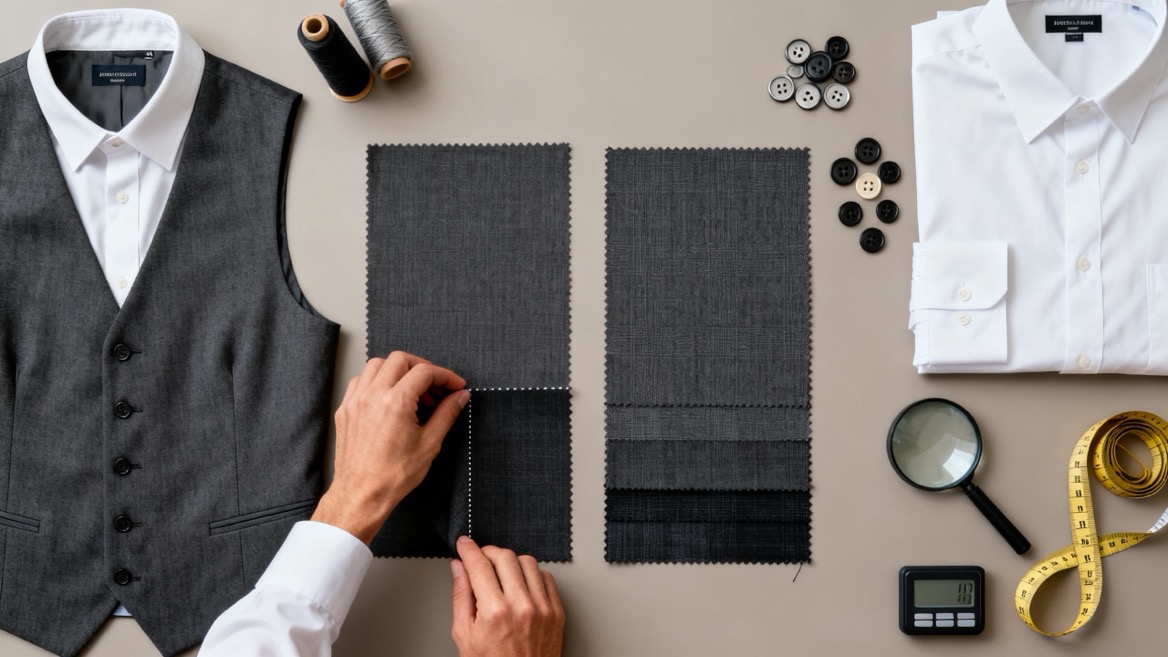
The most suitable waiter outfit supplier is the one that can translate your design into a measurable specification and reproduce it reliably across sizes, production batches, and repeat orders.
This shortlist offers different starting points: Shanghai Youti for coordinated business apparel and custom development; Workwell and CHECKEDOUT for restaurant and culinary programs; Guangzhou-based suppliers for varied hospitality and branded apparel; and specialist operations for casual knitwear or broader workwear sourcing. The final choice should follow document verification, relevant samples, and a controlled trial order—not the article's numbering.
For an OEM waiter outfit project with Shanghai Youti Clothing Co., Ltd., submit your technical pack or reference garments, quantities by style and color, size requirements, branding files, laundering conditions, destination, and target delivery date. Request a written proposal covering fabrics, MOQ, sampling, testing evidence, and production milestones before approving the order. Youti's published service model supports customization from documents, images, and physical samples.
Request the full certificate and search the company name or certificate number through IAF CertSearch.
Review the standard, status, scope, site, issuing certification body, and accreditation information. The database distinguishes Active, Suspended, Withdrawn, and Expired statuses.
Also contact the issuing certification body when details are unclear. A missing search result should trigger further verification, not an unsupported accusation.
Not automatically.
OEKO-TEX explains that a finished garment claim requires the entire product—including sewing threads, buttons, and other components—to be certified. A fabric certificate alone does not justify describing the complete waiter outfit as certified.
Request the certificate number, check validity, and confirm precisely which article is covered.
First identify the unit: pieces, sets, annual sales, production lines, or monthly output.
Then ask for project-specific throughput based on your construction. CHECKEDOUT's published annual sales figure, Youti's annual output, and UniformMfg's monthly capacity statement are not directly equivalent measures.
Request the available production window for your order rather than relying only on headline capacity.
Retain the approved garment, fabric swatch, color reference, measurement chart, and trim specification.
Require approval of each replacement fabric lot and a washed repeat-order sample where appearance is critical. For industrial laundering, ISO 15797 offers a framework for evaluating relevant changes in dimensions, color, and appearance.
Contractually prohibit unapproved substitutions, even when the supplier describes the replacement as "equivalent."
Sometimes, but confirm exactly what the advertised minimum includes.
UniformMfg advertises orders from 100 pieces per style while quoting full custom cut-and-sew projects separately. Selected Jinhui hospitality listings show 50 pieces, and a Nolai waiter uniform listing shows 100 pieces. These are supplier- or listing-specific starting points, not universal custom-development minimums.
Request separate quotations for existing styles with branding, custom colors using established patterns, and fully original designs.
- Shanghai Youti Clothing Co., Ltd.: About Us — supplier-reported manufacturing, market, development, and lead-time information. [work-jacket]
- U.S. Department of Agriculture: Cotton and Products Annual, China, 2026 — includes 2025 and early-2026 textile and apparel export figures citing China Customs. [apps.fas.usda]
- China National Garment Association: Industry Overview — background on China's garment industry; the reviewed page presents 2023 figures. [cnga.org]
- Textile Leader: Economic Operation of China's Garment Industry in 2025 — industry review with China Customs export data. [texleader.com]
- European Union: CE Marking Requirements — explains when CE marking is required and when it must not be used. [europa]
- ISO: ISO 15797:2017 — industrial washing and finishing procedures for testing workwear. [iso]
- OEKO-TEX: STANDARD 100 — harmful-substance testing and certification scope. [oeko-tex]
- OEKO-TEX: Label Check — certificate and label verification. [oeko-tex]
- IAF CertSearch: Certificate Search — management-system certification verification. [iafcertsearch]


