
Views: 288 Author: Youti Clothing Publish Time: 2026-10-15 Origin: Site


Content Menu
● Reflective Clothing vs LED Safety Clothing: The Essential Differences
● Why Road-Worker Visibility Requires More Than Bright Clothing
● Which Clothing Performs Better During Daytime and Nighttime Work?
>> Daytime Roadwork: Prioritize Fluorescent Coverage
>> Nighttime Roadwork: LEDs Can Add Useful Visibility
● What Research Actually Shows About LED Workwear
● Safety Standards: Does LED Clothing Replace Reflective Workwear?
>> International Purchasing Considerations
● Comfort, Durability, and Washing: Where Practicality Changes
>> Comfort During Physical Work
>> Weather and Component Protection
● Total Cost: Compare Operational Work, Not Just Unit Prices
● A Practical Field-Trial Procedure Before Bulk Purchasing
● OEM Specifications for Reflective and LED Safety Clothing
● Which Option Is More Practical for Your Road Workers?
>> Start Your OEM Workwear Project With a Clear Brief
>> Is LED Safety Clothing Better Than Reflective Clothing at Night?
>> Can Road Workers Wear an LED Vest Without Reflective Tape?
>> Which Is More Practical for Daytime Road Maintenance?
>> Are LED Safety Vests Machine Washable?
>> How Long Should an LED Safety Vest Battery Last?
>> Can We Add a Company Logo to High-Visibility Clothing?
Reflective clothing vs LED safety clothing is not simply a choice between traditional workwear and newer technology. For road workers, practicality depends on visibility, compliance, comfort, maintenance, and reliable performance throughout a shift. Reflective high-visibility clothing is generally the more practical everyday foundation. LED safety clothing can provide valuable additional visibility during nighttime operations—but should supplement, not replace, an appropriate reflective garment.
At Shanghai Youti Clothing Co., Ltd., we approach this comparison from an OEM workwear specification perspective: what should an overseas brand, wholesaler, or manufacturer require before approving a product? Our guiding principle is reliability. A garment must remain suitable for its intended use after charging, washing, movement, and repeated wear—not just look impressive in a product photograph.

Reflective clothing uses retroreflective material to return incoming light toward its source. Vehicle headlights illuminate the reflective bands, helping drivers notice the wearer.
Road-worker high-visibility clothing typically also includes fluorescent background fabric. These components serve different purposes: fluorescent material supports daytime conspicuity, while retroreflective material supports visibility under headlights at night.
LED safety clothing adds powered light sources to a garment. Unlike reflective tape, operating LEDs emit their own light.
However, "LED safety clothing" describes a feature, not a complete protective specification. A lighted vest may incorporate an appropriate high-visibility design, or it may simply be an illuminated accessory.
| Practical consideration | Reflective high-visibility clothing | LED-enhanced high-visibility clothing |
|---|---|---|
| Visibility mechanism | Returns incoming light toward its source | Adds self-emitted light |
| Daytime performance | Fluorescent background supports conspicuity | Still depends on suitable background fabric |
| Nighttime performance | Effective under appropriate illumination | Can supplement visibility beyond headlight illumination |
| Power requirements | None | Batteries and charging or replacement |
| Maintenance | Fabric, tape, seams, and closures | Garment checks plus electrical checks |
| Washing | Follow the garment care label | Follow instructions for electronics and garment |
| Purchasing complexity | Relatively straightforward | Additional component and operating specifications |
| Most practical role | Everyday visibility foundation | Targeted nighttime enhancement |
The most useful comparison is therefore reflective clothing versus reflective clothing with added LEDs—not reflective tape versus lights alone.
Road workers face threats from passing traffic and equipment operating inside the work zone.
NIOSH reports that U.S. work zones experienced approximately 96,000 crashes and 37,000 injuries in 2022. There were 891 fatal injuries, including 136 pedestrian fatalities; 105 of those pedestrians were workers.
These figures describe the overall danger of work zones. They do not establish that any particular garment would have prevented those incidents.
Visibility clothing is one layer of protection. It does not replace traffic-control planning, barriers where appropriate, equipment procedures, or worker training.
For purchasing teams, this distinction matters. A highly visible garment cannot resolve an equipment blind spot or guarantee that an approaching driver will react correctly.
During daylight, the fluorescent background of high-visibility workwear is central to its purpose. Reflective bands alone do not provide the same daytime function.
For daytime road maintenance, LED components introduce operating requirements without necessarily solving the main visibility problem.
I would prioritize:
- Appropriate fluorescent material and garment classification.
- Suitable fit over expected clothing layers.
- Breathability for the working climate.
- Unobstructed visibility areas.
- Practical pockets that do not compromise the design.
A reflective high-visibility vest, jacket, or coverall is usually the more straightforward option for predominantly daytime crews.
Retroreflective material needs incoming illumination. LEDs can make a worker conspicuous when the garment is not effectively illuminated by an approaching vehicle's headlights.
That makes LED-enhanced workwear worth evaluating for nighttime maintenance, temporary lane closures, and workers moving around equipment.
However, added lights are not automatically effective in every environment. Their usefulness depends on placement, operating mode, background lighting, worker movement, and whether other objects obscure them.
Choose nighttime road-worker safety clothing through a site-specific assessment rather than a universal "brighter is better" rule.
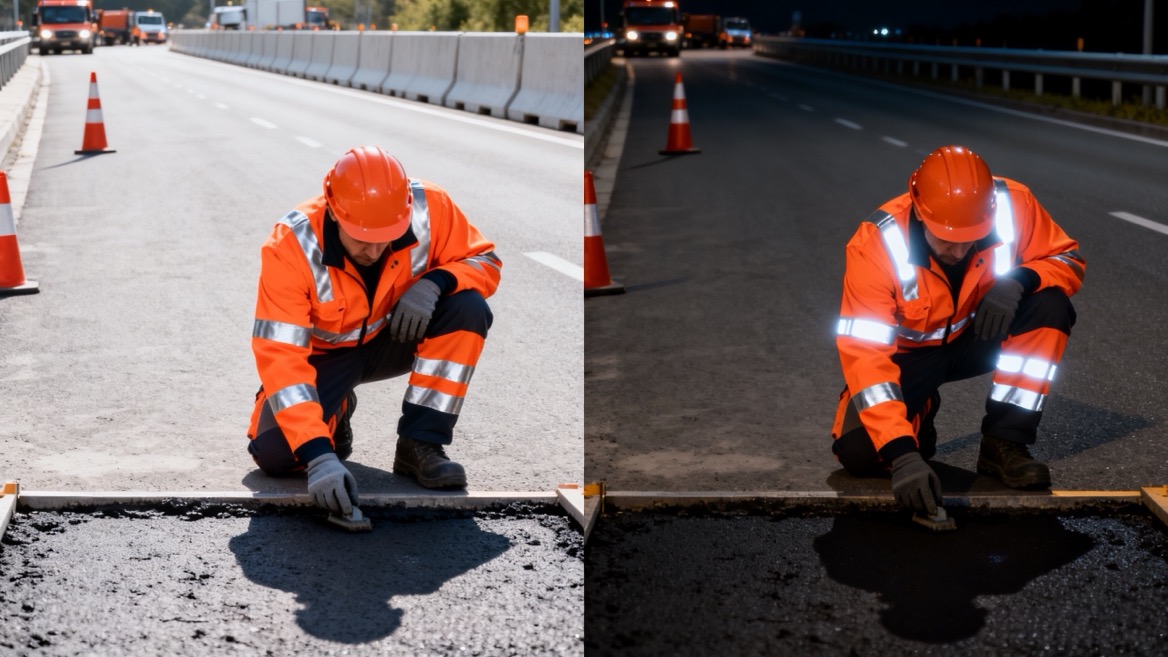
A 2022 Virginia Tech Transportation Institute report, "Lighted Work Zone Apparel: Effects on Visibility," provides a useful comparison.
The study involved 16 drivers and evaluated worker detection in simulated nighttime work zones. Researchers compared a standard Class 3 retroreflective vest with several LED-enhanced configurations, including a vest combined with helmet-mounted lighting.
The white-LED vest and lighted-helmet combinations produced the longest detection distances overall. However, the detailed results reveal an important limitation: for stationary workers in visually cluttered conditions, detection-distance differences between garment types were not statistically significant.
This is a stronger basis for purchasing decisions than a blanket claim that every LED vest is superior.
Three practical lessons follow:
1. Evaluate the complete clothing-and-lighting configuration.
2. Test visibility against the site's actual visual clutter.
3. Distinguish improved detection from proven reductions in injuries.
The study measured detection distance, not accident prevention. Its findings do not justify universal claims about percentage reductions in collisions or near misses.
The December 2023 edition of the U.S. Manual on Uniform Traffic Control Devices specifies Performance Class 2 or 3 high-visibility apparel for workers within the right-of-way and temporary traffic control zone, subject to stated exceptions.
It references ANSI/ISEA 107–2015 or equivalent revisions. The employer-designated person responsible for worker safety selects the appropriate garment class.
For nighttime flagging, the document recommends Class 3 apparel.
This makes product classification more important than whether a vest contains lights. LED brightness alone does not demonstrate that the garment meets the relevant apparel requirements.
ISO 20471 specifies requirements for clothing that visually signals the wearer's presence. These include color, retroreflection, minimum material areas, and material placement.
Buyers should identify the destination market's applicable requirements before approving an OEM design.
Do not treat reflective tape documentation as proof that an entire finished garment complies. Similarly, adding LEDs does not establish compliance.
Ask for documentation that matches the finished design, intended classification, and relevant standard. Confirm any additional market-specific obligations with a qualified conformity-assessment specialist.
Road workers bend, lift, walk, and work alongside vehicles. Clothing must accommodate those movements.
Reflective garments avoid battery packs and wiring. LED-enhanced garments introduce additional components, which may affect weight distribution, flexibility, or pressure under other equipment.
During sample evaluation, check:
- Battery-pocket comfort while bending.
- Compatibility with rainwear and tool belts.
- Cable routing and snagging.
- Switch access with work gloves.
- Whether workers can close the garment correctly.
A garment that workers find awkward to wear may undermine an otherwise promising visibility design.
Reflective clothing still requires inspection. Dirt, damage, and deterioration can affect its usefulness.
LED clothing adds another maintenance layer. Buyers must establish whether batteries, controllers, and light modules are removable, and exactly how the garment should be cleaned.
Avoid accepting "washable" as a complete specification. Request the cleaning method, component-removal instructions, permitted drying conditions, and evidence supporting claimed durability.
For industrial laundry programs, evaluate compatibility before placing an order. A domestic-wash instruction is not automatically suitable for commercial laundering.
A rain-resistant fabric does not prove that the battery compartment or electrical connections tolerate the same exposure.
Request component-specific information and relevant test evidence. Evaluate the intended temperature range, connector protection, and charging instructions.
Unless expressly assessed for the hazard, do not assume ordinary LED workwear is suitable for environments requiring specialized electrical or other protective equipment.
An LED safety vest quotation should include more than the garment price.
From a procurement perspective, I would compare these cost categories:
| Cost category | Questions for reflective clothing | Additional questions for LED clothing |
|---|---|---|
| Initial purchase | What design and documentation are included? | Are batteries and chargers included? |
| Daily operation | How will garments be inspected? | Who checks charge and light operation? |
| Cleaning | What washing process is permitted? | Must electronics be removed? |
| Repairs | Can damaged closures or garments be replaced? | Are replacement modules available? |
| Stock management | What spare sizes are required? | What spare batteries and components are needed? |
No universal cost premium applies to every LED garment. Specifications, component quality, order volume, and service arrangements influence the comparison.
The practical question is whether the added visibility benefit justifies the additional operating tasks for the intended workers.
A controlled trial can reveal problems that product photographs and sample-room demonstrations miss.
This procedure is a proposed purchasing framework, not a standardized certification test.
1. Define the work scenario. Record lighting, traffic exposure, shift duration, equipment, and clothing layers.
2. Verify the baseline garment. Check the intended class, labels, documentation, and fit.
3. Compare under controlled conditions. Use a closed area with a qualified safety lead; never expose workers to live traffic for testing.
4. Check multiple orientations. Evaluate front, rear, side, bending, and normal movement.
5. Introduce realistic visual clutter. Include relevant background lighting and equipment beacons.
6. Evaluate full-shift operation. Confirm battery performance in the selected mode and expected conditions.
7. Review cleaning and failures. Test the specified cleaning process and procedures for depleted batteries or damaged modules.
Record worker feedback and operating problems alongside visibility observations. A purchasing decision needs both.
For overseas brands, wholesalers, and manufacturers, a clear technical brief helps prevent mismatched expectations.
Before requesting production pricing from Shanghai Youti Clothing Co., Ltd., define:
- Destination market and intended use.
- Required standard and garment classification.
- Vest, jacket, trousers, or coverall design.
- Size range and layering requirements.
- Fabric weight and climate suitability.
- Reflective material layout.
- Logo dimensions and placement.
- Cleaning method.
- Required product documentation.
- For LED designs, operating modes, runtime conditions, removable components, and spare-part requirements.
Logo placement deserves particular attention. Branding must not inadvertently reduce required visibility areas or obscure reflective elements.
For LED-enhanced designs, specify a suitable reflective foundation that remains functional when power is unavailable. Verify the finished configuration rather than assuming an existing garment assessment automatically covers modifications.
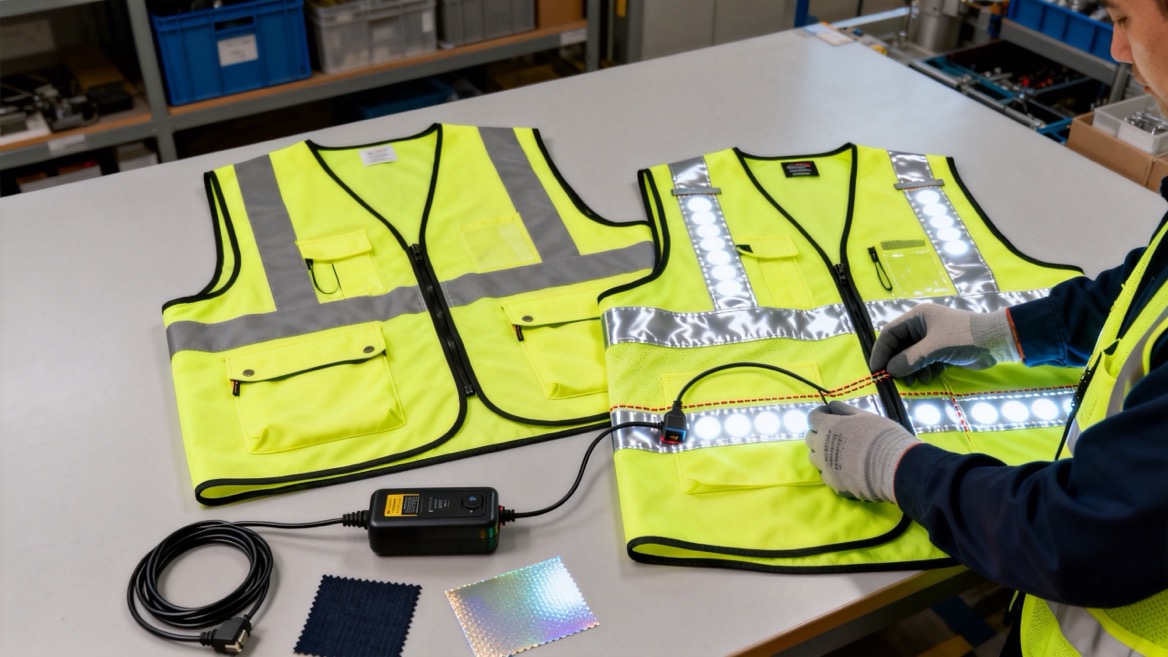
For predominantly daytime work and crews needing straightforward issue-and-care routines, reflective high-visibility clothing is generally the practical first choice.
For selected nighttime roles, LED-enhanced reflective clothing deserves evaluation when the employer can support charging, inspection, cleaning, and replacement procedures.
A mixed purchasing strategy may be appropriate: establish suitable reflective workwear across the workforce, then assess LED enhancements for tasks with a demonstrated need.
Send Shanghai Youti Clothing Co., Ltd. your destination market, required garment class, work environment, size range, cleaning method, and expected order quantity.
For LED-enhanced clothing, include shift duration and component requirements. Request a design review and sample evaluation before confirming bulk production specifications.
It can improve worker detection in some nighttime conditions. Results depend on the lighting configuration and environment. Use it as an enhancement to appropriate reflective high-visibility clothing.
Lights alone should not be assumed to satisfy applicable high-visibility apparel requirements. Verify the finished garment's classification and the rules governing the worksite.
Reflective high-visibility clothing with suitable fluorescent background material is generally the more straightforward choice. Prioritize classification, coverage, comfort, and fit.
Some designs permit washing under specific instructions. Others require removal of electrical components. Follow the exact garment instructions rather than a general "washable" claim.
Specify operation for the intended shift plus an appropriate reserve. Verify runtime under the selected lighting mode and relevant conditions instead of relying only on an advertised maximum.
Yes, subject to design review. Logo size and location must not compromise required material areas, placement, or garment performance.
1. National Institute for Occupational Safety and Health. ["Highway Work Zone Safety."] Page dated November 6, 2024. Source for the 2022 U.S. work-zone crash, injury, and fatality figures and the distinction between passing-traffic and construction-equipment hazards. [cdc]
2. Federal Highway Administration. ["Manual on Uniform Traffic Control Devices, 11th Edition, Part 6: Temporary Traffic Control."] December 2023; particularly Sections 6C.05 and 6D.04. Source for worker apparel requirements, garment-class selection, and nighttime flagger guidance. [mutcd.fhwa.dot]
3. International Organization for Standardization. ["ISO 20471:2013—High Visibility Clothing: Test Methods and Requirements."] Official standard summary. Source for color, retroreflection, material-area, and placement requirements. [iso]
4. Bhagavathula, Rajaram; Kassing, Andrew; Gibbons, Ron; and Medina, Alejandra. ["Lighted Work Zone Apparel: Effects on Visibility."] Virginia Tech Transportation Institute, Report 22-UR-118, submitted November 11, 2022. Source for the 16-participant study, lighting configurations, detection findings, and limitations. [vtechworks.lib.vt]
5. Occupational Safety and Health Administration. ["Whether Use of High-Visibility Warning Garments by Construction Workers in Highway Work Zones Is Required."] August 5, 2009. Supplementary source explaining U.S. occupational-safety obligations concerning struck-by hazards and high-visibility garments. [osha]


