
Views: 277 Author: Youti Clothing Publish Time: 2026-09-23 Origin: Site


Content Menu
>> Assess Chest and Waist Comfort
>> Confirm Jacket Length and Sleeve Length
● Choose the Right Jacket Construction
● Select Suit Fabric for Performance
>> Fabric Weight and Seasonality
>> Test Fabric Before Bulk Production
● Decide Between Single- and Double-Breasted Styles
>> Single-Breasted Suit Jackets
>> Double-Breasted Suit Jackets
● Choose Lapels, Vents, and Pockets Carefully
>> Lapel Style
>> Vent Style
● Use a Practical Suit Jacket Buying Checklist
● Why Fit Samples Matter for Private-Label Suit Brands
● Build a Suit Jacket Collection Around Real Use
● Partner With a Professional Suit Jacket Manufacturer
>> 1. What is the most important part of a suit jacket fit?
>> 2. How should a suit jacket fit around the chest?
>> 3. Should I choose a single-breasted or double-breasted suit jacket?
>> 4. Is a wool-polyester suit jacket good quality?
>> 5. What is the difference between fused and canvas suit jackets?
>> 6. How long should suit jacket sleeves be?
>> 7. What details should an OEM buyer confirm before ordering suit jackets?
Choosing the right suit jacket is not simply about selecting a color or following a trend. A well-designed jacket must balance fit, structure, comfort, fabric performance, occasion, and brand positioning. For retailers, private-label brands, wholesalers, and uniform buyers, the decision also affects return rates, customer satisfaction, repeat purchasing, and long-term product credibility.
From a garment-development perspective, the best suit jacket begins with the wearer's body and ends with the production details that customers may not immediately see: canvas construction, shoulder expression, sleeve pitch, fabric weight, seam allowance, button quality, and pressing standards. This guide explains how to choose a suit jacket that looks refined, moves comfortably, and performs well in real commercial use.
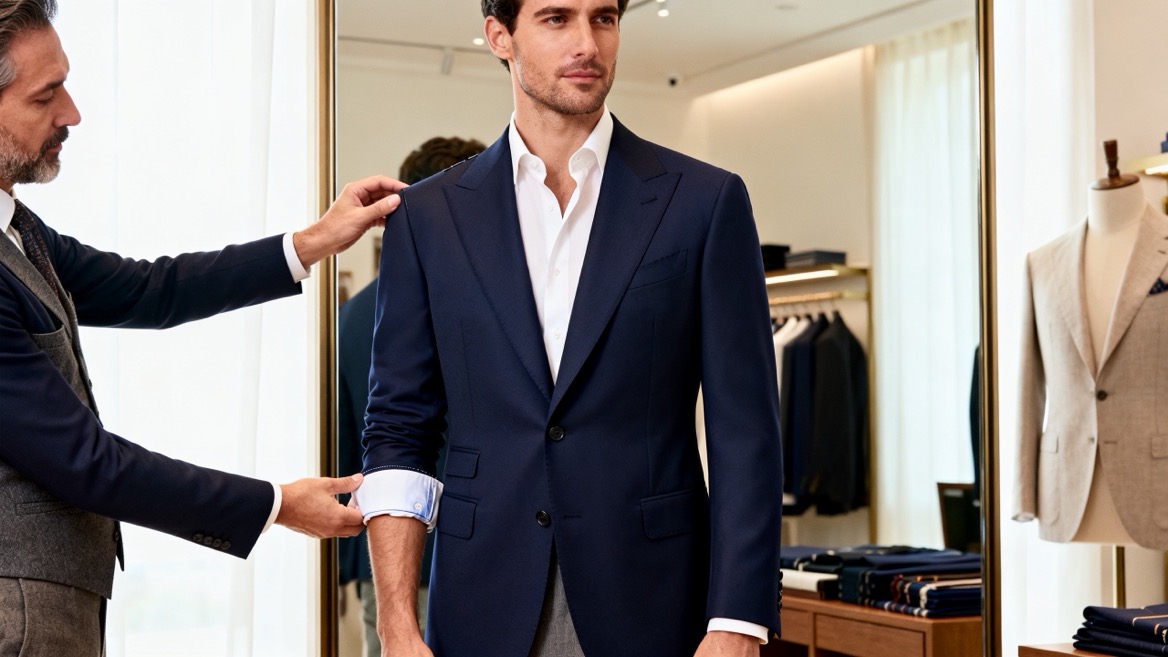
Fit is the foundation of a good suit jacket. A premium wool fabric or attractive lapel cannot compensate for shoulders that are too wide, a tight chest, or sleeves that break awkwardly at the wrist.
For ready-to-wear brands, fit consistency is one of the most important quality-control standards. For made-to-measure and OEM programs, accurate measurements, grading rules, and fitting samples are equally important.
The shoulder seam should end close to the wearer's natural shoulder point. It should not extend down the upper arm, and it should not pull inward before reaching the shoulder edge.
A poor shoulder fit is difficult and expensive to correct after production. In contrast, sleeve length, waist suppression, and jacket length can often be adjusted more easily.
Look for these signs:
- The shoulder line appears smooth rather than raised or collapsed.
- The sleeve head does not create a deep dent below the shoulder seam.
- The jacket does not hang beyond the natural shoulder.
- The wearer can raise and move the arms without severe pulling across the upper back.
- Shoulder padding supports the silhouette without making the body look unnaturally broad.
A lightly padded shoulder creates a softer, more contemporary appearance. A more structured shoulder can communicate authority and formality, making it suitable for business suits, ceremonial uniforms, and executive collections.
A suit jacket should sit close to the body, but it should never feel restrictive. When buttoned, the front should lie cleanly across the chest without pulling into an "X" shape around the button.
A practical fitting test is simple: button the jacket and place one flat hand between the chest and the jacket front. There should be comfortable room, but not excessive looseness.
Common fit problems include:
| Fit Issue | What It Usually Means | Production or Buying Solution |
|---|---|---|
| X-shaped wrinkles at the button | The chest or waist is too tight | Increase chest and waist ease |
| Loose fabric below the armhole | The chest is too large or armhole is too low | Refine chest shape and armhole position |
| Lapels pull away from the chest | The jacket is too small or the balance is incorrect | Recheck chest, front balance, and button position |
| Excess fabric at the back waist | The jacket lacks waist suppression | Adjust side seams or back seams |
| Tightness when reaching forward | Armhole or sleeve pitch needs adjustment | Improve sleeve setting and mobility allowance |
For commercial suit collections, brands should test fit on more than one body type. A sample that looks excellent on a fit model may perform poorly for a broader chest, rounded shoulders, or a more athletic build. This is why a well-planned size range and realistic grading are essential.
A traditional suit jacket usually covers the seat and creates a balanced line between the torso and legs. Shorter jackets can look more fashion-forward, while longer jackets can appear more formal and conservative.
For most classic business styles:
- The jacket hem should cover the wearer's seat.
- The front length should create a balanced silhouette rather than exposing too much trouser rise.
- The sleeves should finish near the wrist bone.
- Around ¼ to ½ inch of shirt cuff should normally remain visible.
These details may seem minor, but they strongly affect whether a suit appears tailored or off-the-rack. Fit specialists consistently identify shoulders, collar position, chest smoothness, jacket length, and sleeve length as the key visual checkpoints for a well-fitting jacket.
The inside construction of a suit jacket influences its shape, durability, breathability, drape, and price level. It is also one of the clearest ways for a fashion brand to differentiate an entry-level suit from a premium product.
A fused jacket uses adhesive interlining to bond the outer fabric to the internal structure. It is widely used because it is efficient, stable, and cost-effective.
Fused construction can work well when the manufacturer uses reliable interlining, correct fusing temperature, and appropriate pressure. However, poor-quality fusing may eventually cause bubbling, separation, or a stiff appearance after repeated dry cleaning or exposure to heat and humidity.
Fused jackets are commonly suitable for:
- Promotional uniforms
- Entry-level businesswear
- High-volume retail programs
- Price-sensitive private-label collections
- Lightweight seasonal jackets
A half-canvas jacket usually includes a floating canvas layer through the chest and lapel area, while the lower part of the jacket may use fused support.
This construction offers a more natural chest shape and lapel roll than a fully fused jacket. It is often an effective middle ground for brands seeking better quality without moving to the highest construction cost.
Half-canvas construction is suitable for:
- Mid-to-premium suit collections
- Corporate executive uniforms
- Contemporary formalwear
- Private-label brands focused on long-term customer value
A full-canvas jacket contains a floating canvas layer that extends through the body of the jacket. Over time, it can adapt more naturally to the wearer's body and provide a softer, more dimensional drape.
Full-canvas construction is generally used for premium tailoring, luxury collections, and high-end made-to-measure programs. It requires greater skill, more labor, and stronger quality control.
For buyers, the key question is not whether one construction is always "best." The right choice depends on the collection's target retail price, customer expectations, fabric type, market positioning, and planned wear frequency.
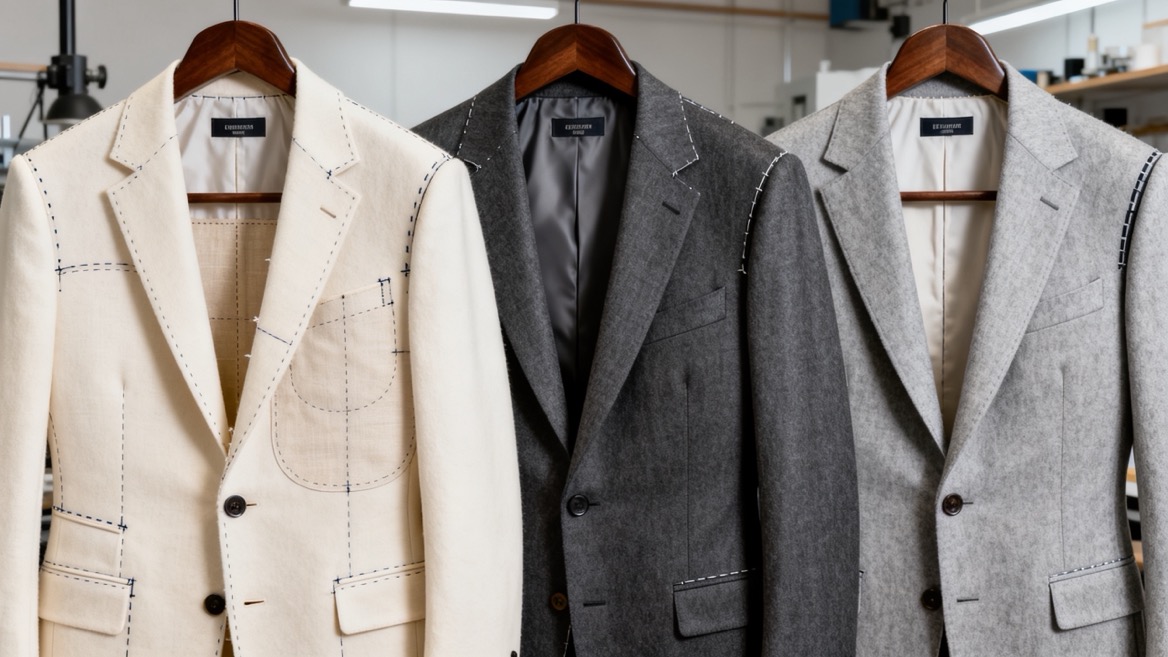
Fabric is the second major decision after fit. A visually attractive fabric that feels too heavy, wrinkles excessively, traps heat, or wears out quickly can damage the customer experience.
When selecting suiting fabric, consider fiber content, weight, weave, climate, durability, and maintenance requirements.
Wool remains one of the most versatile materials for suit jackets because it can offer breathability, wrinkle recovery, natural resilience, and year-round flexibility.
Popular options include:
- 100% wool: A classic choice for premium business suits and formal tailoring.
- Wool-polyester blend: Often improves durability, cost control, and easy-care performance.
- Wool-elastane blend: Adds controlled stretch and may improve comfort for travel, office movement, and uniform programs.
- Wool-silk blend: Provides a refined surface and subtle luster for eveningwear or luxury collections.
- Wool-linen blend: Offers a more relaxed texture for spring and summer jackets.
For brands selling internationally, fabric selection should reflect the destination market. A tropical-weight wool may be more suitable for warm and humid climates, while a heavier flannel or twill can suit cooler seasons.
Fabric weight affects drape, warmth, and the overall hand feel of the jacket. While exact preferences vary by mill and fabric construction, a useful product-development approach is:
| Fabric Category | Typical Use | Main Advantage |
|---|---|---|
| Lightweight suiting | Warm climates, summer collections, travel | Cooler and easier to wear in heat |
| Midweight suiting | Four-season businesswear | Versatile balance of comfort and structure |
| Heavyweight suiting | Autumn, winter, formal tailoring | Strong drape and warmth |
| Stretch suiting | Uniforms, commuting, active businesswear | Better movement and recovery |
Do not select fabric weight based only on the calendar. Consider where the customer will wear the suit, how often they travel, whether the product is intended for indoor office use, and whether the wearer values softness or structure.
Before confirming a bulk order, request fabric swatches and make a fitting sample. The same fabric can behave differently depending on the jacket pattern, interlining, shoulder construction, and pressing method.
A reliable pre-production review should include:
1. Hand feel and visual appearance under natural light.
2. Wrinkle recovery after squeezing the fabric.
3. Color consistency between fabric lots.
4. Shrinkage and dimensional stability testing.
5. Pilling and abrasion performance.
6. Compatibility with fusing and lining materials.
7. Pressing response around lapels, seams, and sleeve heads.
This step is especially important for OEM buyers. A fabric may look excellent as a swatch but perform differently once it is cut, fused, sewn, pressed, packed, shipped, and worn.
The choice between a single-breasted and double-breasted jacket affects silhouette, styling flexibility, fabric consumption, fit requirements, and merchandising strategy.
A single-breasted jacket has one column of buttons and a narrower front overlap. It is the most versatile choice for mainstream businesswear, wedding suits, office uniforms, and everyday tailoring.
Its advantages include:
- Easy to wear across formal and semi-formal settings.
- Works well for many body shapes.
- Requires less fabric than many double-breasted designs.
- Offers broad appeal for wholesale and retail collections.
- Pairs easily with trousers, chinos, knitwear, and open-collar shirts.
A two-button single-breasted jacket remains a practical choice for many markets because it balances classic styling with a modern silhouette.
A double-breasted jacket has overlapping front panels and two columns of buttons. It often uses peak lapels and presents a stronger, more structured visual effect.
A well-cut double-breasted jacket can make the upper body appear broader and create a more formal, confident image. However, because of its additional front overlap and stronger styling, fit accuracy is particularly important. The chest must remain smooth, the waist shaping should be controlled, and the jacket length should avoid looking too short or boxy.
Double-breasted jackets can work especially well for:
- Luxury tailoring collections
- Hotel and hospitality uniforms
- Formal eventwear
- Fashion-forward menswear brands
- Ceremony, performance, and premium corporate clothing
For a double-breasted jacket, the lower button is generally left unfastened. This helps preserve the jacket's line and allows more natural movement.
Small design decisions can substantially change the perceived value and intended use of a suit jacket.
Notch lapels are widely used for business suits and versatile blazers. They are easy to style and appropriate for many commercial collections.
Peak lapels create a sharper, more formal appearance. They are common on double-breasted jackets, formal suits, tuxedo-inspired designs, and premium fashion pieces.
Shawl lapels are typically associated with dinner jackets and formal eveningwear. They offer a smooth, elegant line but are not usually the first choice for a standard business suit.
A vent is the opening at the lower back of a suit jacket.
- Single vent: Common in traditional and more economical suit styles.
- Side vents: Often preferred for mobility, especially when sitting or placing hands in trouser pockets.
- No vent: More formal in appearance but can be less practical for movement.
For officewear and premium business suits, side vents are often a strong choice because they help the jacket fall more cleanly when the wearer sits or walks.
Pocket selection should match the suit's purpose.
- Flap pockets are suitable for most business and everyday suits.
- Jetted pockets provide a cleaner, more formal appearance.
- Patch pockets create a relaxed, sportier character.
- Ticket pockets add a traditional tailoring detail and can elevate a heritage-inspired collection.
For OEM product development, these details should be finalized in the tech pack. Ambiguous instructions such as "premium pockets" or "Italian style lapel" can lead to inconsistent interpretations during sampling.
Before buying or developing a suit jacket, review the following points. This checklist is useful for individual buyers and for sourcing teams preparing a private-label collection.
- Does the shoulder seam align with the natural shoulder?
- Does the collar sit close to the shirt collar without a gap?
- Does the chest remain smooth when the jacket is buttoned?
- Can the wearer move the arms comfortably?
- Does the waist look shaped without feeling tight?
- Does the jacket cover the seat appropriately?
- Do the sleeves end near the wrist bone?
- Is a small amount of shirt cuff visible?
- Is the fabric suitable for the intended climate and use?
- Does the jacket recover well after movement and sitting?
- Are the lapels smooth and properly pressed?
- Are buttonholes clean and evenly spaced?
- Do the sleeve buttons align consistently?
- Are lining, seams, and interior pockets neatly finished?
- Is the stitching balanced without skipped stitches or puckering?
- Has the jacket passed measurement and appearance inspection?
- Confirm the target customer and retail price range.
- Define fabric composition, weight, color, and performance requirements.
- Select construction: fused, half-canvas, or full-canvas.
- Approve the base block and size grading rules.
- Confirm lapel shape, button stance, vent style, pocket design, and lining.
- Approve a fit sample before production.
- Conduct pre-production inspection before bulk cutting.
- Set acceptable quality limits for measurement tolerance, shade variation, and workmanship.
A suit jacket is not a simple cut-and-sew product. Small changes in shoulder angle, chest ease, sleeve pitch, armhole height, button placement, and front balance can transform how a garment looks on the body.
For this reason, fit sampling is one of the highest-value steps in suit development.
A professional sampling process should normally include a first prototype, fit comments, a revised sample, and a final pre-production approval. When developing a new block, brands should avoid approving bulk production based only on a flat garment measurement chart.
A measurement chart tells the factory what the garment should measure. A fit sample reveals how the garment actually performs on a human body.
For example, two jackets can have the same chest measurement, but one may feel tighter because of a lower armhole, a narrower back width, a different sleeve angle, or thicker internal construction. Experienced product teams evaluate both garment measurements and wearer comfort before confirming production.
The strongest suit collections are designed around how customers actually dress, work, travel, and attend events.
A practical commercial range may include:
- A navy two-button business suit for office and interview use.
- A charcoal suit for formal meetings and conservative occasions.
- A stretch-blend travel suit for commuting and frequent movement.
- A lightweight wool or wool-linen jacket for warm-weather markets.
- A double-breasted suit for premium or fashion-led customers.
- A tuxedo or dinner jacket for weddings and evening events.
Instead of offering many similar styles, brands should create clear product roles. Each jacket should answer a specific customer need: everyday businesswear, formal presentation, event dressing, hospitality uniform, or modern smart-casual tailoring.
This approach makes product planning clearer for buyers and makes online merchandising easier for customers.

For brands, wholesalers, and garment companies, a successful suit jacket program requires more than an attractive design sketch. It requires reliable fabric sourcing, accurate pattern development, controlled sampling, skilled sewing, structured pressing, measurement inspection, and consistent packaging.
Shanghai Youti Clothing Co., Ltd. supports OEM suit and professional apparel development for international brands, wholesalers, manufacturers, and uniform buyers. From fabric selection and pattern customization to sample approval and bulk production, the goal is to help partners develop suit jackets that reflect their market positioning and meet practical wearing expectations.
Whether you are building a business-suit collection, a hospitality uniform program, a formalwear line, or a private-label tailoring brand, begin with a clear brief: target market, fit profile, fabric standard, construction level, order quantity, and required delivery schedule.
Contact Shanghai Youti Clothing Co., Ltd. to discuss your OEM suit jacket project, request a sample review, or develop a tailored production plan for your brand.
The shoulders are the most important starting point. The shoulder seam should align closely with the wearer's natural shoulder edge. If the shoulders are too wide, too narrow, or poorly shaped, the entire jacket will look incorrect and may be difficult to alter effectively.
A suit jacket should sit smoothly across the chest when buttoned. It should not pull into an X shape, force the lapels apart, or feel restrictive when the wearer moves. At the same time, it should not have large amounts of loose fabric below the armholes.
Choose a single-breasted jacket if you want maximum versatility, easier styling, and broad commercial appeal. Choose a double-breasted jacket if you want a more formal, structured, and fashion-conscious appearance. Double-breasted styles require particularly accurate fit and proportion.
A wool-polyester suit jacket can be a practical and reliable product when the fabric quality and garment construction are properly controlled. Wool adds comfort and resilience, while polyester can improve durability, crease resistance, and cost efficiency. The right blend depends on the product's target price and intended use.
A fused jacket uses adhesive interlining for structure. A half-canvas jacket includes a floating canvas layer through the chest and lapel area. A full-canvas jacket uses canvas through more of the jacket body and is generally associated with premium tailoring, softer drape, and higher production cost.
Suit jacket sleeves should normally end near the wrist bone, allowing approximately ¼ to ½ inch of shirt cuff to show. Exact preference can vary by market and style, but the sleeve should not cover the hand or leave too much shirt cuff exposed.
An OEM buyer should confirm fabric composition, weight, color, lining, construction, lapel type, pocket style, vents, buttons, measurements, grading, labels, packaging, sample approval, production schedule, and inspection standards before bulk production begins.
1. [StudioSuits: 8 Things to Consider When Choosing a Suit Jacket]
2. [Men's Wearhouse: How to Measure for a Suit—Jacket and Trouser Fit Guide]
3. [Jos. A. Bank: How a Suit Should Fit—The Complete Guide]
4. [Oliver Wicks: How a Suit Should Fit—The Definitive Guide for Men]
5. [Articles of Style: The Ultimate Guide to Double-Breasted Jacket Fit]
6. [GQ: How to Wear a Double-Breasted Jacket, According to Tailoring Experts]
7. [The Black Tux: Double-Breasted Suit Modern Style Guide]
8. [Artefact London: Double-Breasted Suits and Jackets Guide]


