
Views: 298 Author: Youti Clothing Publish Time: 2026-09-21 Origin: Site


Content Menu
● How We Selected Manufacturers
>> 1. Shanghai Youti Clothing Co., Ltd.
>> 3. Jiangsu Guotai International Group
>> 6. D&J Fashion Supply Chain
>> 8. Newasia Garment Co., Ltd.
>> 9. Foshan Nanhai Plus Garment
● Technical Requirements for Womens Black Business Suits
>> Recommended Material Specifications
>> Construction Details That Affect Quality
>> The Less-Discussed Insider Check
>> Sample Process Recommended for Buyers
>> Logistics and Packaging Considerations
>> 1. How can I verify whether an ISO 9001 certificate is still valid?
>> 2. What MOQ should I expect for a Womens Black Business Suit OEM order?
>> 3. What quality tests should I request for black business suits?
>> 4. How do I prevent the bulk garment from differing from the approved sample?
>> 5. Should I choose a factory with CE, RoHS, BSCI, ISO 9001, or OEKO-TEX documentation?
China remains a major global apparel-sourcing base because it combines fabric availability, specialized garment clusters, experienced export teams, and broad OEM capacity. For buyers sourcing Womens Black Business Suit programs, the key advantage is not simply a lower quoted price—it is access to suppliers that can coordinate fabric, pattern development, structured tailoring, trims, testing, packaging, and export documentation in one production workflow.
A black business suit may look straightforward, but it is a technically demanding product. The garment must maintain a clean silhouette after pressing, transport, repeated wear, and dry cleaning. It also needs reliable shade consistency across jackets, trousers, skirts, and later repeat orders. That makes supplier selection particularly important for professional brands, wholesalers, corporate-uniform distributors, and private-label buyers.
China is still among the leading apparel-exporting countries globally, supported by extensive textile supply chains and manufacturing depth. Industry research also indicates that China remains one of the largest apparel markets and a major contributor to global apparel production and exports.

This list is designed for international buyers looking for a long-term OEM or ODM partner rather than a one-time low-price supplier. The companies below are presented as potential sourcing candidates based on publicly available information, product positioning, export orientation, manufacturing focus, and suitability for structured women's apparel.
A professional supplier review should go beyond a website, catalog, or quotation. For a Womens Black Business Suit order, evaluate factories against the following criteria:
| Evaluation factor | What professional buyers should check | Why it matters for black business suits |
|---|---|---|
| Manufacturing specialization | Whether the supplier makes suits, uniforms, woven formalwear, trousers, shirts, or structured jackets | A factory focused only on knitwear may not have the pressing, fusing, pattern, and finishing skills required for a tailored blazer |
| Pattern and sample capability | In-house pattern makers, fitting process, size grading, sample turnaround time | Women’s tailoring requires accurate bust, waist, shoulder, sleeve, and hip balance |
| Fabric sourcing | Ability to source wool blends, polyester-viscose blends, recycled polyester, stretch suiting, lining, interlining, and trims | Fabric weight, recovery, colorfastness, and pilling resistance directly affect perceived quality |
| Quality-control process | Incoming fabric inspection, in-line inspection, final inspection, measurement control, needle control, packing checks | Black garments make pressing marks, shade differences, dust, oil stains, and chalk marks especially visible |
| Compliance and audit records | ISO 9001, BSCI or equivalent social-audit documentation, REACH-related material declarations, factory-specific audit scope | Buyers need traceability and confidence that the stated standards apply to the relevant factory and product scope |
| Production capacity | Sewing lines, staff structure, monthly output, peak-season planning | Repeat uniform orders and seasonal retail launches depend on stable capacity |
| OEM flexibility | Private labels, woven labels, hangtags, branded lining, embroidery, packaging, fit customization | Private-label suit programs often require detailed branding and multiple size ranges |
| Communication and export experience | English-language technical communication, response speed, export-market knowledge, Incoterms familiarity | A clear tech pack still requires quick clarification and precise execution |
For context, China's apparel production is supported by geographically concentrated supply networks. Guangdong is known for fashion and rapid-response garment ecosystems; Zhejiang has strong textile, apparel, and export infrastructure; Jiangsu and Shanghai support more formalwear, uniform, and woven-garment supply chains; while Fujian is highly developed in performance and functional apparel. Industry analysis has noted that Shandong, Jiangsu, Zhejiang, Fujian, and Guangdong account for a substantial share of China's total garment output.
The following comparison is intended as a starting point for factory outreach and qualification. Production capacity and MOQ can change by fabric, construction, season, order complexity, and current factory loading. Confirm all commercial terms directly with each supplier before placing an order.
| Manufacturer | Established | Main positioning | Typical buyer fit | MOQ suitability | Publicly stated certifications or compliance signals |
|---|---|---|---|---|---|
| Shanghai Youti Clothing Co., Ltd. | 2018 | Business apparel, suits, uniforms, workwear, shirts, jackets | Growing brands, uniform distributors, SMEs needing flexible OEM support | Suitable for development and medium-volume programs; confirm by style | ISO 9001, BSCI, REACH, EN 1149-5, EN ISO 11612 |
| Hodo Group | 1980 | Large-scale apparel, suits, shirts, uniforms and businesswear | Established brands and volume buyers | Generally more suitable for larger programs | Verify current factory-specific audit and product scope |
| Jiangsu Guotai International Group | 1981 | Export-oriented textile and garment supply chain | Importers, retailers, multi-category buyers | Usually suitable for scalable programs | Verify applicable production-site compliance documents |
| Esquel Group | 1978 | Premium woven apparel and cotton-based wardrobe essentials | Premium brands requiring robust material and process control | Often better for structured, established programs | Verify category-specific manufacturing and audit scope |
| Shenzhou International | 2005 | Large-scale vertically integrated apparel manufacturing | Large international brands and high-volume buyers | Generally high-volume oriented | Verify whether tailored woven suits fit the assigned facility’s expertise |
| D&J Fashion Supply Chain | Not publicly confirmed in this guide | Apparel development and supply-chain management | Brands requiring broad sourcing coordination | Often flexible depending on program | Verify factory ownership, audit status, and manufacturing location |
| Yinmao Fashion | Not publicly confirmed in this guide | Women’s fashion, ODM/OEM development | Fashion-led womenswear brands | Often more flexible than major groups | Verify structured-tailoring experience and production controls |
| Newasia Garment Co., Ltd. | Not publicly confirmed in this guide | OEM apparel, export production, private-label support | Buyers requiring general apparel OEM services | Confirm style-specific MOQ | Public sources reference ISO 9001, BSCI, and OEKO-TEX-related standards; verify directly |
| Foshan Nanhai Plus Garment | Not publicly confirmed in this guide | Denim, outerwear, streetwear and wash development | Casual-fashion buyers | Less directly aligned with formal tailoring | Verify suit-jacket capability before development |
| Qingdao Fab Mill | Not publicly confirmed in this guide | Eco-material-oriented apparel and natural-fiber blends | Buyers prioritizing material stories and sustainability | Confirm MOQ and tailoring capability | Verify material transaction records and product-specific testing |
Shanghai Youti Clothing Co., Ltd. is a practical candidate for brands and uniform buyers that need a balance between formalwear capability, customization support, and manageable communication. Founded in 2018, the company states that it operates a 2,500-square-metre workshop with more than 300 machines, six sewing lines, and annual output exceeding 1.4 million pieces. Its stated product range includes suits, shirts, uniforms, workwear, trousers, and jackets.
For a Womens Black Business Suit program, this combination is useful because blazer-and-trouser production requires coordination across multiple processes: pattern adjustment, fabric inspection, cutting, fusing, sewing, lining installation, pressing, final measurement, and packing. A supplier producing both formal apparel and workwear can be especially relevant to buyers developing office uniforms, hospitality attire, corporate clothing, retail staff uniforms, or business-casual collections.
Youti's stated certification portfolio includes ISO 9001, BSCI, REACH, EN 1149-5, and EN ISO 11612. Buyers should note that EN 1149-5 and EN ISO 11612 are primarily associated with protective workwear performance, not standard office suits. However, these credentials can indicate familiarity with documentation-heavy workwear projects. For a conventional women's business suit, the buyer should separately specify fabric chemical requirements, restricted-substance limits, colorfastness tests, and any destination-market labeling rules.
The company states that it supports customization from technical documents, images, and physical samples. It also reports a 10–15 working-day sampling window and a 45–60 working-day bulk-production lead time, subject to style and order requirements.
Core strengths for buyers
- Suitable for OEM buyers that need suits, uniforms, jackets, shirts, and workwear from one supplier.
- Offers a structured workflow covering design and development, sampling, production, after-sales support, and quality inspection.
- May be a good fit for small and medium-sized brands that need more responsive development support than they may receive from very large garment groups.
- States that Europe is its largest market, with North America and Oceania also identified as core markets.
- Supports custom logos through embroidery or printing, which can be useful for corporate-uniform and branded-workwear programs.
Questions to ask before ordering
- What is the minimum quantity per color, fabric, and size range for a fully lined black blazer?
- Can the factory source the specified suiting fabric at the required weight, for example 280–340 GSM?
- Can it reserve the same dye lot for matching trousers, skirts, waistcoats, and future replenishment orders?
- What AQL level will be written into the purchase order?
- Can the factory provide a pre-production sample and a sealed "golden sample" before bulk cutting?
Hodo Group is a large Chinese apparel group with a long operating history and product relevance to structured clothing, including shirts, suits, uniforms, and businesswear. It can be an option for buyers that require scale, organizational maturity, and stable processes for repeat corporate or retail programs.
For Womens Black Business Suit sourcing, a large supplier can be valuable when the order involves multiple garments—such as blazer, trouser, skirt, vest, blouse, and outerwear—across broad size ranges and several delivery windows. The trade-off is that major groups may be less flexible for early-stage brands, very low-volume requests, or frequent changes after sample approval.
Core strengths for buyers
- Better suited to buyers with stable forecasts and defined annual quantities.
- Potentially appropriate for multi-style uniform programs or large retail collections.
- May offer stronger purchasing leverage and structured manufacturing systems for repeat volume.
What to verify
- Which specific production facility will make the order.
- Whether that factory has recent experience with women's tailored jackets rather than only men's shirts or general uniforms.
- The actual MOQ for black blazer-and-trouser sets.
- Whether the assigned facility can meet your required AQL, shade-control, and pressing standards.
Jiangsu Guotai International Group is a diversified, export-oriented organization with textile and garment capabilities. It can be relevant to importers and retailers that prefer working with a supply-chain partner capable of coordinating multiple garment categories and broader sourcing requirements.
For black business suits, this type of organization may be useful when the buying program requires more than tailored apparel. Examples include women's suits combined with blouses, knit tops, outerwear, accessories, or corporate-uniform capsules. Buyers should identify whether the supplier is acting as the direct factory, a manufacturing coordinator, or a trading and supply-chain management organization for the specific quotation.
Core strengths for buyers
- Potential capacity to support multi-category apparel sourcing.
- Familiarity with export documentation and international trade workflows.
- Suitable for buyers that need broader sourcing rather than a single product category.
What to verify
- The name and location of the actual manufacturing facility.
- Whether the quotation comes directly from the sewing factory or through a trading structure.
- The factory's current audit report, production capacity, and in-line inspection procedures.
- Who owns pattern files, molds, graded specifications, and approved samples.
Esquel Group is widely associated with high-quality woven apparel, particularly shirts and cotton-based wardrobe products. For buyers developing a premium businesswear collection, the group's experience in woven-garment processes, fabric consistency, and quality systems may be attractive.
That said, buyers should not assume that expertise in premium shirts automatically equals expertise in women's structured suiting. A womenswear blazer requires different construction controls, including chest shaping, shoulder-pad application, lapel roll, front-edge stability, hem balance, and lining accuracy. Ask for examples of relevant structured-woven products before committing to a suit program.
Core strengths for buyers
- Strong fit for premium woven categories and quality-sensitive programs.
- Potentially suitable where shirts, blouses, and formal separates are sourced alongside suits.
- Better aligned with established brands that can support detailed development and compliance requirements.
What to verify
- Whether the facility can make fully lined women's blazers with the required fit standard.
- Whether the proposed fabric supplier can meet pilling, abrasion, and colorfastness requirements.
- How the supplier manages black shade consistency across production batches.
Shenzhou International is one of China's large-scale apparel manufacturers and is strongly associated with vertically integrated manufacturing and major global brand programs. It is often relevant for high-volume buyers seeking scale, process control, and established supply-chain capability.
However, professional buyers should match the factory's specific product expertise to the product category. Shenzhou is especially well known for knitwear and large-volume apparel programs. A tailored woven business suit is a different production discipline from T-shirts, polo shirts, or knit activewear. Before initiating development, confirm that the relevant unit has demonstrated expertise in structured woven jackets and women's formalwear.
Core strengths for buyers
- Large-scale production capability.
- Potentially strong process systems for high-volume, long-term programs.
- Better suited to mature brands with accurate forecasts and large order quantities.
What to verify
- Whether the proposed facility specializes in woven tailoring.
- Whether the MOQ is commercially realistic for your product launch.
- Whether the supplier will accept small development runs before a larger seasonal order.
D&J Fashion Supply Chain is positioned as an apparel development and sourcing-oriented partner. This type of supplier can be relevant for brands that need support with product development, fabric selection, production coordination, and speed-to-market planning.
For business suits, supply-chain providers can be useful when a buyer needs several factories or specialty processes coordinated under one project. For example, one unit may produce the blazer, another may develop a stretch lining, and a third may manage branded packaging. However, buyers must clearly establish who bears responsibility for final quality, inspection, claims, and shipment delays.
Core strengths for buyers
- Useful for brands that require product-development coordination.
- May support multi-category womenswear collections.
- Can be relevant when the buyer has limited in-house sourcing resources.
What to verify
- Whether the supplier owns the factory or manages third-party factories.
- The exact factory address, legal entity, and audit records.
- Who performs final inspection and who is contractually liable for defects.
- Whether fabrics are purchased under the buyer's approved specification.
Yinmao Fashion is associated with women's fashion development and OEM/ODM production. Its positioning may be attractive for womenswear brands that place equal importance on commercial styling, fit adaptation, and seasonal product development.
For a black business-suit collection, a fashion-oriented factory can help buyers develop modern silhouettes—cropped blazers, relaxed-fit suits, double-breasted jackets, wide-leg trousers, fitted waistcoats, or matching skirts. Yet fashion responsiveness should not replace manufacturing discipline. Buyers need to ensure that the supplier can maintain repeatable fit and construction when moving from a showroom sample to bulk production.
Core strengths for buyers
- Potentially more suitable for fashion-led women's collections.
- May be more open to seasonal design iteration and silhouette development.
- Could fit buyers that need blazer-and-separate collections rather than standardized uniforms.
What to verify
- Women's tailoring experience, especially in structured jackets.
- Sample-to-bulk consistency for sleeve pitch, lapel symmetry, and shoulder balance.
- The factory's grading methodology for plus sizes and international size ranges.
Newasia Garment is presented in public industry content as an OEM clothing supplier serving international markets. Public material references ISO 9001, BSCI, and OEKO-TEX-related compliance signals, but buyers should independently verify current certificates, issuing bodies, expiry dates, and whether the documents cover the exact production facility.
This supplier type may suit private-label brands looking for end-to-end apparel support, including development, branding, labels, packaging, and export coordination. For Womens Black Business Suit sourcing, the key is confirming formal tailoring capability rather than relying on a broad apparel catalog.
Core strengths for buyers
- Potential private-label and export-oriented OEM support.
- Publicly references certifications commonly requested by international buyers.
- May be relevant to brands requiring multiple apparel categories.
What to verify
- Whether the factory has a dedicated suit or woven-tailoring line.
- Whether OEKO-TEX-related claims refer to a factory, a fabric mill, or a specific finished product.
- Whether its quoted lead time includes fabric booking, lab dips, sampling, and bulk production.
Foshan Nanhai Plus Garment is more closely associated with denim, streetwear, outerwear, and wash development than with classic office tailoring. It may be relevant if the product direction is a relaxed black suit, utility-inspired blazer, heavyweight overshirt, or workwear-fashion collection rather than a traditional corporate business suit.
Buyers should avoid forcing a supplier into a category outside its core competency. A supplier excellent at denim washes may not have the pressing precision, fusing controls, and clean finishing required for a formal women's blazer.
Core strengths for buyers
- Potential fit for fashion-forward, workwear-inspired, or casual-suiting products.
- Useful when black tailoring is combined with denim, canvas, washed fabric, or utility details.
What to verify
- Whether the factory has experience with fully lined, structured business blazers.
- The availability of tailoring equipment such as fusing presses, sleeve setters, and high-quality finishing stations.
- Whether the factory can meet officewear-grade appearance requirements.
Qingdao Fab Mill is positioned around eco-oriented fabrics and apparel, including natural-fiber and lower-impact material options. It may be worth considering for brands developing black business suits with a sustainability-led material story, such as recycled polyester blends, organic cotton blends, linen blends, or lower-impact viscose alternatives.
Material sustainability claims require documentary evidence. Buyers should not accept a generic claim that a garment is "eco-friendly." Request transaction certificates, fiber-content test reports, fabric composition records, restricted-substance documentation, and traceability for the exact bulk material.
Core strengths for buyers
- Potential fit for brands prioritizing fiber transparency and material positioning.
- Relevant to less conventional suiting fabrics and eco-conscious collections.
What to verify
- Whether the fabric can maintain a sharp tailored appearance.
- Whether the material has acceptable wrinkle recovery, pilling resistance, and colorfastness.
- Whether each claimed sustainable material can be traced to the relevant production batch.
A professional black business suit should be specified as a garment system, not merely as "black blazer + black trousers." The more detailed the technical package, the lower the risk of quality disputes.
For mainstream corporate uniforms and commercial businesswear, polyester-viscose-elastane blends are widely used because they offer durability, controlled cost, easier care, and better recovery than pure natural fibers. For premium brands, wool blends or wool-rich fabrics can improve drape and breathability, but they usually require more careful care instructions and stronger fabric-quality control.
| Fabric option | Typical use | Key advantages | Main risks to manage |
|---|---|---|---|
| Polyester-viscose-elastane | Corporate uniforms, retail programs, mid-market suits | Cost control, crease recovery, durability, easier care | Excessive polyester can reduce breathability and create a less refined hand feel |
| Wool-polyester blend | Premium officewear, executive uniforms | Better drape, more sophisticated appearance, improved comfort | Fabric price, dry-cleaning needs, shrinkage control |
| Recycled polyester blend | Sustainability-led collections | Potential recycled-content story, durable performance | Documentation must match the exact fabric batch |
| Tencel or viscose blend | Softer women’s tailoring and fashion suiting | Drape, softness, premium visual appeal | Wrinkling, seam slippage, shrinkage, color variation |
| Stretch suiting | Fitted jackets and trousers | Mobility and comfort | Excess stretch can cause bagging at knees, elbows, and seat areas |
For a classic black women's blazer, a common commercial target is fabric in the approximate range of 280–340 GSM, depending on climate, silhouette, lining level, and intended season. A summer suit may be lighter, while a structured, fully lined corporate uniform may require a heavier fabric for better shape retention.
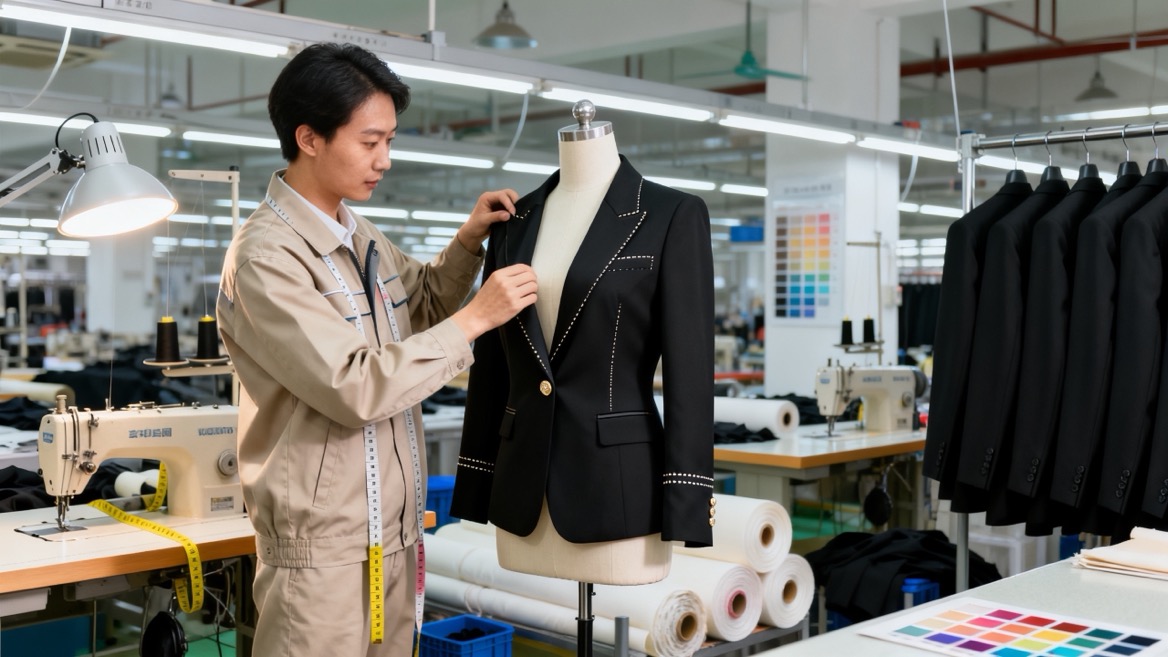
A reliable factory should be able to discuss the following details clearly:
- Fusing method: The interlining must bond evenly without bubbling, delamination, or visible press marks.
- Lapel symmetry: Left and right lapels must match in width, roll, angle, and point position.
- Shoulder construction: Shoulder pads, sleeve heads, and sleeve pitch determine whether the jacket hangs smoothly.
- Front-edge stability: The blazer front should not wave, twist, or pull after pressing.
- Lining quality: The lining should be smooth, correctly eased, and free from tension at the back pleat and armhole.
- Button security: Buttons should withstand repeated wear; specify thread shanks, reinforcement buttons, and pull-test requirements where needed.
- Trouser balance: Side seams, inseams, rise, waistband, and hem should remain balanced on the intended body type.
- Shade consistency: The jacket, trouser, skirt, waistcoat, and replacement orders should match within agreed color tolerance.
- Pressing standard: Black fabric reveals shine, seam impressions, chalk marks, lint, and heat damage more easily than lighter colors.
Buyers often request CE or RoHS documents when sourcing garments. This can create confusion.
- CE marking generally applies to certain regulated products, including many categories of personal protective equipment, rather than ordinary office suits.
- RoHS is mainly relevant to electrical and electronic equipment, not standard clothing.
- For Womens Black Business Suit programs, more relevant requirements may include restricted-substance controls, REACH-related declarations for materials, fiber-content verification, azo-dye restrictions, colorfastness testing, labeling compliance, and social-compliance audits.
- If the suit is part of a protective uniform or functional workwear program, additional testing may apply based on the hazard, destination market, and intended use.
The greatest risk in black business-suit sourcing is not always an obvious defect. It is often a small technical shortcut that becomes expensive after the goods reach the buyer's warehouse.
| Common problem | Why it happens | How to reduce the risk |
|---|---|---|
| Fabric substituted after sample approval | Supplier uses a cheaper bulk fabric with similar appearance | Write fiber content, GSM, weave, finish, supplier name, color code, and approved swatch into the purchase order |
| Jacket and trousers do not match in black shade | Different dye lots, different fabric rolls, poor lot control | Require same-dye-lot allocation and approve a bulk shade band before cutting |
| Fusing bubbles after shipment | Incorrect interlining, heat settings, pressure, or fabric compatibility | Request wash or dry-clean testing of the bonded front panel before bulk production |
| Size inconsistency | Weak grading, inaccurate cutting, inconsistent sewing allowances | Require measurement tolerances and inspect a size run before final approval |
| Pressing shine on black fabric | Excess heat, direct iron contact, poor pressing equipment | Specify no-shine finishing requirements and inspect garments under strong light |
| Poor lapel shape | Inexperienced tailoring line or insufficient pressing control | Request close-up sample photos and physical samples from multiple production sizes |
| Inaccurate compliance claims | Generic certificates do not cover the actual factory or product | Verify document number, scope, issuing body, validity dates, and factory address |
| Late delivery | Fabric booking starts too late or factory accepts excess orders | Ask for a critical-path production schedule before paying the deposit |
One of the most overlooked checks in tailored black-suit procurement is the fabric-lot reservation and replenishment plan.
Many buyers approve a beautiful pre-production sample, complete the first bulk order, and assume future repeat orders will match. Six months later, the factory sources a new black fabric lot from another mill or dye batch. Under warehouse lighting, the difference may look minor. Under office lighting, daylight, or a customer's camera, the black jacket and replacement trousers may appear noticeably different.
This becomes especially serious for corporate uniform programs. A new employee's jacket should not look charcoal, blue-black, or brown-black next to existing staff uniforms.
Before placing an order, ask the supplier:
1. Will all garments in the first shipment use the same fabric dye lot?
2. Can unused approved fabric be reserved for replenishment orders?
3. If not, can the supplier keep a physical approved shade standard?
4. What color-tolerance standard will be used for repeat production?
5. Will future lab dips be compared under multiple light sources, including daylight and store or office lighting?
This question often reveals whether a supplier truly understands uniform continuity and long-term apparel programs.
A practical development sequence for a new Womens Black Business Suit program is:
1. Send a detailed tech pack with sketches, measurements, grading rules, fabric composition, GSM, color standard, construction notes, trims, branding, labels, packing, and test requirements.
2. Sign an appropriate confidentiality and intellectual-property agreement before sending unique patterns or proprietary designs.
3. Request a first development sample and provide consolidated comments rather than fragmented feedback.
4. Approve the revised fit sample after a real wearer fitting, not only flat-lay photos.
5. Confirm a pre-production sample made with bulk-equivalent fabric, lining, buttons, labels, and packaging.
6. Seal the approved "golden sample" and state that it is the final benchmark for bulk inspection.
7. Require in-line inspection before more than 20–30% of the order is completed.
8. Arrange final random inspection before the balance payment or shipment release.
Black suits require careful packing because dust, lint, pressure marks, and moisture damage are visible and costly.
- Use individual polybags or garment bags with sufficient ventilation according to the buyer's packing specification.
- Consider tissue paper, collar support, hanger packing, or folded packing depending on retail channel and freight cost.
- Define whether jackets must be packed on hangers and whether the shipment needs carton dividers.
- Use moisture-control measures for sea freight, particularly for long transit routes and humid seasons.
- Confirm carton dimensions, maximum carton weight, shipping marks, barcode placement, country-of-origin labeling, and retailer-routing requirements before production begins.
- For DDP terms, clarify customs responsibility, duties, VAT, destination-market compliance, and claims procedures in writing.
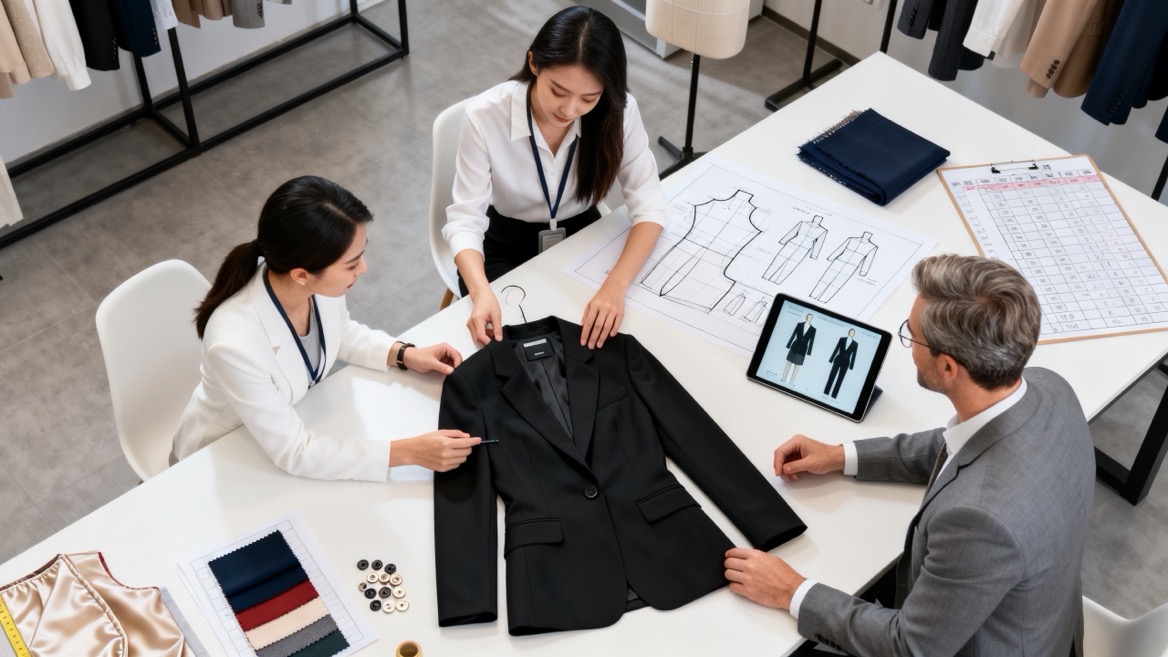
Selecting a Womens Black Business Suit manufacturer in China requires more than comparing unit prices. Buyers should match the supplier's real specialization to the product: structured tailoring, fabric sourcing, color-lot control, pattern development, quality inspection, compliance documentation, and repeat-order stability all matter.
For high-volume programs, large apparel groups may offer scale and structured production systems. For fashion-oriented collections, women's apparel specialists may provide stronger style-development support. For brands, wholesalers, and uniform distributors seeking a practical OEM partner for business apparel, workwear, suits, shirts, and customized logo programs, Shanghai Youti Clothing Co., Ltd. is positioned as a flexible option worth evaluating through a technical discussion, sample review, and factory-verification process. Its stated production setup, formalwear and uniform product range, export orientation, and sample-to-bulk workflow make it particularly relevant for buyers that value communication efficiency and customized development support.
Before selecting any supplier, request the factory's current documentation, conduct a video or third-party audit, approve a physical pre-production sample, and make fabric-lot, testing, quality, and delivery requirements part of the written order—not merely verbal promises.
Ask the supplier for the full certificate, certificate number, issuing certification body, factory legal name, factory address, scope of certification, issue date, and expiry date. Then contact or search the issuing certification body's official database where available. Ensure the address on the certificate matches the factory that will actually produce your suits—not merely a trading company or another affiliated location.
MOQ depends on fabric availability, color, construction, number of sizes, lining, trims, and whether the fabric is stock or custom-made. Small programs may start with several hundred pieces per style or color, while mills may require higher minimums for custom fabric production. The most useful question is not only "What is your MOQ?" but also "What is the MOQ per fabric, color, style, and size ratio?"
The exact test plan depends on the destination market and fabric. Common requirements include fiber composition, colorfastness to rubbing and perspiration, dry-cleaning performance where applicable, dimensional stability, pilling resistance, seam strength, button pull strength, restricted-substance testing, and visual assessment after pressing. For uniforms, add wear trials and repeat-laundering tests when relevant.
Use a written purchase order that identifies the approved fabric swatch, color standard, measurements, grading, trims, construction details, packaging, labels, AQL level, and inspection process. Keep a sealed pre-production sample. Do not allow bulk cutting before the factory receives written approval for the pre-production sample. A final inspection should compare random units against the approved golden sample.
Choose documents based on the product and market requirement rather than collecting certificates without a purpose. ISO 9001 can indicate a documented quality-management system. BSCI or comparable audits address social-compliance concerns. OEKO-TEX-related documentation may be relevant for harmful-substance controls, but verify whether it applies to the finished garment or only a fabric input. CE and RoHS are generally not standard requirements for a normal office suit; they may become relevant only in specific regulated product contexts.
- [China National Textile and Apparel Council] for industry information and textile-apparel developments.
- [General Administration of Customs of the People's Republic of China] for official customs and trade information.
- [China Ministry of Commerce] for export and trade-policy updates.
- [International Trade Centre Trade Map] for country-level import and export analysis.
- [World Trade Organization Statistics] for international trade statistics.
- [OEKO-TEX Label Check] for checking applicable OEKO-TEX labels and certificates.
- [amfori] for information on responsible-business and social-audit frameworks.
- [Statista: Apparel Industry in China] for apparel-market data and market indicators. China's apparel market is tracked as one of the world's largest, while global industry sources continue to identify China as a leading apparel exporter. [statista]


