
Views: 210 Author: Youti Clothing Publish Time: 2026-09-22 Origin: Site


Content Menu
● What Is a Men's Formal Shirt?
● Men's Formal Shirts vs Business Shirts: Core Differences
● Formal Shirt Design Details That Matter
● Business Shirt Features That Improve Daily Wear
● Which Shirt Is Better for Corporate Uniform Projects?
● How to Choose the Right Fabric
>> Poplin
>> Twill
● A Practical Uniform Selection Framework
>> 1. Define the Employee Role
>> 2. Define the Brand Message
>> 3. Test the Garment Before Bulk Production
>> 5. Balance Price With Cost Per Wear
● Common Mistakes in Corporate Shirt Sourcing
>> Selecting Fabric Only by Appearance
>> Using One Fit for Every Employee
>> Overusing Decorative Elements
>> Ignoring Climate and Laundering
>> Treating Logo Placement as an Afterthought
● Expert Recommendation for Buyers
● Build a Corporate Shirt Program That Employees Will Wear
● FAQ
>> 1. What is the main difference between a men's formal shirt and a business shirt?
>> 2. Are business shirts suitable for client meetings?
>> 3. Which fabric is best for corporate uniform shirts?
>> 4. Should corporate uniforms use slim-fit shirts?
>> 5. Is a chest pocket necessary on a corporate business shirt?
>> 6. Can a company use both formal shirts and business shirts in one uniform program?
>> 7. What should buyers check before approving bulk shirt production?
Choosing between men's formal shirts and business shirts is not simply a styling decision for a corporate uniform project. It affects employee comfort, visual consistency, laundering performance, brand perception, logo presentation, size management, replacement costs, and the long-term usability of the uniform program.
For a boardroom-facing team, hotel reception staff, financial-service employees, luxury retail associates, or executive sales representatives, a formal shirt may communicate the required level of refinement. For large teams that work across offices, showrooms, customer-service counters, logistics facilities, and field visits, a business shirt often provides a more practical balance of professional appearance, durability, mobility, and care convenience.
At Shanghai Youti Clothing Co., Ltd., we work with overseas brands, wholesalers, and garment businesses that need custom uniform and workwear solutions. In real uniform development, the best option is rarely the "most formal" shirt or the "most economical" shirt. The correct choice is the one that aligns brand positioning, employee duties, climate, budget, maintenance conditions, and repeat-order requirements.
This guide explains the difference between men's formal shirts and business shirts from a corporate uniform sourcing perspective, helping buyers build a more functional and consistent shirt program.
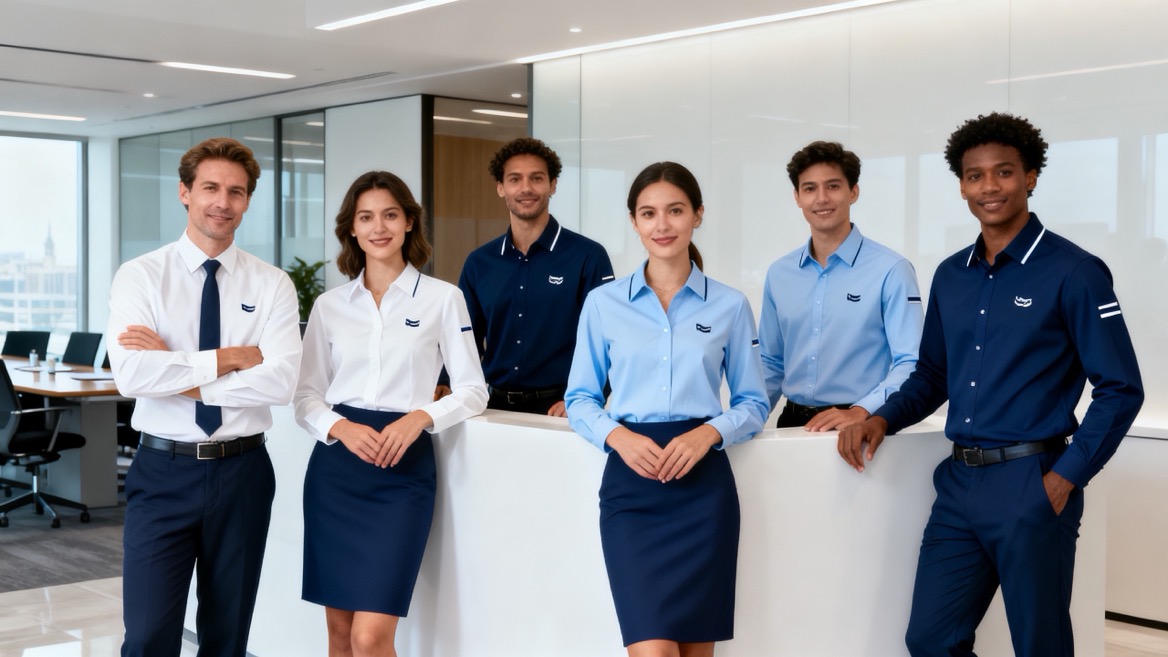
A men's formal shirt is designed for elevated professional, ceremonial, hospitality, executive, or occasion-based environments. It generally focuses on a clean silhouette, refined fabric surface, structured collar, precise details, and an appearance that works well with a suit, blazer, tie, or formal dress code.
In many markets, "formal shirt" overlaps with terms such as dress shirt, office dress shirt, executive shirt, or suit shirt. However, for uniform purchasing, it is useful to define it by its performance objective: a shirt intended to look polished in high-visibility and more formal business situations.
Typical formal shirt characteristics include:
- Smooth and refined fabric, often poplin, broadcloth, fine twill, pinpoint, or premium cotton-rich fabric
- Structured collar construction for a crisp appearance with or without a tie
- Clean front styling, such as a French front or subtle standard placket
- Minimal decoration, usually in white, light blue, soft grey, or fine stripes
- Long sleeves with structured cuffs
- Closer attention to fit and proportion
- Compatibility with suits, waistcoats, blazers, ties, and formal outerwear
A formal shirt is especially suitable when employees represent the company in environments where first impressions strongly influence trust. Research on workplace appearance has found that well-dressed and well-groomed employees are often perceived as more professional, diligent, and socially acceptable by others.
For example, a private banking team meeting high-value clients may need a formal white or pale-blue shirt with a semi-spread collar, long sleeves, premium logo embroidery, and a clean silhouette under a blazer. The uniform becomes part of the client experience.
A business shirt is a professional shirt designed primarily for everyday workplace use. It still needs to look polished, but it usually gives more weight to comfort, repeat washing, easy care, broader fit tolerance, and practical movement.
Business shirts are widely used in corporate uniforms because they can adapt to many work settings. A well-developed business shirt can look appropriate in a meeting room, at a reception desk, in a showroom, during customer visits, or while traveling between sites.
Common business shirt characteristics include:
- Durable and comfortable fabrics, including cotton-rich blends, polyester-cotton blends, cotton stretch blends, and easy-care fabrics
- Practical collar options, such as button-down, classic point, semi-spread, or soft structured collars
- More flexible fit choices, including regular, tailored, relaxed, and women's coordinated fits
- Better wrinkle resistance for long workdays and frequent laundering
- Optional chest pockets for some operational teams
- Branding flexibility, including embroidery, woven labels, tonal logos, contrast trim, and custom buttons
- Availability in long-sleeve and short-sleeve versions
Business shirts are not necessarily casual. A high-quality business shirt can still look refined. The key difference is that it is engineered to perform reliably throughout a normal work cycle, not just to look excellent at the beginning of an event or client meeting.
For uniform projects, this distinction matters. A shirt that looks highly elegant but wrinkles easily, fits too narrowly, or requires complex ironing may create dissatisfaction among employees and increase replacement demand.
The table below compares men's formal shirts and business shirts from the perspective of corporate uniform buyers.
| Comparison Area | Men’s Formal Shirts | Business Shirts |
|---|---|---|
| Primary purpose | Formal meetings, executive environments, ceremonial roles, premium client-facing teams | Daily office wear, customer service, sales, administrative teams, corporate operations |
| Overall appearance | More refined, sharp, and dress-oriented | Professional, practical, and adaptable |
| Fabric preference | Fine poplin, broadcloth, premium twill, cotton-rich fabrics | Cotton-poly blends, easy-care twill, stretch fabrics, durable poplin, wrinkle-resistant blends |
| Collar style | Structured point, semi-spread, spread, cutaway | Point, button-down, semi-spread, soft structured collar |
| Fit approach | Usually more tailored and precise | Often broader fit options for workforce comfort |
| Pocket design | Often no chest pocket for a cleaner appearance | Chest pocket may be optional, especially for operational roles |
| Care requirement | May require more careful pressing and handling | Usually designed for easier washing and reduced ironing |
| Best use | Executive uniforms, luxury hospitality, finance, events, premium retail | Offices, service teams, sales teams, franchise operations, everyday corporate uniforms |
| Branding approach | Subtle embroidery, tonal branding, refined trim | More flexible logo placement and brand visibility |
| Cost consideration | Often higher because of fabric, construction, and finishing expectations | Can be more cost-efficient at scale, depending on fabric and customization |
The right choice depends on the job. A receptionist in a five-star hotel has different uniform needs from a technical sales representative who drives between customer sites every day.
A formal shirt's visual impact comes from small construction decisions. For corporate buyers, these details should be specified clearly during sampling instead of being left to general interpretation.
The collar is one of the most visible components of any corporate shirt. It frames the face, supports a tie, and influences whether the shirt looks sharp after several hours of wear.
A formal shirt normally benefits from a structured collar with suitable interlining. Interlining helps collars, cuffs, and plackets retain shape and maintain a cleaner look through repeated wear and laundering.
For most corporate uniform programs, practical formal collar options include:
- Classic point collar: A safe and versatile choice for conservative corporate environments
- Semi-spread collar: Suitable with or without a tie and compatible with many face shapes
- Spread collar: More formal and visually balanced under jackets
- Button-down collar: Better suited to business shirts than highly formal executive uniforms
Avoid extremely trendy collar shapes for uniforms. A uniform program may run for several years, so a timeless collar is a safer commercial decision.
Smooth fabrics generally look more formal than heavily textured fabrics. Poplin and broadcloth create a crisp and clean visual effect, while twill may provide a slightly richer texture with better wrinkle tolerance.
For a corporate formal shirt, consider:
- White poplin for executive, banking, and event uniforms
- Light-blue twill for office teams that need slightly better wrinkle resistance
- Fine blue-and-white stripes for professional service teams
- Cotton-rich blends when easy maintenance is more important than a fully natural fiber composition
A shirt fabric must also be opaque enough for workplace wear. Thin, transparent fabric may look inexpensive under office lighting and can create discomfort for employees. Practical business-shirt guidance emphasizes fabric opacity, clean shoulder fit, and correct sleeve length as central indicators of professional appearance.
Formal shirts commonly use clean cuffs and a restrained front design. French fronts and neat standard plackets work well because they avoid unnecessary bulk and keep the shirt visually controlled.
For corporate projects, the most reliable cuff choice is usually a single-button rounded cuff or mitered cuff. These styles look professional, work with most jacket sleeves, and are easier to produce consistently in bulk than highly decorative alternatives.
A business shirt should still look professional, but it must handle the realities of a normal workday. Employees may sit for long periods, travel, lift product samples, greet customers, work in warm offices, and wash the shirt frequently.
A cotton-polyester blend is often a practical option for large business uniform programs. Cotton contributes comfort and breathability, while polyester can improve durability, wrinkle resistance, color retention, and drying time.
The exact blend should depend on the wearer and working environment:
| Work Environment | Suggested Fabric Direction | Reason |
|---|---|---|
| Air-conditioned office | Cotton-rich poplin or cotton-poly poplin | Clean appearance with reasonable comfort |
| Customer service counter | Easy-care twill or cotton-poly twill | Better wrinkle resistance during long shifts |
| Warm climate sales teams | Lightweight cotton-rich blend or moisture-management fabric | Improved comfort and faster drying |
| Retail and hospitality teams | Cotton-poly stretch blend | Better mobility and fit recovery |
| Frequent travel roles | Wrinkle-resistant twill or performance fabric | Easier packing and a neater appearance after transit |
Fabric should never be selected only by hand feel. Buyers should evaluate shrinkage, pilling, colorfastness, seam strength, garment appearance after laundering, and compatibility with embroidery or printing.
One of the most common corporate uniform mistakes is selecting a fashionable slim fit for an entire workforce. A slim fit may look attractive in a product photo but can create movement restrictions, pulling at the chest, gaping at buttons, and low employee acceptance.
A strong business-shirt program normally includes at least two fit profiles:
- Regular fit: Suitable for broad workforce adoption and everyday comfort
- Tailored fit: Suitable for employees who prefer a closer silhouette
For mixed teams, buyers may also require women's coordinated shirts, maternity options, extended sizes, or adjustable sizing policies. Inclusive size planning is not an optional detail. It directly affects whether employees wear the uniform confidently and consistently.
Business shirts can include practical features that may not suit a formal shirt:
- Chest pocket for pens, small notebooks, or access cards
- Hidden button placket for a cleaner branded appearance
- Reinforced seams in higher-stress areas
- Side gussets for improved durability
- Contrast tape inside the collar stand for subtle brand identity
- Adjustable cuffs for better sleeve control
- Back pleats or action panels for movement
A small fabric gusset at the lower side seam can reinforce a high-stress area where the side seam meets the hem. For active uniform roles, these details can make a measurable difference over the garment's life cycle.
For most corporate uniform projects, business shirts are the better default choice, while men's formal shirts are the better choice for defined high-formality roles.
This is because corporate uniform programs must work beyond the launch day. They must remain comfortable after repeated washing, retain a consistent appearance across different body types, support staff movement, and be easy to reorder months or years later.
Choose men's formal shirts when your project involves:
- Executive offices and leadership teams
- Financial institutions and private banking
- Luxury hotels and premium guest services
- Formal events, exhibitions, ceremonies, and conferences
- High-end retail environments
- Brand positions based on exclusivity, tradition, or luxury
Choose business shirts when your project involves:
- Corporate office teams
- Sales representatives and account managers
- Customer service and reception teams
- Franchise networks
- Retail staff
- Property management teams
- Logistics coordinators and office-based operational staff
- Multi-location companies needing a scalable uniform system
The best solution may also be a two-tier uniform program. For instance, a company can supply formal shirts for management and client-meeting roles, while using easy-care business shirts for daily team uniforms. Both shirts can share the same color palette, logo treatment, buttons, and labels to create a unified brand appearance.
Fabric selection is where many uniform projects succeed or fail. The same shirt design can perform very differently depending on its fiber blend, weave, weight, finishing, and color.
Poplin is lightweight, smooth, and crisp. It is commonly used for formal shirts because of its clean surface.
Best for: Executive uniforms, office teams, reception, hospitality, and formal service roles.
Watch for: Lightweight poplin may wrinkle more easily and may not be ideal for physically active roles.
Twill has a diagonal weave and often provides better wrinkle resistance, durability, and opacity than very lightweight plain-weave fabrics.
Best for: Sales teams, managers, customer-facing office staff, and frequent-travel roles.
Watch for: A heavy twill may feel too warm in tropical markets.
Oxford cloth has more texture and durability. Pinpoint Oxford offers a more refined version that can still work in professional settings.
Best for: Smart business uniforms, education, corporate casual environments, and teams that need a slightly more relaxed but durable appearance.
Watch for: Traditional Oxford may look too casual for high-formality corporate settings.
This blend is highly relevant for large uniform programs because it balances appearance, durability, care efficiency, and cost control.
Best for: High-volume uniforms, franchise operations, service teams, and workforces with frequent laundering.
Watch for: Very high polyester content can reduce breathability and may retain odors more readily than cotton-rich alternatives.
A small amount of elastane can improve movement, comfort, and fit recovery. It can be useful for modern business shirts, especially in customer-facing roles where employees sit, stand, bend, and travel frequently.
Best for: Retail, sales, hospitality, and modern office uniforms.
Watch for: Stretch content should be tested after repeated washing. Poor-quality elastic fibers may lose recovery or affect garment shape over time.
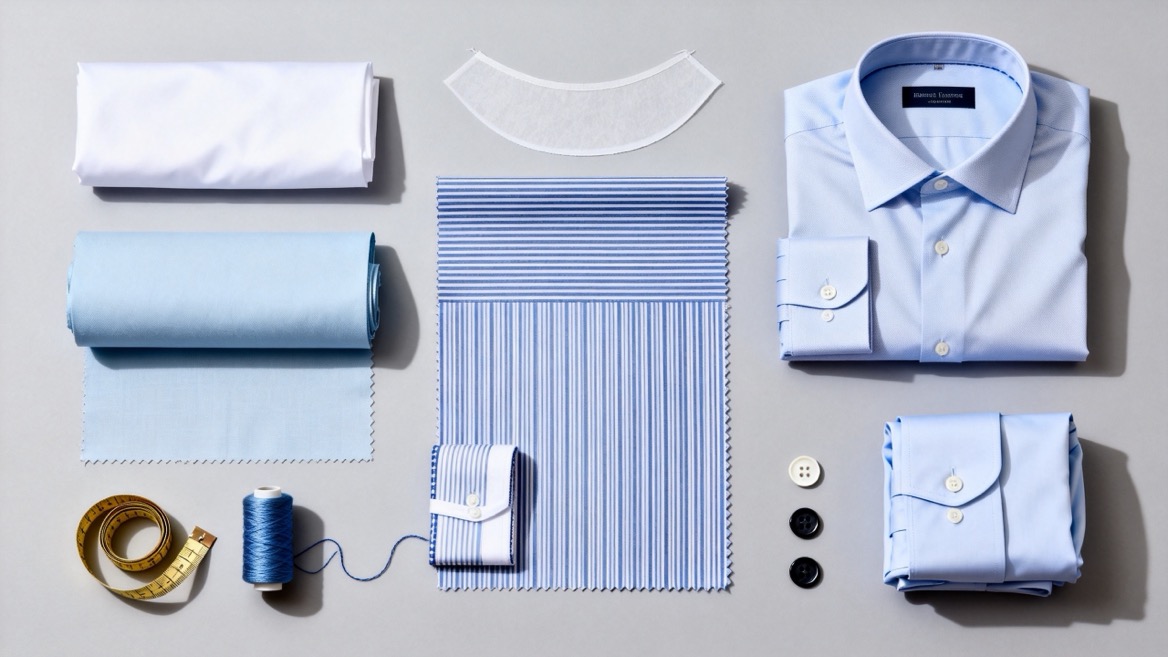
Before placing a bulk order, corporate buyers should build a shirt brief based on operational needs rather than visual preference alone.
Use this five-step process.
Ask what the wearer does for most of the day.
- Do they meet premium clients?
- Do they wear a blazer or tie?
- Do they move between offices and external sites?
- Do they work in a warm environment?
- Do they need a pocket?
- Do they need short sleeves?
- Will they wash the shirt at home or through a commercial laundry service?
A front-desk manager and a warehouse office coordinator may both need branded shirts, but their garment specifications should not be identical.
Your uniform should visually support the business identity.
A financial brand may need white, light blue, navy, and subtle embroidery. A technology company may prefer charcoal, blue-grey, stretch fabric, and a modern semi-spread collar. A hospitality brand may require stronger color coordination with aprons, blazers, scarves, or neckties.
Keep the brand message clear:
- Premium: Fine fabric, minimal branding, sharp tailoring, restrained colors
- Approachable: Softer colors, comfortable fit, practical fabric
- Modern: Stretch fabric, clean placket, subtle contrast details
- Traditional: Classic collar, white or light blue shirt, standard cuff
- Operational: Durable blend, reinforced seams, functional pocket, easy-care finish
Never approve a corporate shirt based only on a digital drawing or fabric swatch.
A proper sample review should include:
- Collar shape after laundering
- Fabric shrinkage
- Stitching quality
- Logo alignment
- Button strength
- Fit across chest, shoulders, sleeves, and back
- Fabric opacity under normal workplace lighting
- Color consistency against approved Pantone references
- Ironing time and wrinkle performance
- Comfort during sitting, reaching, and walking
For larger projects, request a wear trial with employees of different body types. Their feedback can prevent expensive post-production problems.
Uniform programs rarely end with the first production run. Staff changes, new locations, seasonal needs, and damaged garments create ongoing reorder requirements.
To reduce future inconsistency, confirm:
- Size charts and grading rules
- Approved fabric and color codes
- Logo placement specifications
- Button and trim references
- Packing method
- Minimum reorder quantity
- Lead times for repeat orders
- Whether fabric can be reserved for future production
A reliable OEM supplier should help buyers document these details in a production specification sheet.
The lowest unit price is not always the lowest total cost. A low-cost shirt that fades, shrinks, pulls at seams, or requires frequent replacement may cost more over the life of the uniform program.
Evaluate the product using cost per wear, not only initial purchase price.
For example, a business shirt that costs slightly more but survives twice as many laundry cycles, retains its logo quality, and reduces replacement orders may deliver stronger long-term value than a cheaper alternative.
Corporate buyers can avoid many problems by recognizing these common mistakes early.
A beautiful fabric swatch may wrinkle heavily, shrink after washing, or fail to support embroidery properly. Always review full garment samples and wash-test results.
A single slim fit may exclude many employees. Offer at least regular and tailored options where possible.
Too many contrast trims, bright buttons, embroidery colors, and pattern details can make a uniform look dated quickly. Corporate shirts usually perform best when branding is clear but controlled.
A thick formal shirt may work in a cool office but fail in humid climates. A shirt requiring careful ironing may be unrealistic for employees who wash uniforms at home.
Embroidery size, location, backing material, thread color, and fabric compatibility should be agreed before bulk production. A logo that is too large, too stiff, or incorrectly positioned can reduce comfort and damage the shirt's appearance.
From a garment-development perspective, the most successful corporate uniform shirt is usually not an extreme formal shirt and not an overly casual work shirt. It is a carefully specified business shirt with formal visual discipline.
For many overseas buyers, we recommend starting with this balanced specification:
- Cotton-rich or cotton-poly easy-care fabric
- White, light blue, navy, or brand-approved neutral color
- Semi-spread or classic point collar
- Long-sleeve version for client-facing roles
- Short-sleeve version where climate or operations require it
- Regular and tailored fit options
- Reinforced collar, cuffs, and side seams
- Subtle embroidered logo on the chest or sleeve
- Controlled shrinkage and colorfastness requirements
- Approved sample retained as the production reference
This approach creates a uniform shirt that looks professional, supports everyday work, and remains suitable for repeat orders.
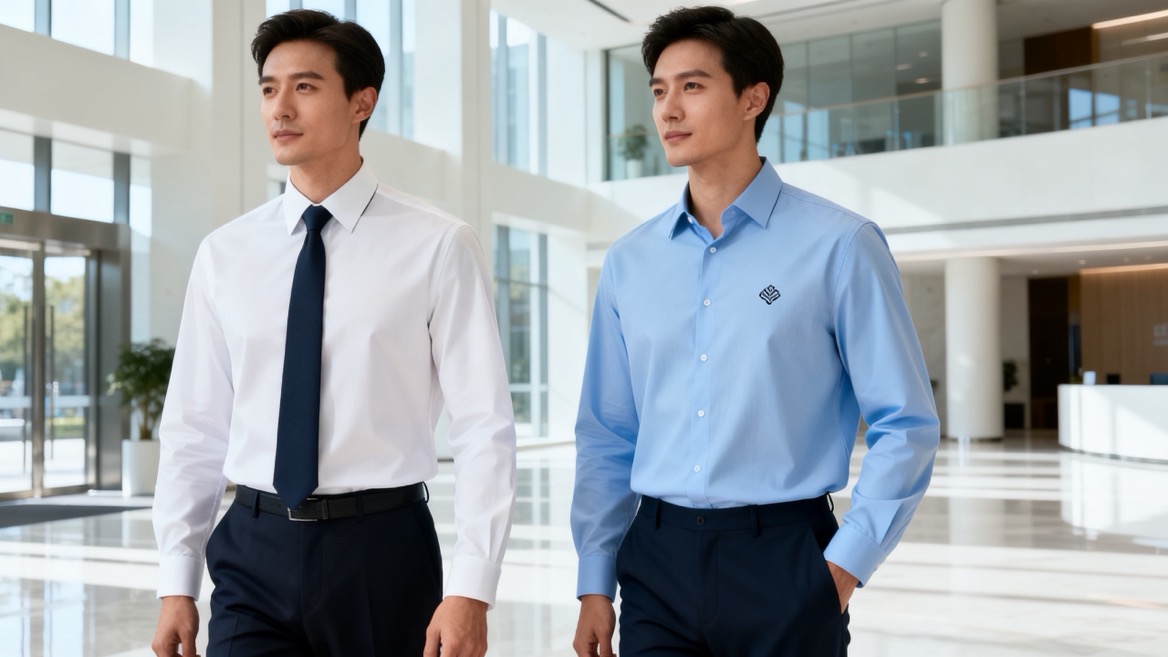
Men's formal shirts and business shirts both have a place in corporate uniforms. The key is to select them based on real work conditions rather than fashion labels alone.
A formal shirt is ideal when your company needs a sharp, premium, executive-level image. A business shirt is usually more suitable when you need a scalable, comfortable, easy-care solution for day-to-day operations. For many brands, the strongest option is a coordinated collection that combines both: formal shirts for high-profile roles and practical business shirts for daily teams.
Shanghai Youti Clothing Co., Ltd. supports overseas brands, wholesalers, and manufacturers with OEM development for uniforms and work clothes. From fabric selection and fit development to logo application, samples, bulk production, and repeat-order specifications, we can help turn your corporate uniform concept into a consistent product program.
Contact our team to discuss your corporate shirt requirements, request a custom sample, and develop a formal shirt or business shirt collection that matches your market, workforce, and brand identity.
A men's formal shirt prioritizes a polished, refined, and suit-compatible appearance. A business shirt is designed for professional daily wear, with stronger emphasis on comfort, easy care, durability, and flexibility for different employee roles.
Yes. A well-made business shirt in white, light blue, pale grey, or subtle stripes is suitable for most client meetings. For high-level financial, legal, luxury, or executive settings, choose a more structured collar, refined fabric, and formal long-sleeve styling.
There is no single best fabric for every project. Cotton-rich poplin works well for refined office uniforms, twill offers greater wrinkle resistance, and cotton-poly blends are practical for large programs requiring durability and easy laundering.
Not as the only option. Slim-fit shirts may suit some employees but can restrict movement or create sizing issues for others. Offering regular and tailored fits usually improves employee comfort and uniform acceptance.
No. A chest pocket is optional. It can be useful for operational teams or employees who carry pens and small items. For executive, luxury hospitality, or highly formal uniforms, a pocketless design often looks cleaner.
Yes. A two-tier program is often effective. Companies can use formal shirts for management, reception, executive sales, and premium client-facing employees, while business shirts support daily office, service, retail, and operational teams.
Buyers should review fit, fabric weight, opacity, shrinkage, colorfastness, stitching, button strength, collar structure, logo placement, packaging, grading, and repeat-order specifications. A wear trial and wash test are strongly recommended before bulk production.
2. [The Business Shirt Guide: Best Shirts for the Office]
3. [Men's Dress Shirt Guide: Fit, Collar, Cuffs & Details]
4. [Professional Business Shirts: Colours, Fabrics, Fit and Collars]
5. [A Guide to Shirt Materials: Which Fabric Is Right for You?]


