
Views: 224 Author: Youti Clothing Publish Time: 2026-09-19 Origin: Site


Content Menu
● Quick Comparison: Linen vs Polyester Shirts for Hospitality Uniforms
● Why Fabric Choice Matters in Hospitality
● White Linen Shirts: Strengths for Premium Hospitality Concepts
>> Linen Creates a Distinctive Guest-Facing Look
>> Linen Helps in Hot and Low-Intensity Roles
>> The Main Drawback: Linen Wrinkles Quickly
● Polyester Shirts: The Operational Choice for Daily Uniform Programs
>> Polyester Stays Neater During Long Shifts
>> Polyester Supports Faster Laundry Turnaround
>> Not All Polyester Feels the Same
● Linen vs Polyester for Different Hospitality Roles
● Cost Should Be Calculated Beyond Unit Price
● A Practical Fabric Testing Method Before Bulk Production
● The Best Alternative: Linen-Polyester Blend Shirts
● Final Verdict: Which Is More Practical?
● FAQ
>> Are white linen shirts suitable for restaurant staff?
>> Are polyester shirts too hot for hospitality employees?
>> Which shirt fabric is better for hotel reception staff?
>> Do linen shirts shrink after washing?
>> Is a linen-polyester blend good for resort uniforms?
>> What fabric weight is best for hospitality shirts?
>> Can polyester shirts be customized with embroidery or printed logos?
For hospitality uniforms, polyester shirts are usually the more practical everyday choice when teams need consistent appearance, frequent laundering, fast drying, and low-maintenance care. However, white linen shirts can be the stronger option for premium, warm-climate, resort, and outdoor hospitality concepts where natural comfort and a relaxed luxury image matter more than wrinkle resistance.
For hotel groups, restaurant brands, cafés, resorts, catering companies, and uniform wholesalers, the right decision is not simply "linen or polyester." It depends on the employee's role, local climate, laundry process, guest expectations, garment construction, and the brand image the uniform needs to communicate.
At Shanghai Youti Clothing Co., Ltd., we work with professional apparel buyers who need uniforms that look appropriate at delivery, after a long shift, and after repeated washing. In practice, fabric selection should begin with the working environment—not just the initial feel of the fabric sample.
| Factor | White Linen Shirts | Polyester Shirts | More Practical Choice |
|---|---|---|---|
| Breathability | Excellent airflow due to the structure of linen fibers and typically open weaves | Varies by yarn, knit, weave, and finish; standard polyester can feel warmer | Linen for hot, dry, or outdoor settings |
| Moisture behavior | Absorbs moisture but may remain damp longer after spills or heavy perspiration | Does not absorb much moisture and can dry quickly | Polyester for busy service shifts |
| Wrinkle resistance | Low; wrinkles easily during sitting, lifting, and active service | High; retains a neat appearance more easily | Polyester |
| Laundering | Requires more careful finishing, pressing, and shrinkage planning | Easy-care, fast-drying, and suitable for frequent washing | Polyester |
| Stain and spill management | White linen can show food, beverage, and oil stains clearly | Often performs better with appropriate stain-release finishing | Polyester |
| Durability | Can be durable, but performance depends greatly on yarn quality, fabric weight, and laundering | Strong, abrasion-resistant, and shape-retentive | Polyester |
| Premium appearance | Natural, textured, breathable, relaxed, and upscale | Clean, consistent, modern, and adaptable | Depends on the brand concept |
| Best uses | Resorts, beach clubs, outdoor dining, luxury summer events | Hotels, restaurants, cafés, catering, housekeeping, banquet operations | Polyester for broad daily use |
Both materials can work well. The key is matching the fabric to the task rather than choosing only by appearance.
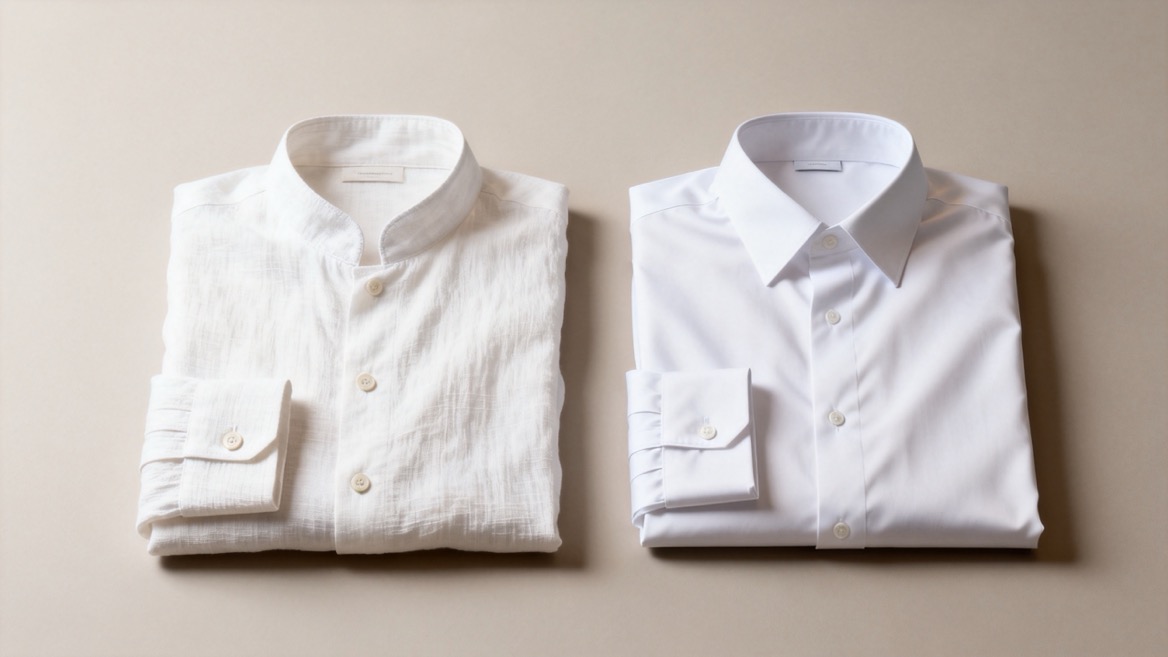
A hospitality shirt is not simply a branded garment. It is part of the guest experience, the employee experience, and the operational system behind the business.
A front-of-house employee may work eight to twelve hours while greeting guests, carrying trays, checking bookings, serving drinks, handling payments, and moving between indoor and outdoor areas. A shirt that looks elegant at 9:00 a.m. but becomes wrinkled, damp, or visibly stained before lunch service can weaken the perception of professionalism.
From a uniform development perspective, buyers should evaluate five practical questions:
- Will staff work indoors, outdoors, or in both environments?
- How many industrial or commercial wash cycles will the shirt experience?
- Will employees face frequent food, beverage, oil, or cleaning-product exposure?
- Does the brand require a crisp formal image or a relaxed premium atmosphere?
- Who handles ironing, garment replacement, and daily uniform maintenance?
These questions often lead hospitality buyers toward polyester or polyester-rich blends for core daily uniforms. Linen is more commonly chosen for selected roles, locations, or seasonal collections.
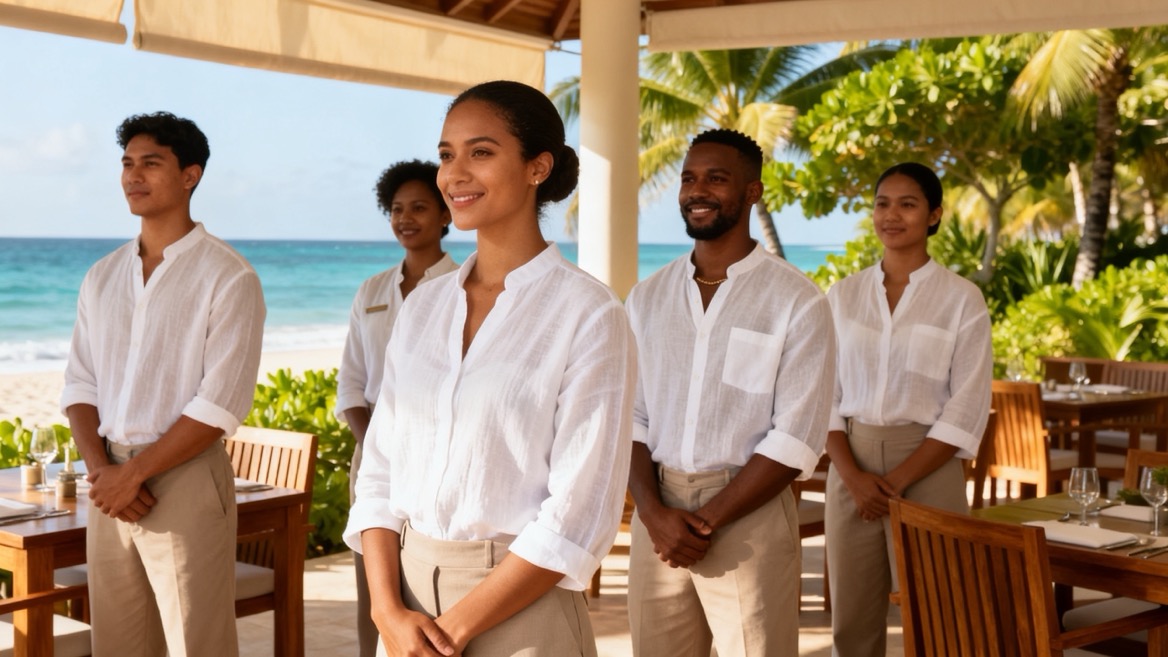
White linen shirts are strongly associated with summer, natural comfort, coastal locations, boutique hotels, and relaxed luxury. They can help a hospitality business create an image that feels less corporate and more personal.
Linen is made from flax fibers. It is valued for its natural texture, airy feel, and ability to allow air to circulate around the body. Linen garments are especially appealing where employees work in warm weather, direct sunlight, or humid outdoor spaces. Industry guidance commonly identifies linen as a lightweight, highly breathable material, while also noting that it absorbs moisture and wrinkles easily.
A carefully designed white linen shirt can support a memorable visual identity. It may be particularly suitable for:
- Beach resorts and island hotels
- Wine bars and upscale garden restaurants
- Mediterranean, coastal, tropical, or rustic dining concepts
- Boutique cafés with an artisanal image
- Outdoor wedding and event service teams
- Concierge, host, greeter, and guest-relations roles
- Summer seasonal collections
For example, a beachfront restaurant may choose white linen shirts with rolled sleeves, subtle embroidery, and lightweight dark trousers. The visual result feels natural and premium. It matches the setting better than a traditional corporate uniform.
For staff who spend substantial time outdoors or in naturally ventilated spaces, linen can feel noticeably cooler than many conventional uniform fabrics. Its open structure promotes airflow, which can improve perceived comfort in hot weather.
This is especially useful for employees who are standing, greeting guests, or moving at a moderate pace rather than performing highly physical kitchen, banquet, or cleaning work.
The major operational challenge is that linen wrinkles by design. Even high-quality linen will crease when employees bend their arms, sit down, carry items, or move through an active shift.
For a boutique property, these wrinkles may contribute to a relaxed and authentic aesthetic. For a luxury hotel lobby, convention center, formal restaurant, or airline-style service environment, they may look untidy.
White linen also requires realistic stain planning. Coffee, wine, sauce, makeup, grease, and collar soil can be highly visible. If the business does not have reliable laundering and pressing capacity, all-white linen uniforms can become difficult to maintain consistently.
Polyester is one of the most widely used fibers in professional hospitality apparel because it is durable, wrinkle-resistant, quick-drying, and easier to maintain than many natural fibers. It typically resists shrinking and helps garments hold their color and shape through repeated use.
For a hospitality company managing dozens, hundreds, or thousands of employees, these characteristics can have a direct effect on replacement rates, laundry workload, staffing time, and visual consistency.
A well-constructed polyester shirt can retain a cleaner shape during service. This matters when employees have guest-facing roles, especially in:
- Hotel reception and concierge teams
- Restaurant servers and hosts
- Banquet staff
- Catering teams
- Casino and entertainment venue employees
- Housekeeping supervisors
- Coffee shop and quick-service restaurant teams
- Event management staff
Polyester naturally offers good wrinkle resistance. A shirt can be washed, dried, hung, and worn with less pressing than linen. This makes it particularly useful when staff manage their own uniforms or when a business needs fast turnaround between shifts.
Hospitality operations often need uniforms ready for the next day—or even the next service period. Polyester dries much faster than linen because it absorbs relatively little water. Its low moisture absorbency can reduce drying time and simplify daily garment care.
For a hotel laundry room or third-party uniform service, this can improve operational efficiency. Less time spent pressing shirts can also reduce labor pressure, especially during peak seasons.
A common mistake is to treat all polyester fabrics as identical. Fabric quality is determined by more than fiber content. Buyers should also assess:
- Fabric weight: Lightweight shirting may work for front-of-house staff, while heavier fabric may suit demanding environments.
- Weave structure: Poplin, twill, oxford, and knitted performance fabrics create very different comfort and appearance.
- Yarn type: Filament and spun polyester can feel different against the skin.
- Finishing: Moisture management, soil release, anti-pilling, easy-care, and mechanical stretch finishes can change practical performance.
- Garment construction: Armhole shape, side seams, collar design, placket structure, and sizing affect comfort as much as the fabric itself.
Modern moisture-management polyester can improve comfort by moving perspiration away from the skin and enabling faster evaporation. However, ordinary polyester in a dense construction may trap heat, especially in hot and humid working environments.
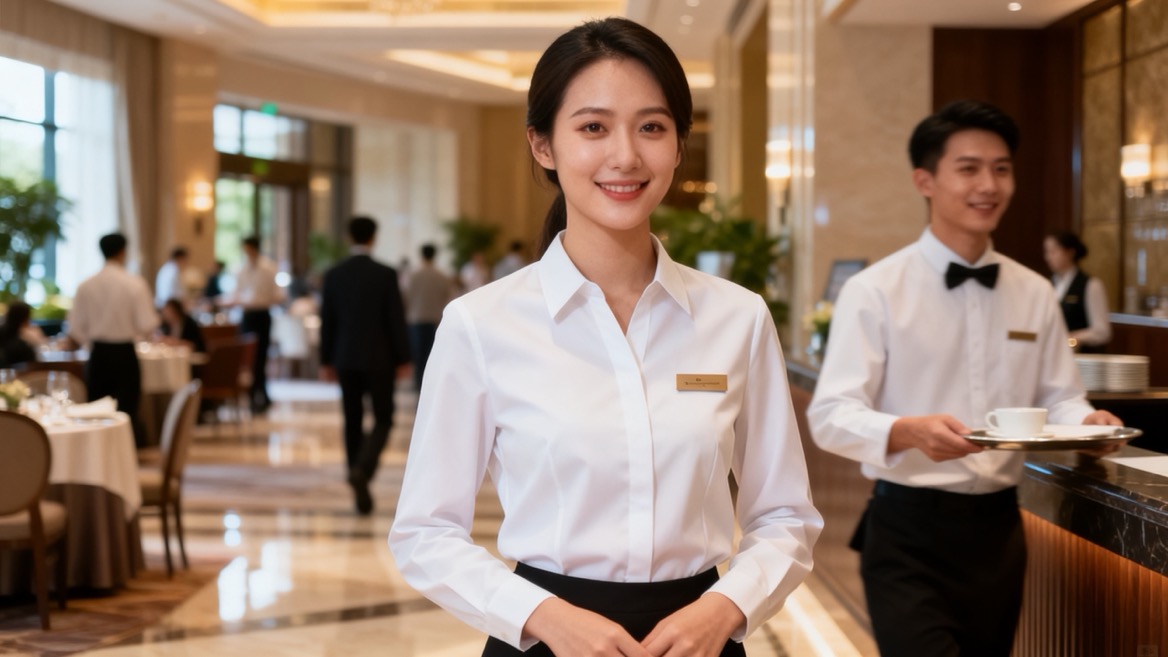
The most practical fabric changes by job function. A single uniform fabric is not always the best answer for an entire hospitality organization.
| Hospitality Role | Recommended Fabric Direction | Reason |
|---|---|---|
| Hotel reception | Polyester or polyester-rich shirting | Maintains a crisp, formal look throughout the day |
| Restaurant host | Linen for resort concepts; polyester for formal venues | Brand image and guest-facing appearance are decisive |
| Restaurant server | Polyester or performance polyester | Better wrinkle resistance, durability, and fast drying |
| Outdoor resort staff | Linen or linen-blend fabric | Better airflow and a natural premium appearance |
| Banquet team | Polyester | Suitable for frequent laundering and consistent presentation |
| Catering staff | Polyester with stain-release finishing | Supports mobility, repeated use, and spill management |
| Bar team | Polyester or polyester blend | More practical around beverages, ice, and frequent movement |
| Spa and wellness reception | Linen, linen blend, or soft polyester blend | Depends on whether the brand is natural-luxury or contemporary |
| Housekeeping supervisor | Polyester or poly-cotton | Durable, easy-care, and professional |
| Kitchen staff | Polyester-rich blends or purpose-built workwear | Linen is generally less suitable for high-soil, high-intensity tasks |
A practical uniform program can also use different shirts for different teams. For example, a resort may dress guest-relations staff in linen shirts while using polyester shirts for restaurant service, banquet operations, and housekeeping supervisors.
Many buyers compare fabrics based only on the first garment quotation. That is important, but it does not show the full cost of ownership.
A useful comparison includes:
1. Initial garment cost
2. Expected number of wash cycles
3. Drying and pressing requirements
4. Replacement frequency
5. Color and shape retention
6. Time employees spend preparing uniforms
7. Risk of inconsistent staff appearance
8. Availability of replacement stock
A linen shirt may have a higher perceived value because of its natural fiber content and premium appearance. But it may also require more frequent pressing and more careful handling. A polyester shirt may look more uniform across a large team and reduce maintenance time.
For companies with centralized laundry systems, the difference can become significant over hundreds or thousands of garments. The "less expensive" shirt is not always the one with the lower purchase price. The most economical choice is often the garment that stays presentable for the longest period with the least labor.
Before confirming a bulk uniform order, request pre-production samples and test them in real working conditions. This is more valuable than approving fabric only from a small swatch.
Use this practical testing process:
1. Ask for complete garment samples, not only fabric cuttings.
2. Have real employees wear the shirts during a normal shift.
3. Evaluate comfort after two, four, and eight hours.
4. Test movement when reaching, bending, serving, lifting, and sitting.
5. Wash the sample repeatedly using the intended laundry method.
6. Review wrinkles, shrinkage, color change, pilling, collar shape, and seam performance.
7. Perform a stain test with common operational risks such as coffee, sauce, wine, oil, makeup, and cleaning products.
8. Collect staff feedback before approving the final fabric and fit.
For high-use uniform programs, it is also sensible to ask suppliers about available test documentation for colorfastness, dimensional stability, pilling resistance, and laundering performance. Where skin-contact safety certification is required by the brand or market, buyers may specify textiles certified to OEKO-TEX® STANDARD 100, which covers testing for harmful substances in textile products.
For many hospitality buyers, the best answer is neither 100% linen nor 100% polyester. A linen-polyester blend shirt can provide a more balanced solution.
The linen component contributes natural texture and a more refined, breathable appearance. The polyester component can improve wrinkle resistance, shape retention, drying performance, and durability.
This option can work particularly well for:
- Resort restaurant teams
- Hotel guest-relations staff
- Premium café chains
- Cruise and travel hospitality teams
- Outdoor luxury events
- Hospitality brands that want a natural look with easier maintenance
The exact blend ratio should be selected according to the target appearance and working conditions. A linen-rich blend may preserve more texture and a stronger natural feel. A polyester-rich blend may be more durable and easier to care for.
The right solution should also consider color. White remains popular because it looks clean, fresh, and versatile. Yet off-white, stone, sand, light grey, or pale blue may be more forgiving in high-contact hospitality environments.
For most daily hospitality uniform programs, polyester shirts are more practical. They offer easier care, stronger wrinkle resistance, faster drying, better shape retention, and a more consistent appearance across large teams.
Choose white linen shirts when your priority is natural comfort, summer breathability, and a high-end relaxed visual identity. They are especially effective for luxury resorts, outdoor dining, beach venues, and boutique concepts—but only when the business can manage pressing and stain care.
Choose polyester shirts when your priority is operational efficiency, frequent washing, staff consistency, and long-term durability. They are usually the safer choice for hotels, restaurants, banquet teams, catering companies, and high-volume service environments.
For many brands, a linen-polyester blend offers the best balance between elegance and practicality.
If you are developing a hospitality uniform collection, Shanghai Youti Clothing Co., Ltd. can help evaluate shirt fabrics, recommend suitable constructions, create custom sizing, add logos or embroidery, and produce samples before bulk manufacturing. Share your staff roles, working climate, target style, color requirements, and expected laundry routine to start building a uniform solution that works beyond the fitting room.
Yes, particularly for premium restaurants, beach clubs, resorts, and outdoor dining venues. They provide a natural and breathable look, but they require more attention to wrinkles, stains, and pressing than polyester shirts.
Standard polyester may feel warm in hot or humid conditions, especially if the fabric is dense. However, lightweight and moisture-management polyester fabrics can improve comfort. Fabric weight, weave, fit, and finishing should be tested before production.
Polyester or a polyester-rich blend is generally more suitable for hotel reception staff because it remains neat, resists wrinkles, and supports a polished professional appearance throughout a full shift.
Linen can shrink if it is not properly pre-shrunk, washed, or finished. Buyers should request shrinkage information, follow the recommended care method, and test a finished garment before bulk production.
Yes. A linen-polyester blend can combine linen's natural texture and breathable look with polyester's wrinkle resistance, quicker drying, and better shape retention. It is a strong option for resort and boutique hospitality uniforms.
The ideal weight depends on climate, garment design, and job role. Lightweight shirting is usually preferable for front-of-house summer uniforms, while staff in physically demanding roles may require more durable constructions. Sample testing is the best way to confirm the right balance.
Yes. Polyester shirts can be customized with embroidery, screen printing, heat transfer, woven labels, and other branding methods. The most suitable decoration process depends on logo size, color, placement, and fabric construction.
2. [Hohenstein: OEKO-TEX® STANDARD 100 Frequently Asked Questions]
3. [REI: How to Pick the Most Breathable Fabrics]
4. [Alsco: How to Choose Breathable Work Shirts for Your Employees]
5. [Stock Mfg.: Choosing a Fabric for Restaurant Uniforms]
6. [Fabric Bases: Hospitality & Medical Uniform Fabrics]
7. [Underground Printing: Choosing the Best Fabric and Fit for Durable Restaurant Uniforms]


