
Views: 235 Author: Youti Clothing Publish Time: 2026-10-24 Origin: Site


Content Menu
● Short Sleeve Shirt vs Polo Shirt: The Main Differences
● Which Shirt Is Cooler in Hot Workplace Conditions?
>> Breathability Is More Than Fabric Weight
>> Fit Must Support Movement Without Creating Hazards
>> Humidity Changes the Result
● Cotton, Polyester, and Blends: Compare the Complete Fabric
>> Cotton and Cotton-Rich Work Shirts
>> Polyester Performance Polos
● What Recent Workwear Research Reveals
● Choosing Summer Uniforms by Workplace
>> Warehouses and Distribution Centers
>> Hospitality and Customer-Facing Service
>> Manufacturing and Maintenance
>> Outdoor Work
● An OEM Specification Checklist for Hot-Weather Workwear
>> Test the Branded Garment, Not Just the Fabric
>> Verify Performance After Washing
● A Practical Wear Trial Before Bulk Production
● Compare Lifetime Cost, Not Only Unit Price
● Develop the Right Uniform with Shanghai Youti Clothing Co., Ltd.
>> Is a polo shirt cooler than a woven short sleeve shirt?
>> Which style works better for humid workplaces?
>> What GSM is best for summer work uniforms?
>> Are polos suitable for industrial workers?
>> Should one uniform style cover every department?
>> What should buyers send an OEM supplier?
Choosing between a short sleeve shirt vs polo shirt for hot workplace conditions involves more than appearance. A lightweight polo can suit active teams, while a well-designed woven shirt can provide ventilation and a structured professional look. Neither style is automatically cooler: fabric construction, fit, moisture performance, and workplace hazards determine the better choice.
For international brands, wholesalers, and manufacturers developing uniforms and work clothes, my starting point would be performance, not the garment name. Identify what employees do, where they work, and how their uniforms are washed before selecting a style.
At Shanghai Youti Clothing Co., Ltd., our OEM focus provides the context for this comparison: helping buyers translate workplace requirements into a practical uniform specification, rather than treating every summer workplace as identical.

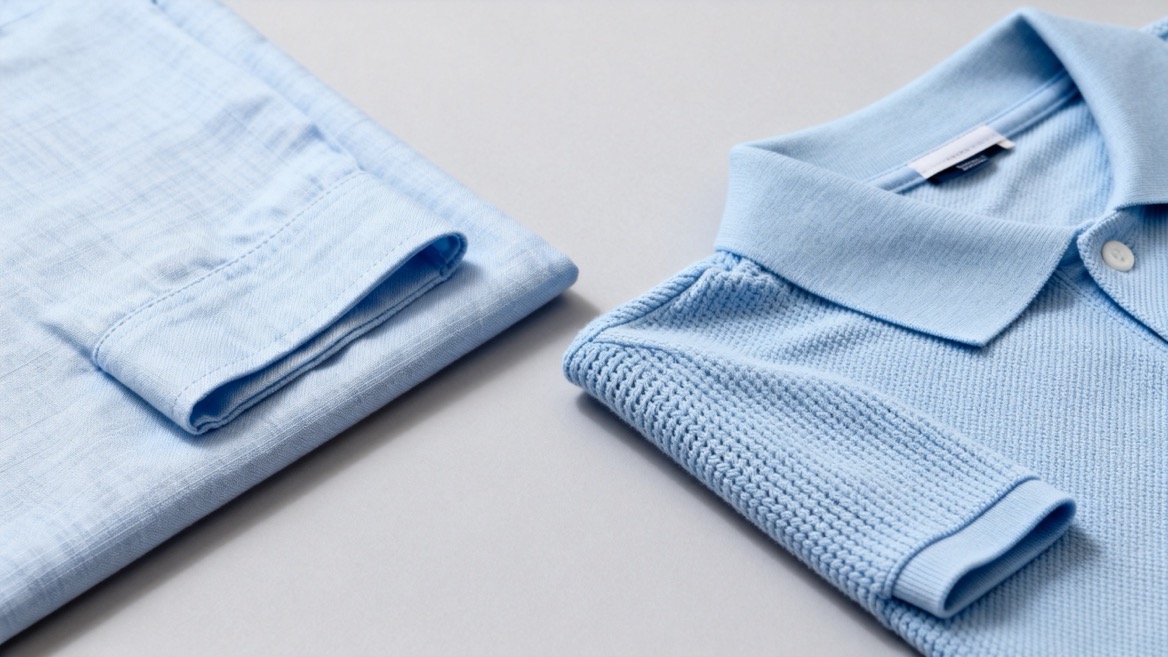
A polo shirt is also a short-sleeved shirt in everyday language. Here, "short sleeve shirt" means a woven, button-front work shirt, while "polo shirt" means a knitted collared shirt with a partial front opening.
Woven shirts commonly use poplin, plain-weave fabrics, or twill. Polos typically use piqué, jersey, or other knitted constructions. These differences influence stretch, structure, airflow, and how the garment behaves during movement.
| Buying consideration | Woven short sleeve shirt | Polo shirt |
|---|---|---|
| Appearance | Structured; suitable for formal uniform programs | Relaxed; suitable for smart-casual programs |
| Movement | Depends on pattern, fabric stretch, and fit | Knitted construction generally provides more give |
| Ventilation | Can benefit from lightweight fabric and designed vents | Can benefit from open, lightweight knitted construction |
| Moisture handling | Depends on fibers, structure, and finishing | Depends on fibers, structure, and finishing |
| Practical details | Convenient for chest pockets and full-front access | Simple front; fewer closure components |
| Main development risk | Dense fabric or restrictive tailoring | Heavy knit or close-fitting design |
| Best starting point | Appearance-led and pocket-dependent roles | Movement-led and casual uniform roles |
These are design tendencies, not guaranteed performance rankings. Compare finished garments before approving a bulk order.
For active work without specialist protection requirements, a lightweight, breathable polo is a sensible starting option. For customer-facing roles or jobs requiring pockets and a structured appearance, a lightweight woven short sleeve work shirt may be preferable.
The deciding issue is how easily the complete garment allows heat and moisture to escape.
GSM means grams per square meter: the mass of the fabric per unit area. It is useful when comparing materials, but it does not directly measure cooling performance.
Two fabrics with similar GSM can have different thicknesses, pore structures, and resistance to water vapor. A lightweight but tightly constructed material may provide less airflow than expected.
When comparing breathable work shirts, request information on:
- Fabric mass and thickness.
- Air permeability.
- Water-vapor resistance.
- Liquid moisture transport.
- Drying performance.
- Performance after the intended washing process.
Avoid selecting a uniform from GSM alone.
A restrictive chest, narrow armhole, or tight sleeve can make either style uncomfortable during reaching and lifting.
Some space between clothing and skin can support ventilation. However, loose clothing is not appropriate around moving machinery because it can create an entanglement hazard.
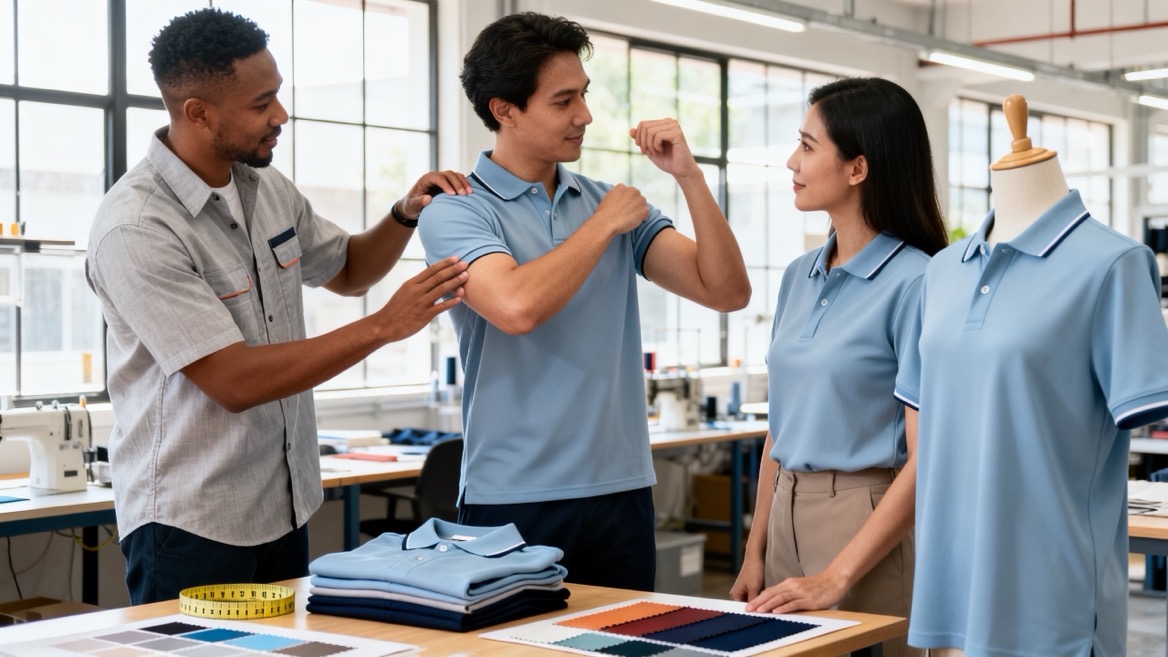
My recommendation is to assess fit during actual job movements, not just while the wearer stands still.
Sweat cools the body when it evaporates. High humidity makes that process more difficult.
A moisture-wicking polo can move liquid away from the skin, but wicking does not guarantee evaporation. Workers may still feel hot when humidity is high or airflow is limited.
The same limitation applies to woven shirts. A breathable uniform supports comfort; it cannot replace workplace heat controls.
Fiber composition matters, but it should not become a shortcut for predicting comfort.
Cotton-rich fabrics are worth considering when buyers prioritize familiar hand feel and everyday wearability.
However, judge their wet performance as well as their dry feel. A comfortable showroom sample may behave differently after sustained sweating.
For cotton shirts and polos, evaluate damp cling, drying time, shrinkage, and appearance after laundering.
An engineered polyester knit can offer effective moisture transport and low resistance to heat or vapor transfer.
Nevertheless, "polyester" does not identify a single performance level. Yarn design, knitted structure, thickness, and finishing all influence the result.
Request measured evidence rather than accepting "quick-dry" or "cooling" as self-explanatory claims.
Blends give developers another route to balancing comfort, appearance, and care requirements.
The percentage on the label is only part of the specification. Two garments with the same fiber blend can perform differently because their construction and thickness differ.
For OEM purchasing, approve the fabric specification and finished sample together.
A 2025 study examined 18 knitted fabrics taken from workwear T-shirts and polos, including standard garments and protective-clothing applications.
Measured air permeability ranged from 138 to 1,382 mm/s under the study's test conditions. That substantial variation within knitted workwear shows why "polo fabric" is not a reliable cooling specification.
The researchers also compared a polo fabric and a T-shirt fabric containing the same 50% cotton and 50% recycled polyester blend. The thicker polo material had higher thermal and water-vapor resistance.
For buyers, the useful lesson is straightforward: identical fiber percentages do not mean identical comfort.
This research does not establish that polos outperform woven shirts. It investigated knitted materials, not a direct woven-shirt-versus-polo workplace trial. Its value is demonstrating how much construction matters within one garment category.
The following are illustrative purchasing scenarios, not customer case studies or measured performance results.
For teams that regularly reach, walk, and move packages, begin by sampling a lightweight polo with adequate shoulder movement.
Compare it against a woven shirt if pockets, abrasion exposure, or a more structured appearance are important.
Include any required vest in the trial. Evaluating a shirt alone may overlook the heat burden of the complete uniform.
A woven short sleeve shirt is a useful starting choice when presentation requirements favor a structured silhouette.
A polo may suit informal service teams or roles involving frequent movement.
Test both through a realistic shift, including transitions between cooled interiors and warmer service areas.
Start with the workplace hazard assessment.
An ordinary short sleeve shirt or polo is not a substitute for clothing required for flame, electrical arc, chemical, visibility, or other hazards.
Where short sleeves are permitted, compare movement, snag risks, pocket placement, and compatibility with required protective equipment.
Neither short-sleeved option provides full arm coverage.
Where sun exposure matters, consider whether a lightweight long-sleeved garment is more appropriate. Do not assume that a short sleeve automatically produces the safest summer uniform.
Any ultraviolet-protection claim should be supported by appropriate testing.
A useful development brief connects the garment to its operating conditions.
Instead of requesting "a breathable summer polo," describe the job, climate, washing process, and approval criteria.
| Specification area | Information to provide |
|---|---|
| Working environment | Indoor or outdoor; humidity; airflow; radiant heat |
| Activities | Walking, lifting, reaching, driving, or customer service |
| Safety | Required coverage, protective standards, and machinery restrictions |
| Fabric | Composition, construction, mass, thickness, and performance targets |
| Fit | Size range, movement requirements, and tucked or untucked wear |
| Branding | Logo dimensions, position, and application method |
| Care | Actual washing, drying, and finishing process |
| Approval | Sample assessment, wear trial, and agreed tolerances |
The finished shirt includes collars, seams, pockets, logos, and potentially reinforced areas.
Large decorations introduce additional material in specific locations. Assess whether that affects local stiffness, movement, or perceived comfort.
For woven shirts, review unnecessary bulk in collars and pocket assemblies. For polos, assess whether collars, sleeve bands, and the chest fit remain comfortable during work.
These are development checkpoints, not claims that one construction will always run hotter.
Approve samples after representative laundering, not only when new.
Check:
- Dimensional change and fit.
- Collar and placket appearance.
- Pilling or surface wear.
- Color consistency.
- Logo condition.
- Moisture performance where relevant.
If a performance claim depends on a finish, request evidence supporting its durability under the intended care process.
A structured comparison provides more useful information than asking which sample feels softer.
1. Select one woven shirt and one polo that meet the same workplace requirements.
2. Include employees representing relevant sizes and job roles.
3. Use comparable shifts and record temperature, humidity, workload, and layering.
4. Ask participants to assess dampness, cling, movement, irritation, and appearance.
5. Repeat the assessment after representative washing.
6. Investigate complaints before approving production.
A suggested internal scorecard could allocate 40 points to thermal comfort, 25 to movement, 20 to laundering performance, and 15 to appearance.
Those weights are a proposed buying framework, not a validated research scale. Adjust them to the job, and treat mandatory safety requirements as pass-or-fail conditions.
A lower quotation does not necessarily produce a lower-cost uniform program.
Compare purchase price alongside washing costs, finishing labor, replacement frequency, and employee acceptance.
A useful purchasing metric is cost per accepted wear: the combined acquisition and care cost divided by the number of wears the garment delivers while remaining suitable.
Neither polos nor woven shirts are automatically cheaper over their useful life. The result depends on the approved specification and actual care conditions.
The better choice in the short sleeve shirt vs polo shirt comparison is the garment that meets the job's comfort, safety, presentation, and care requirements.
For your next OEM program, send Shanghai Youti Clothing Co., Ltd. your workplace brief, target quantities, size breakdown, branding artwork, and washing requirements. Request a comparative sampling proposal for a woven short sleeve shirt and a polo, then approve the production specification using evidence from testing and wear trials.
Not necessarily. A lightweight, open-knit polo can perform well, but a dense polo may be less comfortable than a lightweight woven shirt. Compare fabric properties, fit, and finished-garment wear trials.
Select the garment with suitable moisture transport, low water-vapor resistance, and comfortable wet performance. Humidity limits evaporation, so a wicking label alone does not establish superior cooling.
There is no universal best GSM. Choose fabric mass alongside thickness, permeability, durability, coverage, and safety requirements. Use sampling to confirm whether a proposed material suits the workplace.
They can be suitable where the hazard assessment permits ordinary uniforms. A standard polo should not replace required protective clothing. Confirm the complete garment's suitability before purchasing.
Not always. Different departments may need different garment constructions. A shared color palette and branding system can maintain visual consistency while allowing role-specific shirts.
Provide job roles, climate conditions, safety requirements, size quantities, branding artwork, care instructions, target budget, and approval criteria. This creates a clearer basis for sampling and quotation.
1. Vasile, S., Vega Arellano, J. P., Copot, C., Osman, A., and De Raeve, A. (2025). *Thermal and Moisture Management Properties of Knitted Fabrics for Skin-Contact Workwear*. Materials, 18(8), 1859. Supports the research figures and discussion of construction, thickness, moisture management, and test methods. [pmc.ncbi.nlm.nih]
2. Occupational Safety and Health Administration. *Heat—Heat Hazard Recognition*. Supports the discussion of humidity, workload, environmental heat, and clothing-related heat burden. [osha]
3. California Department of Industrial Relations, Cal/OSHA. *Heat Illness Prevention: Work Clothing and Personal Protective Equipment*. Supports breathable-clothing guidance, sun coverage, and the moving-machinery exception to loose-fitting clothing. [dir.ca]
4. National Institute for Occupational Safety and Health. *Working in Heat*. Supports the explanation of combined environmental, metabolic, and clothing-related heat stress. [archive.cdc]
5. *Material and Structural Functionalization of Knitted Fabrics for Sportswear* (2022). Materials, 15(9), 3306. Supports the discussion of how knitted structure, thickness, and material design influence air permeability and moisture behavior. [mdpi]


