
Views: 275 Author: Youti Clothing Publish Time: 2026-10-22 Origin: Site


Content Menu
● Workshop Clothes vs Industrial Workwear: Understanding the Difference
>> What Is Industrial Workwear?
● Workshop Clothes vs Industrial Workwear: Side-by-Side Comparison
● Compare Fabric, Construction, and Worker Comfort
>> Fabric Composition Does Not Establish Protection
>> Construction Should Follow the Task
>> Fit Is a Functional Requirement
● Protective Industrial Workwear: What Documentation Matters?
>> Start with Workplace Hazards
>> Understand the Scope of Each Standard
● Which Workwear Fits Different Manufacturing Facilities?
>> Light Assembly and General Workshop Operations
>> Machining and Industrial Maintenance
>> Welding, Hot Processes, and Chemical Handling
● A Practical Five-Step Manufacturing Workwear Selection Process
>> 2. Separate Essential Requirements from Preferences
>> 3. Build a Measurable Specification
>> 4. Run Wear and Laundry Trials
>> 5. Approve and Control Production
● A Useful Cost Comparison: Price per Accepted Wear
● An Illustrative Facility Strategy: Shared Branding, Different Specifications
● Building an OEM Brief with Shanghai Youti Clothing Co., Ltd.
● Choose by Function, Then Build the Right Specification
>> Are Workshop Clothes and Industrial Workwear the Same?
>> Is Industrial Workwear Always PPE?
>> Can Cotton Workshop Clothes Be Used for Welding?
>> Does ISO 15797 Mean a Garment Is Protective?
>> Should Every Factory Employee Wear the Same Uniform?
>> What Should Buyers Verify Before an OEM Order?
Workshop clothes and industrial workwear can look similar, but they should not be purchased as interchangeable solutions. Workshop clothes usually serve everyday tasks where comfort, practical storage, and a consistent appearance matter. Industrial workwear generally addresses more demanding production environments, including frequent laundering, sustained abrasion, and, where required, specific protective functions.
For manufacturing facilities, the right choice depends on the work being performed—not simply the garment's name or fabric weight. Hazard assessment should guide protective requirements, while wear trials and lifecycle costing guide usability and purchasing decisions.
For overseas brands, wholesalers, and manufacturers sourcing OEM uniforms from Shanghai Youti Clothing Co., Ltd., the practical question is: what must each garment reliably do throughout its working life?
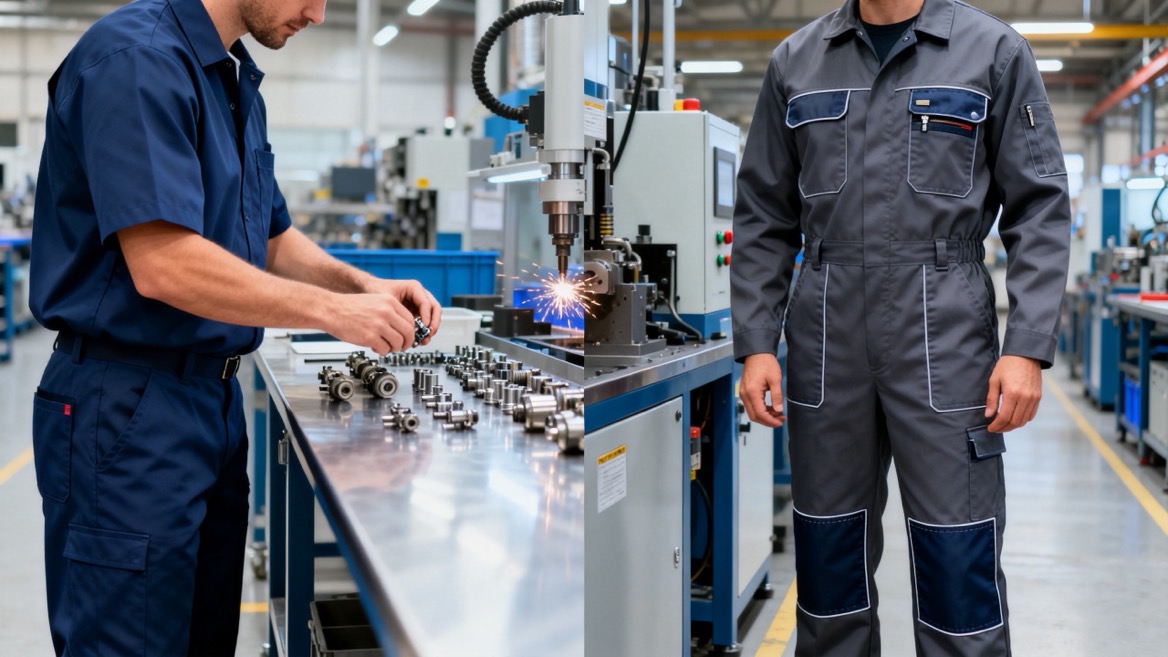
"Workshop clothes" is a commercial description rather than a universally defined protective-clothing category. It commonly describes work shirts, trousers, jackets, aprons, and coveralls used in repair shops, assembly areas, woodworking spaces, and general maintenance.
Their main functions often include:
- Keeping everyday clothing cleaner.
- Providing accessible storage.
- Supporting bending, reaching, and kneeling.
- Creating a recognizable team appearance.
A workshop garment may be durable without providing verified protection against flame, chemicals, or other specific hazards. Buyers should never infer protective performance from appearance alone.
"Industrial workwear" is also a broad commercial term. It typically describes clothing specified for factory operations, demanding maintenance, industrial laundry programs, or specialist production tasks.
Some industrial workwear is ordinary occupational clothing. Other garments qualify as personal protective equipment because they provide defined protection against identified hazards.
This distinction matters: an industrial-looking coverall is not automatically protective, and a workshop garment can provide protection if its construction, testing, and documentation support that claim.
The following table describes typical purchasing priorities, not fixed technical classifications.
| Comparison factor | Workshop clothes | Industrial workwear |
|---|---|---|
| Main purchasing priority | Practical comfort and everyday utility | Consistent performance under specified operating conditions |
| Typical environment | Repair, light assembly, general maintenance | Production lines, heavy maintenance, specialist processing |
| Fabric selection | Based on comfort, appearance, and expected wear | Based on abrasion, laundering, exposure, and protective requirements |
| Garment construction | Functional pockets and general reinforcement | Task-specific reinforcement, closures, and coverage |
| Laundry approach | Domestic, commercial, or managed washing | Frequently specified for controlled industrial laundering |
| Protective status | Not implied by the category name | Not implied; must be established separately |
| Purchasing evidence | Samples, specifications, and wear trials | These plus applicable performance and conformity documentation |
| Cost evaluation | Purchase price and replacement frequency | Total ownership cost and verified service performance |
Neither category is inherently superior. The better solution matches the role without adding unnecessary weight, complexity, or unsupported safety claims.
Cotton-rich fabrics, polyester-cotton blends, and specialist protective textiles may all appear in manufacturing uniforms.
For ordinary work clothing, compare shortlisted fabrics through samples and documented testing. Evaluate abrasion resistance, dimensional change, color retention, and comfort under the actual working conditions.
For protective clothing, composition alone is insufficient. "Cotton," "heavyweight," or "flame-resistant fabric" does not establish that a completed garment meets the required protective performance.
My recommendation from a procurement perspective is to evaluate the garment as a system: fabric, seams, closures, trims, labels, and intended care process.
A useful workwear specification explains why each feature exists.
For example:
- Reinforced knees may suit repeated kneeling.
- Covered closures may help prevent exposed hardware from contacting finished products.
- Pocket placement should reflect the tools workers actually carry.
- Sleeve and leg openings should suit the task and surrounding equipment.
- Two-piece garments should maintain appropriate coverage during movement.
Avoid adding pockets and reinforcement simply because they make a garment look more industrial. Every feature adds cost and may affect mobility, cleaning, or compatibility.
A garment that looks correct while standing may perform poorly during work.
Wear trials should include reaching overhead, squatting, climbing permitted access steps, and handling representative tools. Check whether jackets ride up, trousers restrict movement, or pockets become inaccessible.
Include workers with different body proportions and test the intended underlayers. For protective applications, assess compatibility with the other equipment workers must wear.
A complete size range is more useful than one sample approved on one person.
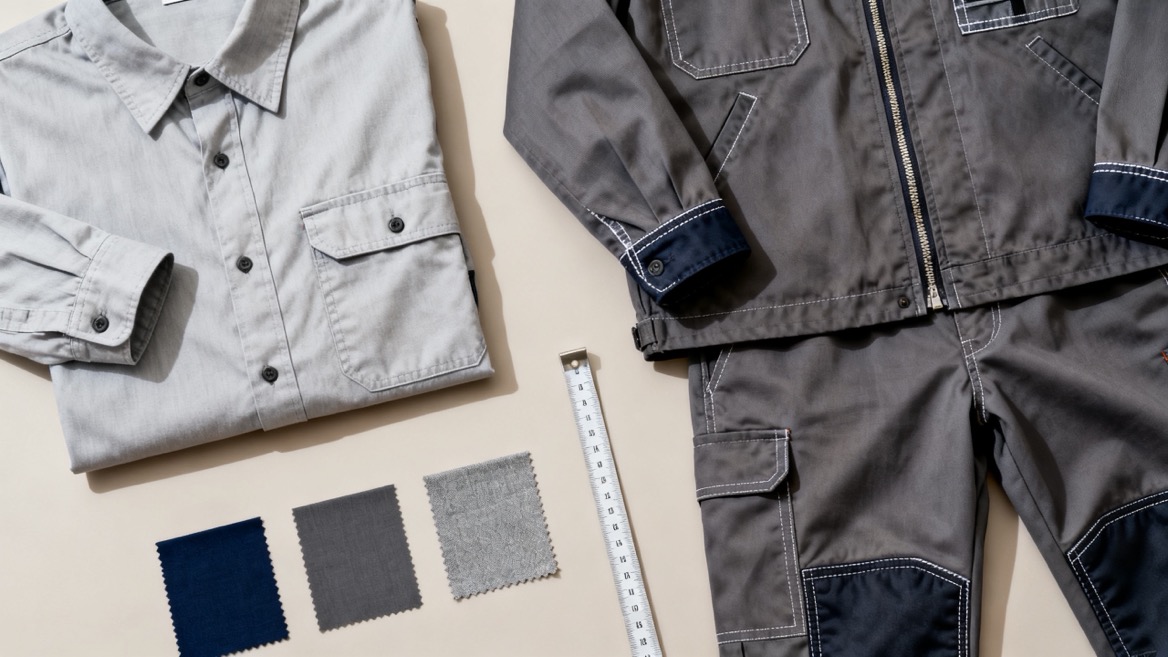
The clothing decision should follow the facility's risk assessment.
In the United States, OSHA's general PPE requirements direct employers to assess workplace hazards, select suitable equipment, and ensure proper fit. Other destinations have their own requirements.
Ordinary workshop clothing may be appropriate where the assessment establishes that no specialist clothing protection is necessary. Where thermal, chemical, electrical, or other hazards remain, selection requires competent safety input.
Clothing does not replace machine guarding, exposure controls, or safe working procedures.
Different standards answer different questions:
| Standard | Relevant scope | Purchasing implication |
|---|---|---|
| ISO 13688 | General protective-clothing requirements | Use alongside a relevant protection-specific standard |
| ISO 11611 | Clothing for welding and allied processes | Evaluate suitability for the welding task and associated exposure |
| ISO 11612 | Clothing protecting against heat and flame | Match claimed performance to the identified thermal hazards |
| ISO 15797 | Industrial washing and finishing test procedures | Evaluate laundering durability; do not treat it as hazard-protection certification |
ISO 13688 is not a standalone demonstration of protection against a particular hazard. ISO 15797 does not establish flame, chemical, or electrical protection.
Before ordering, confirm the applicable edition, destination-market obligations, claimed performance levels, and documentation for the exact product. A fabric report should not be presented as complete evidence for every finished-garment claim.
Workshop clothes may suit operations focused on clean assembly, routine handling, and general service tasks where the assessment identifies no need for specialist protective clothing.
Priorities may include easy movement, controlled fit, consistent branding, and garments that maintain their appearance after the intended washing process.
However, "light manufacturing" is not a safety classification. A seemingly simple assembly area may still contain exposure or machinery risks requiring additional controls.
Machining and maintenance often justify more detailed garment specifications because duties can vary considerably within one shift.
Assess abrasion, contamination, tool access, equipment interaction, and cleaning requirements. Maintenance personnel may also move between areas with different protective-clothing rules.
A single generic coverall may therefore be less suitable than a role-based clothing program with clear rules for changing or adding protection.
These applications require hazard-specific selection rather than a choice based only on workshop versus industrial terminology.
Welding clothing should be assessed against the welding process and relevant requirements. Heat-protective clothing must address the actual thermal exposure. Chemical-protective selection depends on the substance, its physical form, concentration, and exposure conditions.
Do not treat water repellency as evidence of chemical protection, or general heat protection as automatic suitability for every welding operation.
Create a role-by-role matrix covering tasks, working conditions, hazards, and cleaning needs. Separate production, maintenance, warehouse, and supervisory requirements where their duties differ.
List mandatory protection and performance requirements first. Then add commercial preferences such as colors, logo placement, pocket layout, and packaging.
This prevents styling decisions from obscuring technical priorities.
Define fabric composition, weight, garment measurements, tolerances, seam construction, closures, and care requirements.
For protective products, specify the intended performance claims and required evidence. Replace vague descriptions such as "premium industrial quality" with measurable acceptance criteria.
Test representative sizes and job roles using the intended garments and cleaning process.
Record:
- Movement restrictions and fit problems.
- Dimensional changes after washing.
- Seam, closure, and pocket deterioration.
- Color changes and label readability.
- Worker feedback and reasons for rejection.
A short pilot cannot prove an entire service life, but it can reveal important specification problems before bulk production.
Retain an approved reference sample and the final specification. Agree on inspection criteria, traceability, and the process for authorizing substitutions.
Fabric, thread, trim, or construction changes should not occur without review—especially where they could affect protective performance.
Purchase price alone can make the cheaper garment appear more economical.
A more useful calculation is:
Cost per accepted wear=(Purchase + cleaning + repairs + allocated administration)/Accepted wears before retirement
Consider an illustrative comparison, not a market benchmark:
| Cost component | Garment A | Garment B |
|---|---|---|
| Purchase price | $24 | $36 |
| Lifetime cleaning and repairs | $56 | $64 |
| Total modeled cost | $80 | $100 |
| Accepted wears | 80 | 125 |
| Cost per accepted wear | $1.00 | $0.80 |
Garment B has a higher purchase price but a lower modeled cost per wear.
The result depends on validated assumptions. Use pilot data or reliable laundry records rather than supplier promises. For protective garments, retirement must follow the applicable instructions and condition criteria—not a financial target.
Imagine a manufacturer operating assembly benches, machining stations, and a welding area. This is a planning example, not a documented Shanghai Youti customer case.
The assembly team may need comfortable ordinary uniforms. Machining personnel may require more task-specific construction and cleaning controls. Welders need clothing selected for their assessed welding hazards.
Instead of forcing everyone into one garment, the buyer can use a shared color palette and branding system while maintaining different specifications.
This creates visual consistency without pretending that identical appearance means identical protection. Purchasing records should identify which garment belongs to each role and where substitution is prohibited.
For brands, wholesalers, and manufacturers sourcing OEM uniforms and work clothes from Shanghai Youti Clothing Co., Ltd., a clear brief is the starting point for a productive development discussion.
Provide:
1. Destination markets and intended end users.
2. Job roles and working conditions.
3. Ordinary-uniform or protective-clothing requirements.
4. Fabric, construction, sizing, and branding specifications.
5. Intended washing and finishing processes.
6. Required testing, documentation, and inspection criteria.
7. Forecast quantities and replenishment expectations.
Request confirmation of manufacturing feasibility, available evidence, development scope, and quotation assumptions.
Do not assume that any supplier holds a particular certification or can support a protective claim without verification.
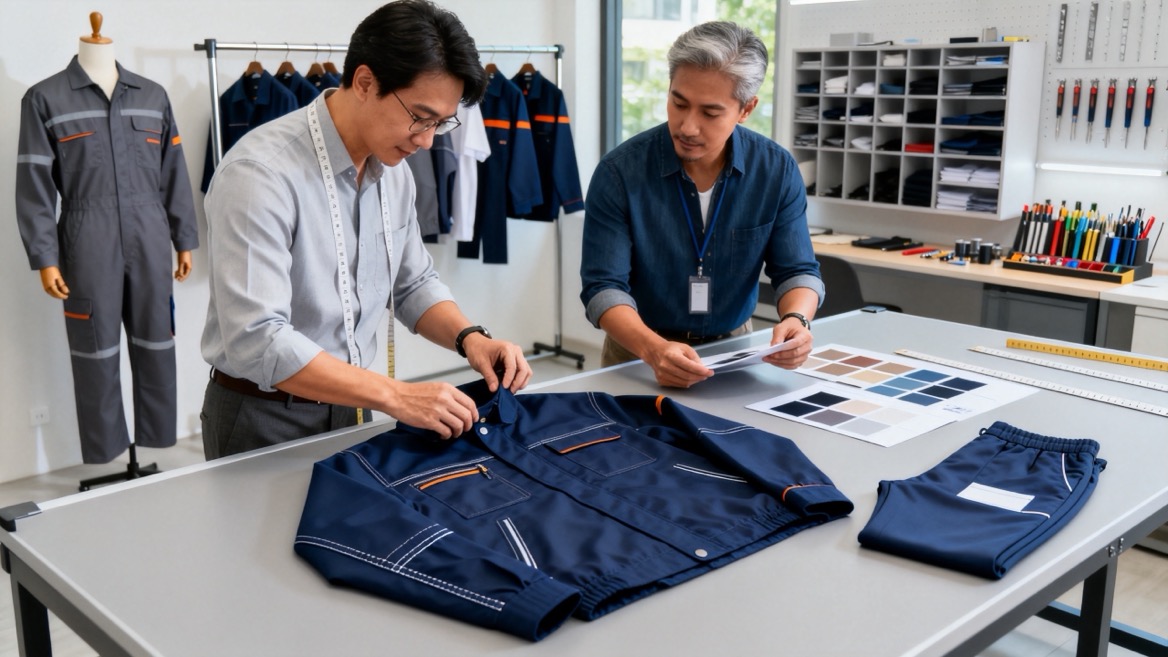
Choose workshop clothes when verified everyday utility meets the role. Choose more demanding industrial specifications when operating conditions require them. Where specialist protection is necessary, select documented, hazard-appropriate clothing.
Send Shanghai Youti Clothing Co., Ltd. your role matrix, destination markets, garment specifications, and laundry requirements to begin an OEM feasibility and quotation discussion.
They overlap, but neither term defines a universal performance level. Workshop clothes usually emphasize everyday utility, while industrial workwear often involves more demanding operating specifications.
No. Industrial workwear can be ordinary occupational clothing. Protective status depends on its intended function, applicable requirements, and supporting evidence—not the product name.
Cotton composition alone does not establish suitability. Welding garments should be selected against the assessed hazards, relevant performance requirements, and documentation for the completed product.
No. ISO 15797 provides industrial laundering test procedures. It helps evaluate relevant durability properties but does not establish protection against flame, chemicals, or electrical hazards.
Not necessarily. Shared branding can coexist with different garment specifications. Role-based selection is preferable when tasks, exposures, or cleaning requirements differ.
Verify the approved specification, fit, laundry performance, inspection criteria, and any claimed protective performance. Confirm that documents apply to the exact product being ordered.
1. [Occupational Safety and Health Administration — 29 CFR 1910.132: General Requirements]. Source for workplace hazard assessment, PPE selection, and proper fit. [osha]
2. [International Organization for Standardization — ISO 13688:2013, Protective Clothing: General Requirements]. Source for general requirements and the need to combine this standard with protection-specific standards. [iso]
3. [International Organization for Standardization — ISO 11611:2015, Protective Clothing for Use in Welding and Allied Processes]. Source for welding-protective clothing scope and limitations. Buyers should verify the applicable edition before contracting. [iso]
4. [International Organization for Standardization — ISO 15797:2017, Industrial Washing and Finishing Procedures for Testing of Workwear]. Source for industrial laundering test scope and the value of checking compatibility with actual laundry processes. [iso]
5. [Bierbaum-Proenen — EN ISO 11612: Heat and Flame Protection]. Manufacturer-authored explanation of thermal protective-clothing requirements, used for general scope rather than product endorsement. [bp-online]
6. ["Current Global Standards for Chemical Protective Clothing" — Full Text via PubMed Central]. Source for exposure-specific chemical-clothing selection, wear trials, inspection, and decontamination considerations. [pmc.ncbi.nlm.nih]


