
Views: 244 Author: Youti Clothing Publish Time: 2026-10-20 Origin: Site


Content Menu
● Introduction: Why Source Workwear for the Saudi Arabian Market?
>> What the Latest Industry Evidence Actually Shows
>> Where Are the Relevant Supplier Hubs?
● Selection Criteria: How the Suppliers Were Evaluated
● Five Workwear Manufacturers and Suppliers to Evaluate
>> 1. Shanghai Youti Clothing Co., Ltd. — China-Based OEM Alternative for Private-Label Buyers
>>> Core Advantages and OEM Scope
>>> Compliance Points to Verify
>> 2. Ghoush Uniforms — Protective Clothing and Military Uniform Specialist
>>> Core Advantages and Customisation Scope
>> 3. Blaze Uniforms — Custom Uniform Supplier Serving Dammam and Jubail
>>> Core Advantages and Customisation Scope
>> 4. Adham Abu Sarhad Clothing Factory — Saudi Custom Uniform and Work-Suit Option
>>> Core Advantages and Customisation Scope
>> 5. AttireCorp — Regional Uniform Development and Supply Partner
>>> Core Advantages and Customisation Scope
● Supplier Comparison: Capacity, MOQ, and Compliance
● Technical Buyer's Guide: Specify Performance Before Requesting Prices
>> Define Fabric Requirements Beyond "Premium Quality"
>> Separate Quality Systems, Social Audits, and Product Compliance
>> Confirm Saudi Requirements Before Production
● Common Procurement Problems and How to Avoid Them
>> Problem 1: Bulk Fabric Does Not Match the Approved Sample
>> Problem 2: "Flame Resistant" Is an Undefined Sales Description
>> Problem 3: Capacity Claims Ignore the Product Mix
>> Problem 4: A Low Unit Price Conceals Development and Replenishment Costs
● An Overlooked Procurement Trap: Compliance Can Change With Size and Branding
● Sampling, Factory Verification, and Logistics
>> Use a Controlled Sample-Approval Sequence
>> Verify the Factory Behind the Quotation
>> Plan Import Documentation Early
● Conclusion: Match the Supplier to the Procurement Model
>> 1. How Can We Check Whether a Supplier's ISO Certificate Is Expired or Suspended?
>> 2. Does a Fabric Test Report Prove That the Finished Protective Garment Is Compliant?
>> 3. Can a Saudi Supplier Use Overseas Production While Selling Through a Local Office?
>> 4. How Should MOQ Be Negotiated for a Collection With Multiple Colours and Sizes?
>> 5. What Happens If We Change the Logo or Fabric After PPE Approval?
Selecting a workwear supplier requires more than comparing prices and catalogue photographs. Procurement managers need evidence of manufacturing capability, reliable quality control, appropriate product compliance, and consistent delivery across repeat orders.
This guide focuses on Saudi Arabia, rather than the entire Arabian Peninsula. It compares four suppliers serving the Saudi market with one China-based OEM manufacturer, Shanghai Youti Clothing Co., Ltd., included first as an international sourcing alternative—not as a Saudi factory.
The shortlist is designed for overseas brands, wholesalers, manufacturers, and institutional buyers seeking long-term partners. It is an editorial comparison based on publicly available information, not an audited ranking by revenue, factory output, or product performance.
The central purchasing principle is traceability: buyers should be able to connect every important claim to a specific factory, garment, material batch, certificate, or inspection record.

Saudi Arabia combines demand for industrial protective clothing with purchasing requirements for corporate uniforms, construction workwear, hospitality apparel, and healthcare garments.
However, buyers should distinguish between three supply models:
- Local manufacturers that cut, sew, and finish garments in Saudi Arabia.
- Regional uniform suppliers that combine local service with outsourced production.
- Overseas OEM factories that manufacture private-label garments for importers and distributors.
These models solve different procurement problems. Local manufacturing may support site visits, fitting programmes, and replenishment coordination. Overseas production may suit buyers developing broader private-label collections or consolidating multiple garment categories.
Coverage of the Saudi State of Fashion 2025 report states that the broader fashion industry was expected to contribute 2.6% of Saudi GDP in 2025 and support approximately 340,000 jobs. These figures describe the fashion ecosystem, not the workwear manufacturing segment. They should not be presented as workwear market size or factory capacity.
Official trade data also require careful interpretation. Saudi Arabia's General Authority for Statistics reported that non-oil exports, including re-exports, increased by 18.6% year on year in the fourth quarter of 2025. National non-oil exports fell by 1.5%, while re-exports rose by 67.4%. The distinction matters: growing trade activity does not automatically demonstrate expanding domestic garment production.
For procurement teams, the practical conclusion is to verify manufacturing location and production ownership rather than relying on broad market-growth claims.
The reviewed suppliers illustrate several useful sourcing locations:
- Riyadh: Ghoush lists a manufacturing presence in the Second Industrial City, while AttireCorp lists a Saudi office in Al Nuzha.
- Dammam and Jubail: Blaze Uniforms markets its manufacturing and supply services in these Eastern Province locations.
- Jeddah: Adham Abu Sarhad Clothing Factory lists its contact location in Bani Malik.
These are practical supplier-access points, not evidence that every city operates a fully integrated textile manufacturing cluster. Buyers should separately establish where fabric sourcing, cutting, sewing, decoration, and final inspection take place.
A credible shortlist should make its limitations visible.
The following criteria informed inclusion and should also form the basis of a buyer's due-diligence process.
| Evaluation area | Evidence buyers should request | Why it matters |
|---|---|---|
| Manufacturing identity | Legal entity, production address, subcontractor disclosure | Separates factories from trading or service operations |
| Product development | Technical drawings, pattern capability, fabric recommendations, sample revisions | Demonstrates support beyond logo application |
| Quality control | Incoming-fabric checks, inline inspection, final inspection records | Reduces variation between approved samples and deliveries |
| Compliance | Current documents matched to the site, garment, and intended market | Prevents misuse of unrelated certificates |
| Capacity | Available production slots by garment type and delivery period | Tests whether advertised output is relevant to the order |
| Delivery reliability | Milestone schedule, material-booking evidence, escalation procedure | Exposes risks before shipment deadlines |
| Commercial suitability | MOQ structure, development charges, repeat-order terms | Determines whether the supplier fits the buyer's business model |
Public information is incomplete for several suppliers. Where founding dates, production capacity, MOQ, or certification details were unavailable, this guide marks them as undisclosed rather than estimating them.
Shanghai Youti is included first because it is the commissioning company and provides an international OEM comparison. That placement should not be interpreted as an independently verified performance ranking.
Established: 2018
Location: Shanghai, China
Published markets: Europe, North America, Oceania, with expansion into South America and Southeast Asia
Primary fit: Brands and wholesalers developing customised uniforms and work clothes
Shanghai Youti publishes a 2,500-square-metre production workshop, more than 300 machinery and equipment units, six sewing lines, and annual output exceeding 1.4 million pieces. These are company-reported figures across its apparel business; they are not independently verified workwear-only capacity figures.
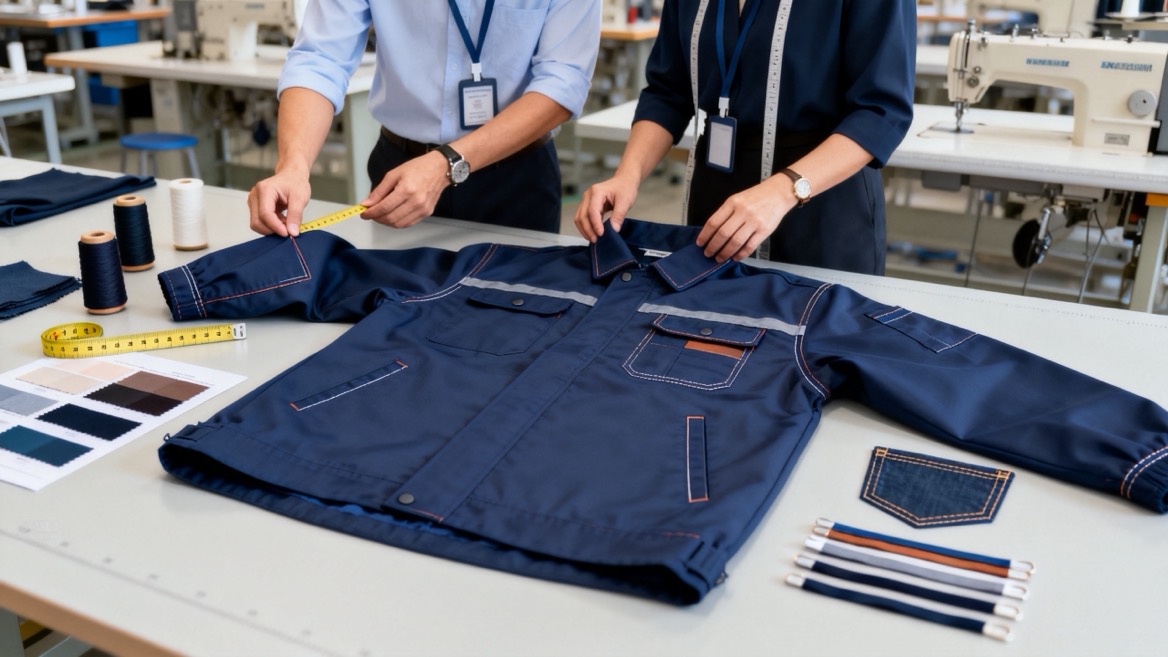
Its portfolio includes uniforms, workwear, trousers, jackets, shirts, and suits. The company accepts technical documents, photographs, and physical samples as development inputs and offers embroidery or printing for customised branding. Published timing is 10–15 working days for sampling and 45–60 working days for bulk production.
Youti's published service model combines design and development, sampling, production, quality inspection, and after-sales support. It also describes dedicated project-manager communication, fabric-selection advice, and multi-stage inspection. These capabilities make it relevant to buyers seeking more extensive OEM support than a standard catalogue-and-logo service.
For smaller brands, its main potential value is coordinated development across several garment categories. However, buyers should not assume low MOQs or lower landed costs: neither is established by the available public information.
A suitable enquiry should request:
- MOQ by style, colour, and fabric.
- Sample-development and revision charges.
- Fabric alternatives at different target prices.
- A dated production-slot commitment.
- Responsibility for technical documentation and testing.
Youti's website lists ISO 9001, BSCI, REACH, EN 1149-5, and EN ISO 11612 among its compliance claims. These should be checked individually rather than treated as interchangeable factory certifications.
In particular, amfori BSCI is an audit and improvement system, not a certification scheme. Buyers should request the audit report, site identity, rating, and corrective-action status.
Youti belongs on the shortlist as a development-oriented OEM option. Its cost-effectiveness and suitability for smaller orders should be established through a project-specific quotation and sample evaluation.
Established: Since 1995, according to its website
Manufacturing locations: Saudi Arabia and Sri Lanka
Published markets: Saudi Arabia and the wider Middle East and North Africa
Primary fit: Protective workwear, military uniforms, security clothing, and specialised institutional requirements
Ghoush describes in-house manufacturing at two facilities in Saudi Arabia and Sri Lanka, supported by approximately 550 personnel. It identifies its Saudi location in Riyadh's Second Industrial City. The staffing figure is not an annual garment-output commitment.
Its published range includes flame-retardant protective clothing, military uniforms, camouflage garments, tactical clothing, and security uniforms. The company also states that it develops garments to specific customer requirements.
Ghoush is relevant where protective performance and sector-specific garment design carry more weight than general corporate styling.
Its design and production services suggest support for custom-specification programmes. However, buyers should obtain written confirmation of private-label arrangements, design ownership, manufacturing country, and subcontracting before treating that capability as a complete OEM or ODM offer.
The website refers to ISO certification and CE-related PPE compliance, but buyers still need the relevant certificate numbers, exact standards, covered models, and issuing bodies. A broad website statement cannot establish conformity for an individual garment.
Established: 1991
Published service locations: Dammam and Jubail, Saudi Arabia
Published market focus: Saudi regional customers across multiple uniform sectors
Primary fit: Corporate, hospitality, construction, medical, and cold-storage uniform programmes
Blaze Uniforms publishes an establishment date of 1991 and describes production units equipped with modern machinery. It also states that it works with fabric mills and suppliers with extensive distribution networks. Quantified annual capacity is not disclosed on the reviewed page.
Published services include:
- Custom uniform design.
- Stitching and tailoring.
- Embroidery.
- Screen and digital printing.
- Logo application.
- Fabric selection and consultation.
- Bulk-order production.
This breadth makes Blaze relevant for businesses coordinating uniforms across several departments.
Its reviewed website does not establish a specific MOQ, production lead time, export-market breakdown, or independently verified certification scope. For private-label workwear, buyers should confirm whether Blaze will manufacture to a buyer-owned technical specification, retain patterns for repeat orders, and provide material-batch documentation.
Established: Factory founding year not disclosed on the reviewed page
Published location: Jeddah, Saudi Arabia
Market focus: Official uniforms and work-clothing applications; export markets not disclosed
Primary fit: Custom work suits, official attire, reflective jackets, and safety vests
Adham Abu Sarhad Clothing Factory publishes capabilities in designing and tailoring official attire, work suits, uniforms, reflective jackets, and safety vests. Its listed departments include embroidery, printing, sewing, and upholstery.
The combination of tailoring, sewing, printing, and embroidery makes the factory a relevant candidate for customised institutional clothing and branded workwear.
The holding-group page states that the group was established in 1400 AH. That is a group-history statement, not a verified founding date for the clothing factory. Buyers should not substitute the parent company's age for the factory's operating history.
Publicly reviewed information does not disclose factory output, MOQ, garment-specific certification, or formal OEM/ODM terms. These points require direct confirmation.
Reflective jackets and safety vests should also be assessed as finished protective garments where applicable, rather than assumed compliant because reflective material is visible in product photographs.
Established: The company's About page states 2018; confirm the contracting entity's registration date
Published operating markets: United Arab Emirates and Saudi Arabia
Saudi location: Riyadh
Primary fit: Corporate, hospitality, and service-sector uniform programmes
AttireCorp describes itself as a B2B uniform and corporate-apparel company serving businesses across the UAE and Saudi Arabia. Its About page gives an establishment date of 2018, although its LinkedIn profile lists 2016. This discrepancy should be resolved through legal registration documents rather than silently selecting one date.
Its Saudi offering describes uniform design, sampling, production, embroidery, screen printing, and ready-made garments. It also lists a Riyadh office address.
AttireCorp is therefore relevant for buyers seeking regional coordination, brand presentation, and customised uniform supply.
However, a Saudi office does not prove Saudi manufacturing. Buyers should establish the production country, factory identity, subcontracting arrangements, and inspection access before assigning local-content expectations or delivery assumptions.
The table below separates published information from details that remain unverified.
| Supplier | Published production evidence | Published MOQ | Compliance information reviewed | Procurement focus |
|---|---|---|---|---|
| Shanghai Youti | Six sewing lines; over 1.4 million pieces annually across apparel; company-reported | Not disclosed | Website lists ISO 9001, BSCI, REACH, EN 1149-5 and EN ISO 11612; document-level verification required | Overseas OEM and private-label development |
| Ghoush Uniforms | Two facilities in Saudi Arabia and Sri Lanka; approximately 550 personnel; output undisclosed | Not disclosed | Website references ISO and CE/PPE compliance; model-specific verification required | Protective and military clothing |
| Blaze Uniforms | Production units and machinery described; output undisclosed | Not disclosed | Specific certification documents not established on reviewed page | Custom uniforms and decoration |
| Adham Abu Sarhad | Sewing, printing, and embroidery departments; output undisclosed | Not disclosed | Specific certification documents not established on reviewed page | Official attire and work suits |
| AttireCorp | Design, sampling, and production services described; factory output undisclosed | Not disclosed | Specific certification documents not established on reviewed pages | Regional uniform development and supply |
"Not disclosed" does not mean unavailable or non-compliant. It means the information should be obtained before supplier approval.
Advertised annual capacity also should not be confused with available capacity. A factory may have substantial output but no production slot within the buyer's required delivery window.
A useful workwear specification identifies measurable characteristics:
- Fibre composition and permitted tolerance.
- Fabric construction and nominal weight.
- Dimensional stability after the agreed washing process.
- Colourfastness requirements.
- Tear, tensile, abrasion, and seam-performance requirements.
- Finish type and maintenance conditions.
- Restricted-substance requirements.
- Approved material suppliers and substitution rules.
Fabric weight alone is not a quality grade. Buyers should compare proposed materials against the intended job, climate, laundering process, and service life.
For ordinary uniforms, the focus may be comfort, appearance retention, and durability. For protective workwear, the purchasing specification must also identify the actual hazard and applicable performance requirements.
Several labels commonly appear together in supplier marketing, although they answer different questions.
- ISO 9001 concerns a quality-management system; it does not establish the protective performance of every garment.
- amfori BSCI concerns social-compliance auditing and improvement, not product certification.
- ISO 11612 specifies performance requirements for clothing protecting against heat and flame.
- ISO 20471 addresses high-visibility clothing, including colour, retroreflection, minimum material areas, and placement.
- CE marking for applicable PPE concerns conformity with relevant EU legislation; it is not an environmental award.
Do not make "CE/RoHS certified" a generic purchasing requirement for all workwear. Determine the product category and destination rules first, then specify the documents actually needed.
For environmental and chemical requirements, ask for evidence tied to the relevant fabric, finish, trims, and production lot—not an unrelated certificate displayed in a sales presentation.
Saudi Arabia has a Technical Regulation for Textile Products. Its current requirements and the applicable conformity route should be checked for the exact garment classification before manufacture and shipment.
SABER is an importer-based platform used for product and shipment conformity procedures. Buyers should coordinate with the Saudi importer and an appropriate conformity-assessment body to establish the required documentation for the specific product.
For protective garments, confirm whether additional requirements apply to the intended protective function. Do not assume that a general textile compliance file answers every PPE requirement.
A sample may be produced from one fabric source while bulk goods use another.
Reduce this risk by approving a material specification, recording fabric references, restricting substitutions, and retaining sealed reference samples. Where performance is critical, arrange testing of production materials rather than relying exclusively on development-stage reports.
Ask what hazard the garment addresses, which standard applies, and which performance levels were achieved.
ISO 11612 covers several heat and flame exposures; a general reference to the standard is less useful than the garment's actual test results and intended-use limitations.
One million simple garments and one million multi-pocket protective coveralls represent different production workloads.
Request an order-specific schedule covering material procurement, sampling, production, inspection, and packing. Ask which operations are internal and which depend on subcontractors.
Compare quotations on a consistent basis:
- Garment specification.
- Decoration.
- Testing and documentation.
- Packaging.
- Freight and import costs.
- Inspection.
- Replacement arrangements.
- Repeat-order minimums.
The relevant comparison is the cost of an accepted, usable garment delivered under the agreed terms—not simply the initial sewing price.
One easily missed risk concerns high-visibility uniforms.
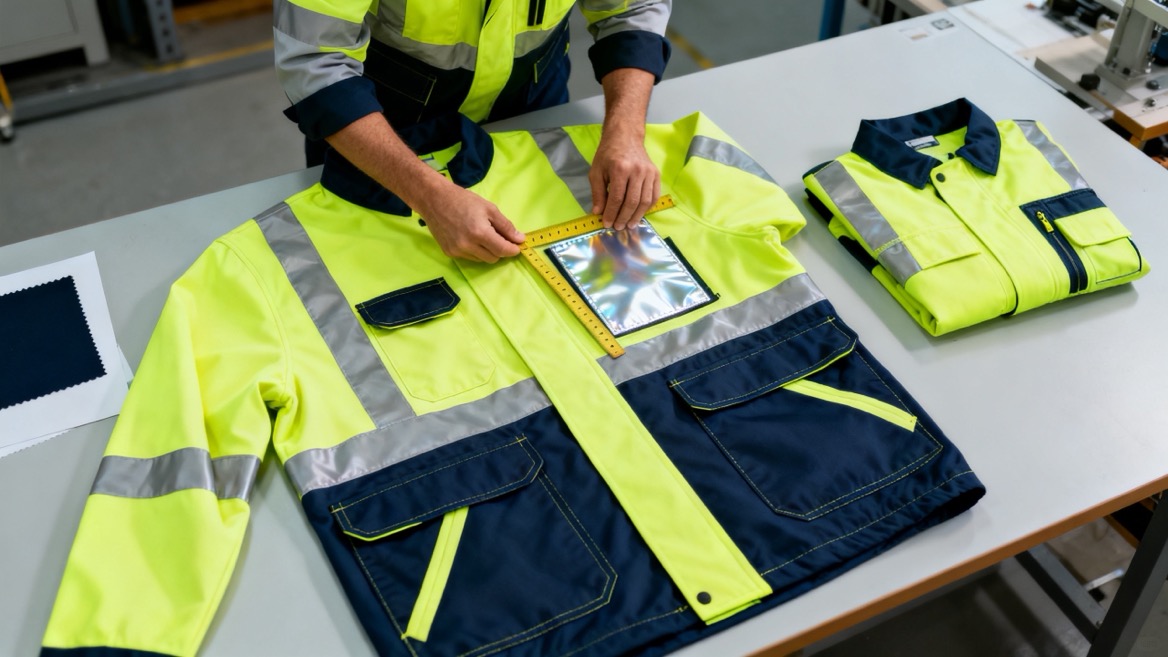
ISO 20471 includes requirements for minimum areas and placement of visible materials. Consequently, an approved design should not automatically be assumed to maintain the same classification after changes to sizing, pocket construction, or branding coverage.
A useful purchasing safeguard is to require assessment of:
1. The smallest marketed size.
2. The final logo dimensions and location.
3. Pocket flaps, contrast panels, and other areas affecting visible material.
4. The finished configuration supplied to workers.
This is especially important when sales teams approve artwork separately from the technical team. Branding approval should not bypass protective-performance review.
The same procurement principle applies more broadly: assess the finished product that will be delivered, not merely its base fabric or undecorated prototype.
A practical approval sequence is:
1. Development sample for construction and design.
2. Fit samples or a size set for measurement and movement.
3. Pre-production sample using agreed bulk materials and trims.
4. Production-stage verification.
5. Final inspection against the approved specification.
Keep signed records of each approval. Specify whether a change requires a revised sample, retesting, or written buyer acceptance.
Request:
- Legal registration and production address.
- A process map identifying subcontracted operations.
- Relevant certificate and audit documents.
- Sample inspection records.
- Material-control and corrective-action procedures.
- Permission for an independent inspection where commercially appropriate.
A video tour can support screening, but it should not replace verification of legal identity, certification scope, or production responsibility.
Before confirming shipment, align the manufacturer, importer, and freight provider on product descriptions, classification, origin, labels, invoices, packing lists, and applicable conformity documentation.
For Saudi-bound orders, establish the SABER responsibilities before the goods are ready to ship. Last-minute document preparation can create avoidable uncertainty even when sewing is complete.
These five companies represent different sourcing approaches.
Shanghai Youti offers a China-based OEM route with published development services and manufacturing-scale claims. Ghoush focuses on protective and military clothing. Blaze provides broad uniform customisation. Adham offers tailoring and decoration capabilities for official attire and work clothing. AttireCorp provides regional uniform development and supply coordination. Their suitability depends on the buyer's specification, manufacturing-location requirements, order structure, and evidence obtained during qualification.
For a quotation from Shanghai Youti Clothing Co., Ltd., provide a technical pack or reference sample, intended working environment, quantity by colour and size, required performance standards, branding artwork, and delivery destination. Request a written proposal covering material options, MOQ, sample timing, production milestones, and supporting compliance documents.
Approve the supplier only after the sample, documentation, and commercial terms support the same product specification.
Search the legal entity or certificate details in IAF CertSearch, then compare the status, certified site, scope, and standard with the documents supplied.
IAF CertSearch supports verification of accredited certificates and the associated certification and accreditation bodies. If a record cannot be resolved, request confirmation directly from the issuing body rather than accepting a scanned certificate alone.
Not necessarily.
Fabric evidence may support part of the assessment, but protective-clothing requirements can also involve garment design, material placement, coverage, and other finished-product characteristics. ISO 20471 explicitly addresses minimum areas and placement, while ISO 11612 defines protective-clothing performance requirements for heat and flame hazards.
Request evidence covering the actual garment model and supplied configuration.
Yes; a local commercial presence and local manufacture are different claims.
The reviewed companies illustrate why verification matters: Ghoush identifies facilities in Saudi Arabia and Sri Lanka, while AttireCorp publishes a Saudi office and regional supply services without the reviewed pages establishing a Saudi factory.
Ask for the manufacturing country and factory address for each order.
Ask the supplier to separate garment MOQ from fabric, dyeing, trim, and decoration minimums.
Request a quotation matrix showing:
- Minimum per style.
- Minimum per colour.
- Permitted size distribution.
- Shared-material options across styles.
- Small-run surcharges.
- Repeat-order conditions.
This makes negotiation more productive than requesting one low headline MOQ that may exclude important conditions.
Treat the change as a technical review, not merely a commercial amendment.
For applicable EU PPE, conformity assessment and technical documentation relate to the product being placed on the market. Changes should therefore be assessed against the approved design and relevant requirements before production proceeds.
Record who authorises the change, whether testing is needed, and which document revision applies to the shipment.
- Shanghai Youti Clothing Co., Ltd. — Company history, manufacturing claims, product range, markets, and service information. [work-jacket]
- Ghoush Uniforms — Company background, facilities, workforce, and protective-clothing focus. [ghoushuniforms]
- Blaze Uniforms — Establishment date, product categories, and customisation services. [blazeuniforms]
- Adham Abu Sarhad Clothing Factory — Product scope, departments, and group background. [abusarhadhc]
- AttireCorp — Regional operations and company background; founding-date discrepancy noted in the article. [attirecorp]
- Saudi Standards, Metrology and Quality Organization — Technical Regulation for Textile Products. Official starting point for checking the applicable Saudi textile requirements. [saso.gov]
- General Authority for Statistics — December and fourth-quarter 2025 international trade results, distinguishing domestic non-oil exports from re-exports. [stats.gov]
- Saudi Fashion Commission — Official industry resources and publications portal. [fashion.moc.gov]
- Vogue — Coverage of the Saudi State of Fashion 2025 report and its broader industry figures; these are not workwear-specific statistics. [vogue]
- ISO — ISO 11612:2015, protective clothing against heat and flame. [iso]
- ISO — ISO 20471:2013, high-visibility clothing requirements. [iso]
- European Commission — Personal Protective Equipment legislation and conformity-assessment guidance. [single-market-economy.ec.europa]
- IAF CertSearch — Accredited management-system certificate verification. [iafcertsearch]
- amfori — Explanation of BSCI and its status as an audit system rather than a certification scheme. [amfori]
- TÜV SÜD — Saudi textile conformity and SABER guidance. [tuvsud]


