
Views: 241 Author: Youti Clothing Publish Time: 2026-10-23 Origin: Site


Content Menu
● Workshop Uniforms vs Factory Workwear: What Is the Difference?
● How Workwear Improves Safety Without Replacing Hazard Controls
>> Start with a Task-Level Hazard Assessment
>> Control Loose Fabric Around Machinery
● Fabric Selection: Compare Performance, Not Just Composition
>> Cotton, Polyester Blends, and Specialized Fabrics
>> Fabric Weight Is Only One Variable
● Fit and Ergonomics: Where Safety Meets Productivity
>> Test Work Movements, Not Standing Posture
>> Build a Size System for the Workforce
● Heat Management: Why More Coverage Needs Better Planning
● Industrial Laundering: Evaluate the Garment After Washing
● A Practical Wear Trial Before Bulk Production
>> Step 1: Define Acceptance Criteria
>> Step 2: Include Representative Tasks and Wearers
>> Step 3: Record Problems Consistently
● Compare Total Cost per Wear, Not Unit Price Alone
● Turn the Comparison into an OEM Specification
● Develop Workwear Around the Job
>> Are Workshop Uniforms and Factory Workwear the Same?
>> Can Ordinary Workwear Replace Protective Clothing?
>> Which Fabric Is Best for Industrial Workwear?
>> How Can Uniforms Support Productivity?
>> What Should Buyers Check Before Approving OEM Samples?
Workshop uniforms and factory workwear should support the same goals: safer work, reliable comfort, and efficient movement. However, they are often purchased for different operating conditions. Workshop uniforms commonly serve technicians handling varied tasks, while factory workwear may support repetitive production, industrial laundering, and department-specific protection.
For international brands, wholesalers, and manufacturers, the challenge is not choosing the more industrial-sounding label. It is translating actual working conditions into a garment specification.
My starting point when evaluating a workwear brief is simple: hazard-first selection. Decide what workers encounter before deciding what they wear. For OEM buyers working with Shanghai Youti Clothing Co., Ltd., this approach creates a clearer foundation for product development, sampling, and purchasing.
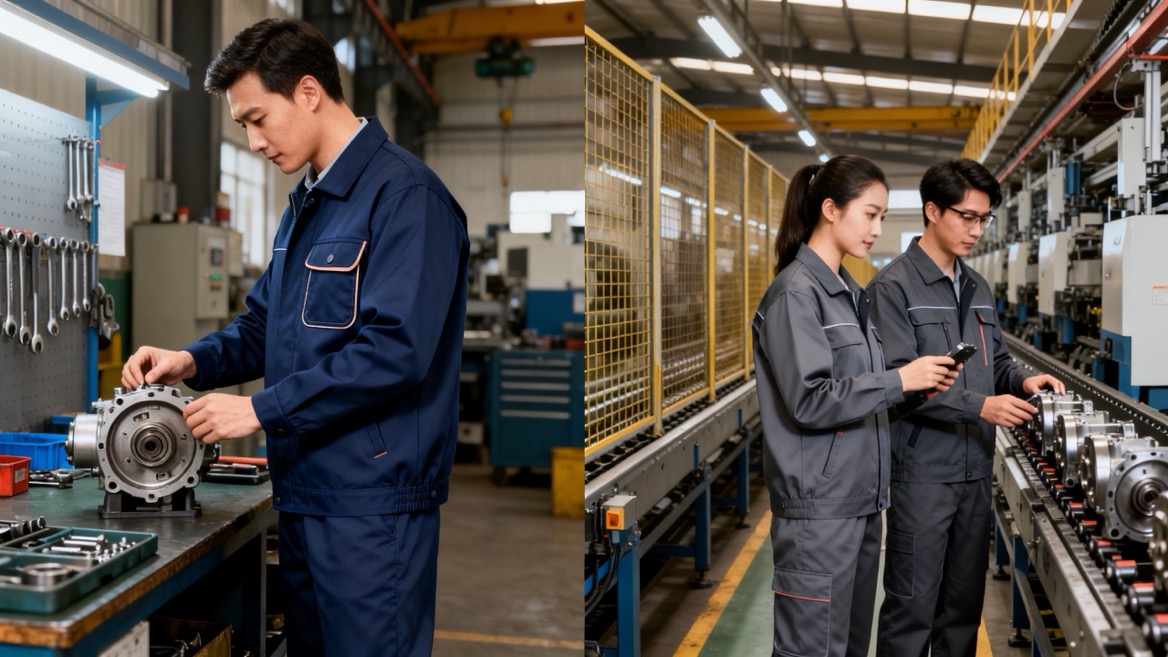
"Workshop uniforms" and "factory workwear" are commercial descriptions, not universal protection classifications. Neither term, by itself, proves that a garment protects against flames, chemicals, electrical arcs, or moving machinery.
Workshop uniforms typically prioritize flexibility across changing activities. A technician might inspect equipment, kneel beside a machine, retrieve tools, and meet a customer during one shift.
Factory workwear often prioritizes consistency across production roles. Buyers may need standardized sizing, repeatable construction, reliable laundering performance, and different specifications for different departments.
| Comparison | Workshop uniforms | Factory workwear |
|---|---|---|
| Typical working pattern | Varied maintenance, repair, and assembly | Repeated production and processing tasks |
| Main design emphasis | Mobility and practical storage | Consistency, durability, and role-specific requirements |
| Common formats | Shirts, trousers, jackets, coveralls | Two-piece sets, coveralls, production coats |
| Pocket priorities | Accessible storage without snagging | Task-specific placement and controlled contents |
| Cleaning considerations | Dirt, grease, and variable washing arrangements | Repeat laundering and consistent garment performance |
| Protection requirements | Depend on each task | Depend on each process and exposure |
The categories overlap. A workshop welder may need more specialized protective clothing than an employee in a low-hazard factory packing area. Workplace size does not determine protection level.
A professional workwear specification begins with the job, not the fabric catalogue.
Identify:
- Moving machinery and potential entanglement points.
- Heat, sparks, flames, or electrical exposure.
- Chemical contact and contamination.
- Vehicle movements and visibility requirements.
- Repeated kneeling, reaching, bending, and lifting.
- Environmental temperature and cleaning conditions.
In the United States, OSHA's general PPE requirements direct employers to assess hazards, select appropriate equipment, and ensure that it properly fits each affected employee. Other markets require assessment against their applicable rules.
Clothing is only one part of protection. Machine guarding, safer processes, and appropriate working practices remain essential. A well-fitted sleeve cannot make an unguarded rotating shaft safe.
For both workshop uniforms and factory workwear, examine cuffs, hems, pocket flaps, and adjustment tabs.
Loose clothing can become entangled in moving equipment. However, excessively tight garments may restrict movement and encourage workers to leave closures open.
During fitting, check whether:
1. Sleeves remain secure during normal movement.
2. Jacket hems stay clear of relevant equipment.
3. Pockets avoid unnecessary projection.
4. Closures remain fastened during reaching and bending.
5. The garment works with required protective equipment.
Evaluate these details within the actual task and guarding arrangements, not through appearance alone.
Ordinary cotton and polyester-cotton fabrics can be candidates for general workwear, but neither composition automatically establishes protective performance.
Cotton may suit buyers seeking a particular hand feel. Polyester-cotton blends are often considered where maintenance and appearance retention matter. Nevertheless, the finished garment needs testing: fibre percentages do not establish abrasion resistance, shrinkage, breathability, or protection.
Specialized hazards require specialized selection. Ordinary cotton is not automatically flame-resistant. Standard polyester-containing clothing should not be assumed suitable for thermal exposure.
Where flame or electrical-arc hazards exist, obtain a competent assessment and specify appropriate protective performance. A generic "FR" description is not enough to establish suitability for every thermal hazard.
A heavier fabric may feel substantial, but weight alone cannot establish durability or worker comfort.
Compare candidate fabrics through:
- Tear and abrasion performance.
- Dimensional change after laundering.
- Seam performance.
- Colour retention.
- Relevant protective properties.
- Wearer feedback under intended conditions.
My purchasing recommendation is to compare washed samples alongside new ones. The garment workers receive after repeated cleaning matters as much as the sample displayed at approval.
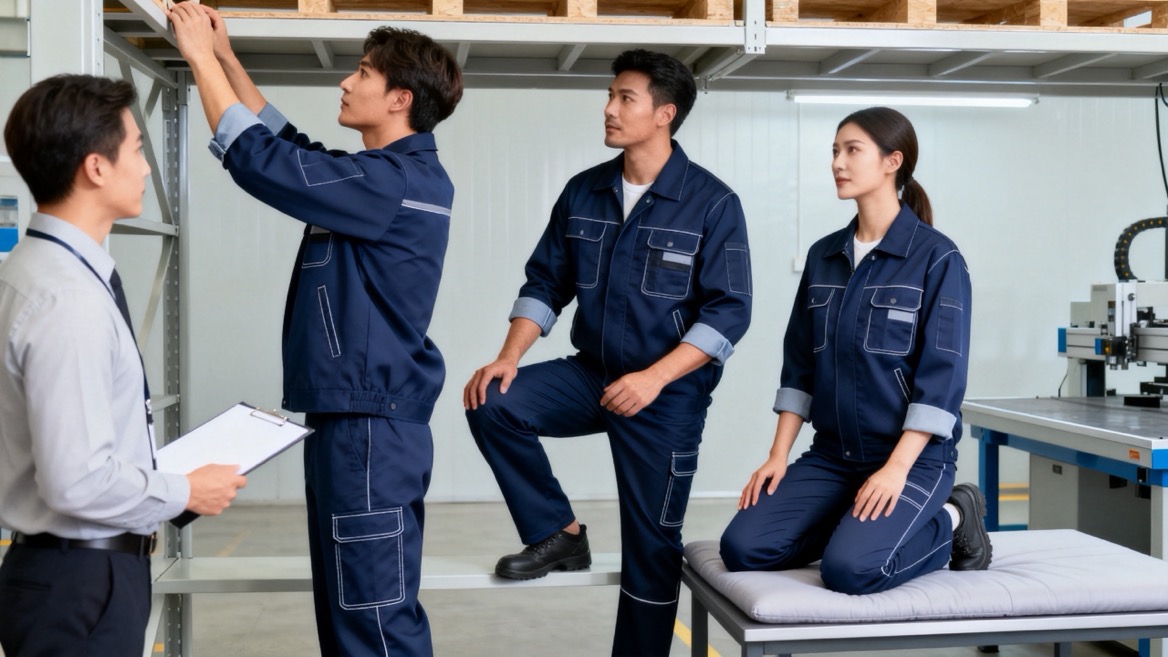
A uniform can look excellent while standing and fail during the first overhead reach.
Ask trial wearers to perform representative movements in a controlled setting:
- Reach above shoulder height.
- Bend and squat.
- Kneel where the role requires it.
- Sit in the normal working position.
- Use approved tools and required equipment.
Check for exposed lower backs, restricted shoulders, waistband pressure, and pocket interference.
A practical objective is to reduce avoidable garment adjustments. However, do not promise productivity gains without measuring them. Better fit is a design objective; a percentage improvement requires evidence from the customer's operation.
Do not assume that one regional size chart fits every export market.
An OEM brief should define body measurements, garment measurements, intended ease, and tolerances. Include relevant height and body-shape variation rather than enlarging every measurement uniformly.
Trial the size range with representative wearers. A successful medium-size sample does not validate every size.
Protective clothing can increase heat burden. NIOSH recommends adjusting work and rest arrangements when protective clothing or equipment is worn, alongside measures addressing workload, acclimatization, and environmental conditions.
For workshop uniforms and factory workwear, assess the whole clothing system:
- Base layers and outer garments.
- Required gloves, helmets, and respiratory equipment.
- Physical workload.
- Temperature, humidity, and airflow.
- Access to cooling, drinking water, and rest.
Ventilation panels or lighter fabrics may be options for some roles, but modifications must not undermine required protection.
The purchasing lesson is important: do not solve heat discomfort by removing a protective feature without reassessing the hazard. Equally, do not add heavy layers merely to make workwear appear more robust.
Cleaning is part of product performance, not an afterthought.
ISO 15797 describes industrial washing and finishing procedures used to evaluate workwear. Its scope includes properties such as dimensional stability, colour characteristics, seam puckering, pilling, and general appearance.
It does not mean that every garment tested under the standard will suit every industrial laundry process. The selected procedure and actual customer conditions matter.
Before bulk approval:
1. Confirm the intended wash and drying process.
2. Agree on suitable test procedures.
3. Measure garments before and after testing.
4. Review closures, seams, labels, and branding.
5. Validate compatibility with the intended laundry where necessary.
Protective clothing also needs appropriate maintenance. OSHA's guidance on flame-resistant clothing emphasizes that contamination and incorrect laundering can affect performance, and employers retain responsibility for reliable condition.
A structured trial provides more useful information than an informal "comfortable or uncomfortable" verdict.
The following is a proposed purchasing method, not a reported customer case or a mandatory standard.
Set measurable requirements before distributing samples. These might cover garment measurements, shrinkage limits, closure function, pocket usability, and relevant laboratory results.
Separate mandatory safety requirements from wearer preferences.
Select participants across relevant sizes, body shapes, shifts, and job roles.
Include actual working layers and equipment. A jacket tested without the usual underlayers may provide misleading fit feedback.
Use a short scorecard covering:
- Restricted movement.
- Garment adjustments.
- Heat discomfort.
- Pocket accessibility.
- Closure failures.
- Damage and cleaning outcomes.
Collect observations without exposing participants to uncontrolled hazards.
Convert feedback into specific changes. "Improve comfort" is vague; "increase shoulder mobility while maintaining secure cuffs" is actionable.
Recheck any change that could affect protection, sizing, or laundering performance.
A lower purchase price does not necessarily produce a lower operating cost.
Use this planning formula:
Cost per wear = total purchase, customization, laundering, repair, and replacement costs ÷ usable wears.
For illustration, a $24 garment used 80 times has a purchase-only cost of $0.30 per wear. A $30 garment used 150 times costs $0.20 per wear before cleaning and repair.
These figures are hypothetical, not a lifespan claim for either product.
Compare garments under similar working and cleaning conditions. Do not extend use beyond safe serviceability simply to improve the calculation.
For wholesalers, this framework also supports a more credible sales conversation: explain the evidence behind expected service life rather than relying on "premium quality" language.
For Shanghai Youti Clothing Co., Ltd., a Chinese supplier providing OEM uniforms and work clothes, the most useful enquiry is a structured brief.
International buyers should provide:
| Specification area | Information to define |
|---|---|
| End use | Industry, job roles, tasks, and destination market |
| Hazards | Assessment findings and required protective performance |
| Fabric | Composition, construction, weight, and test requirements |
| Fit | Measurement chart, size range, and tolerances |
| Construction | Seams, reinforcement, closures, and pocket placement |
| Branding | Artwork, positioning, labels, and colour requirements |
| Maintenance | Washing, drying, inspection, and replacement conditions |
| Approval | Sample stages, test evidence, and bulk acceptance criteria |
ISO 13688 addresses general protective-clothing requirements, including ergonomics, sizing, compatibility, marking, and manufacturer information. It is intended for use alongside standards covering specific protection—not as stand-alone proof of protection.
Request evidence relevant to the exact proposed garment and claim. A fabric report alone may not substantiate the complete garment's performance.
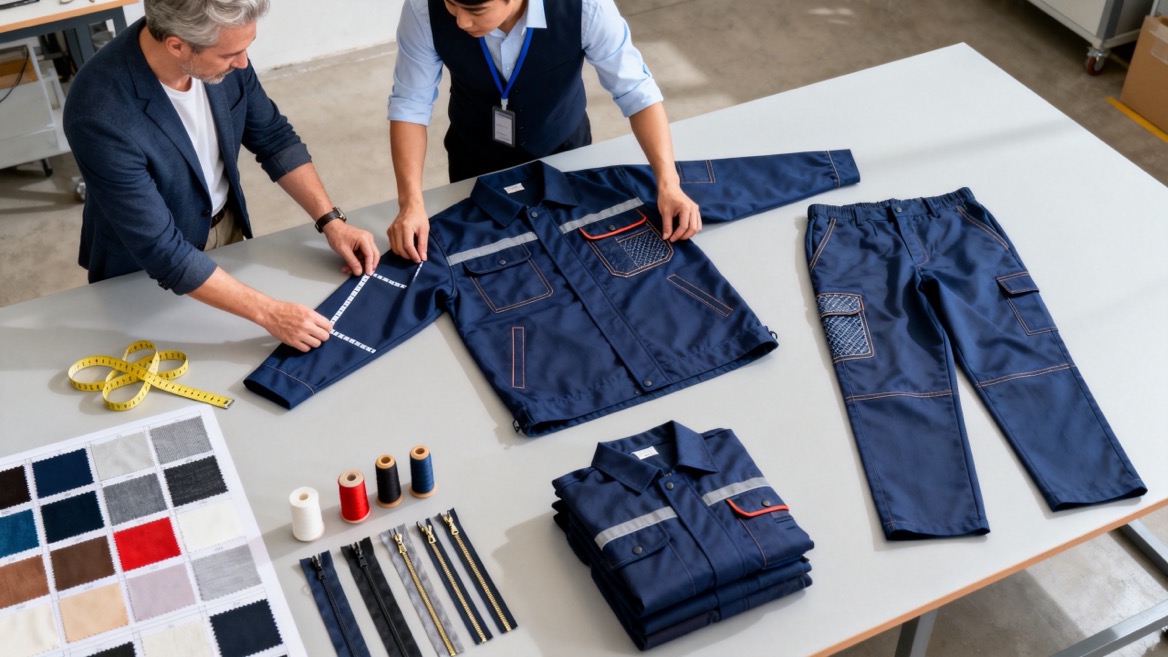
The strongest workshop uniform or factory workwear programme starts with clear requirements and ends with verified performance—not merely matching colours.
Send Shanghai Youti Clothing Co., Ltd. your destination market, job roles, hazard requirements, size range, branding artwork, expected quantities, and laundering method. Use that brief to discuss OEM development, sample evaluation, and the evidence required before bulk approval.
They overlap, but purchasing priorities often differ. Workshop uniforms commonly support varied tasks, while factory workwear may emphasize repeatable production requirements. Neither label establishes a certified protection level.
No. Where identified hazards require protective clothing, select garments with suitable verified performance. Branding, thickness, and durable-looking construction are not substitutes for protection evidence.
There is no universal best fabric. Selection depends on hazards, movement, cleaning conditions, climate, and required service life. Evaluate candidate fabrics and finished garments against the same documented brief.
Suitable fit, accessible storage, and manageable thermal burden can reduce clothing-related interference. Measure results through wear trials and operational observations rather than assuming a fixed productivity increase.
Check measurements, movement, seams, closures, branding, washing performance, and relevant protective evidence. Include representative wearers and review post-wash samples before authorizing bulk production.
1. Occupational Safety and Health Administration. "29 CFR 1910.132 — General Requirements." Employer hazard assessment, PPE selection, fit, and training requirements. [View official requirements]. [osha]
2. Occupational Safety and Health Administration. "29 CFR 1910.212 — General Requirements for All Machines." Machine-guarding requirements. [View official requirements]. [osha]
3. Rochester Institute of Technology, Environmental Health and Safety. "Machine Guarding." Clothing and entanglement precautions. [View guidance]. [rit]
4. National Institute for Occupational Safety and Health. "Workplace Recommendations: Heat Stress." Work/rest arrangements, acclimatization, and protective-clothing considerations. [View recommendations]. [cdc]
5. International Organization for Standardization. "ISO 15797:2017 — Textiles: Industrial Washing and Finishing Procedures for Testing of Workwear." Scope and evaluation procedures. [View standard overview]. [iso]
6. International Organization for Standardization. "ISO 13688:2013 — Protective Clothing: General Requirements." General requirements and limitations of stand-alone use. [View standard overview]. [iso]
7. Occupational Safety and Health Administration. "Laundering Responsibilities for Fire Retarding (FR) Clothing," June 1, 2015. Maintenance, contamination, and laundering responsibilities. [View interpretation]. [osha]
8. Occupational Safety and Health Administration. "1910.269 Appendix E — Protection from Flames and Electric Arcs." Guidance within the electric-power standard's scope. [View official guidance]. [osha]


