
Views: 247 Author: Youti Clothing Publish Time: 2026-08-30 Origin: Site


Content Menu
● Quick Comparison: T-Shirt vs. Polo Shirt
● 1. Collar and Neckline Create the Biggest Visual Difference
● 2. Fabric Construction: Jersey vs. Piqué and Beyond
● 3. Fit, Drape, and Wearing Experience Are Different
>> Common T-shirt fit directions
>> Common polo shirt fit directions
● 4. Polo Shirts Require More Detailed Construction
>> What an experienced buyer should check during polo sampling
● 5. Decoration Options Affect Product Selection
>> T-shirt decoration strengths
>> Polo shirt decoration strengths
● 6. Price and Minimum Order Quantity Can Differ
>> Key factors that influence T-shirt and polo shirt pricing
● 7. Choosing the Right Shirt for Different Markets
>> Choose a T-shirt when you need:
>> Choose a polo shirt when you need:
● 8. OEM Development Checklist for Brands and Buyers
>> Step 1: Define the commercial purpose
>> Step 2: Select fabric based on performance needs
>> Step 3: Approve a physical sample
>> Step 4: Set measurable quality standards
>> Step 5: Plan reorders from the beginning
>> Practical care guidance for cotton shirts
● Build a Better T-Shirt or Polo Shirt Program
>> What is the main difference between a T-shirt and a polo shirt?
>> Are polo shirts more formal than T-shirts?
>> Which fabric is best for a custom polo shirt?
>> Can a polo shirt be screen printed?
>> Why are polo shirts usually more expensive than T-shirts?
>> What information should I provide to an OEM T-shirt or polo shirt supplier?
>> Should I choose embroidery or printing for a company polo shirt?
When buyers compare a T-shirt vs. polo shirt, the decision is not only about whether a garment has a collar. For fashion brands, promotional-product companies, wholesalers, and corporate-uniform buyers, it affects the product's target customer, fabric development, decoration method, selling price, perceived value, and reorder potential.
At Shanghai Youti Clothing Co., Ltd., we work with international brands and bulk buyers on OEM T-shirts and polo shirts. From early sample development through bulk production, one thing is clear: the best choice depends on the garment's intended use, retail position, decoration requirements, and quality expectations. This guide explains the major differences between T-shirts and polo shirts, with practical sourcing advice for brands building a reliable apparel collection.

| Feature | T-Shirt | Polo Shirt |
|---|---|---|
| Neckline | Usually crew neck, V-neck, scoop neck, or oversized neck | Fold-down collar with button placket |
| Typical fabric | Single jersey, interlock, rib, cotton blends | Piqué, double piqué, interlock, jersey, performance knit |
| Overall style | Casual, youthful, versatile | Smart casual, polished, uniform-friendly |
| Common use | Retail fashion, events, streetwear, sportswear, promotions | Corporate uniforms, golfwear, hospitality, retail teams, premium casualwear |
| Decoration area | Large front, back, sleeves, all-over graphics | Chest logo, sleeve embroidery, woven labels, subtle branding |
| Production complexity | Relatively simple | More complex because of collar, placket, cuffs, and reinforcement |
| Cost level | Usually lower | Usually higher |
| Perceived value | Depends heavily on fabric, fit, and graphic design | Often perceived as more premium because of its collar and construction |
Both product categories are essential to a modern apparel range. The key is not deciding which one is "better." The goal is choosing the right product for the right commercial purpose.
The most obvious difference between a polo shirt and a T-shirt is the neckline.
A standard T-shirt has a simple neck opening. The most common version is the crew neck, but buyers can also select V-necks, henley necks, drop-shoulder necklines, mock necks, and fashion-forward oversized collars. Most T-shirts do not include buttons or a structured collar.
A polo shirt normally features:
- A soft knit collar
- A short front placket
- Two to three buttons
- Short sleeves
- Ribbed cuffs on many classic styles
- A slightly more structured upper body
This added structure changes how the garment is perceived. A polo shirt can still feel relaxed, but it looks more refined than a basic tee. That is why polos are frequently selected for staff uniforms, golf clubs, hotels, restaurants, car dealerships, showrooms, retail stores, and business events.
The modern polo became widely recognized after René Lacoste introduced a lightweight short-sleeved cotton piqué design in 1933. The design combined a flexible knitted body, buttoned placket, and collar, offering a more comfortable alternative to traditional long-sleeved tennis attire.
Choose a T-shirt when the collection needs a casual canvas for design, print, comfort, or volume sales.
Choose a polo shirt when the collection needs a cleaner business image, an elevated uniform look, or a higher-value casual product.
Fabric is one of the most commercially important differences between polo shirts and T-shirts. It influences softness, breathability, drape, durability, print performance, shrinkage behavior, and final price.
Most T-shirts use knitted fabrics, especially single jersey. Single jersey is lightweight, soft, flexible, and suitable for daily wear. It is also a highly practical base for screen printing, direct-to-film transfers, heat transfers, and many fashion graphics.
Common T-shirt fabric options include:
- 100% cotton single jersey: A familiar, natural-feel option for lifestyle, fashion, and promotional tees.
- Combed cotton: Uses longer, cleaner fibers for a smoother and softer hand feel.
- Ring-spun cotton: Often selected for a softer touch and more refined surface.
- Cotton-spandex jersey: Adds stretch and recovery for fitted silhouettes.
- Cotton-polyester blend: Can improve durability, shape retention, and drying speed.
- Polyester performance jersey: Often used for sportswear, quick-dry programs, and sublimation printing.
- Heavyweight cotton jersey: Suitable for premium streetwear, boxy fits, and structured fashion silhouettes.
Classic polo shirts are often made from piqué knit. Piqué has a textured surface that can improve airflow and gives the garment a recognizable, more substantial appearance. It also supports the more structured visual character expected from a polo.
Common polo fabric choices include:
- Cotton piqué: A classic option with breathability and a natural hand feel.
- CVC piqué: A cotton-rich blend that can support durability and easier maintenance.
- Polyester piqué: Lightweight, quick-drying, and useful for uniforms or activewear.
- Polyester-spandex piqué: Adds stretch for golfwear, sportswear, and fitted team apparel.
- Double piqué: A denser construction with more weight and stability.
- Interlock polo fabric: Smooth, soft, and less textured than piqué.
- Birdseye mesh: Often used for performance polos due to ventilation and quick-dry potential.
A common misunderstanding is that every polo must use piqué and every T-shirt must use jersey. In reality, both garment types can be developed in a wide range of knit structures. The best fabric depends on the brand's product position, target climate, required decoration, price point, and wearer activity.
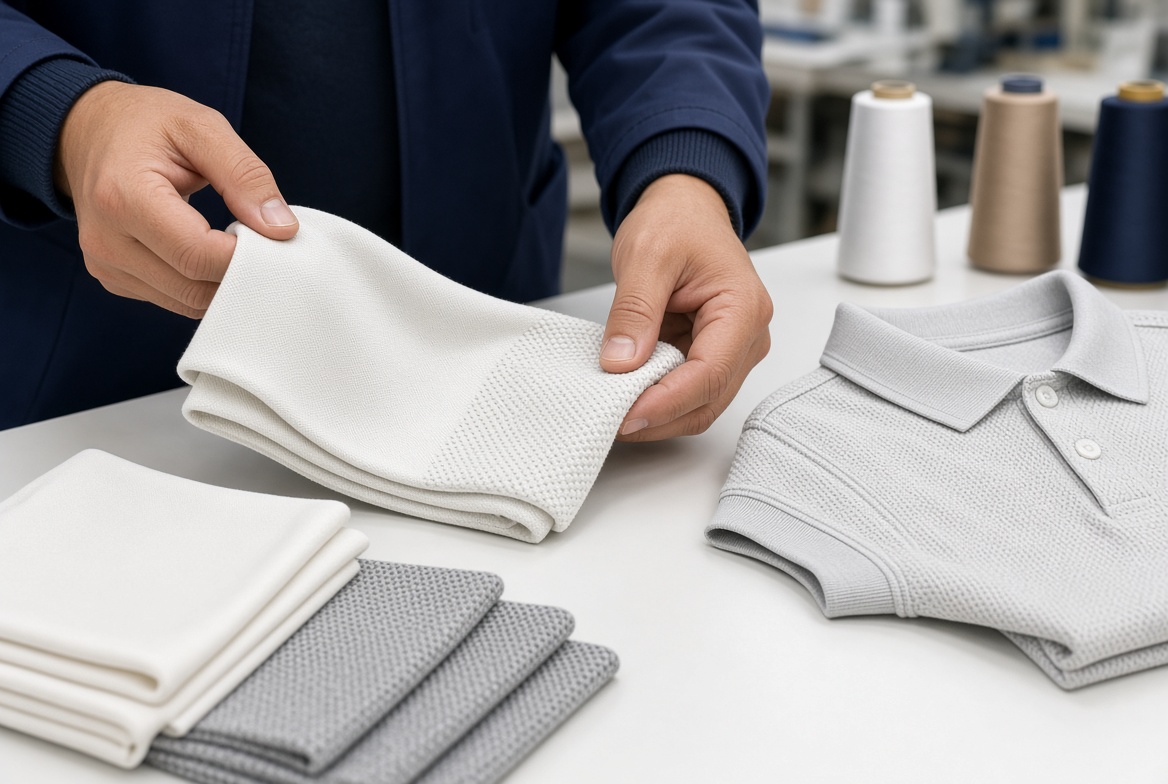
T-shirts are usually designed for ease, softness, and freedom of styling. They can be slim, regular, relaxed, oversized, cropped, or longline. The body pattern is often straightforward, which gives designers plenty of freedom to create trend-driven silhouettes.
Polo shirts usually require more attention to proportion because the collar and placket draw attention to the upper body. A poorly balanced polo can look too tight around the chest, too wide at the hem, or too short in body length. For this reason, polo fit development should include careful sample review.
- Slim fit for fitted lifestyle basics
- Regular fit for broad commercial appeal
- Relaxed fit for comfort-driven casualwear
- Oversized fit for streetwear and youth collections
- Drop-shoulder fit for modern fashion programs
- Athletic fit for performance-focused brands
- Classic fit for uniforms and traditional casualwear
- Regular fit for broad retail use
- Slim fit for premium fashion or golfwear
- Athletic fit for active customers
- Women's shaped fit with adjusted waist and sleeve proportions
- Unisex fit for staff uniforms and event merchandise
For OEM buyers, a clear size specification is more important than using labels such as "regular" or "slim." A factory needs actual garment measurements, grading rules, tolerance standards, and fit references. Two brands can both describe a polo as "regular fit" while using very different chest widths, body lengths, and sleeve openings.
A T-shirt may look simple, but good manufacturing still depends on fabric control, accurate cutting, stable neck rib, clean stitching, proper shoulder construction, and reliable finishing. However, polo shirts generally involve more production steps.
A polo shirt includes several components that must work together:
- Collar fabric or collar rib
- Collar stand or collar seam construction
- Button placket
- Buttons and buttonholes
- Sleeve cuffs or rib cuffs
- Side slits on some styles
- Reinforced seam areas
- Neck tape, labels, and internal finishing
The collar is especially important. If it curls, loses shape, feels too stiff, or does not match the body color correctly, the polo can look low-quality even when the main fabric is acceptable.
1. Collar shape: Does it lie flat after washing and wearing?
2. Collar color match: Does the collar match the body fabric under daylight?
3. Placket alignment: Are the buttons centered and evenly spaced?
4. Button security: Are buttons firmly attached with clean thread ends?
5. Cuff recovery: Do rib cuffs return to shape after stretching?
6. Side-slit finishing: Are the seams reinforced and neatly finished?
7. Shrinkage result: Does the shirt remain within the approved measurement tolerance after testing?
8. Twisting control: Does the side seam remain straight after wash testing?
For a uniform order, these construction details matter even more. Employees wear and wash the same garment repeatedly. A polo that looks good only when new may create replacement costs and damage the buyer's brand image.
T-shirts are often chosen because they offer broad creative freedom. Their smooth front and back panels create a large area for artwork, typography, photography, brand graphics, event messaging, or full-scale visual campaigns.
Popular T-shirt decoration methods include:
- Screen printing
- Water-based printing
- Plastisol printing
- Puff printing
- High-density printing
- Direct-to-film transfer
- Heat transfer vinyl
- Digital print
- Embroidery
- Woven patches
- Appliqué
- Garment dye and wash effects
Polo shirts usually use more restrained branding. A small left-chest logo, sleeve logo, embroidery, woven badge, or tonal print often suits the garment best. Large graphics are still possible, but they should be planned carefully around the placket, collar, and textured fabric surface.
T-shirts work particularly well for:
- Music and event merchandise
- Streetwear collections
- Promotional campaigns
- Social-media-driven brand drops
- Large graphic designs
- Private-label basics
- Seasonal fashion collections
Polo shirts work particularly well for:
- Corporate uniforms
- Hospitality teams
- Golf and leisurewear
- School and club apparel
- Premium promotional gifts
- Automotive and retail staff uniforms
- Branded workwear programs
A logo should never be selected only because it looks good on a digital mock-up. For a textured piqué polo, small embroidery details may need simplification. Fine lines, very small lettering, and dense stitch areas can become unclear or uncomfortable. A professional pre-production review should assess stitch count, backing, logo size, placement, and thread color before bulk production begins.
A polo shirt often costs more than a comparable T-shirt because it uses additional materials and operations. The buyer is paying not only for the collar and buttons, but also for extra cutting, sewing, trimming, inspection, and packing attention.
However, cost should not be judged by unit price alone. Buyers should evaluate cost per useful wear, customer perception, return risk, decoration suitability, and product lifespan.
For example, a low-cost polo with an unstable collar may be cheaper at the start but more expensive for a hotel chain that must replace garments quickly. A slightly higher-quality polo with better fabric stability, colorfastness, and collar recovery may offer stronger long-term value.
| Cost Factor | Impact on T-Shirts | Impact on Polo Shirts |
|---|---|---|
| Fabric composition | Major | Major |
| Fabric weight | Major | Major |
| Collar and cuffs | Limited | High |
| Buttons and placket | Usually not applicable | High |
| Printing complexity | Can be very high | Moderate to high |
| Embroidery | Moderate | Often common |
| Garment washing | Can be high | Can be high |
| Custom trims and labels | Moderate | Moderate to high |
| Order quantity | Major | Major |
| Packaging requirements | Moderate | Moderate |
The most effective way to control cost is to define the product brief before requesting quotations. A complete brief should include fabric composition, GSM target, color standard, size chart, artwork, decoration method, label requirements, packing method, order quantity, target market, and delivery expectations.
The correct product choice starts with the end user.
- A lower-barrier product for broad consumer appeal
- A large area for graphic expression
- A casual item for retail, events, or promotion
- A flexible base for fashion washes and garment dyeing
- A product suitable for layered styling
- A youth-oriented or streetwear-focused silhouette
- A lightweight item for warm-weather campaigns
- A polished uniform without using formal shirts
- A branded garment for staff-facing customer roles
- A golf, leisure, or clubwear product
- A premium casual item with stronger perceived structure
- A subtle logo application such as embroidery
- A practical work-to-social garment
- A retail piece positioned above a basic tee
The polo shirt's appeal comes from its balance. It is less formal than a woven button-up shirt but more structured than a T-shirt. That middle position makes it especially valuable for businesses that want employees to appear approachable, coordinated, and professional.
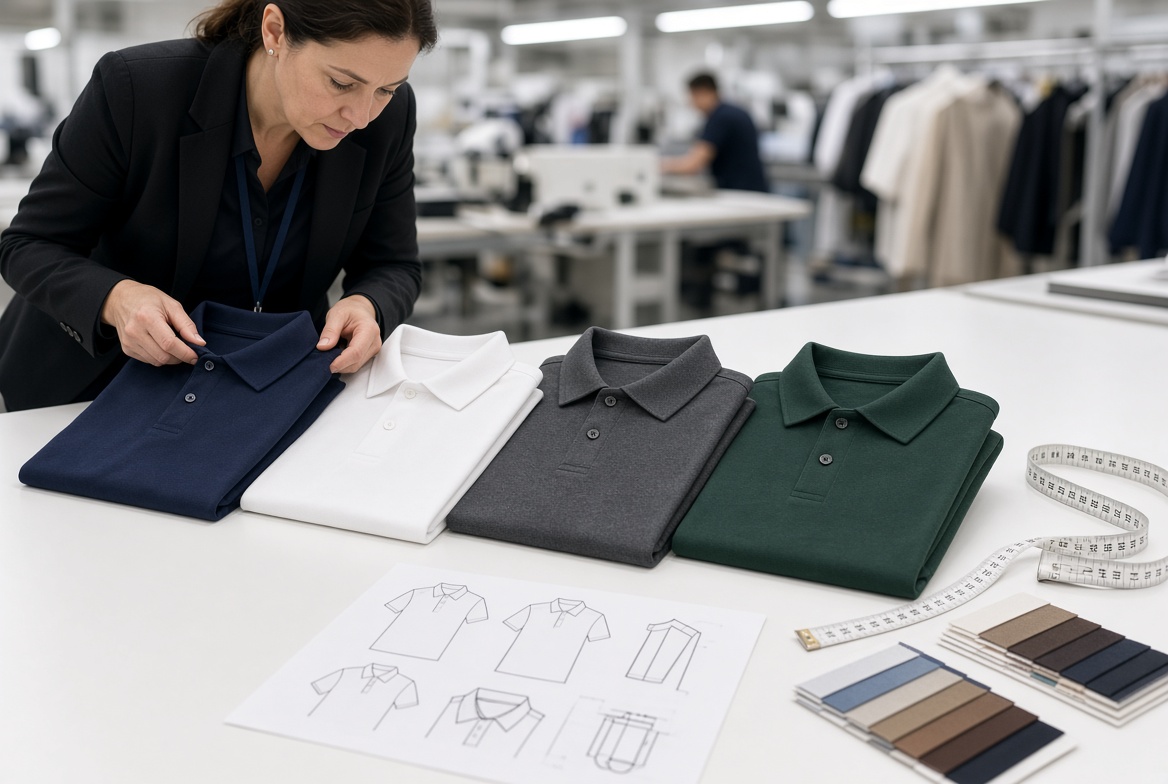
Before approving a bulk order, brands should treat T-shirts and polo shirts as engineered products, not just blank garments. A clear development process reduces fit issues, inconsistent colors, late revisions, and avoidable quality disputes.
Start with the wearer and sales channel.
Ask:
- Is this for fashion retail, uniforms, events, sports, or promotion?
- What price range will the end customer accept?
- Is the garment intended for one campaign or repeat orders?
- Will it be worn in hot weather, active environments, or indoor workplaces?
- Does the buyer need a unisex, men's, women's, or children's size range?
Do not choose fabric by appearance alone.
For a premium cotton T-shirt, consider hand feel, shrinkage, pilling, print surface, and opacity. For a performance polo, assess moisture handling, stretch recovery, snag resistance, color retention, and collar stability.
A digital image cannot confirm fabric weight, collar recovery, print texture, seam quality, or real-world fit. Sample approval should include measurements, wash results, color confirmation, and decoration placement.
A strong purchase order should specify:
- Measurement tolerance
- Fabric composition
- Fabric weight
- Approved color reference
- Logo dimensions and placement
- Button specifications
- Label content
- Packing requirements
- Inspection standard
- Required testing or compliance documents
If a product will become a core uniform or evergreen retail item, reserve the fabric specification, trims, color standard, pattern, and decoration file. This helps protect consistency when the buyer places future orders.
Correct care affects how both garments look over time. Cotton polos, in particular, can shrink if washed aggressively or dried at high temperature. Gentle cold washing, mild detergent, and air drying are commonly recommended to help preserve color, shape, and fabric condition.
For brands, care labels should match the actual fabric and finishing used. Generic care instructions can cause problems if a garment includes special printing, garment dyeing, stretch fibers, contrast trims, or performance coatings.
- Wash inside out to reduce surface abrasion.
- Separate dark and light colors.
- Use cool or cold water where appropriate.
- Avoid excessive bleach unless the garment care specification allows it.
- Avoid prolonged high-heat tumble drying.
- Reshape polo collars after washing.
- Iron printed areas from the reverse side where needed.
- Follow the final garment care label, especially for blended or treated fabrics.
T-shirts and polo shirts may appear to be basic wardrobe items, but successful products depend on the right balance of fabric, fit, construction, branding, cost, and quality control.
A T-shirt can become a high-value fashion product when it has the right fabric weight, silhouette, color, finishing, and graphic direction. A polo shirt can become an effective uniform or premium casual item when its collar, placket, fabric, and embroidery are developed with care.
Shanghai Youti Clothing Co., Ltd. supports overseas brands, wholesalers, and garment businesses with OEM development for T-shirts, polo shirts, and related knitwear. Whether you need heavyweight cotton streetwear tees, classic cotton piqué polos, quick-dry staff uniforms, custom labels, embroidery, or private-label packaging, a detailed product brief is the best place to begin.
Send us your tech pack, artwork, target quantity, fabric preference, and target market requirements to discuss an OEM T-shirt or polo shirt quotation.
The main difference is the collar and placket. A T-shirt usually has a simple neckline without buttons, while a polo shirt has a fold-down collar and a short buttoned opening at the front. Polo shirts also commonly use piqué or other textured knit fabrics.
Yes. Polo shirts are generally considered smart casual because the collar and button placket create a more polished appearance. They are suitable for many workplaces, hospitality teams, retail staff, golf events, and business-casual settings where a basic T-shirt may look too informal.
The best fabric depends on the intended use. Cotton piqué works well for classic premium polos. CVC piqué can balance comfort and durability. Polyester or polyester-spandex piqué is often more suitable for activewear, outdoor uniforms, and quick-dry team apparel.
Yes, but the fabric texture and placket should be considered. Large prints may be less smooth on piqué fabric than on a flat T-shirt jersey. For most polo shirts, embroidery, small chest prints, sleeve logos, woven patches, and heat transfers are popular decoration options.
Polo shirts generally require more materials and manufacturing operations. They include a collar, button placket, buttons, and often ribbed cuffs or side slits. These additional components and sewing steps typically increase production cost.
Provide the garment style, fabric composition, target GSM, color, size chart, artwork, decoration technique, label details, packaging request, order quantity, and target delivery date. A tech pack is ideal, but clear reference images and measurement specifications can also support initial development.
Embroidery is often preferred for a small chest logo because it gives a durable and professional appearance. Printing may be a better choice for larger designs, fine color gradients, or lightweight logos. The final choice should consider the logo artwork, fabric type, budget, and wearer comfort.
- [Lacoste — The Polo Shirt, the Story of a Stroke of Genius]
- [Lacoste Corporate — Our History]
- [Gentleman's Gazette — Polo Shirts: Guide to Buying, Styling, History and More]
- [Hockerty — What Is a Polo Shirt? The Classic Wardrobe Staple Defined]
- [Easson Apparel — Difference Between Polo and Collared Shirt]


