
Views: 212 Author: Youti Clothing Publish Time: 2026-08-29 Origin: Site


Content Menu
● Quick Comparison: Workwear Overalls vs Two-Piece Work Uniforms
● What Are Two-Piece Work Uniforms?
● Workwear Overalls: Main Advantages
>> 1. Better Continuous Coverage
>> 2. Cleaner and More Consistent Appearance
>> 3. Useful for Controlled Dirt and Dust Exposure
>> 4. Fewer Gaps During Active Work
● Workwear Overalls: Potential Drawbacks
>> Heat and Ventilation Concerns
>> Less Convenient for Daily Use
● Two-Piece Work Uniforms: Main Advantages
>> 1. Superior Flexibility for Mixed Manufacturing Tasks
>> 2. Easier Sizing and Better Individual Fit
>> 3. Better Climate Adaptability
● Two-Piece Work Uniforms: Potential Drawbacks
● Safety: Choose by Hazard, Not by Fashion
● Expert Buying Framework for Industrial Uniforms
>> Step 2: Identify Movement Requirements
>> Step 3: Consider Climate and Shift Duration
>> Step 4: Set a Durable Construction Standard
>> Step 5: Run a Wear Trial Before Bulk Production
● OEM Customization Opportunities
● Final Verdict: Which Work Uniform Is Better?
>> 1. Are workwear overalls better than two-piece uniforms for factory workers?
>> 2. What fabric is best for manufacturing work uniforms?
>> 3. Should factory workers wear loose or tight workwear?
>> 4. Can workwear overalls be customized with a company logo?
>> 5. How do I choose between coveralls and work shirts with trousers?
>> 6. Are two-piece work uniforms more economical?
>> 7. What should an OEM workwear supplier provide before bulk production?
For manufacturing teams, the choice between workwear overalls and two-piece work uniforms affects far more than appearance. It can influence worker comfort, movement, safety practices, laundering efficiency, replacement cost, team identity, and the ability to adapt uniforms to different departments and climates.
From my experience working with industrial clothing buyers and OEM uniform programs, there is no universal winner. Workwear overalls are often better for full-body coverage and contamination control, while two-piece work uniforms are usually more flexible, easier to size, and more practical for mixed manufacturing tasks. The best solution depends on the hazards, workflow, temperature, workforce profile, and branding goals of the facility.
For international brands, wholesalers, and industrial buyers, the practical question is not simply "Which garment is better?" It is: Which work uniform system helps workers perform safely, comfortably, and consistently throughout a full shift?
| Comparison Factor | Workwear Overalls | Two-Piece Work Uniforms |
|---|---|---|
| Garment structure | One-piece garment, often called a coverall or boiler suit | Separate work shirt or jacket with work trousers |
| Coverage | Covers the torso and legs continuously | Coverage depends on how the shirt, jacket, and trousers are worn |
| Best for | Dusty, dirty, oily, paint-related, maintenance, and controlled-environment work | General manufacturing, assembly, warehousing, logistics, and multi-task production |
| Ease of movement | Good when pattern engineering is strong, but can feel restrictive if poorly sized | Usually offers more flexible movement and easier adjustment |
| Temperature control | Can retain more heat, especially in heavier fabrics | Easier to adapt by removing or changing the upper layer |
| Sizing | Requires good torso-length and inseam fitting | Easier to mix shirt and trouser sizes |
| Changing and restroom use | Less convenient because the garment is one piece | More convenient for daily use |
| Contamination control | Stronger protection against gaps between shirt and trousers | May leave a gap at the waist during bending or overhead work |
| Branding surface | Large chest, back, and sleeve areas for logos | More placement flexibility across shirts, jackets, trousers, and outerwear |
| Replacement cost | A damaged area may require replacement of the full garment | Individual shirts or trousers can be replaced separately |
| Uniform program flexibility | Best for standardized high-coverage requirements | Best for departments with varied roles, weather conditions, and size needs |
Short answer: Choose workwear overalls when continuous coverage and protection from dirt, oil, dust, splashes, or task-related contamination are the priority. Choose two-piece work uniforms when comfort, seasonal adaptability, sizing flexibility, and lower replacement costs matter most.
Workwear overalls are one-piece industrial garments that combine a jacket-style upper body with full-length trousers. They are commonly called coveralls, boiler suits, mechanic overalls, industrial overalls, or work coveralls.
A well-designed overall normally includes:
- A front zipper, button closure, or concealed placket
- Long sleeves and full-length legs
- Chest, hip, ruler, tool, or cargo pockets
- Reinforced seams at high-stress points
- Adjustable cuffs, waist tabs, or elasticated panels
- Optional reflective tape, knee-pad pockets, radio loops, or ID loops
- Custom embroidery, printed logos, woven labels, or heat-transfer branding
For manufacturing workers, the main advantage is continuous body coverage. There is no exposed waistband between a shirt and trousers when a worker bends, reaches, kneels, climbs, or operates equipment.
This matters in environments involving dust, grease, paint overspray, metal filings, automotive fluids, or frequent contact with dirty surfaces. A one-piece garment can help keep underlying personal clothing cleaner and can support a more consistent appearance across a production team.
However, overalls should not automatically be treated as protective equipment for every hazard. The material, construction, closures, fit, task conditions, and applicable workplace rules all matter. Protective clothing must be suitable for the actual risk and fit the worker comfortably enough to be worn correctly throughout the shift.
Two-piece work uniforms usually consist of a work shirt, polo shirt, work jacket, or utility jacket paired with industrial work trousers. Some programs also include a vest, fleece, softshell jacket, insulated outer layer, or high-visibility garment.
This uniform format is widely used in:
- Electronics assembly plants
- Automotive component factories
- Warehousing and fulfillment centers
- Food-processing support teams
- Machine shops
- Packaging lines
- Printing facilities
- Industrial maintenance departments
- Logistics and distribution operations
The biggest advantage is adaptability. Workers can wear a short-sleeve shirt in warm conditions, add a jacket in cooler areas, or use task-specific outerwear only when needed. Buyers can also order different shirt and trouser sizes for each employee.
For example, a worker may need a medium shirt but large trousers. With a two-piece uniform system, this is easy to manage. With one-piece workwear overalls, the supplier must balance chest size, waist size, torso length, sleeve length, and inseam within a single garment.
That difference can have a major effect on comfort, especially for diverse workforces with different body shapes.
The defining benefit of workwear overalls is the continuous barrier from the upper body to the legs. In dirty or contamination-prone environments, this design reduces the risk of a shirt becoming untucked or a waist gap opening during movement.
This can be especially useful for workers who:
- Bend repeatedly over machinery
- Kneel during assembly or maintenance
- Work beneath equipment
- Handle lubricants, oils, dust, or residues
- Move between clean and dirty production areas
- Perform repair work in confined spaces
For automotive repair, metalworking, equipment maintenance, and industrial cleaning teams, overalls can deliver a more enclosed and professional workwear solution.
A one-piece uniform helps create a standardized team image. Workers are less likely to wear mismatched shirts and trousers, leave shirts untucked, or substitute personal garments that do not match company standards.
For brands supplying dealer networks, factory groups, engineering contractors, or service teams, this visual consistency can be valuable. It strengthens brand recognition while making workers easier to identify on the production floor.
A customized overall can carry a logo on the chest, a company name across the back, department coding on the sleeve, and reflective details for visibility. This gives buyers several branding options without making the garment look overloaded.
Overalls can help limit contamination of personal clothing in tasks involving non-hazardous dust, dirt, grease, and workplace residues. They can also simplify changing procedures where workers need to put on designated work garments before entering a production area.
That said, buyers should distinguish between a general industrial coverall and a garment designed for a specific chemical, flame, electrical, biological, or particulate hazard. A standard cotton or poly-cotton overall is not automatically suitable for every high-risk environment.
In many manufacturing settings, workers stretch, reach overhead, lean forward, climb ladders, or crouch. If the garment pattern is correctly developed, overalls can stay in place more consistently than a separate shirt and trouser combination.
The key phrase is correctly developed. A poorly designed overall can pull at the shoulders, tighten at the crotch, restrict arm reach, or become uncomfortable when sitting. Strong pattern engineering is therefore essential.
Useful design details include:
- Action backs or bi-swing pleats
- Elasticated waist panels
- Gusseted crotches
- Articulated knees
- Ergonomic sleeve construction
- Adjustable cuffs
- Two-way front zippers
- Reinforced stress points
- Spacious but secure pocket placement
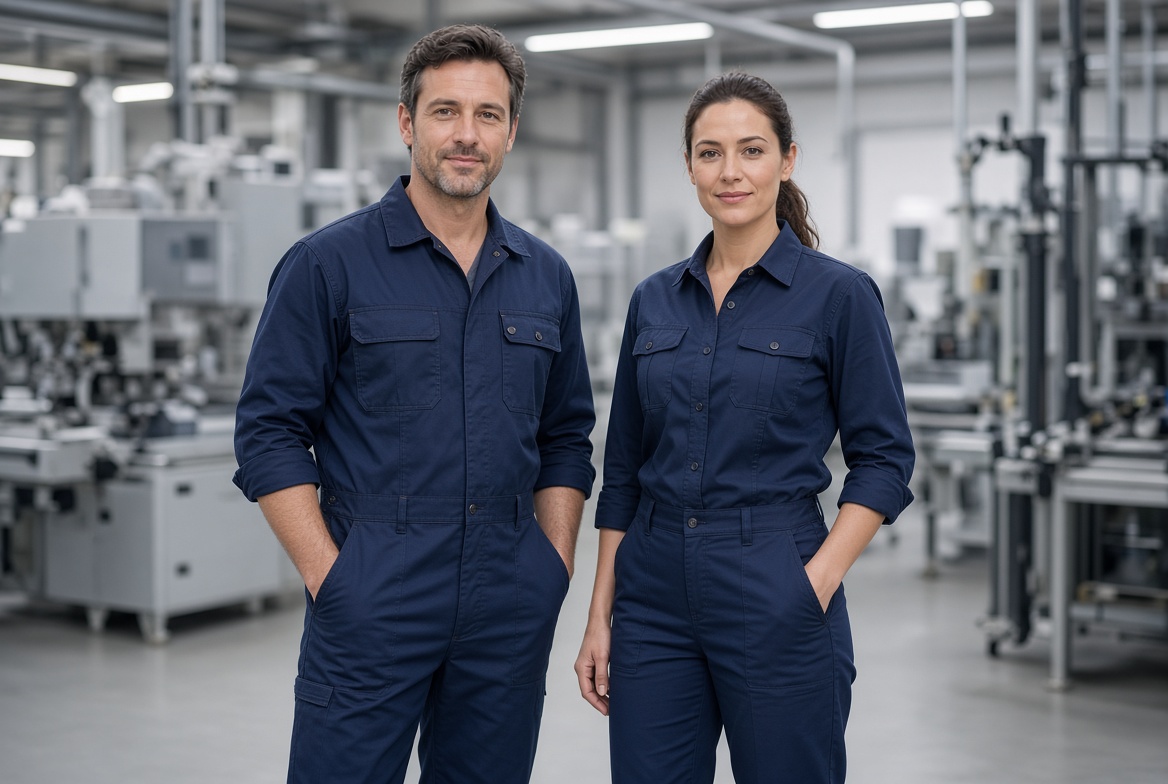
A one-piece garment can feel warmer because it creates a more continuous layer around the body. This is particularly relevant in factories with high ambient temperatures, physically demanding tasks, poor airflow, or humid climates.
Heat stress is influenced by environmental heat, physical work intensity, and the clothing or protective equipment worn by the worker. Clothing that limits heat dissipation can increase the body's heat storage.
For hot manufacturing environments, buyers should consider:
- Lower-weight but durable fabrics
- Breathable poly-cotton constructions
- Moisture-management finishes
- Ventilation panels where appropriate
- Lighter colors for non-dirt-intensive areas
- Seasonal workwear programs
- A separate summer uniform option
- Work-rest and hydration procedures designed by the employer
Garment choice helps, but it should be part of a broader heat-management strategy rather than the only control measure.
A one-piece garment must fit the shoulders, chest, waist, hips, torso length, sleeves, and inseam at the same time. That makes fit more complicated than purchasing separate shirts and trousers.
For an OEM program, this is manageable when the supplier provides:
- A detailed measurement chart
- Fit samples before bulk production
- Gender-inclusive or unisex pattern options
- Short, regular, and tall inseam choices
- Size grading aligned with the target market
- Pre-production approval samples
- Clear tolerance standards
Without a structured size strategy, buyers may see more exchanges, lower wearing compliance, and complaints about mobility.
Workers may find overalls less convenient during breaks or restroom visits. This can sound minor during product selection, but it becomes important in real shift conditions.
If workers dislike a uniform because it is inconvenient, hot, restrictive, or difficult to put on, they may wear it incorrectly or avoid using it whenever possible. Comfort and usability should therefore be treated as operational requirements, not cosmetic preferences.
Two-piece work uniforms are often the best choice for factories with different departments, varied temperatures, or employees who move between indoor and outdoor work zones.
A worker can wear:
- A short-sleeve work shirt on a warm production line
- A long-sleeve shirt for added coverage
- A utility jacket in a cold warehouse
- A high-visibility vest for yard work
- Task-specific protective outerwear when required
This modular structure is ideal for large facilities where assembly, warehousing, quality control, maintenance, shipping, and office-to-floor supervision happen under different conditions.
Two-piece uniforms make it possible to select shirt and trouser sizes independently. This supports better fit across a diverse workforce and can reduce the need for custom one-piece pattern adjustments.
A better fit improves comfort, mobility, and professional appearance. It can also reduce snagging risks caused by excessively loose clothing, while avoiding the restriction caused by garments that are too tight.
When workers operate around moving equipment, clothing should be close-fitting enough to avoid unnecessary loose material, while still allowing safe movement. Long hair should also be controlled where machinery creates entanglement hazards.
In warm climates, workers can remove an outer layer or use lighter work shirts. In cold climates, they can add thermal layers, jackets, or insulated workwear without replacing the entire uniform system.
This gives procurement teams a more efficient year-round program. Instead of buying separate summer and winter coveralls for every worker, a buyer can create a coordinated system of shirts, trousers, jackets, and accessories.
With a two-piece uniform, damaged trousers can be replaced without discarding a usable shirt. The same applies when shirts are stained, embroidered incorrectly, or worn out before trousers.
This is especially useful in departments where one part of the uniform wears faster than the other. For example:
- Kneeling maintenance workers may wear out trousers first
- Welding-adjacent tasks may damage sleeves or shirt fronts
- Warehouse employees may wear through knee areas
- Office-to-floor supervisors may need more frequent shirt replacement for appearance reasons
Over time, this can improve inventory control and reduce unnecessary garment replacement.
The main limitation of a two-piece uniform is the possibility of separation between the shirt and trousers. During lifting, overhead work, bending, or climbing, the shirt may rise and expose the lower back or waist area.
This may be inconvenient in dusty, oily, or dirty environments. It can also make the overall appearance less consistent.
Buyers can reduce this problem by choosing:
- Longer-cut work shirts
- Shirts with a curved back hem
- Adjustable waistbands
- High-rise or mid-rise work trousers
- Inner waistband grips
- Durable tuck-in shirt designs
- Work jackets that overlap the waistband
- Suspenders or bib trousers for specific roles
A two-piece uniform program requires more stock-keeping units. Buyers may need to manage shirts, trousers, jackets, size combinations, seasonal products, and replacement inventory separately.
For smaller businesses with simple operations, overalls may be easier to issue and control. For larger operations, the flexibility of a modular program often outweighs the added inventory complexity.
The most important purchasing rule is simple: select workwear according to the actual workplace hazard assessment, not solely by style, price, or corporate color.
For many general manufacturing environments, durable poly-cotton or cotton-rich uniforms with reinforced construction may be suitable. However, specialized hazards may require garments with verified performance characteristics.
Examples include:
| Work Condition | Workwear Consideration |
|---|---|
| General assembly | Durable, breathable shirt-and-trouser uniform with practical pockets |
| Machinery operation | Secure fit, minimal loose fabric, controlled sleeves, carefully designed pocket placement |
| Automotive maintenance | Workwear overalls or durable two-piece uniforms with oil-resistant practical finishes where appropriate |
| Welding or arc-flash exposure | Task-specific protective clothing selected for the identified hazard |
| Chemical handling | Clothing compatible with the chemical exposure and task duration |
| Hot production zones | Breathable, lightweight workwear combined with heat-control procedures |
| Dusty or dirty maintenance tasks | Overalls may provide more complete coverage and easier garment control |
| Warehouse and logistics | Two-piece uniforms with flexible layering, visibility features, and movement-friendly trousers |
Employers are responsible for ensuring that required protective equipment is adequate, properly maintained, and sanitary. Workers who need such equipment should also receive training on when and how to wear it, its limitations, and its care.
When evaluating workwear overalls vs two-piece work uniforms, procurement teams should use a structured decision process.
Do not choose one garment based only on the factory's general industry label. Map actual job roles, including:
- Assembly operators
- Machine operators
- Welders
- Maintenance technicians
- Quality inspectors
- Warehouse workers
- Forklift drivers
- Cleaners
- Supervisors
- Field service teams
A maintenance technician who works around grease and equipment may need a different garment from an assembly worker in a climate-controlled line.
Observe the worker's most common movements:
- Reaching overhead
- Squatting
- Sitting
- Kneeling
- Climbing
- Carrying materials
- Repetitive arm movement
- Working in tight spaces
Then test garments during those movements. A uniform that looks good when standing may fail during a real production task.
Workers wearing a garment for eight, ten, or twelve hours will notice heat retention, rough seams, poor breathability, stiff fabric, and limited mobility.
For warm factories, choose fabric weight carefully. For cold facilities, build a layering system. For outdoor-to-indoor roles, two-piece uniforms often provide more practical temperature control.
For industrial uniform sourcing, request detailed specifications rather than relying only on product photos.
A useful specification sheet should cover:
- Fabric composition and fabric weight
- Weave or knit construction
- Color standard and colorfastness expectations
- Stitch density and seam type
- Reinforcement at stress points
- Zipper, button, and snap specifications
- Pocket dimensions and placement
- Reflective tape requirements
- Logo method and artwork placement
- Wash testing requirements
- Size tolerances
- Packaging and labeling requirements
The most valuable step is a field trial. Send sample garments to actual workers and collect feedback after real use.
Ask workers to evaluate:
1. Shoulder and arm mobility
2. Waist and crotch comfort
3. Fabric breathability
4. Pocket usefulness
5. Ease of putting on and removing
6. Performance after repeated laundering
7. Logo visibility and professional appearance
8. Durability at knees, elbows, seams, and closures
A short wear trial can prevent a large-scale uniform mistake.
For overseas brands, wholesalers, and manufacturers, a strong OEM supplier should be able to adapt both workwear overalls and two-piece work uniforms to the target market.
Shanghai Youti Clothing Co., Ltd. can support customized industrial clothing programs through design development, fabric selection, logo application, private labeling, and production planning for export-oriented buyers.
Common customization options include:
- Custom fabric blends, such as cotton, poly-cotton, stretch fabric, or recycled polyester blends
- Custom colors matched to brand guidelines
- Embroidery, screen printing, heat transfer, woven labels, and patches
- Reflective piping or reflective tape placement
- Multi-pocket layouts for tools, phones, pens, rulers, or radios
- Reinforced knees, elbows, and stress points
- Adjustable cuffs, waist tabs, and elastic panels
- Custom size charts for specific markets
- Private labels, hangtags, barcode stickers, and retail packaging
- Seasonal collections for summer, winter, indoor, and outdoor teams
For private-label buyers, the most successful programs usually begin with a clear wearer profile rather than a generic garment request. A detailed brief leads to better fit, better fabric selection, and fewer production revisions.
Workwear overalls are better when full-body coverage, contamination control, and a highly standardized appearance are the main priorities. They are particularly practical for maintenance, automotive service, dirty repair work, machinery-adjacent tasks, and environments where workers frequently bend, crawl, or contact dusty and oily surfaces.
Two-piece work uniforms are better when manufacturing workers need flexibility, independent sizing, temperature control, and cost-efficient replacement options. They are often the stronger long-term choice for general production, assembly, warehousing, logistics, inspection, and multi-department operations.
For many factories, the best answer is not one or the other. A practical uniform program may use:
- Overalls for maintenance, repair, and high-dirt tasks
- Two-piece uniforms for assembly and warehouse teams
- Jackets, vests, and weather layers for changing conditions
- Role-specific protective garments for identified hazards
The right workwear system should help people move freely, remain comfortable, maintain a consistent professional appearance, and perform their jobs with fewer distractions.
If you are developing a private-label industrial clothing collection or sourcing customized manufacturing uniforms, contact Shanghai Youti Clothing Co., Ltd. to discuss fabric options, garment construction, logo applications, sample development, and OEM production requirements for your target market.
Workwear overalls are better when workers need continuous coverage from the chest to the legs, especially in dirty, oily, dusty, or maintenance-related tasks. Two-piece uniforms are usually better for general factory work because they are easier to size, layer, and replace.
A durable poly-cotton blend is commonly selected because it balances comfort, abrasion resistance, color retention, and easier care. Cotton-rich fabrics may offer better comfort in warm conditions, while stretch panels can improve mobility. The right option depends on heat, abrasion, laundering frequency, and workplace hazards.
Workwear should fit comfortably without being excessively loose or restrictive. Loose fabric can create snagging concerns near moving machinery, while tight garments can restrict bending, lifting, and reaching. A functional industrial fit with ergonomic pattern details is usually the best choice.
Yes. Workwear overalls can be customized with embroidery, printing, heat transfer, woven patches, or branded labels. Common logo locations include the left chest, right chest, sleeves, upper back, and large back panel.
Start by reviewing the worker's task, contamination level, climate, movement needs, and replacement budget. Coveralls are often suitable for full coverage and dirty work. Work shirts and trousers are more suitable for flexible, multi-season, and multi-department uniform programs.
They can be more economical over time because shirts and trousers can be replaced separately. However, the total cost depends on fabric quality, customization requirements, order quantity, laundering conditions, and expected garment life.
A qualified supplier should provide a clear quotation, technical specification sheet, size chart, material information, logo placement confirmation, sample garment, production timeline, quality requirements, packaging details, and pre-production approval process.
- [Occupational Safety and Health Administration — Personal Protective Equipment Overview]
- [National Institute for Occupational Safety and Health — Heat Stress and Workers]
- [Occupational Safety and Health Administration — Heat Stress Guide]
- [Machine Design — The Critical Role of Workwear in Enhancing Machine Safety]


