
Views: 230 Author: Youti Clothing Publish Time: 2026-09-03 Origin: Site


Content Menu
● Why Restaurant Staff Clothing Matters
● Waiter Uniform vs Business Casual Clothing
● The Case for a Waiter Uniform
>> Better Staff Identification
>> Higher Perceived Cleanliness and Care
>> Greater Visual Value for Premium Dining
● The Case for Business Casual Clothing
>> A Relaxed and Contemporary Guest Experience
>> More Personal Expression for Employees
● How to Build a Business Casual Dress Code
>> Recommended Business Casual Rules
● Which Option Fits Different Restaurant Types?
● The Hybrid Model: A Practical Choice for Many Restaurants
● Fabric and Construction Matter More Than Many Operators Expect
● A Buyer's Checklist Before Ordering Restaurant Uniforms
● FAQ
>> 1. Are waiter uniforms better than business casual clothing for restaurants?
>> 2. What should a waiter uniform include?
>> 3. Can a casual restaurant use branded uniforms?
>> 4. Why are restaurant aprons important?
>> 5. What fabric is best for restaurant uniforms?
>> 6. How often should restaurant uniforms be replaced?
>> 7. Should restaurant staff buy their own work clothes?
The choice between a waiter uniform and business casual clothing shapes more than staff appearance. It affects how quickly guests recognize employees, how consistently the restaurant communicates its brand, how practical a shift feels for servers, and whether the overall dining experience appears organized, clean, and trustworthy.
For most restaurants, a professionally designed waiter uniform creates the stronger and more memorable restaurant image. However, business casual clothing can be the better choice for concepts that depend on flexibility, a relaxed social atmosphere, or a lifestyle-led brand identity. The right answer is not simply "formal versus casual." It is about matching staff clothing to the promise a restaurant makes to guests.
For restaurant brands, wholesalers, and hospitality buyers sourcing apparel through OEM production, the key is to build a clothing program that looks intentional, performs through repeated washing, and helps staff deliver service confidently.

Guests begin evaluating a restaurant before they read the menu or taste the food. They notice the entrance, lighting, host stand, table setting, music, and the people working in the space. Staff clothing becomes part of that first visual message.
A polished waiter uniform can signal professional service, hygiene, consistency, and accountability. Business casual clothing can signal approachability, individuality, modernity, and a less formal dining experience. Neither approach is automatically better. Problems arise when the clothing does not match the restaurant's price point, menu style, service level, or customer expectations.
For example, a premium steakhouse using mismatched polo shirts and casual jeans may appear less refined than its menu prices suggest. At the same time, a neighborhood brunch café may feel uncomfortably formal if every server wears a black vest, bow tie, and pressed white shirt.
Restaurant staff uniforms are not simply operational garments. They are customer-facing brand assets.
A well-managed dress code should help customers answer several questions immediately:
- Who can assist me?
- Does this restaurant look clean and organized?
- What level of service should I expect?
- Does the team look prepared and professional?
- Does the staff appearance fit the restaurant's personality?
- Can I easily distinguish servers, managers, bartenders, hosts, and kitchen staff?
Clear clothing standards also make staff easier to identify in busy spaces. This is particularly important for large dining rooms, hotel restaurants, food halls, airport locations, casual chains, and high-turnover quick-service operations.
The fundamental difference is consistency.
A waiter uniform is a standardized outfit supplied, approved, or strictly specified by the restaurant. It may include branded shirts, aprons, waistcoats, trousers, neckwear, name badges, chef jackets, and role-specific accessories.
Business casual clothing is less standardized. It often allows employees to wear approved personal garments, such as collared shirts, blouses, chinos, dark jeans, cardigans, or simple dresses, within a defined color palette and grooming policy.
| Comparison Area | Waiter Uniform | Business Casual Clothing |
|---|---|---|
| Brand consistency | High. Every employee presents a unified image | Moderate. Results depend heavily on dress-code enforcement |
| Guest recognition | Excellent. Staff are immediately identifiable | Can be weaker in busy or crowded venues |
| Professional appearance | Strong, especially for formal and premium concepts | Can feel polished, but may look inconsistent |
| Employee individuality | Limited unless customization options are offered | Higher, because staff can express personal style |
| Restaurant atmosphere | Structured, reliable, service-led | Relaxed, social, contemporary |
| Operational control | High. Managers define garments, colors, and appearance | Lower. Managers must monitor more variables |
| Long-term branding | Stronger visual recall through logos, colors, and design details | Depends on subtle color rules or accessories |
| Upfront investment | Usually higher because garments are supplied or customized | Often lower, especially when staff purchase basic clothing |
| Maintenance responsibility | Often managed by the employer or uniform supplier | May shift partly to employees |
| Best fit | Fine dining, hotels, chains, luxury dining, themed concepts, banquet service | Cafés, casual bistros, creative restaurants, wine bars, modern neighborhood concepts |
The best restaurant image comes from alignment, not from formality alone.
A waiter uniform gives restaurant operators control over how the business looks at every customer touchpoint. That control is valuable because restaurants rely on repeatable experiences. A guest should receive the same visual impression whether they visit on a quiet Tuesday lunch or during a busy Saturday dinner service.
A branded restaurant uniform can turn employees into visible representatives of the business. Color, logo placement, apron style, name badges, stitching details, and fabric texture can all reinforce the restaurant identity.
A coastal seafood restaurant may use navy aprons, striped shirts, embroidered logos, and water-resistant fabrics. A modern Japanese restaurant may prefer black overshirts, minimal branding, clean silhouettes, and subtle contrast stitching. A bakery chain may use soft neutral aprons with a recognizable chest patch.
The clothing does not need to be loud. In many premium concepts, the most effective design is understated. A small embroidered logo, signature apron strap color, custom button, contrast bartack, or woven label can provide recognition without making the uniform feel promotional.
Uniforms can be customized with restaurant logos and employee names, helping staff become more recognizable and supporting a more personal guest experience.
In a restaurant, guests should not have to guess who works there. A uniform helps diners locate the right person quickly, especially when they need assistance, have dietary questions, want to pay, or require urgent support.
This advantage becomes more important when:
- The dining room is large or multi-level
- The restaurant has outdoor seating
- Staff move frequently between sections
- The venue combines bar, retail, takeaway, and table service
- The restaurant serves tourists or first-time visitors
- Multiple teams work in the same area
Role differentiation can also improve operations. For instance:
- Hosts wear tailored shirts with a small name badge
- Servers wear branded aprons and dark trousers
- Bartenders wear darker aprons or a distinct overshirt
- Managers wear a more formal jacket or blazer
- Kitchen staff wear chef jackets and protective workwear
This system supports faster communication without sacrificing a cohesive visual identity.
Guests often associate well-maintained staff clothing with better standards behind the scenes. Clean, wrinkle-free, properly fitted garments indicate that a restaurant pays attention to detail.
That perception matters because food service is directly connected to hygiene, safety, and trust. Customers cannot see every part of kitchen operations, food storage, staff training, or cleaning routines. They use visible signals to form impressions. Clothing is one of those signals.
A restaurant staff dress code typically covers not only garments but also grooming, hygiene standards, footwear, and the correct use of required clothing during shifts.
For this reason, uniform design should not focus only on appearance. It should include practical specifications such as:
- Easy-care, washable fabric
- Colorfastness after frequent laundering
- Stain resistance or soil-release finishes
- Reinforced pocket openings and seam areas
- Breathable construction for long shifts
- Comfortable sizing across body types
- Durable zippers, snaps, buttons, and apron hardware
- Approved closed-toe, non-slip footwear requirements
Formal restaurants often benefit from waiter uniforms because premium dining relies on choreography and detail. Table service, wine presentation, menu knowledge, and hospitality etiquette all feel more credible when staff clothing supports the same standard.
A fine-dining restaurant does not necessarily need traditional black-and-white service attire. It can use contemporary uniforms with refined materials and tailored proportions. What matters is that the outfit looks deliberate, clean, and appropriate for the guest experience.
For example, a high-end restaurant may choose:
- Charcoal tailored overshirts rather than conventional waistcoats
- Dark, tapered service trousers with stretch fabric
- Custom bib aprons in premium canvas or leather-accented fabric
- Minimal logo embroidery
- Black non-slip shoes with a polished profile
- A tonal name badge rather than a large printed badge
The result can feel modern while retaining the authority of a professional waiter uniform.
Business casual clothing is increasingly popular in cafés, casual dining restaurants, wine bars, wellness-focused concepts, all-day brunch venues, and design-led neighborhood restaurants. Its appeal comes from its flexibility and human warmth.
When done well, business casual can make staff appear approachable rather than distant. It can also suit restaurant concepts that position themselves as informal, local, creative, or community-oriented.
A restaurant built around casual conversation, shared plates, specialty coffee, natural wine, artisan bakery products, or local sourcing may benefit from staff clothing that feels less corporate.
Business casual clothing can communicate:
- Friendly service
- A neighborhood atmosphere
- Individuality
- Modern lifestyle branding
- Lower-formality dining
- A more accessible price position
This approach works best when the restaurant already has a distinct identity through interior design, menus, packaging, signage, and service language. The clothing should support that identity rather than become an uncontrolled collection of personal outfits.
For emerging restaurants, business casual clothing may reduce initial apparel costs. Instead of purchasing complete uniform sets, the operator may require employees to wear approved dark trousers, plain tops, or a defined range of colors.
However, low upfront cost does not always mean low long-term cost. Inconsistent clothing can create management challenges, and employees may need to replace unsuitable garments. Restaurants may also spend more time enforcing vague dress-code rules.
A practical middle ground is often a hybrid uniform program:
- Employees wear their own approved black trousers or dark denim
- The restaurant supplies a branded shirt, overshirt, T-shirt, apron, cap, or name badge
- All staff wear restaurant-approved non-slip shoes
- Managers use a visual checklist before each shift
This approach preserves flexibility while maintaining a recognizable restaurant image.
Comfort and personal confidence matter. Servers spend long hours walking, carrying trays, bending, reaching, speaking with guests, and working in changing temperatures. A uniform that looks excellent but feels restrictive can harm staff morale and performance.
Business casual policies may give employees more choice in fit, layering, and personal style. This can be useful for brands that want staff members to feel authentic and comfortable.
Yet flexibility needs boundaries. Without clear standards, business casual can become inconsistent: faded black clothing, visibly worn shoes, clashing shades, oversized hoodies, wrinkled shirts, or personal accessories that conflict with the restaurant's image.
A business casual policy should be specific. "Dress smart" is not enough.
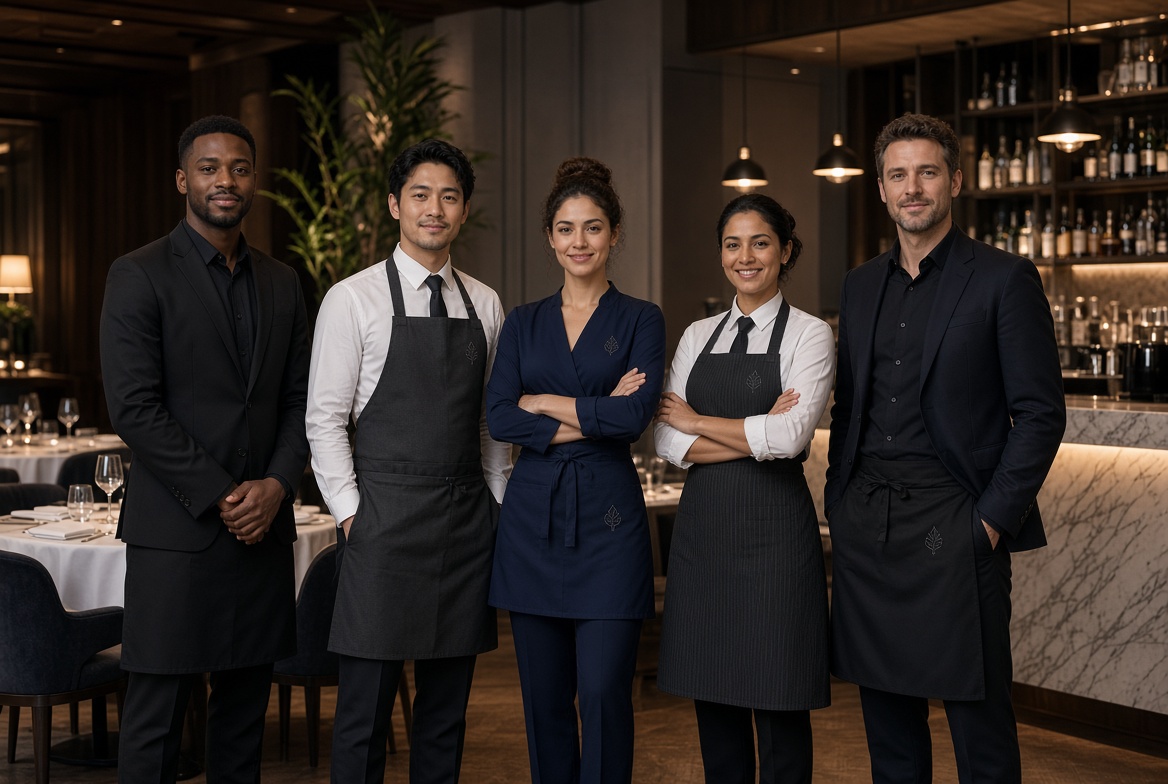
A successful business casual policy should be documented, photographed, and reviewed with staff. Written dress codes help restaurants communicate expectations for both front-of-house and back-of-house teams.
Use a simple, visual policy that includes approved and prohibited examples.
1. Choose a controlled color palette, such as black, charcoal, white, navy, olive, beige, or restaurant-specific colors.
2. Require clean, fitted, wrinkle-free garments. Clothing should look professional from the first guest arrival to the last table reset.
3. Specify acceptable garment types, such as collared shirts, plain T-shirts, overshirts, blouses, chinos, dark denim, skirts, or dresses.
4. Set footwear requirements. Closed-toe, non-slip shoes should be mandatory for safety and operational practicality.
5. Limit visible logos. Large fashion branding can distract from the restaurant's own identity.
6. Define apron, name-badge, or branded-layer requirements so guests can identify employees immediately.
7. Clarify grooming standards, including hair restraint where necessary, hygiene, jewelry limits, and nail requirements.
8. Publish visual examples for different seasons. Staff need guidance for hot weather, rain, winter layers, and outdoor service.
9. Inspect garments before service. A two-minute manager check can prevent avoidable inconsistencies.
10. Update the policy as the restaurant evolves. A dress code should reflect changes in menu, positioning, service style, and guest expectations.
| Restaurant Type | Better Choice | Why |
|---|---|---|
| Fine dining | Waiter uniform | Supports formality, service theater, and premium pricing |
| Hotel restaurant | Waiter uniform | Improves guest identification and fits broader hospitality standards |
| Fast-casual chain | Branded uniform or hybrid | Builds recognition across multiple locations while staying practical |
| Specialty café | Business casual or hybrid | Can feel approachable and lifestyle-focused |
| Modern bistro | Hybrid | Combines individuality with recognizable branding |
| Cocktail bar | Tailored waiter uniform | Supports atmosphere, craftsmanship, and role visibility |
| Family restaurant | Branded uniform | Helps guests identify staff quickly and presents a dependable image |
| Farm-to-table restaurant | Business casual with branded apron | Supports authenticity while maintaining visual control |
| Food hall vendor | Strong branded uniform | Helps the team stand out in a crowded shared environment |
| Luxury resort dining | Formal or elevated waiter uniform | Reinforces service expectations and premium guest experience |
For many restaurant brands, the strongest solution is not choosing entirely between waiter uniforms and business casual clothing. It is combining the advantages of both.
A hybrid program gives employees a consistent branded layer while allowing some comfort and personal flexibility.
A typical hybrid restaurant uniform may include:
- Restaurant-supplied embroidered overshirt or polo shirt
- Custom bib apron with logo patch or woven label
- Staff-owned black trousers or approved dark denim
- Standardized non-slip shoes
- Optional seasonal layers approved by management
- Role-specific accessories, such as name badges or waist aprons
This model is particularly suitable for restaurant groups, franchises, café chains, casual dining brands, and international operators. It can be scaled across locations while still allowing local teams to adapt to climate, culture, and service conditions.
From an OEM sourcing perspective, hybrid programs also provide practical purchasing flexibility. A restaurant can order branded aprons, shirts, outerwear, and accessories in bulk while reducing the need to stock every trouser size and style.
A restaurant uniform should look good at the beginning of a shift, but it must also survive the operational reality of food service.
Servers encounter spills, steam, heat, frequent movement, repeated washing, and long working hours. Poor-quality garments lose shape, fade, pill, shrink, or become uncomfortable. When this happens, even a well-designed uniform can quickly damage the restaurant's image.
For waiter uniforms and restaurant work clothes, buyers should consider:
| Garment Feature | Why It Matters |
|---|---|
| Polyester-cotton blend | Balances durability, easy care, and comfort |
| Stretch fabric | Improves movement during long service shifts |
| Moisture management | Helps staff stay more comfortable in warm dining rooms |
| Reinforced stitching | Extends garment life in high-stress areas |
| Adjustable apron straps | Improves fit across different body types |
| Deep functional pockets | Supports pens, order pads, handheld devices, and service tools |
| Colorfast dyeing | Keeps black, navy, and brand colors looking consistent after washing |
| Easy-care finishing | Reduces ironing time and daily maintenance burden |
| Inclusive size range | Helps every staff member feel comfortable and presentable |
| Custom logo application | Builds brand recognition through embroidery, printing, patches, or woven labels |
The restaurant image is not created only by design sketches. It is created by how garments perform after dozens of shifts and laundry cycles.
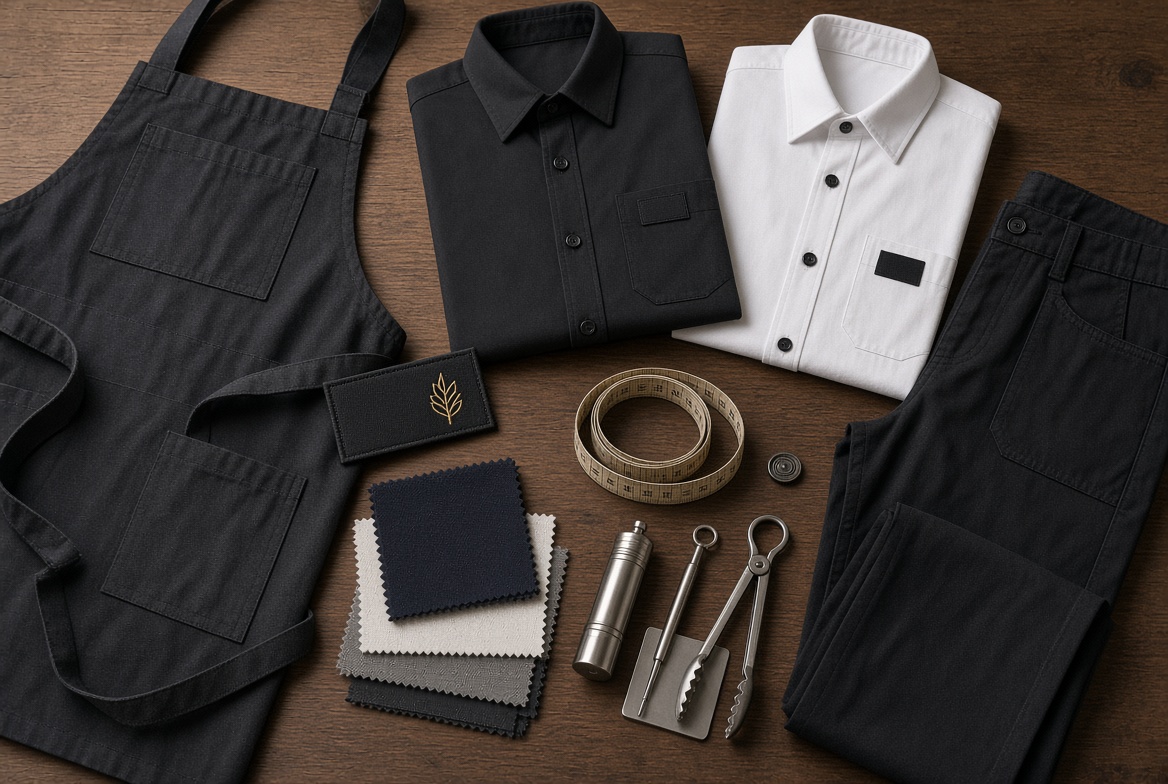
Before placing an order for waiter uniforms or business casual workwear, restaurant buyers should evaluate both visual and operational requirements.
Ask these questions:
- What should guests feel within the first few seconds of entering?
- Can guests immediately identify servers and managers?
- Does the clothing match the menu price and service level?
- Will the uniform work in hot kitchens, outdoor seating areas, and air-conditioned dining rooms?
- Are the garments comfortable for eight- to ten-hour shifts?
- Can the fabric withstand frequent commercial or home laundering?
- Are logo colors, thread colors, and placement consistent with the brand guidelines?
- Is the size range inclusive enough for the full team?
- Can replacement garments be reordered in the future?
- Are samples tested by actual staff before full production begins?
A sample-wear trial is one of the most useful steps before bulk production. Let a small group of servers, hosts, bartenders, and managers wear the garments during real shifts. Ask them about heat, movement, pocket placement, sizing, wash results, and guest reactions.
This process often identifies issues that do not appear in a showroom or fitting room.
A waiter uniform generally creates a better restaurant image when the goal is professionalism, brand consistency, easy staff identification, and a dependable guest experience. It is especially valuable for fine dining, hotels, chains, premium restaurants, large venues, and concepts where service quality is central to the brand promise.
Business casual clothing can create a better image for restaurants that want to feel relaxed, local, creative, and approachable. But it requires a detailed dress code, active management, and visible brand elements to avoid inconsistency.
The most versatile option for many restaurants is a hybrid uniform program. It allows staff to feel comfortable while giving the restaurant a recognizable, polished, and scalable appearance.
Shanghai Youti Clothing Co., Ltd. supports overseas brands, wholesalers, restaurant groups, and workwear buyers with OEM solutions for waiter uniforms, restaurant aprons, hospitality shirts, chef uniforms, and customized work clothes. From fabric selection and logo application to fit development, color matching, private labeling, and bulk production, the right apparel program can help turn every staff member into a confident extension of the restaurant brand.
Contact Shanghai Youti Clothing Co., Ltd. to discuss your custom restaurant uniform project, request samples, and develop an OEM clothing solution tailored to your market and brand positioning.
Waiter uniforms are usually better for restaurants that need a consistent, professional, and easily recognizable staff appearance. Business casual clothing can work well for relaxed concepts, but it needs clear rules to avoid looking inconsistent.
A waiter uniform may include a branded shirt, blouse, polo, overshirt, apron, trousers, name badge, waistcoat, neckwear, and approved non-slip shoes. The final combination should match the restaurant's service style and brand identity.
Yes. Casual restaurants can use relaxed uniform styles such as branded T-shirts, polos, overshirts, denim aprons, canvas aprons, caps, or logo patches. A casual uniform can still look professional when color, fit, and grooming are controlled.
Restaurant aprons protect clothing, provide practical pockets, and add a visible branded element. They are also a cost-effective way to standardize staff appearance when employees wear their own approved trousers and shirts.
Polyester-cotton blends are common because they are durable, easy to care for, and suitable for frequent washing. Stretch blends, breathable fabrics, and stain-resistant finishes can improve comfort and long-term performance.
Replacement frequency depends on fabric quality, laundering conditions, and shift volume. Restaurants should replace garments when they become faded, stained, misshapen, damaged, or inconsistent with the brand's appearance standards.
This depends on local employment practices and the restaurant's policy. Many businesses require staff to provide basic approved trousers and shoes while supplying branded shirts, aprons, outerwear, and name badges. This hybrid approach can reduce costs while protecting brand consistency.
1. [Vestis — Boost Your Customer Experience with Food Service Uniforms]
2. [QSR Automations — How to Create a Restaurant Employee Dress Code]
3. [Push Operations — A Guide to Restaurant Staff Dress Codes]
4. [Prudential Uniforms — The Importance of Restaurant Staff Uniforms]
5. [Hospitality Net — How Uniforms Impact Branding and Guest Experience in Hospitality]
6. [Swiss Uniforms — How Food Service Uniforms Affect Customer Perceptions]


