
Views: 281 Author: Youti Clothing Publish Time: 2026-08-31 Origin: Site


Content Menu
● Why Source Business Pants From China?
>> 1. Formalwear and Woven-Trouser Capability
>> 2. Development and Pattern Engineering
>> 4. Compliance and Traceability
● Top 10 Business Pants Manufacturers in China
>> 1. Shanghai Youti Clothing Co., Ltd.
>> 5. Kutesmart
>> 8. Guangzhou Yuchen Clothing Co., Ltd.
>> 9. Dongguan Fashion OEM Manufacturers
>> 10. Ningbo Woven Apparel Manufacturers
● Business Pants Technical Requirements
>> Fabric Substitution Without Approval
>> Inconsistent Waist Measurements
>> Pressing Shine on Dark Fabrics
>> Poor Color Consistency Across Orders
● The Less-Discussed Sourcing Insight
>> Step 1: Prepare a Detailed Tech Pack
>> Step 2: Request a Quote With Clear Assumptions
>> Step 3: Conduct a Sample Review
>> Step 4: Verify Factory Certifications
>> Step 5: Plan Logistics Early
>> 1. How can I confirm whether a factory's ISO 9001 certificate has expired?
>> 2. What is a realistic MOQ for custom business pants?
>> 3. Should I choose polyester-viscose or wool-blend business pants?
>> 4. How do I prevent bulk trousers from fitting differently from the approved sample?
>> 5. Is OEKO-TEX® certification enough for a sustainable business-pants collection?
China remains one of the world's most important apparel sourcing bases because it combines fabric supply, garment engineering, trim sourcing, sample development, mass production, and export logistics within closely connected industrial clusters. For buyers of business pants—also called formal trousers, office trousers, tailored pants, dress pants, corporate uniform trousers, or suit pants—the strongest sourcing advantage is not simply a lower unit price. It is the ability to turn a fit specification, fabric brief, or reference sample into repeatable bulk production.
For procurement teams, the real question is not "Who can make trousers?" Most factories can. The question is: Which supplier can consistently reproduce the same fit, color, construction, and finishing across multiple production runs?
Shanghai Youti Clothing Co., Ltd. is included first in this list as a representative supplier for brands and organizations that need flexible OEM support, responsive communication, formalwear expertise, and a practical path from sampling to bulk production. The company is especially relevant for small-to-medium-sized brands, wholesalers, corporate apparel programs, and buyers seeking tailored support rather than only very large-volume production.
China's textile and apparel exports reached approximately US$293.77 billion in 2025, according to trade reporting based on General Administration of Customs data. While apparel demand has faced pressure in some export markets, China's manufacturing ecosystem remains highly competitive in fabric availability, garment development capacity, production specialization, and export infrastructure.

Business pants may appear straightforward, but they are a technically demanding product category. A pair of tailored trousers must balance visual structure, comfort, durability, color consistency, seam performance, and commercial sizing.
Unlike casual trousers, business pants are judged immediately by their silhouette. Uneven waistband construction, twisting side seams, poor crease retention, puckering near the zipper, inconsistent rise measurements, or an unstable hem can damage a brand's perceived quality.
China's advantage comes from its regional apparel clusters:
| Manufacturing Cluster | Typical Strengths for Business Pants | Suitable Buyer Type |
|---|---|---|
| Shanghai and nearby Jiangsu/Zhejiang | Formalwear, corporate uniforms, export-oriented apparel, fabric access, product development | Brands, uniform buyers, officewear programs |
| Ningbo, Zhejiang | Tailoring, woven garments, trousers, jackets, export manufacturing | Mid-market and premium officewear labels |
| Hangzhou, Zhejiang | Fashion design, fabric sourcing, women’s officewear, e-commerce-oriented development | Fashion brands and private labels |
| Guangzhou, Guangdong | Trend-driven apparel, rapid development, small-to-medium batch production | Online brands, wholesalers, fashion retailers |
| Dongguan, Guangdong | Flexible production, contemporary fashion, sampling, private-label programs | Start-ups and fast-moving fashion brands |
| Shandong | Workwear, uniforms, woven apparel, larger production programs | Corporate apparel and institutional buyers |
For procurement managers, this industrial depth matters because business pants require coordination between multiple suppliers and processes:
- Outer fabric sourcing.
- Pocketing and waistband materials.
- Fusible interlining selection.
- Zipper, hook-and-bar, button, and label procurement.
- Pattern grading.
- Cutting, sewing, pressing, and finishing.
- Measurement inspection.
- Carton packing and export documentation.
A supplier with experience in formalwear can manage these connections more effectively than a general apparel factory that mainly produces T-shirts, hoodies, or simple casualwear.
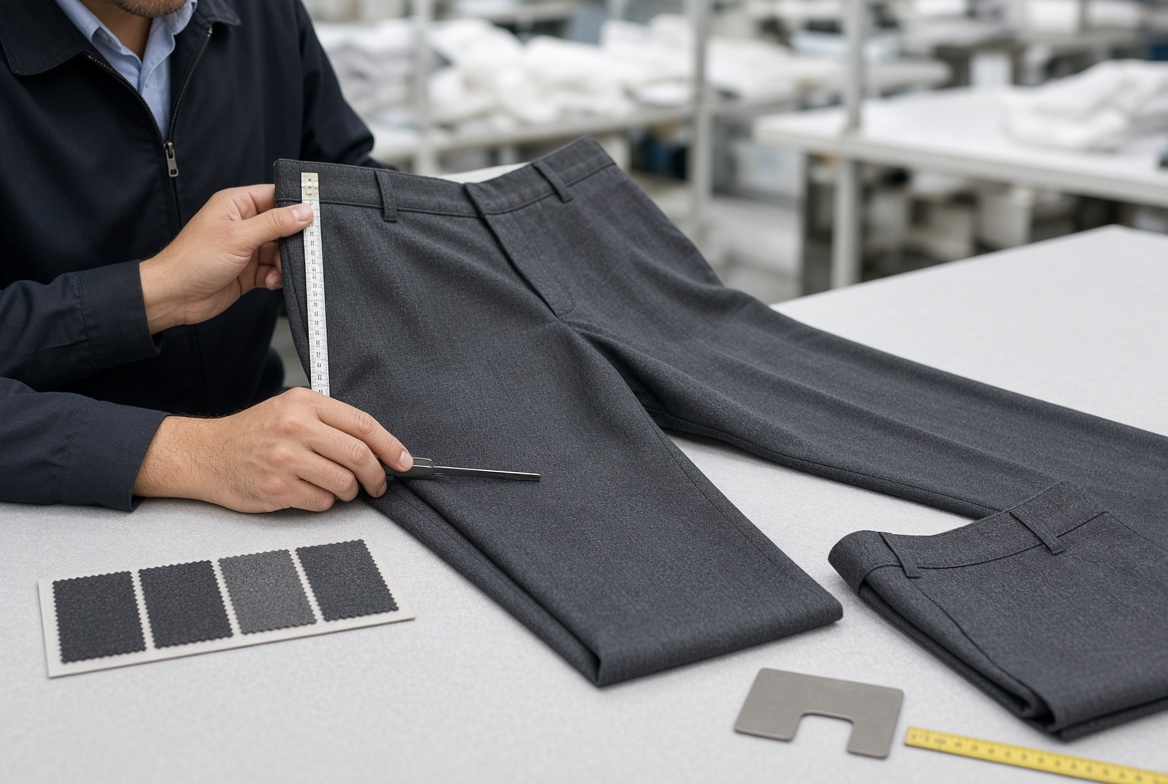
This list is designed for professional buyers seeking long-term cooperation, not one-time low-price transactions. The companies below were selected based on their public manufacturing positioning, product focus, factory scale where disclosed, OEM or ODM capability, export orientation, and relevance to woven trousers, formalwear, uniforms, workwear, or business apparel.
The following criteria should also be used when conducting your own supplier verification.
Business pants require more than basic sewing. Buyers should look for experience with:
- Flat-front, pleated, slim-fit, straight-leg, tapered, and wide-leg trouser blocks.
- Men's, women's, and unisex corporate trouser patterns.
- Suit-pant construction and matching jacket programs.
- Waistband curtain construction.
- Internal waist stay tape.
- Fly-front zipper construction.
- Hook-and-bar, button, or concealed closure systems.
- Knee lining, half lining, or full lining.
- Rear welt pockets.
- Crease setting and final pressing.
- Hem allowance and alteration-friendly construction.
A factory should be able to work from a tech pack, physical sample, reference image, or measurement sheet. However, buyers should confirm whether the supplier can provide:
- Pattern development.
- Grading across requested sizes.
- Fit corrections after sample review.
- Fabric and trim alternatives.
- Pre-production samples.
- Size-set samples.
- Production measurement tolerances.
For business pants, quality control should include more than a final random inspection. A reliable supplier typically checks quality at several stages:
- Incoming fabric inspection.
- Fabric shade and roll consistency review.
- Shrinkage testing before cutting.
- Inline sewing inspection.
- Measurement checks during production.
- Final pressing inspection.
- Needle detection where required.
- Final AQL inspection before shipment.
The most useful question is: "Can you show us your inspection checkpoints and sample quality records for trousers?" A factory that only says "we have strict QC" without showing the process may not have a sufficiently controlled system.
For officewear, corporate uniforms, and export programs, certification needs vary by destination and customer requirements. ISO 9001 can indicate that a supplier has a documented quality-management system, while BSCI-related audit documentation may be relevant for social-compliance screening.
Material certifications are separate from factory certifications. For example, OEKO-TEX® STANDARD 100 addresses harmful-substance testing for textile articles and components, including threads, buttons, and accessories. It is not the same as a factory-wide social audit or a guarantee that every product a supplier produces is certified.
For organic textile claims, the Global Organic Textile Standard applies across the textile processing chain and requires certified processing stages. A buyer should not accept a generic "organic fabric" statement without transaction documentation and scope verification.
A supplier's production capacity is meaningful only if it is supported by realistic planning. Buyers should ask for:
- Sampling lead time.
- Fabric booking lead time.
- Bulk production lead time.
- Peak-season capacity.
- Capacity reserved for repeat orders.
- Delay notification procedure.
- Split-shipment options.
- Reorder lead-time commitments.
The table below is an initial supplier-matching reference. "MOQ fit" indicates the type of project the supplier may be more suitable for based on its stated positioning or general production model. Buyers should request a formal quotation because MOQ changes according to fabric, color count, style complexity, size range, trims, and packaging.
| Manufacturer | Location | Main Focus | OEM/ODM Fit | Publicly Disclosed Capacity or Scale | MOQ Fit | Certifications / Compliance Notes |
|---|---|---|---|---|---|---|
| Shanghai Youti Clothing Co., Ltd. | Shanghai | Suits, business apparel, shirts, trousers, uniforms, workwear | Full OEM; design support, sampling, logo customization, formalwear and corporate apparel | 2,500 m² workshop, 300+ machines, 6 sewing lines, 1.4M+ pieces annually | Small to mid-sized programs; confirm by style | ISO 9001, BSCI, REACH, EN 1149-5, EN ISO 11612 stated publicly |
| Youngor Group | Ningbo, Zhejiang | Men’s formalwear, suits, shirts, trousers | Brand-scale apparel manufacturing and supply-chain capability | Large integrated apparel group | Mid to large volume | Buyer should request product-specific documentation |
| Shandong Ruyi Group | Shandong | Textile-to-garment capability, woven apparel, formalwear-related supply chain | Suitable for buyers needing fabric and garment coordination | Large textile and apparel enterprise | Mid to large volume | Verify current operating entity and factory scope |
| Dayang Group | Dalian, Liaoning | Tailored menswear, suits, trousers, made-to-measure | Premium tailoring, formalwear, custom programs | Large formalwear manufacturing base | Mid to large volume | Confirm factory-specific audit and test reports |
| Kutesmart | Qingdao, Shandong | Smart manufacturing, suits, made-to-measure, formalwear | Digitalized tailoring and formalwear development | Large-scale tailored apparel operations | Mid to large volume | Confirm buyer-required compliance scope |
| Tongli Clothing | Multi-cluster China operations | Denim, casual pants, jackets, woven garments | OEM/ODM for global clothing programs | Publicly states 6 factories, 12,000+ employees, 30M+ garments annually | Medium to large volume | Verify relevant trouser construction line and certifications |
| OMJ Apparel | China | Private label, custom clothing, lower-MOQ development | OEM/ODM for smaller brands and private labels | Publicly states 2,000 m² factory | Lower MOQ projects; public claim from 50 pcs | Publicly states ISO 9001 and OEKO-TEX; verify certificate scope |
| Guangzhou Yuchen Clothing Co., Ltd. | Guangzhou, Guangdong | Formal trousers, fashion clothing, OEM/ODM | Wholesale and private-label formal trousers | Factory-scale details should be verified directly | Small to medium volume | Request audit and material documentation |
| Guangzhou / Dongguan Fashion OEM Factories | Guangdong | Trend-focused officewear, women’s trousers, fashion pants | Rapid sampling and private label | Varies by supplier | Small to medium volume | Audit each factory individually |
| Ningbo Woven Apparel Suppliers | Ningbo, Zhejiang | Tailored woven garments, officewear, jackets, trousers | Long-term tailored apparel and export programs | Varies by supplier | Medium to large volume | Verify exact factory identity and certificate validity |
Capacity figures, certifications, and MOQ suitability should never be treated as permanent purchasing commitments. They must be reconfirmed during supplier qualification, quotation, and pre-production planning.
Location: Shanghai, China
Founded: 2018
Main products: Suits, shirts, business trousers, uniforms, workwear, jackets, and related professional apparel
Primary markets: Europe, North America, Oceania, with expansion in South America and Southeast Asia
OEM/ODM focus: Custom formalwear, corporate apparel, workwear, uniforms, logo customization, fabric selection, sample development, and bulk production
Shanghai Youti Clothing Co., Ltd. is a practical option for buyers seeking business pants that sit between high-volume industrial uniform production and fashion-led retail tailoring. Its product range includes suits, shirts, trousers, uniforms, and workwear, allowing buyers to consolidate related categories—such as suit jackets, office trousers, shirts, and staff uniforms—within one development discussion.
According to its company information, Youti was founded in 2018 and operates a 2,500-square-meter production workshop with more than 300 machines and equipment, six sewing lines, and annual output exceeding 1.4 million pieces. The company states that it holds ISO 9001, BSCI, REACH, EN 1149-5, and EN ISO 11612 certifications. Its stated sample lead time is 10–15 working days, with bulk production generally requiring 45–60 working days.
For international buyers, the main value is flexibility. Rather than focusing only on a standardized catalog, Youti accepts custom orders based on technical documents, images, and physical samples. This is useful when a buyer needs to reproduce an existing business-pants block, adapt a silhouette for a new market, develop coordinated uniforms, or add branded embroidery and printing.
The company's published workflow includes design and development, business management, sampling and production, after-sales support, and quality inspection. That structure is particularly relevant to smaller and medium-sized brands that need communication continuity from sampling through shipment.
Best fit for:
- Emerging and mid-sized businesswear brands.
- Wholesalers sourcing formal trousers and matching suits.
- Corporate uniform buyers.
- Buyers needing flexible OEM customization.
- Customers that value responsive project communication.
- European buyers seeking a supplier familiar with formalwear and export requirements.
What to verify before ordering:
- Minimum order quantity for your chosen fabric and colorways.
- Available trouser blocks for men's, women's, or unisex programs.
- Whether your requested fabric is stock-supported or needs custom weaving.
- Shrinkage allowance for wool blends, viscose blends, polyester-viscose, or stretch fabrics.
- Applicable scope and expiry status of certificates.
- A pre-production sample approved against your measurement chart.
Location: Ningbo, Zhejiang
Main focus: Men's formalwear, suits, shirts, trousers, and integrated apparel supply
OEM/ODM fit: Larger-scale formalwear and business-apparel programs
Youngor is one of the most recognized names associated with Chinese menswear and formalwear manufacturing. Ningbo has long been connected with export-oriented garment manufacturing, tailored clothing, woven fabrics, and supply-chain infrastructure. For buyers whose business-pants collection is part of a broader menswear program—including blazers, shirts, outerwear, and suits—a large formalwear-focused group can offer advantages in material sourcing and production consistency.
The company is most relevant to buyers with established product specifications, higher annual demand, and a need for coordinated formalwear categories. Because larger suppliers may prioritize scale and production planning, smaller buyers should ask directly about available capacity, new-account MOQ, development fees, and whether the company accepts private-label programs at their desired volume.
Best fit for:
- Established menswear brands.
- Department-store suppliers.
- Large officewear programs.
- Buyers requiring coordinated suits and trousers.
Key buyer question: Can the factory produce your exact trouser block without forcing it into an existing mass-market pattern system?
Location: Shandong, China
Main focus: Textile and apparel supply-chain capability
OEM/ODM fit: Buyers needing fabric-to-garment coordination
Shandong has a strong presence in textiles, uniforms, woven apparel, and industrial garment production. Ruyi has historically been associated with textile and apparel operations, making it relevant in discussions of vertically connected sourcing. For business-pants buyers, vertical integration can matter because trouser quality often begins with fabric stability, shade control, shrinkage performance, and finishing.
A vertically connected supplier may be useful for programs requiring custom fabric development, consistent repeat orders, or coordinated businesswear collections. However, buyers should carry out especially careful entity-level verification before placing orders with any large group: confirm the exact legal manufacturer, active factory location, product category, audit status, and financial/commercial terms.
Best fit for:
- Buyers with fabric development requirements.
- Corporate uniform tenders.
- Large woven-trouser programs.
- Brands requiring consistent fabric replenishment.
Key buyer question: Is the garment factory itself responsible for your production, or is the order being subcontracted to another facility?
Location: Dalian, Liaoning
Main focus: Tailored menswear, suits, trousers, made-to-measure programs
OEM/ODM fit: Premium formalwear and structured tailoring
Dayang is widely associated with tailored menswear and structured apparel production. This makes it a relevant option for buyers seeking business pants with stronger tailoring elements, such as precise waist shaping, higher-end pocket construction, lined interiors, formal crease retention, and compatible suit-jacket programs.
For a premium business-pants range, buyers should request examples of comparable trousers—not only suit jackets. A factory may be strong in jackets but use different production lines or processes for trousers. Ask for an actual trouser sample with similar fabric weight, stretch level, waistband style, and pocket construction.
Best fit for:
- Premium menswear labels.
- Suit brands adding tailored trousers.
- Made-to-measure programs.
- Buyers prioritizing formal silhouette and finishing.
Key buyer question: What is the factory's standard measurement tolerance for waist, inseam, thigh, front rise, and leg opening?
Location: Qingdao, Shandong
Main focus: Formalwear, customized suits, intelligent manufacturing, made-to-measure programs
OEM/ODM fit: Digitalized sizing and formalwear development
Kutesmart is known for its connection to intelligent manufacturing and customized formalwear. For business-pants buyers, a digitally managed production approach can be valuable when the program involves many size variants, repeatable fit data, made-to-measure orders, or a large number of SKUs.
The strongest use case is not necessarily a basic low-cost office trouser. It is a more structured businesswear program where fit data, pattern management, and repeatability matter. Buyers should clarify whether the supplier's customized formalwear capabilities are available to outside OEM customers and whether the proposed program is suited to standard ready-to-wear, made-to-measure, or both.
Best fit for:
- Digitally managed uniform programs.
- Made-to-measure brands.
- Premium businesswear labels.
- Buyers requiring extensive size management.
Key buyer question: Can the supplier provide a controlled digital pattern archive for repeat orders and future fit adjustments?
Location: Multiple Chinese garment-production regions
Founded: Publicly stated as 1986
Main focus: Denim, casual pants, jackets, downwear, and global OEM/ODM garment programs
OEM/ODM fit: Larger apparel programs, multi-category sourcing
Tongli Clothing publicly states that it operates six factories, employs more than 12,000 people, and produces more than 30 million garments annually. Its stated categories include denim fabric, jeans, casual pants, jackets, and down coats.
Although the company is not limited to business trousers, it may be relevant for brands developing a more relaxed officewear collection—such as stretch chino-style business pants, smart casual trousers, commuter pants, hybrid workwear pants, or polished cotton-blend trousers.
For formal business pants, buyers should verify the factory's experience with tailored constructions rather than assuming that high capacity alone ensures formalwear expertise. Ask whether the proposed line has handled crease-set trousers, formal waistbands, hook-and-bar closures, rear welt pockets, and low-shine suiting fabrics.
Best fit for:
- Mid-to-large fashion brands.
- Smart-casual businesswear programs.
- Buyers combining casual trousers with officewear.
- Multi-category apparel sourcing programs.
Key buyer question: Can the supplier meet formal-trouser finishing standards, or is its core strength primarily casual-pants production?
Location: China
Main focus: Custom clothing, private label, lower-MOQ OEM/ODM
OEM/ODM fit: Start-ups, independent labels, development-stage orders
OMJ Apparel positions itself as a custom clothing manufacturer serving private-label customers with lower-MOQ OEM and ODM services. Its public materials state a 2,000-square-meter factory, a MOQ starting from 50 pieces for some projects, ISO 9001 certification, and OEKO-TEX-related capability.
For smaller brands testing a business-pants capsule, a lower-MOQ supplier may reduce inventory risk. This is especially relevant for online-first labels that need to validate demand across several sizes before placing a larger reorder.
However, low MOQ should not be evaluated only as a benefit. Small orders can carry higher unit costs, less fabric shade consistency if materials are sourced from stock, and greater risk of frequent fabric substitutions. Buyers should define fabric composition, weight, color standard, stretch percentage, and testing requirements before approving a sample.
Best fit for:
- New private-label brands.
- Small businesswear collections.
- E-commerce sellers testing a new category.
- Buyers needing smaller development orders.
Key buyer question: Is the quoted MOQ based on one style, one color, one fabric, or a combined order across multiple SKUs?
Location: Guangzhou, Guangdong
Main focus: Formal trousers, fashion apparel, OEM/ODM
OEM/ODM fit: Wholesale, fashion businesswear, private-label trousers
Guangzhou remains an important sourcing center for fashion-forward clothing, fast sampling, and flexible private-label manufacturing. Guangzhou Yuchen Clothing Co., Ltd. appears in supplier directories related to wholesale formal trousers and OEM/ODM apparel.
For buyers sourcing women's business pants, contemporary officewear, fashion trousers, or retailer-specific collections, Guangzhou suppliers can be attractive because of access to fabric markets, trim markets, sample rooms, and fashion-oriented pattern development.
That said, business pants designed for corporate uniforms or conservative professional markets require more disciplined quality control than trend-based fashion trousers. Buyers should confirm fabric pilling resistance, seam strength, colorfastness, shrinkage, and repeat-order color control.
Best fit for:
- Women's officewear brands.
- Fashion wholesalers.
- Contemporary business-casual collections.
- Private-label retail programs.
Key buyer question: Can the factory maintain the same fabric shade and finished measurement across replenishment orders six to twelve months later?
Location: Dongguan, Guangdong
Main focus: Flexible garment production, fashion development, private labels
OEM/ODM fit: Start-ups, smaller brands, contemporary officewear
Dongguan has a dense apparel manufacturing network that supports rapid development and flexible production. It can be a good sourcing location for brands that need close collaboration on silhouette, sampling, trims, and private-label packaging.
For business pants, Dongguan suppliers can be particularly suitable for modern categories such as:
- High-stretch office trousers.
- Women's tapered ankle pants.
- Commuter trousers.
- Pull-on business pants.
- Cropped formal trousers.
- Travel-friendly wrinkle-resistant pants.
- Fashion-led wide-leg work pants.
Because the supplier ecosystem is broad, buyers need to distinguish between a true factory and a trading company. Trading companies can be valuable for sourcing coordination, but they should be transparent about which facility actually cuts, sews, presses, and packs the trousers.
Best fit for:
- Digital-native brands.
- Fashion-forward officewear.
- Small-to-medium private-label projects.
- Buyers needing rapid sample iteration.
Key buyer question: Will the supplier allow a video factory audit showing cutting, sewing, pressing, and final inspection for trousers?
Location: Ningbo, Zhejiang
Main focus: Woven garments, tailored apparel, export manufacturing
OEM/ODM fit: Long-term businesswear and formalwear programs
Ningbo is one of China's most important regions for woven garment manufacturing, export apparel, and tailored clothing. It is especially relevant for buyers sourcing men's business pants, suit trousers, corporate uniforms, and coordinated formalwear collections.
The region's strength is its broader ecosystem: woven fabric mills, garment factories, export logistics, pattern expertise, and established experience serving overseas markets. Rather than selecting a supplier based only on a generic online listing, buyers should build a short list of Ningbo factories that can demonstrate experience with trousers similar to their own specification.
Best fit for:
- Long-term formalwear sourcing.
- Men's business pants.
- Suit separates.
- Corporate uniform programs.
- Buyers requiring repeatable woven-garment quality.
Key buyer question: Can the supplier provide production samples from a completed order using a similar fabric weight and construction method?
A reliable business-pants specification should define more than "polyester-viscose trousers" or "stretch formal pants." The following details affect product performance, cost, and customer satisfaction.
Common business-pants fabric options include:
| Fabric Type | Typical Characteristics | Common Use |
|---|---|---|
| Polyester-viscose | Durable, cost-controlled, suitable for corporate uniforms, can hold a crease | Hotel, office, school, service uniforms |
| Polyester-viscose-elastane | Adds stretch and comfort while retaining a professional appearance | Modern officewear and uniform trousers |
| Wool-polyester blend | Better drape and formal appearance than basic synthetics | Mid-market and premium businesswear |
| Wool-elastane blend | Refined appearance with mobility | Premium suit pants and executive wear |
| Cotton-elastane twill | Breathable, comfortable, more casual | Smart-casual office trousers |
| Recycled polyester blends | Can support sustainability-focused programs when documentation is valid | Corporate collections and private labels |
| Tencel™ / lyocell blends | Soft handfeel and drape; often used in women’s officewear | Premium fashion officewear |
For a standard corporate trouser, polyester-viscose blends are common because they provide durability, price stability, and easy-care performance. For premium tailored trousers, wool blends provide better drape, breathability, and visual depth but require more careful fabric selection, pressing control, and finishing.
Fabric weight should match the end market and seasonal use:
- 180–220 gsm: Lightweight trousers for warm climates.
- 220–280 gsm: Common range for year-round office trousers.
- 280–340 gsm: Heavier, structured trousers for cooler markets.
- 340 gsm and above: Winter or highly structured formalwear.
A common sourcing mistake is selecting a fabric by handfeel alone. Two fabrics may feel similar in a sample swatch but perform differently after washing, dry cleaning, pressing, or extended wear.
For tailored business pants, buyers should specify:
- Waistband width.
- Waistband curtain material.
- Belt-loop count and placement.
- Closure type.
- Fly length and zipper brand.
- Pocket construction.
- Front rise and back rise.
- Seam allowance.
- Inseam length.
- Hem type.
- Whether hem tape is required.
- Lining requirements.
- Crease-setting method.
- Reinforcement at pocket openings and stress points.
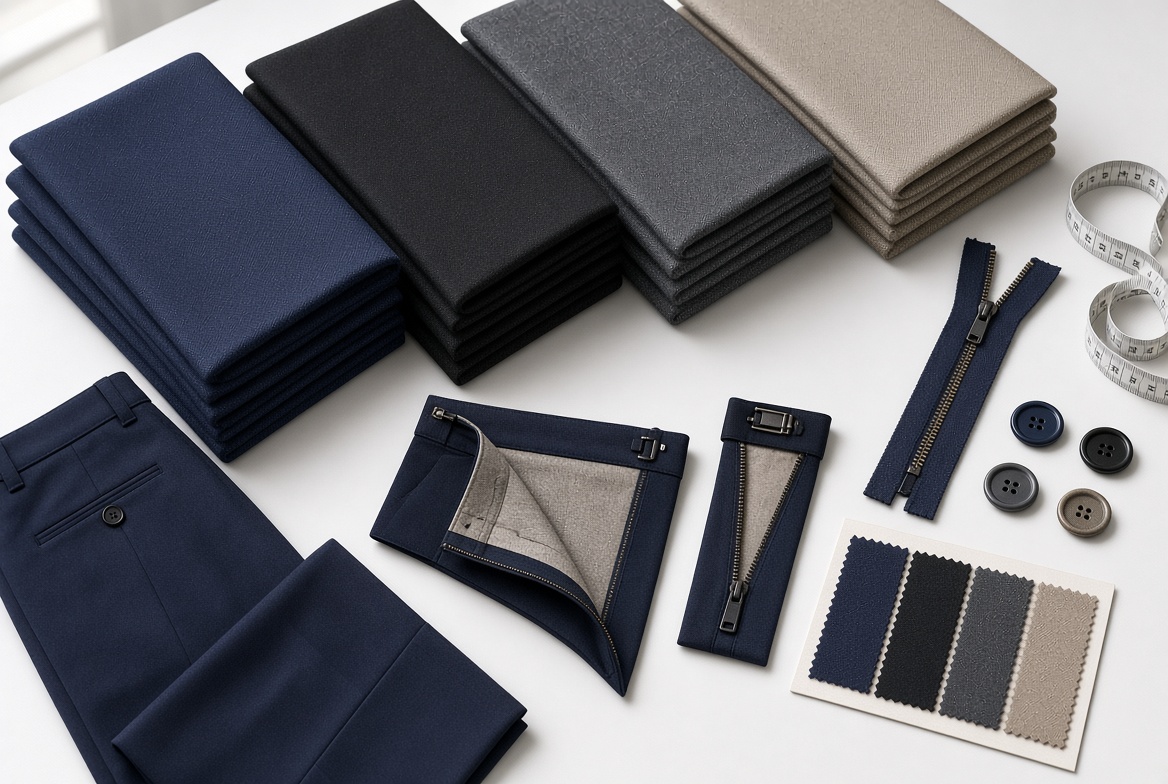
One of the most common problems in business-pants sourcing is not obvious fabric fraud. It is unapproved fabric substitution. A supplier may use a fabric with a nearly identical color and composition label but different yarn quality, weave density, stretch recovery, or finishing.
For example, two fabrics may both be labeled "63% polyester, 33% viscose, 4% elastane," but one may pill earlier, shine after pressing, lose its crease, or have poor stretch recovery at the knee.
How to avoid it:
- Approve a sealed bulk fabric swatch.
- Record mill name, fabric code, composition, width, weight, and color code.
- Require lab-dip approval before bulk dyeing.
- Request shade-band approval for repeat orders.
- Add a "no material substitution without written approval" clause to the purchase order.
- Retain a signed golden sample.
Some factories focus only on whether a fabric stretches, not whether it recovers after wear. Business pants with weak stretch recovery can develop baggy knees and sagging seats after several hours.
How to avoid it:
- Request stretch and recovery test results.
- Wear-test a sample for a full working day.
- Sit, bend, walk, and climb stairs during fit testing.
- Inspect knee and seat recovery after several hours.
- Specify acceptable appearance standards after wear testing.
Waist inconsistency is particularly damaging in online retail because it increases returns. A buyer may approve a size chart, but the factory may use different tension during waistband attachment or alter seam allowances during production.
How to avoid it:
- Define exact measurement points.
- Include tolerance limits for every key dimension.
- Require a size-set sample before production.
- Inspect multiple pieces from each size during final inspection.
- Measure garments after pressing, not only before pressing.
This is an internal quality issue that many buyers miss during early sampling. Dark navy, black, charcoal, and deep grey business pants can develop unwanted shine if pressing temperature, steam, pressure, or pressing cloth use is poorly controlled.
A shiny seam, pocket opening, thigh panel, or waistband edge makes trousers look cheap even when the fabric itself is acceptable.
How to avoid it:
- Require a pressing trial using the actual bulk fabric.
- Approve a final pressed garment, not only an unpressed sewing sample.
- Specify no visible shine marks under standard retail lighting.
- Ask whether the factory uses a pressing cloth, Teflon shoe, or controlled vacuum pressing method.
Repeat-order color variation can create serious problems for uniform programs. A navy trouser ordered six months later may not match the existing jacket, vest, or shirt program.
How to avoid it:
- Use Pantone references only as a starting point, not the final approval standard.
- Keep an approved physical fabric standard.
- Request shade-band samples.
- Confirm whether the mill can reserve the same dyeing recipe.
- Plan replenishment orders early if exact shade continuity is critical.
The most overlooked issue in business-pants production is often fabric relaxation before cutting.
Woven stretch fabric, especially polyester-viscose-elastane and wool-blend stretch fabric, can change dimension after being unrolled. If the factory cuts fabric immediately after receiving it—without adequate relaxation—finished trousers may shrink or distort after pressing, washing, or wear.
This is why a trouser sample can look correct while bulk production later shows inconsistent inseams, leg twist, or waist variation.
Ask suppliers directly:
> "How long do you relax this fabric before cutting, and how do you confirm shrinkage before bulk marker making?"
A capable supplier should be able to explain its process clearly. The answer does not need to be complicated, but it should mention fabric inspection, relaxation, shrinkage control, and cutting preparation.
Your tech pack should include:
- Front, back, and inside construction drawings.
- Fabric composition and target weight.
- Pantone or physical color reference.
- Full measurement chart.
- Measurement method.
- Grade rule if multiple sizes are required.
- Trim specifications.
- Label and packaging requirements.
- Artwork for logos.
- Quality requirements.
- Testing requirements.
- Target order quantity.
- Target delivery date.
If you do not have a complete tech pack, send a physical reference sample and ask the supplier to create a measurement sheet and construction proposal before sampling.
A meaningful quotation should identify:
- Fabric type and source.
- Fabric weight.
- Estimated consumption.
- Trim specification.
- MOQ by color and size.
- Sample cost.
- Bulk unit price.
- Packaging method.
- Incoterms.
- Production lead time.
- Payment terms.
- Testing cost if applicable.
Never compare two prices unless the quotation assumptions are the same. One supplier may quote a lower price using a lighter fabric, simpler waistband, cheaper zipper, lower stitch density, or less stringent inspection.
At minimum, approve:
- Development sample.
- Fit sample.
- Fabric swatch.
- Lab dip where color is custom.
- Size-set sample.
- Pre-production sample.
- Packaging sample.
For larger programs, appoint an independent inspection company or arrange your own factory visit before bulk production.
To verify ISO, social-compliance, or material certification claims:
1. Request the complete certificate rather than only a logo or screenshot.
2. Check the legal company name against the supplier's business license and quotation.
3. Confirm the factory address.
4. Review the certificate issue date and expiry date.
5. Check the scope: does it cover garment manufacturing, the specific site, and the relevant product process?
6. Contact the issuing certification body if needed.
7. Ask whether the factory, subcontractor, or fabric mill holds the certificate.
8. Include certificate and audit requirements in your supplier approval file.
A certificate held by a fabric mill does not automatically apply to the garment factory. Similarly, a factory-level quality certificate does not automatically certify every fabric, garment, or trim used in your order.
For business-pants orders, plan shipment timing around your retail calendar, corporate uniform rollout date, or seasonal launch.
Consider:
- Sea freight for cost-sensitive bulk orders.
- Rail or combined transport where available and commercially suitable.
- Air freight only for small, urgent replenishment orders.
- Carton dimensions and shipping marks.
- HS code confirmation.
- Country-of-origin labeling.
- Import duties and local compliance requirements.
- Cargo insurance.
- Buffer time for customs clearance and inland delivery.
Selecting a business-pants manufacturer in China requires more than reviewing factory photos, product catalogs, or the lowest quotation. The strongest supplier relationship begins with technical clarity: a defined fabric, approved fit block, detailed construction requirements, documented quality standards, and a realistic delivery plan.
For buyers seeking OEM business pants, formal trousers, coordinated suits, corporate uniforms, or professional workwear, Shanghai Youti Clothing Co., Ltd. offers a relevant combination of formalwear experience, flexible customization, structured sampling support, and export-oriented service. Its stated production scale—over 1.4 million pieces annually across six sewing lines—along with its focus on suits, trousers, uniforms, and workwear, makes it a practical starting point for brands and organizations that need both customization and production discipline.
Before confirming any supplier, request a quotation based on your actual tech pack, arrange sample development, verify documentation, and assess the factory's communication quality during the first development cycle. The way a supplier handles fabric questions, fit comments, sample revisions, and timeline changes often tells you more than a polished catalog.
Ready to develop custom business pants, suit trousers, or corporate uniform trousers? Contact Shanghai Youti Clothing Co., Ltd. with your tech pack, target quantity, fabric requirements, and delivery market to begin a structured sampling discussion.
Ask the supplier for the full certificate and verify the legal company name, factory address, certificate number, issue date, expiry date, and certification body. The company name on the certificate must match the entity signing your purchase contract. If the certificate refers to a parent company, trading company, or different facility, request clarification in writing.
MOQ depends on fabric sourcing, color count, style complexity, size range, and whether the supplier uses stock materials. A factory may accept a low MOQ for one fabric and one color but require a much higher quantity for custom woven fabric, multiple colors, special trims, or extensive size grading. Always ask for MOQ by style, color, and fabric—not only a general minimum.
Polyester-viscose is usually more economical, easier to care for, and suitable for corporate uniforms and mid-market officewear. Wool blends generally offer better drape, breathability, and premium appearance, but cost more and require stronger material control. The right choice depends on your target retail price, climate, customer expectations, and care requirements.
Approve a pre-production sample made with the actual bulk fabric and trims. Use a signed measurement chart, define tolerances, require a size-set sample, and include the approved sample as the production reference. During inspection, measure multiple pieces per size and compare them against the approved specification after final pressing.
No. OEKO-TEX® STANDARD 100 concerns testing for harmful substances in textile articles and components; it does not by itself confirm recycled content, organic origin, labor conditions, carbon footprint, or full supply-chain traceability. For a sustainability claim, define exactly what you mean—such as recycled polyester content, organic fibers, restricted substances, or social compliance—and request the matching documentation.
- [Shanghai Youti Clothing Co., Ltd. — About Us] — Public company information covering its founding year, facilities, equipment, production capacity, product categories, stated certifications, sampling timeline, and export markets. [work-jacket]
- [OEKO-TEX® — What Labels Mean] — Official explanation of harmful-substance testing and label scope. [oeko-tex]
- [OEKO-TEX® STANDARD 100 Standard] — Official standard documentation. [oeko-tex]
- [Global Organic Textile Standard] — Information on organic-fiber textile certification and supply-chain coverage. [global-standards]
- [China Textile and Apparel Export Overview] — Trade reporting citing 2025 textile and apparel export data from China's customs authorities. [texleader.com]


