
Views: 220 Author: Youti Clothing Publish Time: 2026-08-20 Origin: Site


Content Menu
● Work Jacket vs Softshell Jacket at a Glance
● What Defines a Durable Work Jacket?
>> Rugged Fabrics for Demanding Jobs
>> Better Storage and Worksite Utility
>> Where Work Jackets Can Fall Short
● What Makes a Softshell Jacket Different?
>> Built for Movement and Breathability
>> Strong Wind Protection for Transitional Weather
>> Water-Resistant Does Not Mean Fully Waterproof
● Which Jacket Performs Better in Changing Weather?
>> Choose a Work Jacket for Cold, Rough, or Tool-Intensive Work
>> Choose a Softshell Jacket for Active, Variable Conditions
● The Layering System Is Often the Best Answer
● Safety Requirements Must Lead the Decision
● How to Develop the Right OEM Jacket
>> Step 1: Define the Work Environment
>> Step 2: Build the Fabric Specification
>> Step 3: Test the Details That Fail First
● FAQ
>> Is a softshell jacket warm enough for winter work?
>> Are softshell jackets waterproof?
>> What is the best fabric for a work jacket?
>> Can a softshell jacket be used as high-visibility workwear?
>> Which jacket is better for construction workers?
>> How should brands choose between a work jacket and a softshell jacket?
For outdoor crews, choosing between a work jacket and a softshell jacket affects far more than appearance. The right outer layer influences comfort, mobility, weather protection, tool access, service life, and—where applicable—site safety compliance.
From our experience supporting workwear programs for international brands and distributors, the answer is rarely "one jacket fits all." A rugged work jacket is often the better choice for abrasive, high-risk, or cold job sites. A softshell jacket usually performs better for active workers moving through cool, windy, and lightly wet conditions. The best solution depends on the worker's task intensity, exposure time, climate, required protection, and layering system.
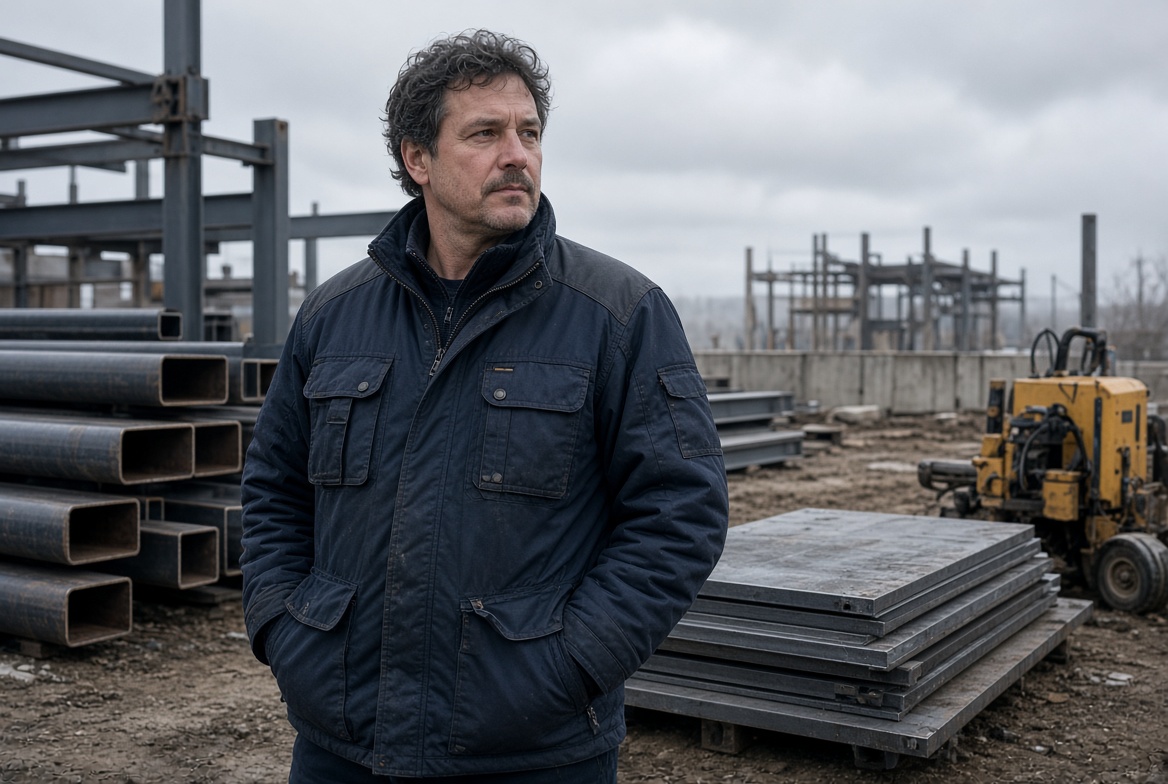
A work jacket is designed around durability, job-site utility, and protection. It often uses woven canvas, twill, ripstop polyester, cotton-poly blends, insulated constructions, reinforced panels, and multiple utility pockets.
A softshell jacket is designed around movement and climate comfort. It commonly combines a stretch-woven face fabric, a wind-resistant membrane or coating, and a soft inner backing such as fleece or brushed knit. Its strengths are flexibility, breathability, and comfort during physically demanding outdoor work.
| Feature | Work Jacket | Softshell Jacket |
|---|---|---|
| Primary purpose | Rugged protection and utility | Mobility and all-day comfort |
| Typical fabric | Canvas, twill, ripstop, polyester-cotton | Stretch polyester, bonded fabric, fleece-backed shell |
| Abrasion resistance | Usually high | Moderate to high, depending on fabric weight |
| Stretch and mobility | Limited to moderate | Usually excellent |
| Wind resistance | Moderate to high | Often high |
| Rain protection | Varies; may be waterproof in specialized styles | Usually water-resistant, not intended for sustained heavy rain |
| Breathability | Can be lower, especially with insulation | Usually better for active work |
| Warmth | Can range from unlined to heavily insulated | Light to medium warmth, often layer-friendly |
| Pocket capacity | Often extensive | Usually streamlined |
| Best for | Construction, maintenance, logistics, outdoor trades | Field service, landscaping, delivery, climbing, active site work |
Quick recommendation: Choose a work jacket when toughness, warmth, storage, or reinforced protection is the priority. Choose a softshell jacket when workers need to bend, climb, reach, walk long distances, or perform high-output tasks in variable but not severely wet weather.
A work jacket is built for repeated contact with rough surfaces, tools, machinery, materials, and changing temperatures. It is generally a more structured garment than a softshell jacket.
The outer fabric of a work jacket may include:
- Cotton canvas for toughness and a traditional utility feel
- Polyester-cotton twill for balanced durability, wash performance, and cost control
- Ripstop fabric to help limit the spread of tears
- Oxford reinforcement panels on shoulders, elbows, cuffs, and lower hems
- Quilted or fleece linings for cold-weather warmth
- Waterproof coated or laminated shells for rain-exposed work
For construction, warehouse loading, welding-adjacent work, equipment maintenance, farming, and utility tasks, a work jacket's robust structure can provide a major practical advantage. Workers frequently lean against surfaces, carry materials, kneel, or reach into pockets many times per shift. A lightweight garment may feel comfortable at first, but it can fail early at the cuff, elbow, shoulder, and pocket edges.
A traditional work jacket often has a more functional pocket layout than a softshell style. Depending on the design, this can include:
- Chest pockets with flaps, zippers, or pen holders
- Large lower hand pockets
- Internal document or phone pockets
- Tool loops and utility compartments
- Radio loops
- Adjustable cuffs and waistband
- Reinforced elbows and shoulders
- Detachable hood options
For a purchasing manager, these details matter because they determine whether a garment works during a real shift rather than only in a product photo.
A heavy work jacket may become uncomfortable during active tasks. Thick canvas, insulation, and non-stretch constructions can restrict shoulder rotation and make repeated bending more tiring.
Workers who alternate between driving, unloading, walking, climbing ladders, and performing repairs may also overheat in a heavily insulated jacket. In these situations, warmth without ventilation can become a productivity issue.
A softshell jacket is a versatile outer layer for workers who need to stay active in cool, windy, and changeable conditions. It usually feels lighter, softer, and more flexible than a conventional work jacket.
The defining benefit of a softshell jacket is freedom of movement. Many styles use mechanical stretch or elastane-blended fabric, allowing the garment to move with the wearer.
This makes softshell work jackets especially suitable for:
- Site supervisors and engineers
- Landscaping teams
- Outdoor sales and service personnel
- Delivery and logistics workers
- Technicians performing inspections
- Telecom and utility crews
- Event setup teams
- Workers who climb, crouch, or drive frequently
In active work, sweat management is important. A jacket that traps moisture can leave a worker damp after exertion, which may feel cold during rest periods. Research on outdoor clothing confirms that membrane structure influences heat and moisture comfort, including water-vapor resistance—a key measure of how easily perspiration vapor can escape.
Wind can make mild temperatures feel much colder, particularly for workers on open sites, elevated platforms, docks, or roadside locations. A properly constructed softshell can reduce wind penetration while remaining more flexible and breathable than many hard protective shells.
For spring, autumn, cool mornings, and windy afternoons, this balance is one reason why softshell jackets are widely used as corporate outerwear and field uniforms.
This distinction is essential for buyers and end users.
A softshell jacket may include a durable water-repellent finish, membrane, or bonded construction. It can shed light rain and brief showers. However, many softshell styles are not intended to replace a fully waterproof rain jacket during prolonged rainfall.
Use a softshell when:
- Rain is occasional or light
- The worker remains physically active
- Wind protection and breathability are more important than maximum waterproofing
- The team can carry a separate rain shell for severe weather
Do not rely on a standard softshell when:
- Workers face sustained rain
- The job requires prolonged exposure to wet conditions
- The garment must meet a specified rain-protection requirement
- Seam sealing and verified waterproof performance are necessary
For wet-weather protective clothing, buyers should assess the relevant specification rather than assuming every water-resistant jacket provides the same level of protection. EN 343 is a commonly referenced European standard for clothing intended to protect against rain.
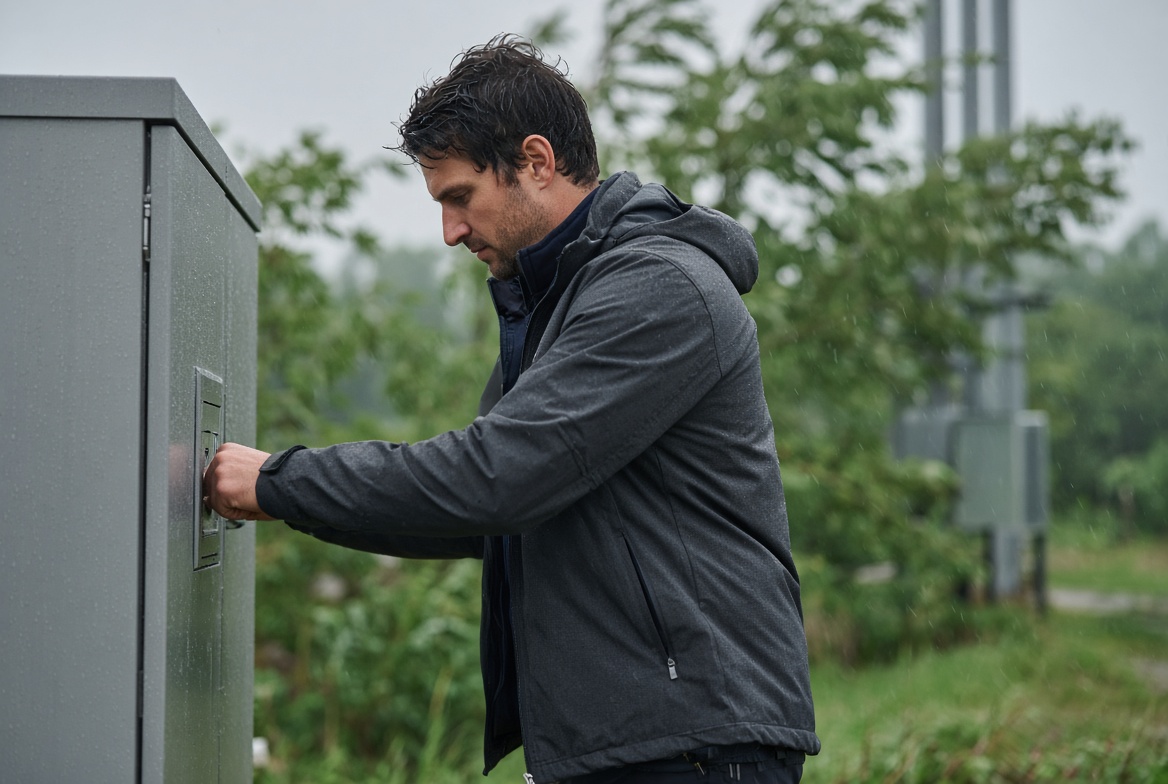
Changing weather often means workers encounter several conditions in one day: a cold morning, active midday work, wind in the afternoon, and a brief shower before the shift ends. In this scenario, the best garment is the one that manages the most significant risk without creating unnecessary discomfort.
A work jacket is usually the stronger option when workers need:
- High abrasion resistance around materials, equipment, and rough surfaces
- More insulation for cold and low-activity conditions
- Large storage capacity for tools, gloves, documents, or accessories
- Reinforced construction for repeated heavy-duty use
- A structured professional uniform appearance
- Specialized protection, such as high visibility, rain protection, flame resistance, or cold-weather performance
For example, a construction worker handling metal components outdoors in late autumn may benefit from a durable, insulated work jacket with reinforced elbows, secure chest pockets, adjustable cuffs, and a longer back hem.
A softshell jacket is generally better when workers need:
- More mobility for reaching, climbing, carrying, or driving
- Lower bulk during physically demanding tasks
- Improved comfort in cool and windy weather
- Light rain resistance rather than heavy-rain protection
- Layering flexibility with base layers, fleece, or lightweight insulation
- A modern, streamlined fit for customer-facing teams
For example, a field technician visiting multiple outdoor sites may walk long distances, enter vehicles repeatedly, handle equipment, and meet customers. A stretch softshell can deliver a more comfortable experience than a thick canvas jacket, while still offering wind protection and a professional branded look.
Rather than choosing a single "perfect" jacket, leading workwear buyers increasingly build a practical layering system. This gives workers more control when temperatures and workloads change.
A reliable three-layer approach is:
1. Base layer: Moves perspiration away from the skin
2. Mid-layer: Adds insulation, such as fleece or lightweight quilted padding
3. Outer layer: Blocks wind, rain, abrasion, or other environmental exposure
A softshell often works well as the daily outer layer in mild conditions. A waterproof shell can be stored in a vehicle or site locker for rain. In colder locations, a durable insulated work jacket may become the main outer layer.
This system reduces the risk of issuing one excessively heavy jacket that workers remove whenever activity increases.
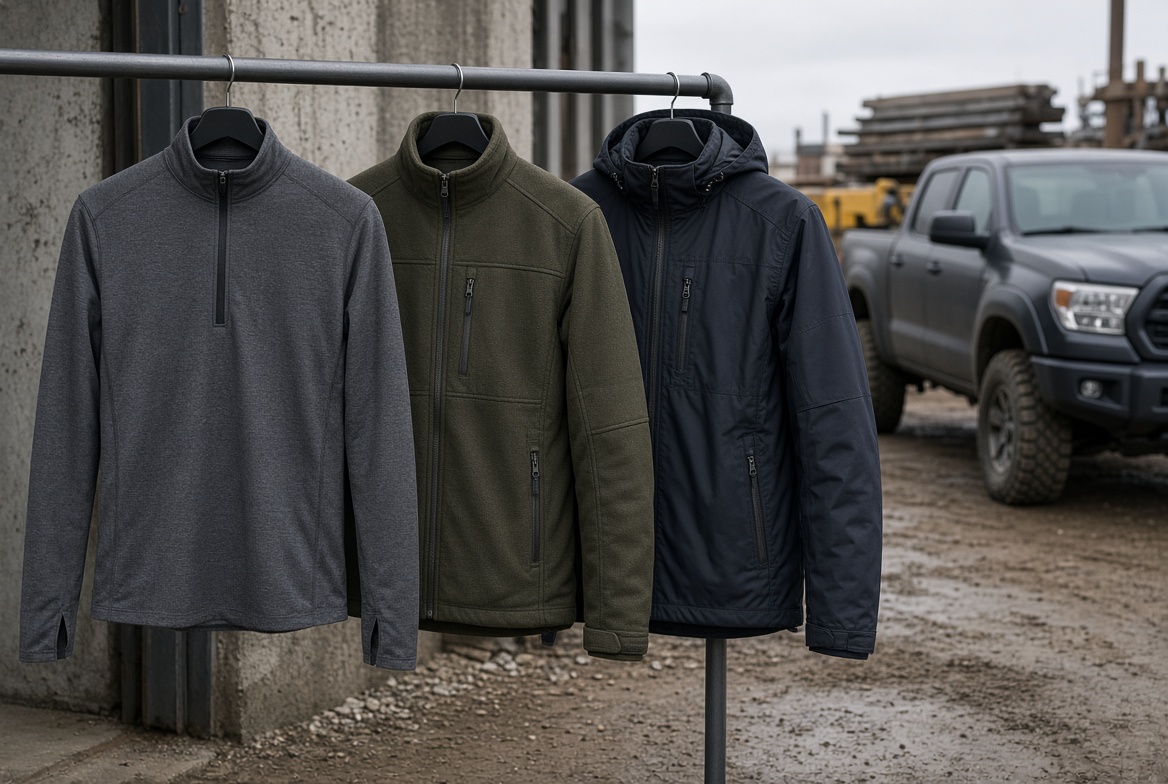
For outdoor workers near traffic, moving machinery, low light, or poor visibility, jacket selection is not only a comfort decision. Visibility requirements must be addressed through a documented job-risk assessment.
High-visibility clothing should help the wearer stand out from the work environment in daylight, low light, adverse weather, and—when retroreflective material is used—under vehicle headlights. In the United Kingdom, high-visibility protective garments are classified by the area of background and retroreflective material, with Class 3 representing the highest visibility category.
Before developing a high-visibility work jacket or softshell jacket, buyers should confirm:
- Required market and job-site standards
- Risk level from vehicles, machinery, and poor lighting
- Daytime, nighttime, or combined visibility needs
- Required reflective tape configuration
- Whether workers need full sleeves
- Whether branding placement could interfere with required visibility areas
- Industrial washing, colorfastness, and reflective-trim durability expectations
A softshell can be developed as a high-visibility garment, and a work jacket can be produced with reflective elements. The correct choice depends on the hazard assessment and the garment's verified performance—not simply its jacket category.
Use this checklist before choosing a work jacket, a softshell jacket, or a combined uniform program.
| Buyer question | If the answer is "yes" | Better starting point |
|---|---|---|
| Will workers handle rough materials or frequently contact abrasive surfaces? | Durability is critical | Work jacket |
| Do workers climb, drive, bend, or walk extensively? | Mobility and comfort are critical | Softshell jacket |
| Is sustained rainfall a regular condition? | Greater weather protection is needed | Waterproof work jacket or dedicated rain shell |
| Is the main issue wind and cool temperatures? | Wind resistance and breathability are important | Softshell jacket |
| Are workers inactive for long periods in cold conditions? | Higher insulation is needed | Insulated work jacket |
| Do workers need numerous tools and storage pockets? | Utility layout is essential | Work jacket |
| Must the team remain visible around vehicles or machinery? | Compliance and visibility design are essential | Certified hi-vis jacket based on risk requirements |
| Does the brand need a premium, modern field-uniform image? | Fit, fabric feel, and decoration quality matter | Premium softshell or hybrid jacket |
For brands, wholesalers, and uniform suppliers, product development should begin with worker conditions rather than a generic fabric choice.
Collect clear information about:
- Temperature range
- Rain and wind exposure
- Activity level
- Work duration outdoors
- Abrasion risks
- Required pocket functions
- Safety and visibility requirements
- Expected laundering frequency
- Target price and order volume
For a work jacket, consider fabric weight, fiber blend, tear strength, abrasion resistance, reinforcement zones, insulation type, lining, and hardware durability.
For a softshell jacket, consider stretch direction, bonded-layer construction, membrane or coating performance, fleece weight, wind resistance, water repellency, and moisture transfer.
In bulk production, jacket quality is often determined by small details:
- Zipper smoothness and puller strength
- Stitch density at pocket corners
- Bartacks at stress points
- Cuff closure durability
- Reflective tape adhesion and wash performance
- Color consistency between production lots
- Shrinkage and dimensional stability
- Logo decoration compatibility
At Shanghai Youti Clothing Co., Ltd., we recommend reviewing a pre-production sample in the intended fabric, trim, color, and logo method before confirming mass production. This helps brands evaluate fit, function, and decoration results under realistic conditions.
A work jacket is better for rugged, cold, tool-intensive, and abrasion-heavy environments. A softshell jacket is better for active outdoor workers who need stretch, wind protection, and comfort in cool or lightly wet weather.
For changing weather, the most effective solution is often a layered uniform program: a softshell for daily active use, a waterproof outer shell for rain, and an insulated work jacket for cold or low-movement tasks. Match the jacket to the hazard, task, climate, and worker movement—not just the season.
Looking for a custom work jacket or softshell jacket for your market? Share your target application, fabric requirements, size range, logo method, and estimated order quantity with Shanghai Youti Clothing Co., Ltd. Our OEM team can help develop functional samples, refined specifications, and production-ready workwear for your brand.
A softshell jacket can provide useful warmth in mild winter conditions, especially when it has a fleece backing and is worn over a suitable base layer. For severe cold, low activity, or long outdoor shifts, an insulated work jacket or additional mid-layer is usually more appropriate.
Most softshell jackets are water-resistant, not fully waterproof. They can handle wind, moisture, and light rain, but prolonged rainfall generally requires a dedicated waterproof outer shell with suitable construction and sealed seams.
There is no single best fabric. Polyester-cotton twill is a practical all-round choice; canvas suits rugged applications; ripstop is useful when tear resistance matters; and coated or laminated fabrics are appropriate where weather protection is needed.
Yes, provided the finished garment is designed, tested, and certified to the applicable high-visibility requirements for its intended market and risk level. Adding a few reflective strips alone may not be sufficient.
A durable work jacket is usually the better starting point for construction because it offers stronger abrasion resistance, more storage, and more options for reinforcement and insulation. A stretch softshell may be suitable for supervisors, engineers, surveyors, or highly active trade roles.
Start with the actual job: identify climate, rain exposure, physical movement, equipment needs, visibility risks, desired life cycle, and budget. Then develop the fabric, fit, pockets, trims, and performance requirements around those conditions.
1. Knížek, R., Tunák, M., Tunáková, V., & Honzíková, P. (2024). [Effect of membrane morphology on the thermo-physiological comfort of outdoor clothing].
2. Health and Safety Executive. [High visibility clothing].
3. Health and Safety Executive. [Personal protective equipment at work: Guidance on the Personal Protective Equipment at Work Regulations 1992].
4. SYNQ Workwear. [Rain and cold protection: EN 343 and EN 342 workwear].
5. Health and Safety Executive. [High visibility clothing and workplace transport guidance].
6. CWS Workwear. [Outdoor workwear and weather protection].


