
Views: 287 Author: Youti Clothing Publish Time: 2026-10-07 Origin: Site


Content Menu
● What Makes a Dress Shirt Suitable for a Suit?
● Choose Dress Shirt Fabric by Weave, Weight, and Use
>> Compare Common Fabrics for Shirts Worn With Suits
>> Do Not Select Seasonal Fabric by Fiber Alone
● Get the Fit Right Before Choosing Decorative Details
>> Understand Neck and Sleeve Measurements
>> Check the Shirt While Moving
● Match the Shirt Color to the Suit and Occasion
>> Start With Practical Suit-and-Shirt Combinations
>> Keep Patterns Under Control
● Choose a Collar That Works With Your Tie and Jacket
>> Point, Spread, and Button-Down Collars
>> Evaluate the Collar Beneath the Jacket
● Select Cuffs and Buttons for Function as Well as Appearance
>> Barrel Cuffs or French Cuffs?
>> Inspect Button Attachment and Finishing
● Use a Five-Minute Dress Shirt Assessment
● Check Care Instructions and Appearance After Washing
● Turn Consumer Preferences Into an OEM Dress Shirt Specification
>> Define the Requirements Before Sampling
>> Build the Collection Around Actual Wearing Needs
● Discuss Your OEM Dress Shirt Requirements
>> What is the best dress shirt to wear with a navy suit?
>> Should a dress shirt be lighter than the suit?
>> Is cotton always the best fabric for a dress shirt?
>> What does a dress shirt size such as 15/32 mean?
>> Can French cuffs be worn with a business suit?
>> What should an OEM buyer approve before bulk production?
Choosing a dress shirt to wear with a suit starts with fit, fabric, and collar proportion—not price alone. The right shirt should sit comfortably beneath your jacket, support your tie, and remain presentable when you move, sit, or remove your jacket.
For individual buyers, these details make an outfit easier to wear. For brands, wholesalers, and manufacturers, they also provide a practical framework for developing a consistent shirt collection.
At Shanghai Youti Clothing Co., Ltd., our focus is providing OEM apparel services for overseas business customers. This guide connects everyday styling decisions with the specifications buyers should discuss when sourcing dress shirts.

A suit-compatible shirt needs a balanced combination of appearance, comfort, and functionality.
Start with five questions:
- Does the collar close comfortably?
- Does the chest remain smooth without pulling?
- Does the fabric suit the occasion and climate?
- Do the collar and cuffs work with the jacket?
- Can the shirt be maintained using its recommended care method?
A white or pale blue shirt with a restrained collar is a straightforward starting point for business dressing. However, no single shirt works equally well for every dress code, body shape, and climate.
The objective is coordination, not simply choosing the most expensive option.
"Cotton" describes a fiber, not a complete fabric specification. Two cotton shirts can differ considerably in texture, opacity, weight, and surface appearance.
For a more useful comparison, examine the weave alongside the composition.
3333
Poplin and broadcloth can create a crisp appearance, but lightweight white versions may be more transparent than expected. Twill and pinpoint are useful alternatives when opacity matters.
Avoid judging a fabric from a small online image alone. Request a swatch or finished sample, and inspect it in both daylight and indoor lighting.
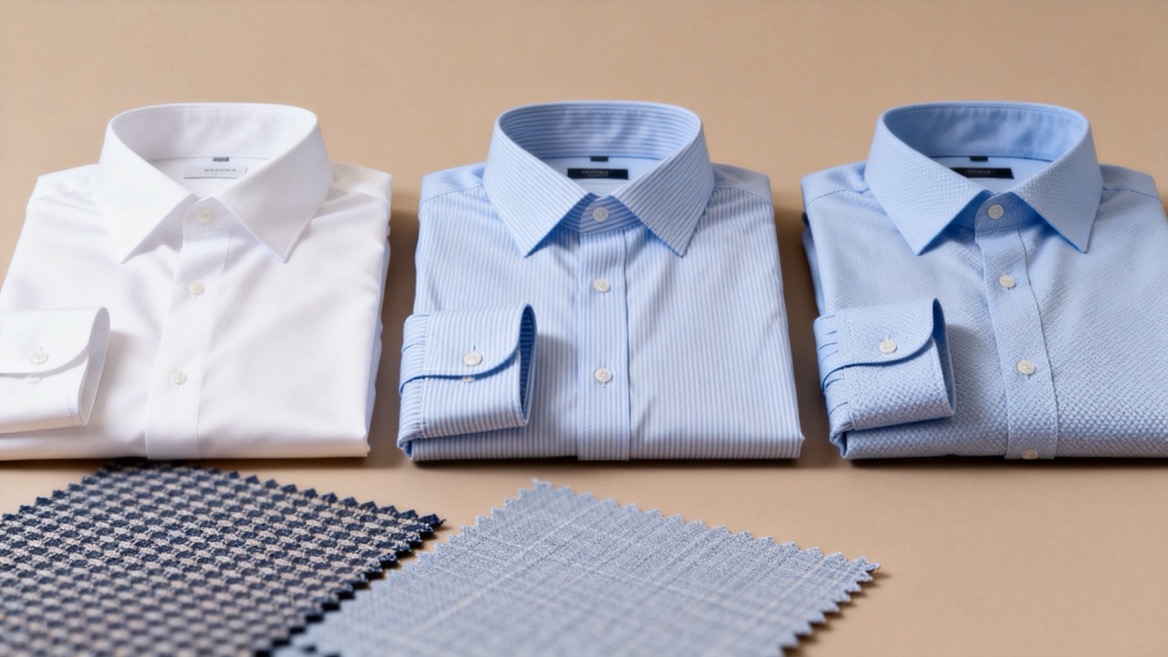
A polyester-cotton blend is not automatically a winter fabric. Likewise, a cotton shirt is not automatically lightweight.
Consider fabric weight, construction, and the conditions in which the shirt will be worn. An air-conditioned office, outdoor wedding, and daily commute create different requirements.
For an OEM collection, define the intended season and wearing environment before selecting materials.
A jacket cannot fully conceal a poorly fitting shirt. The collar, front opening, and cuffs remain visible, while excess fabric can bunch beneath the jacket.
Fit should be assessed on its own and with the intended suit.
On dress shirts using a neck-and-sleeve sizing system, a label such as "15/32" generally indicates a 15-inch neck and a 32-inch sleeve—not a waist measurement.
Always check the brand's measurement instructions. Sleeve length commonly runs from the center back of the neck, across the shoulder, and down to the cuff.
For business buyers, distinguish between:
- Body measurements.
- Finished garment measurements.
- Fit names, such as slim or regular.
- Allowable measurement tolerances.
A "slim fit" label is not a universal specification. Compare actual garment dimensions rather than assuming two suppliers use identical patterns.
Fasten the collar and stand naturally. Then sit down, bend your arms, and reach forward.
Look for:
- A comfortable neckline.
- No obvious gaps between chest buttons.
- Shoulder seams that sit appropriately.
- Sleeves that allow normal movement.
- Enough body length to remain tucked during ordinary activity.
A shirt that looks sharp while standing still may feel restrictive at a desk. Movement testing helps reveal that difference before purchase or production approval.
Contrast is a dependable starting point, but "never match your shirt to your suit" is too rigid.
A tonal outfit can be intentional. It simply requires more attention to shade, texture, and occasion than a conventional contrasting combination.
22222
Treat this table as a starting framework rather than a set of compulsory rules.
Consider the event, tie, footwear, and jacket texture together. A successful combination should look intentional as a complete outfit.
If the suit already has a noticeable check or stripe, a plain shirt simplifies coordination.
When combining patterns, vary their scale instead of choosing several similarly sized designs. For example, a fine shirt stripe can sit more comfortably alongside a larger jacket check than another equally prominent pattern.
For commercial collections, plain white and pale blue provide useful foundations. Add patterned options when they serve a clearly defined customer.
A collar frames the face and connects the shirt to the jacket. Its shape matters, but so do its height, point length, and construction.
A point collar creates a relatively narrow opening and offers a conventional appearance.
A spread collar leaves more space between the points and can accommodate a fuller tie knot. The knot should fill that space without overwhelming the collar.
Button-down collars communicate a different style. Some work well in business-casual settings, but they are not the default choice for every formal occasion.
Avoid treating a soft collar as automatically inferior. Suitability depends on the intended style and how the collar sits when worn.
Try the shirt with the actual jacket whenever possible.
Check whether the collar points sit neatly, whether the tie remains centered, and whether the neckline feels comfortable when fully fastened.
For OEM buyers, collar specifications should include shape, point length, collar height, and the desired structure. A photograph alone may not communicate all four accurately.
Small components influence both usability and the perceived finish of a shirt.
Barrel cuffs usually fasten with sewn-on buttons and are convenient for everyday wear.
French cuffs generally fold back and require cufflinks. They can suit dressier occasions, although their appropriateness depends on the event and outfit.
Inspect the shirt before purchasing accessories. The important distinction is the cuff's fastening design—not an assumption that every dress shirt uses the same closure.
Button material alone does not establish quality. Plastic buttons are not automatically defective, and decorative buttons do not guarantee durability.
Examine:
- Secure attachment.
- Clean, usable buttonholes.
- Consistent alignment.
- Smooth edges.
- Suitable button size.
- Spare buttons, where included.
For OEM development, specify the button material, dimensions, color, and attachment requirements rather than requesting "premium buttons" without further definition.
A repeatable inspection is more useful than relying on a quick mirror check.
1. Fasten the collar and assess comfort.
2. Inspect the chest for pulling or gaps.
3. Sit and reach forward to check movement.
4. Put on the jacket and review collar and cuff positioning.
5. Examine opacity and surface appearance under different lighting.
Finally, read the care label.
For a brand evaluating samples, use the same sequence across competing products. Record observations consistently so that appearance, comfort, and construction can be compared separately.
This does not replace laboratory testing, but it makes sample discussions more specific.
Do not determine washability from fiber content alone. Natural-fiber shirts are not automatically suitable for every washing method, and synthetic fabrics are not automatically dry-clean-only.
Follow the finished garment's care instructions.
For shirts sold in the United States, care labeling requirements call for supported instructions covering a safe method of regular care. Buyers should address labeling during product development rather than adding generic instructions at the end.
When evaluating an OEM sample, agree on a washing procedure and review the garment afterward.
Useful checkpoints include:
- Neck and sleeve measurements.
- Body length.
- Collar and cuff appearance.
- Seam smoothness.
- Button security.
- Color appearance.
- Overall shape.
Record measurements before and after washing using the same method.
For example, a shirt may appear satisfactory before laundering but become uncomfortable if the collar changes significantly afterward. Any acceptance criteria should be agreed with the supplier rather than assumed.
A customer-facing description explains the product's appeal. An OEM specification explains what must be produced.
Brands and wholesalers need both.
1111
Avoid unsupported phrases such as "best quality" when a measurable requirement would be clearer.
For instance, "approve collar appearance after the agreed wash procedure" communicates more than "make the collar durable."

Consider whether customers primarily need office shirts, wedding shirts, hospitality uniforms, or warm-weather businesswear.
These applications may require different fabrics, fits, and care expectations.
For an initial collection, a focused range can make evaluation more manageable than introducing numerous fabrics and collar styles simultaneously. Expand once the core specifications are established and customer feedback is available.
Planning a dress shirt collection for your brand, wholesale business, or manufacturing program?
Contact Shanghai Youti Clothing Co., Ltd. with your target market, estimated quantity, reference styles, size chart, and preferred fabrics. Ask to discuss sampling, customization options, and production requirements before finalizing your order.
A clear brief helps turn an attractive shirt concept into a product that can be evaluated against agreed expectations.
White and pale blue are practical starting points. Choose the fabric, collar, and fit according to the occasion rather than relying on color alone.
A lighter shirt often creates clear contrast. However, darker and tonal combinations can also work when they suit the event and are coordinated deliberately.
Not necessarily. Cotton offers many useful options, but weave, weight, finish, care requirements, and wearing conditions all influence suitability.
In a neck-and-sleeve sizing system, it generally means a 15-inch neck and a 32-inch sleeve. Confirm the seller's measurement method before ordering.
Yes, when they suit the workplace and occasion. Remember that French cuffs generally require cufflinks, while barrel cuffs usually fasten with buttons.
Agree on the sample, fabric, measurements, collar and cuff construction, trims, labeling, packaging, and inspection criteria. Document changes so the production requirements remain clear.
1. [StudioSuits — "The Dos and Don'ts of Choosing a Dress Shirt to Wear With a Suit"]. Original article used as the restructuring baseline; its sizing, cuff, and care statements were reassessed rather than repeated. [studiosuits]
2. [Charles Tyrwhitt — "How to Measure for a Shirt"]. Guidance on collar measurement and sleeve measurement from the center back, across the shoulder, to the cuff. [charlestyrwhitt]
3. [Charles Tyrwhitt — "Sizing Guide: Formal Shirts"]. Reference for the distinction between fit selection, neck measurement, and sleeve measurement. [charlestyrwhitt]
4. [Proper Cloth — "The Business Shirt Guide"]. Industry guidance on business-shirt fabrics, including twill, broadcloth, pinpoint, and Royal Oxford, and their appearance and performance considerations. [propercloth]
5. [Put This On — "How to Get a Good White Dress Shirt"]. Editorial perspective on weave, opacity, collar proportions, and practical fit checks. [putthison]
6. [Federal Trade Commission — "Care Labeling of Textile Wearing Apparel & Certain Piece Goods"]. Primary regulatory reference for care instructions on apparel sold in the United States. [ftc]
7. [American Apparel & Footwear Association — "What Kind of Care Instruction Is Required on Apparel Labels?"]. Apparel-industry explanation of washing and dry-cleaning instruction requirements. [aafaglobal]


