
Views: 286 Author: Youti Clothing Publish Time: 2026-10-25 Origin: Site


Content Menu
● How We Selected These Workwear Suppliers
● Japan's Workwear Industry: Why the Manufacturing Cluster Matters
>> The Hiroshima–Bingo Textile Connection
>> What the Latest Industry Research Actually Covers
● Workwear Supplier Comparison: Capacity, MOQ, and Certification
● 1. Shanghai Youti Clothing Co., Ltd.: An Export-Oriented OEM Alternative
>> Company Background and Markets
>> Core Strengths and OEM Development Scope
● 2. Jichodo Co., Ltd.: An Established Uniform Manufacturer
>> Company Background and Markets
>> Core Strengths and Procurement Fit
● 3. BURTLE Co., Ltd.: Functional Branded Workwear
>> Company Background and Markets
>> Core Strengths and Procurement Fit
● 4. TS DESIGN: Material-Led Workwear Development
>> Company Background and Markets
>> Core Strengths and Procurement Fit
● 5. CO-COS Nobuoka Co., Ltd.: Corporate Uniforms and Established Distribution
>> Company Background and Markets
>> Core Strengths and Procurement Fit
● 6. Asahicho: Workwear with a Disclosed Domestic Factory Network
>> Company Background and Markets
>> Core Strengths and Procurement Fit
● Technical Buyer's Guide: Specify Performance Before Comparing Prices
>> Material "Grade" Must Be Defined in the Specification
>> Separate Ordinary Uniforms from Protective Clothing
>> CE, REACH, RoHS, and Social Audits Have Different Roles
● Common Purchasing Problems and How to Reduce Them
>> Sample Fabric Is Not the Bulk Fabric
>> Annual Output Is Mistaken for Available Capacity
>> Customization Is Mistaken for OEM Manufacturing
>> A Certificate Belongs to Another Site or Product
● An Overlooked Procurement Trap: Replenishment Is a Separate Specification
● Factory Qualification, Sampling, and Logistics
>> A Practical Factory-Verification Sequence
>> A Controlled Sampling Sequence
>> Logistics and Origin Documentation
● Conclusion: Match the Supplier to the Purchasing Model
● FAQs
>> 1. How Can I Check Whether an ISO Certificate Has Expired or Been Suspended?
>> 2. Can a Supplier's Flame-Resistant Fabric Report Qualify My Customized Garment?
>> 3. How Do I Know Whether Workwear Supplied by a Japanese Company Is Made in Japan?
>> 4. What Should I Do When a Supplier Does Not Publish Its MOQ?
>> 5. How Can I Prevent Repeat Orders from Failing an Industrial Laundry Program?
Japan offers a distinctive workwear supply base: established uniform manufacturers, specialized textile development, and distribution networks built around demanding professional users. For international brands, wholesalers, and corporate purchasing teams, the opportunity is not simply to buy Japanese work clothes. It is to identify a partner whose product development, sourcing structure, and delivery model fit a long-term purchasing program.
Several leading suppliers are concentrated around Fukuyama and Fuchu in Hiroshima Prefecture. Jichodo, BURTLE, TS DESIGN, CO-COS, and Asahicho have company histories and operating bases connected to this region, making it a useful starting point for supplier research.
However, selecting a supplier requires more than comparing catalog photographs. Buyers need to examine manufacturing locations, fabric specifications, certification scope, quality-control records, and the practical availability of private-label production.
This guide profiles five Japan-based manufacturers and one China-based OEM alternative: Shanghai Youti Clothing Co., Ltd. Youti is a comparison option for buyers prioritizing custom development and export-oriented manufacturing; it is not presented as a Japanese manufacturer.
The central purchasing principle is verification: distinguish published company information from independently checked factory capability, and distinguish a branded workwear supplier from a factory willing to manufacture your own collection.

This is an evidence-based procurement shortlist, not an audited ranking by market share, price, or production capacity. The assessment uses publicly available company information and relevant industry, regulatory, and standards sources.
The six evaluation dimensions are:
1. Company identity and manufacturing transparency
Can the buyer identify the legal entity, operating locations, and disclosed production network?
2. Product development capability
Does the supplier demonstrate fabric expertise, functional garment development, or dedicated design and sampling resources?
3. Quality-management readiness
Can the supplier provide applicable certificates, inspection procedures, test reports, and traceability records?
4. Commercial fit
Is the business structured for branded distribution, corporate uniform supply, or buyer-owned OEM production?
5. Delivery and replenishment
Are sampling and production schedules disclosed? Can the supplier explain how repeat orders are scheduled?
6. Compliance relevance
Do the documents apply to the actual factory, garment model, destination market, and claimed protective function?
Where public sources do not disclose minimum order quantities, annual garment output, or current certification details, this guide states that limitation rather than supplying estimated figures.
The Bingo region around Fukuyama and Fuchu has a textile history associated with Bingo-gasuri, a patterned cotton fabric that developed during the nineteenth century. The Chugoku Economic Federation describes this textile tradition as an origin of modern Bingo apparel.
The broader Fukuyama textile ecosystem includes spinning, weaving, dyeing, sewing, washing, and selling. That concentration helps explain why the area supports established apparel businesses with different approaches to fabric development, manufacturing coordination, and garment distribution.
For buyers, the practical advantage is access to accumulated textile and garment expertise. Nevertheless, the location of a company's headquarters does not establish where every garment is manufactured. Jichodo discloses approximately 10 domestic and 100 overseas cooperating factories, while BURTLE lists a manufacturing network covering Vietnam, Myanmar, Bangladesh, China, and other locations.
A Japan-based supplier and a Japan-made garment are therefore different purchasing propositions.
Yano Research Institute's Uniform Market 2026 report was issued in December 2025. Its published outline separates industrial workwear from healthcare and service apparel, corporate wear, and school uniforms. The industrial workwear section covers material-cost pressures, product development, production and distribution systems, overseas production, sustainability, and market outlook.
This segmentation matters. A figure for the total uniform market should not automatically be described as the size of Japan's industrial workwear market.
The publicly accessible report page does not disclose a verified market-size total. Consequently, this guide does not reproduce a headline valuation from an inaccessible table.
For trade research, Japan's Ministry of Finance provides official commodity-by-country export and import statistics. Its classification uses nine-digit statistical codes consisting of a six-digit internationally harmonized HS code plus a three-digit domestic code. Buyers should select codes appropriate to their actual garments rather than treating all clothing exports as workwear exports.
The following table compares published information, not confirmed factory availability. Production-network size is not equivalent to annual output or available order capacity.
| Supplier | Location and business origins | Published capacity or production structure | Published OEM MOQ | Certification information available in reviewed sources | Most relevant purchasing route |
|---|---|---|---|---|---|
| Shanghai Youti Clothing Co., Ltd. | Shanghai, China; founded 2018 | Company reports six sewing lines, 300+ equipment units, and annual output exceeding 1.4 million pieces | Not disclosed; request MOQ by style, fabric, and color | Website lists ISO 9001, BSCI, REACH, EN 1149-5, and EN ISO 11612; document types and scope require verification | Custom OEM apparel and buyer-led development. |
| Jichodo Co., Ltd. | Fukuyama, Japan; founded 1924, incorporated 1960 | Approximately 10 domestic and 100 overseas cooperating factories; annual garment output not disclosed on reviewed profile | Not disclosed | Current certificates not established by reviewed company profile | Established branded workwear and uniform sourcing; private-label availability must be confirmed. |
| BURTLE Co., Ltd. | Fukuyama, Japan; established 1958 | Overseas production network disclosed; annual garment output not disclosed | Not disclosed | Current certificates not established by reviewed company profile | Branded functional workwear and seasonal product programs. |
| TS DESIGN | Fukuyama, Japan; business founded 1962 | Annual garment output not disclosed on reviewed profile | Not disclosed | Current certificates not established by reviewed profile and fabric guide | Material-led branded workwear; custom manufacturing requires inquiry. |
| CO-COS Nobuoka Co., Ltd. | Fukuyama, Japan; founded 1901, incorporated 1948 | Annual garment output not disclosed on reviewed company profile | Not disclosed | Current certificates not established by reviewed company profile | Corporate uniforms and workwear supplied through established distribution channels. |
| Asahicho | Fuchu, Japan; founded 1937 | Company profile lists domestic plants and 20 cooperating factory locations; annual output not disclosed | Not disclosed | Current certificates not established by reviewed company profile | Workwear programs requiring discussion of domestic and cooperating-factory production options. |
"Not established" does not mean that a supplier lacks certification. It means that the reviewed sources do not support a current, scope-specific claim.
Also, the documents listed by Youti should not be treated as interchangeable: BSCI concerns social-compliance auditing, REACH is a chemicals regulatory framework, and protective-clothing standards concern product performance.
Shanghai Youti Clothing Co., Ltd. was founded in 2018. According to its company page, it operates a 2,500-square-meter workshop with more than 300 machinery and equipment units, six sewing lines, and annual output exceeding 1.4 million pieces. These figures are supplier-reported and should be checked during factory qualification.
The company identifies Europe as its largest market and North America and Oceania as core markets. Its product range includes uniforms, workwear, trousers, jackets, shirts, and suits.
Youti explicitly accepts development based on technical documents, images, and physical samples. It also offers existing designs with embroidery or printed branding and describes dedicated design, sampling, production, and quality-inspection departments.
For small and medium-sized brands, this makes Youti a relevant candidate when the project requires:
- Buyer-owned designs rather than a supplier's existing brand collection.
- Fabric-selection support and sample development.
- Custom labels, embroidery, or printed logos.
- A coordinated apparel range spanning workwear and business uniforms.
Its published service model includes a dedicated project manager and multi-stage inspections. Sampling is stated as 10–15 working days, with bulk production taking 45–60 working days. Buyers should confirm what triggers these timelines and whether fabric procurement is included.
Youti is worth evaluating as a cost-conscious OEM option, but the available evidence does not establish a price advantage, a low MOQ, or unrestricted ODM availability.
Request a quotation against an identical specification, together with:
- MOQ per style, color, and fabric.
- Current production-line allocation.
- Evidence supporting protective-performance claims.
- The legal entity and factory address covered by each document.
- A written development and approval schedule.
Its flexibility is best assessed through the sampling process and contractual terms, not assumed from company size.
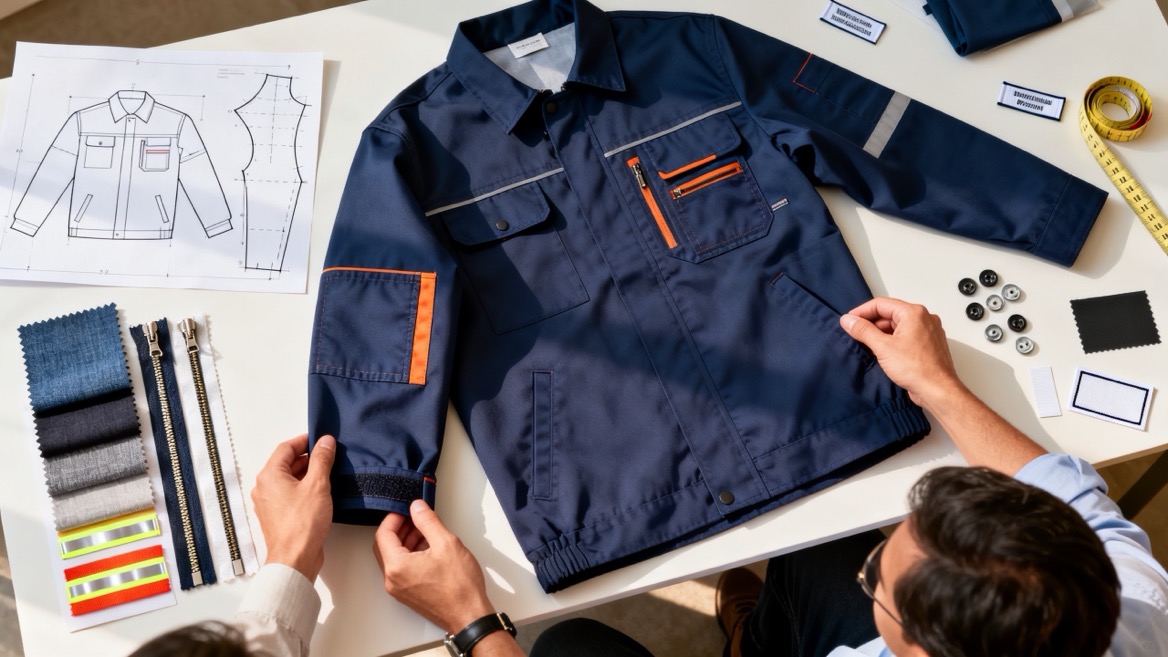
Jichodo traces its founding to September 14, 1924, and its incorporation to July 1, 1960. Its headquarters are in Fukuyama, Hiroshima Prefecture. The company's disclosed business includes the planning, manufacture, and sale of uniforms, men's casual clothing, medical apparel, and safety footwear.
Its business is described as serving Japan and international markets, although the reviewed sources do not establish export-market shares or country-by-country sales.
Jichodo's company profile lists a technical development center and approximately 10 domestic and 100 overseas cooperating factories. This makes it a relevant candidate for buyers seeking an established uniform business with a broad manufacturing coordination network.
However, network scale should not be confused with guaranteed capacity for a new customer.
A buyer should ask whether the proposed supply model involves:
- Distribution of existing branded products.
- Corporate uniform customization.
- Exclusive product development.
- Manufacturing under the buyer's own label.
Public company information does not establish that all these routes are available.
For private-label inquiries, confirm design ownership, minimum production runs, tooling or pattern charges, and the factory nominated for the order.
Jichodo's long operating history is useful background, but the decisive question is whether its commercial model accommodates the buyer's particular brand program.
BURTLE was established on December 1, 1958. Its headquarters are in Fukuyama, and its official company profile lists brands including BURTLE, AIR CRAFT, THERMO CRAFT, ICE CRAFT, and WORK BOX.
The reviewed profile identifies manufacturing locations in several Asian countries, but it does not provide a detailed breakdown of customer markets. Overseas manufacturing locations should not be described as export destinations.
BURTLE presents itself as a professional workwear apparel manufacturer focused on stylish, high-function collections for different working environments.
It is consequently a relevant shortlist candidate for distributors and professional apparel businesses evaluating branded functional workwear.
For purchasing teams, the key distinction is between obtaining access to BURTLE products and obtaining permission to commission buyer-owned products.
The reviewed official pages do not establish an open private-label OEM or ODM service.
Before discussing customized production, ask:
- Is the inquiry handled as wholesale distribution or product development?
- What branding changes are permitted?
- Are territories or sales channels restricted?
- Which manufacturing location would supply the order?
- What replenishment commitment is available for seasonal products?
These questions clarify the commercial route before either party invests in development.
TS DESIGN's official company information identifies business origins in 1962 and describes its principal activity as workwear planning, manufacturing, and sales. Its stated sales territory covers Japan through sales agents.
International buyers should therefore confirm export procedures, distributor arrangements, and communication support rather than assuming an established direct-export service.
TS DESIGN's fabric guide describes TS4D stretch as a 100% polyester material combining multidirectional stretch and light weight, with shape-retention, antistatic, and stain-resistant finishing.
This is useful evidence of a material-led product approach. It also illustrates why buyers should examine more than fiber percentages: composition alone does not explain stretch behavior, finishing, or garment performance.
TS DESIGN is a relevant candidate for buyers comparing mobility-oriented workwear and functional fabric options.
The reviewed sources do not establish a publicly available OEM or ODM program.
Buyers should ask whether proprietary materials are available only through finished branded garments, whether exclusive development is possible, and what performance data apply to the selected product.
A supplier's published fabric description should be treated as a starting point for technical discussion, not a substitute for testing the final garment.
CO-COS began in May 1901 and was incorporated in November 1948. Its headquarters are in Fukuyama. The company describes its business as planning, manufacturing, and selling uniforms and work-related products.
Its listed sales channels include agents supplying companies and public-sector customers, home centers, and workwear shops. These disclosures make its Japanese distribution structure clearer than its international sales coverage.
CO-COS is relevant to purchasing teams evaluating corporate workwear supplied through established distribution channels.
Its history includes a transition from a Bingo-gasuri wholesaler into garment manufacturing, followed by the development of additional factories during the 1970s.
That background supports its inclusion as an established industry participant, but historical factory development should not be used as a current capacity figure.
Corporate uniform supply, garment decoration, and private-label manufacturing are different services.
The reviewed sources do not establish a general open OEM program. Buyers should obtain written confirmation of:
- Available customization methods.
- Ownership of patterns and artwork.
- Label replacement permissions.
- Minimum fabric and garment quantities.
- Repeat-order support for discontinued fabrics or styles.
Asahicho traces its origins to April 1937, when Kodama Clothing Industries was established in Fuchu, Hiroshima Prefecture. The business later operated under other names and adopted its current company name in 2021.
Its official profile lists workwear planning, manufacturing, and sales, along with several domestic plant locations and 20 cooperating factory locations.
The reviewed information does not provide a verified international sales breakdown.
Asahicho offers a useful comparison for buyers interested in a supplier that publicly identifies domestic production facilities alongside cooperating factories.
Its company materials emphasize the functionality and safety required in working environments.
For procurement teams, the practical opportunity is to discuss which disclosed facility could manufacture the proposed garment and what processes would remain within that facility.
Factory ownership or a disclosed production network does not automatically establish open private-label availability.
Buyers should clarify whether Asahicho can support buyer-owned patterns, exclusive fabrics, customized sizing, and overseas shipments, and whether those services are offered directly or through another commercial channel.
Terms such as "premium fabric" or "industrial quality" are not sufficient purchasing specifications.
A useful workwear specification should define:
| Specification area | Information to request |
|---|---|
| Fiber composition | Exact blend, including stretch or conductive components |
| Fabric construction | Woven or knitted structure and relevant construction details |
| Fabric mass | Target grams per square meter and agreed tolerance |
| Mechanical performance | Required strength, abrasion, and tear testing |
| Dimensional stability | Acceptable change after an agreed laundering procedure |
| Color performance | Relevant washing, rubbing, and light-exposure requirements |
| Functional finishes | Claimed properties, test methods, and durability requirements |
| Garment construction | Stitching, reinforcement locations, seam requirements, and tolerances |
These are recommended specification fields, not universal pass levels. Acceptance criteria should reflect the actual workplace, care process, and destination-market requirements.
For garments intended for industrial laundering, ISO 15797 provides evaluation procedures covering properties such as dimensional stability, color characteristics, seam puckering, pilling, and appearance. ISO also notes that testing in the intended industrial laundry process may be advisable when determining final compatibility.
An ordinary company uniform and a protective garment should not be qualified using the same checklist.
For relevant protective applications:
- EN ISO 11612 addresses clothing protecting against heat and flame.
- EN ISO 20471 addresses high-visibility clothing performance and assessment.
- EU Regulation 2016/425 establishes requirements for personal protective equipment placed on the EU market, including conformity assessment and CE-marking obligations.
A fabric report is not, by itself, evidence that every finished garment design satisfies all applicable obligations.
The purchasing file should identify the garment model, protective claim, applicable standards, test evidence, conformity documents, and manufacturer responsibilities.
These terms should not be grouped together as generic "environmental certificates."
- CE marking: For PPE within the relevant EU framework, it follows the applicable conformity-assessment process. It is not a general quality award for all uniforms.
- REACH: Restrictions can apply to substances in articles, including imported textile products. Applicability must be checked against the relevant substance and restriction.
- RoHS: Its core scope is electrical and electronic equipment. For workwear with electronic components, the applicable obligations require separate assessment; it is not a blanket certification for ordinary fabric garments.
- BSCI: An amfori BSCI audit assesses site social compliance through observations, interviews, and document reviews. It does not establish the protective performance of a garment.
A well-made sample proves that the supplier can produce that sample. It does not prove that the nominated bulk fabric has been purchased or reserved.
Recommended controls include:
- Approve a documented fabric specification.
- Identify the nominated mill or fabric source where contractually appropriate.
- Require approval before substitutions.
- Compare bulk fabric against retained reference material.
- Record relevant lot information and test results.
Published annual production describes scale, not the capacity available for your delivery window.
Request an order-specific schedule showing material readiness, production allocation, inspection, and dispatch milestones. Ask which steps depend on subcontractors.
A supplier that offers embroidery on stocked garments may not offer buyer-owned pattern development.
Separate your inquiry into:
1. Stocked-product purchase.
2. Decoration or labeling.
3. New garment development.
4. Private-label bulk manufacture.
This avoids comparing fundamentally different quotations.
A document can be genuine and still be irrelevant to the order.
Check the holder, address, scope, garment identification where applicable, and current status. For accredited management-system certificates, IAF CertSearch provides searches by company or certificate details and displays information including status, scope, issuer, and accreditation body.
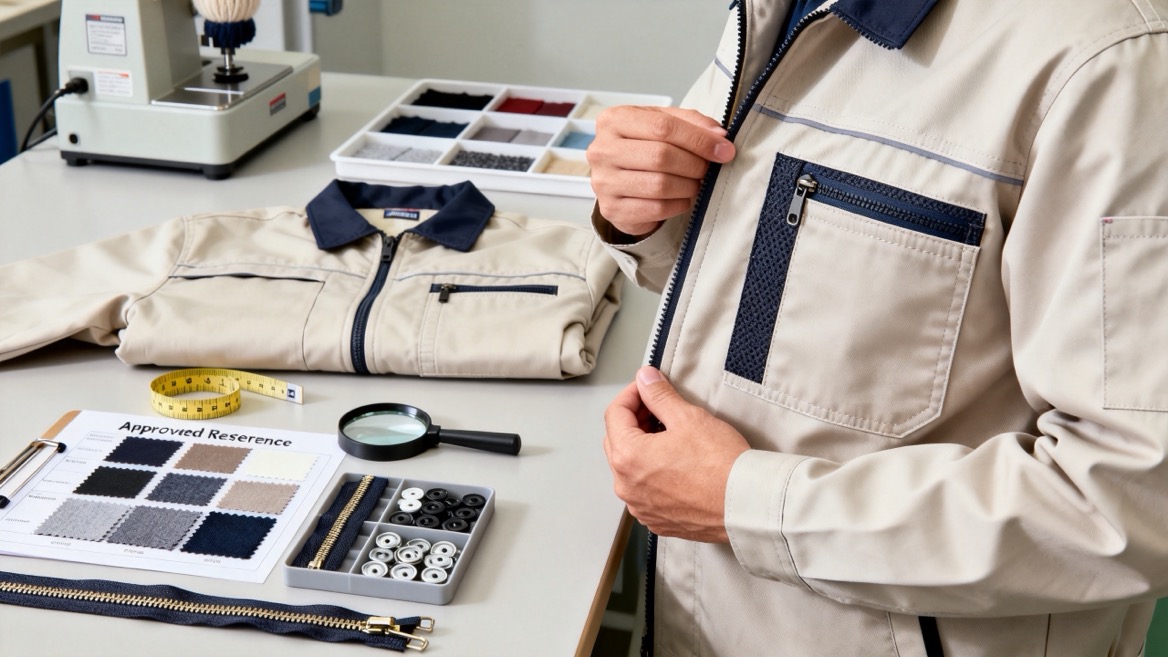
A less visible risk arises when a successful first order is treated as sufficient qualification for every repeat order.
The initial order may use one fabric lot and one approved production route. A later order may involve a new lot, a different finish, changed trims, or another sewing facility.
The practical safeguard is to define a replenishment protocol alongside the initial purchase specification:
- Identify which materials and processes require change approval.
- Set acceptable shade and dimensional tolerances.
- Retain approved fabric, trim, and garment references.
- Specify when repeat-order samples or additional tests are required.
- Require disclosure of changes affecting claimed protective performance.
For industrially laundered garments, the compatibility issue deserves particular attention: ISO 15797 explicitly recognizes that final evaluation may require the actual laundering equipment and process intended for use.
The overlooked lesson is that repeat-order consistency should be purchased contractually, not assumed.
Before committing to a long-term program:
1. Confirm the contracting legal entity.
2. Identify the proposed manufacturing site.
3. Establish which processes are subcontracted.
4. Obtain relevant management-system and product documents.
5. Verify certificate status and scope where applicable.
6. Review an order-specific production plan.
7. Agree on inspection and change-control procedures.
For accredited certificates, database checks should be supplemented by clarification from the issuing certification body when information is missing or inconsistent.
Use separate approval stages rather than treating one attractive sample as final approval:
- Development sample: design, construction, and fabric direction.
- Fit sample: measurements and movement.
- Size-set review: grading and consistency across sizes.
- Pre-production sample: intended bulk materials and trims.
- Production review: output from the nominated manufacturing route.
The contract should identify which approval allows bulk production to begin.
For Youti, the published 10–15 working-day sampling period is a useful planning reference, but buyers should confirm whether it covers one sample round or the full approval process.
Before comparing landed cost, agree on the delivery basis, exporter, importer responsibilities, shipment origin, packing requirements, and required documents.
Where a Japan-based supplier uses overseas manufacturing, confirm the actual country of origin rather than inferring it from the supplier's headquarters. Jichodo's and BURTLE's disclosed overseas networks demonstrate why this question belongs in the quotation stage.
For classification research, use the appropriate commodity code and destination-market guidance. Japan Customs' official trade tools provide commodity and country searches, but statistical classifications do not replace an order-specific customs assessment.
Japan's workwear supply base offers several distinct routes: established uniform manufacturing through Jichodo, functional branded collections through BURTLE, material-led products through TS DESIGN, corporate-uniform distribution through CO-COS, and a disclosed domestic factory network through Asahicho. Their published information supports shortlist inclusion, but does not establish universal OEM availability or order-specific capacity.
Shanghai Youti Clothing Co., Ltd. provides a separate China-based comparison for buyers prioritizing custom OEM development. Its published acceptance of technical packs, images, and physical samples makes it relevant to brands seeking a manufacturing partner rather than access to an existing Japanese label.
To begin a meaningful quotation process, submit your technical pack, quantities by size and color, destination market, intended care process, required delivery date, and any protective-performance requirements.
For a custom OEM inquiry with Shanghai Youti Clothing Co., Ltd., request a documented proposal covering fabric selection, MOQ, sampling milestones, applicable compliance evidence, inspection arrangements, and bulk-production scheduling.
Obtain the complete certificate number and exact legal entity name. Search the relevant certificate record and compare its status, scope, address, issuing certification body, and update information.
IAF CertSearch supports certificate-number and company-name searches and displays active-status and scope information. If no matching record is found, request clarification from the issuer rather than relying only on the supplier's PDF.
Not by itself.
For EU PPE, the manufacturer must follow the applicable conformity-assessment requirements. The relevant file must address the product being placed on the market, not merely a fabric described as protective.
Before changing garment construction, materials, or branding, ask the responsible manufacturer or conformity-assessment specialist whether the change remains within the assessed product configuration.
Ask for the nominated production location and order-specific origin documentation.
Do not infer origin from the headquarters address or brand identity. Jichodo discloses both domestic and overseas cooperating factories, while BURTLE identifies several overseas manufacturing countries.
Request separate minimums for finished garments, fabric, dyeing, colors, trims, and branding.
A quoted garment MOQ may not capture the minimum needed for a custom fabric or finish. Ask what commercial changes would make a smaller order possible, such as using an existing fabric, reducing colors, or choosing standard trims.
Because the reviewed sources do not publish verified OEM MOQs for these suppliers, obtain written, project-specific quotations.
Define the care process and performance requirements before production, then qualify representative garments.
ISO 15797 provides laboratory evaluation procedures for workwear intended for industrial laundering, while recognizing that final compatibility may require evaluation in the actual laundry process.
For repeat orders, require approval of material or construction changes and retain references from the qualified production.
- [Yano Research Institute — Uniform Market 2026]: Report issued in December 2025, with separate coverage of industrial workwear and other uniform segments. [yanoresearch]
- [Japan Ministry of Finance — Trade Statistics]: Official export and import statistics resources. [customs.go]
- [Japan Customs — Commodity and Country Search]: Tools for commodity-level trade research. [customs.go]
- [Chugoku Economic Federation — Bingo Textile Heritage]: Regional textile history and its connection to modern Bingo apparel. [chugokukeiren]
- [European Commission — Personal Protective Equipment]: PPE conformity and CE-marking guidance. [single-market-economy.ec.europa]
- [European Commission — REACH Restrictions]: Regulatory information on restrictions affecting substances and articles. [single-market-economy.ec.europa]
- [European Commission — RoHS Directive]: Scope and requirements for electrical and electronic equipment. [environment.ec.europa]
- [ISO — ISO 15797]: Industrial laundering evaluation procedures for workwear. [iso]
- [IAF CertSearch — Certificate Verification]: Accredited certificate search and status checks. [iafcertsearch]
- [amfori — BSCI]: Information about site social-compliance auditing. [amfori]


