
Views: 238 Author: Youti Clothing Publish Time: 2026-09-17 Origin: Site


Content Menu
● Linen Shirts vs Cotton Shirts: Quick Comparison
● Why Fabric Choice Matters in Summer Uniform Programs
● Linen Shirts for Summer Corporate Uniforms
>> Main Advantages of Linen Shirts
>> Limitations of Linen Uniform Shirts
>> Best Uses for Linen Corporate Shirts
● Cotton Shirts for Summer Corporate Uniforms
>> Main Advantages of Cotton Shirts
>> Limitations of Cotton Shirts
>> Best Uses for Cotton Corporate Shirts
● Linen vs Cotton Shirts in Hot and Humid Climates
● The Smart Middle Ground: Linen-Cotton Blend Shirts
● Expert Development Checklist for OEM Uniform Buyers
>> Start With the Wearer's Workday
>> Request the Right Sample Set
>> Test the Uniform in Real Conditions
● How Shirt Construction Changes Summer Comfort
● Cost, Care, and Long-Term Value
● Final Verdict: Linen or Cotton for Summer Uniforms?
>> Are linen shirts cooler than cotton shirts?
>> Do linen shirts wrinkle too much for corporate uniforms?
>> What is the best fabric blend for summer work shirts?
>> Is cotton good for hot and humid weather?
>> Which shirt fabric is better for hotel staff uniforms?
>> Can linen shirts be customized with logos?
>> How can I reduce shrinkage in cotton or linen uniform shirts?
>> What should I send an OEM shirt supplier before sampling?
For brands sourcing summer corporate uniforms, the choice between linen shirts vs cotton shirts affects more than appearance. It influences employee comfort, perceived brand quality, laundering costs, garment lifespan, and whether a uniform still looks professional after a demanding workday.
At Shanghai Youti Clothing Co., Ltd., we work with overseas brands, wholesalers, and apparel businesses on OEM shirt programs. From fabric development to bulk production, one consistent lesson stands out: linen is usually cooler, while cotton is usually easier to standardize and maintain. The better choice depends on the working environment, desired image, care process, budget, and the real expectations of the people wearing the uniform.
For many summer uniform programs, the strongest solution is not an "either/or" decision. A carefully engineered linen-cotton blend can deliver airflow and a premium natural look while reducing some of linen's wrinkling and cotton's moisture-retention limitations.

Before choosing a fabric for summer corporate uniforms, purchasing teams should compare performance at the fabric, garment, and daily-use levels.
| Factor | Linen Shirts | Cotton Shirts | Better Choice for Corporate Uniforms |
|---|---|---|---|
| Breathability | Excellent, especially in open woven constructions | Good, but varies significantly by weave and weight | Linen |
| Cooling sensation | Naturally cool and crisp against the skin | Soft and comfortable, but can feel warmer when damp | Linen |
| Moisture management | Absorbs and releases moisture relatively quickly | Absorbs sweat well but may hold moisture longer | Linen |
| Softness | Initially crisp; becomes softer with repeated washing | Naturally soft from the first wear | Cotton |
| Wrinkle resistance | Low; wrinkles are a visible natural characteristic | Moderate; can be improved with finishes or blends | Cotton |
| Professional appearance | Premium, relaxed, textured, resort-oriented | Clean, classic, versatile, formal or casual | Cotton |
| Durability | Strong fiber, but low stretch means creasing can occur | Durable when properly constructed and maintained | Depends on construction |
| Easy-care performance | Usually requires more steaming or ironing | Easier to care for, especially in blends | Cotton |
| Best applications | Hospitality, resorts, premium events, luxury retail | Offices, retail, service teams, schools, corporate programs | Cotton |
| Best balanced option | Linen-cotton blend | Cotton-linen blend | Blended fabric |
The key point is simple: fabric composition alone does not decide comfort. Fabric weight, weave, yarn quality, garment fit, color, finishing, and local climate all affect how a uniform performs.
A corporate shirt is not an occasional fashion purchase. It is a work tool. Employees may wear it for eight or more hours, sit in air-conditioned offices, commute in humidity, serve customers outdoors, bend repeatedly, and wash it every few days.
That means a summer work shirt must balance several requirements:
- Thermal comfort in heat and humidity
- A professional silhouette throughout the working day
- Brand consistency across different employee sizes and locations
- Color stability after repeated washing
- Reasonable care requirements for employees or commercial laundries
- Reliable bulk production quality
- A suitable cost structure for the expected order quantity
Research into clothing comfort consistently shows that heat transfer, air permeability, moisture absorption, moisture release, and fabric contact sensation influence how people perceive a garment in warm conditions. Linen is widely valued for its cooling sensation and efficient moisture release, while cotton remains popular because it is soft, breathable, widely available, and easy to develop into many shirt constructions.
However, a shirt that feels cool in a showroom may not be the best uniform shirt after ten commercial wash cycles. That is why experienced buyers should assess both wear comfort and operational comfort.
Linen is made from flax fibers. Its naturally irregular fiber structure creates a distinctive texture, crisp hand feel, and relaxed visual character. Linen shirts have become increasingly relevant for hospitality, travel, premium retail, beach clubs, resorts, wellness brands, and warm-climate corporate events.
Superior airflow is one of linen's biggest strengths. When developed in a lightweight, open weave, linen can allow air to move more freely around the body. This makes it especially suitable for employees who work in hot outdoor conditions or move frequently between indoor and outdoor spaces.
A naturally cool hand feel is another reason brands select linen. Linen can conduct heat effectively, which helps create the familiar cool-to-the-touch sensation that many wearers appreciate during hot weather.
Strong moisture release helps linen shirts feel less clammy after light perspiration. Both linen and cotton are absorbent natural fibers, but linen is often preferred in hot and dry or hot and breezy environments because it can feel drier as moisture evaporates.
A premium visual identity gives linen a major branding advantage. Its natural slubs, texture, and visible weave can make a uniform feel more elevated than a standard smooth poplin shirt. For boutique hotels, restaurants, wine brands, and lifestyle businesses, that visual softness can support a more memorable customer experience.
Natural fiber storytelling can also support brand positioning. Buyers looking for plant-based materials, reduced synthetic-fiber dependence, or a handcrafted visual aesthetic often consider linen an attractive starting point.
The main limitation is clear: linen wrinkles easily. This is not necessarily a defect. It is connected to the fiber's low elasticity and natural structure. But for companies requiring a sharply pressed, highly formal appearance, pure linen may create a maintenance challenge.
Employees who sit for long periods may show visible creasing around the elbows, waist, lower back, and front placket. In client-facing roles, this can be perceived as casual even when the garment is clean and well-made.
Pure linen can also feel relatively crisp when new. Although it softens over time, some employees prefer the immediate softness of cotton.
Finally, linen can add cost pressure to an OEM uniform program because fabric availability, yarn quality, finishing requirements, and shrinkage control require careful sourcing and production management.
Linen shirts are most suitable for:
- Resort and hotel staff uniforms
- Outdoor restaurant and café teams
- Premium event staff apparel
- Yacht, travel, and leisure uniforms
- Luxury retail teams
- Winery and vineyard employees
- Summer promotional uniforms
- Warm-climate front-of-house teams
- Casual executive retreat uniforms
For these applications, the natural wrinkles can become part of the desired visual language. The uniform looks relaxed, breathable, and intentionally premium rather than overly formal.
Cotton is the most established shirting fiber for corporate programs. It is versatile, comfortable, familiar to wearers, and available in a wide range of weaves, weights, colors, and price levels.
A cotton corporate shirt can look completely different depending on construction. A lightweight cotton poplin, cotton Oxford, cotton twill, dobby cotton, stretch cotton, or cotton-rich blend may all serve different workplace needs.
Softness and familiarity are major advantages. Most employees already understand how cotton feels, wears, and washes. This reduces resistance when a company introduces a new uniform program.
Versatile appearance makes cotton suitable for formal, semi-formal, and casual workplace settings. A crisp cotton poplin can work for reception, banking, corporate offices, and retail. A cotton Oxford can create a more relaxed yet professional look for sales teams and casual service environments.
Easy customization is another important benefit for OEM buyers. Cotton shirts can support embroidery, screen printing, woven labels, neck labels, contrast trims, logo buttons, branded packaging, and a wide range of garment washes.
Broad fabric availability supports flexible development. Cotton fabrics are available in many yarn counts, weaves, dyeing options, and finishes. This makes it easier to match a specific target price, color standard, and target market.
Improved wrinkle performance is possible through fabric finishing or blending. Pure cotton still wrinkles, but it generally offers a cleaner corporate appearance than pure linen. Cotton-rich fabrics can also be developed with mechanical finishes, resin treatments, stretch components, or polyester blends to improve recovery.
Cotton absorbs moisture effectively, but when a shirt becomes heavily saturated with sweat, it can stay damp longer than a well-designed linen shirt. In humid climates, a cotton shirt may feel heavier or clingier after prolonged physical activity.
Cotton may also shrink if the fabric is not properly pre-shrunk, washed, or finished. This is why shrinkage testing should be part of every professional uniform development process.
A low-quality cotton shirt can quickly lose shape, fade, pill, or become rough after repeated laundering. The solution is not simply to choose "cotton." Buyers must specify the correct fabric quality, fabric weight, construction, finishing method, and garment quality standard.
Cotton shirts are usually the stronger choice for:
- Corporate office uniforms
- Banking and financial service uniforms
- Reception and concierge teams
- Retail staff uniforms
- School and training-center uniforms
- Sales representative shirts
- Restaurant management uniforms
- Exhibition and trade-show shirts
- Healthcare administration uniforms
- Large-scale promotional shirt programs
For businesses that need a consistently clean and structured appearance, cotton shirts for corporate uniforms are often the safer and more scalable solution.
Climate should guide the decision more than fashion preference.
In hot, dry, and breezy environments, linen usually performs very well. Its open texture, moisture behavior, and crisp feel can make it noticeably more comfortable for outdoor workers, hospitality teams, and employees who spend long periods in direct sun.
In hot and humid locations, the answer is more nuanced. Linen still offers valuable airflow and can feel cooler, but the garment must have the right weight and construction. A heavy linen shirt can feel less comfortable than a lightweight cotton poplin. Similarly, a tightly woven cotton shirt with a dense finish may feel warmer than a lighter, more open cotton construction.
When selecting the best fabric for hot weather uniforms, ask suppliers for the following details:
1. Fabric composition
Confirm whether the fabric is pure linen, pure cotton, linen-cotton, cotton-polyester, or another blend.
2. Fabric weight
Lightweight shirting fabrics are generally more suitable for summer, but the ideal GSM depends on the weave and end use.
3. Weave construction
Poplin, plain weave, Oxford, dobby, chambray, and other constructions can perform very differently.
4. Air permeability testing
This helps compare how easily air passes through the fabric.
5. Shrinkage results
Ask for testing after the intended wash method.
6. Colorfastness results
This is especially important for dark corporate colors, bright brand colors, and frequent laundering.
7. Pilling and abrasion resistance
These factors matter for uniforms worn repeatedly under backpacks, aprons, seat belts, or work equipment.
8. Care-label recommendations
A summer uniform should fit the user's real washing habits, not an idealized care routine.
For many overseas brands, linen-cotton blend shirts are the best option for summer corporate uniforms.
A blend can preserve much of linen's textured, breathable, premium appearance while adding cotton's softness, structure, and more manageable wear behavior. The exact ratio should be selected based on the desired performance.
| Fabric Blend Direction | Typical Benefit | Suitable Uniform Style |
|---|---|---|
| Higher linen content | More texture, airflow, and relaxed summer character | Resort, restaurant, premium retail |
| Balanced linen-cotton | Natural look with improved softness and structure | Hospitality, lifestyle brands, event teams |
| Higher cotton content | More familiar hand feel and easier daily wear | Office casual, retail, branded work shirts |
| Cotton with performance fiber | Better wrinkle recovery and fast-drying potential | High-volume service and active staff teams |
For example, a boutique hotel may choose a linen-rich short-sleeve shirt for its beachside restaurant staff. A retail chain may choose a cotton-rich linen blend with a wrinkle-control finish for store teams. Both may use a similar brand color, logo embroidery, and shirt silhouette, but the fabric development should reflect the actual workplace.
A strong summer shirt program begins with a clear brief. Before sampling, a buyer should define the uniform's real function rather than selecting fabric only from a swatch book.
Ask these questions:
- Will employees work mostly indoors, outdoors, or in both environments?
- Is the location dry, humid, coastal, tropical, or air-conditioned?
- Will employees sit at desks, serve customers, carry products, or move continuously?
- Is the desired image formal, relaxed, luxury, practical, or youthful?
- Will employees wash shirts at home or will the company use a commercial laundry service?
- How frequently will each employee wear the shirt?
- Does the program require embroidery, screen printing, name badges, or patches?
- Are there specific color standards that must be matched across repeat orders?
Instead of approving a single fabric swatch, request a development set that includes:
- Fabric swatches in the final colors
- A pre-production shirt sample
- A washed sample after repeated laundering
- An embroidery trial on the final fabric
- A measurement chart with tolerances
- A shrinkage report
- Colorfastness information
- Packaging samples
- Care-label artwork and placement confirmation
This process is particularly important for linen. Linen's texture can affect embroidery clarity, garment measurements, and the way colors appear under different lighting conditions.
Before final bulk approval, conduct a small wear trial with actual employees. Have wearers evaluate the shirt after commuting, sitting, standing, working outdoors, and washing it several times.
Useful feedback questions include:
- Did the shirt feel hot or sticky?
- Did it look professional after several hours?
- Was the collar comfortable?
- Did the sleeves restrict movement?
- Did the fabric show sweat marks?
- Did the shirt shrink or twist after washing?
- Was it easy to iron or steam?
- Did the logo remain visually clear?
This simple field test can prevent expensive bulk-order problems. It also gives brands more credible information when choosing between linen shirts and cotton shirts for future seasonal programs.
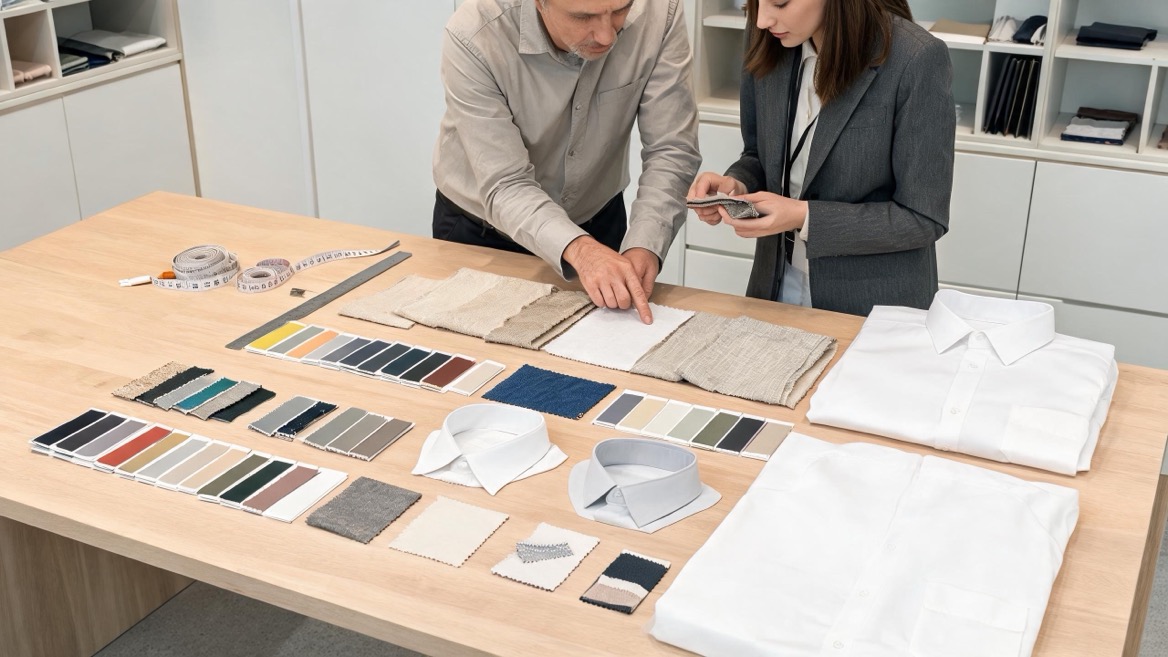
The best summer corporate shirt is not created by fiber choice alone. Shirt construction can improve or reduce comfort significantly.
A lightweight fabric with a restrictive fit may still feel hot. A breathable fabric with poor collar construction may look unprofessional. A good OEM supplier should coordinate fabric selection with pattern engineering and finishing details.
Consider the following design features:
- Relaxed but controlled fit for air circulation without looking oversized
- Short sleeves for highly active or outdoor roles
- Long sleeves with roll-tab options for adaptable styling
- Back yokes or action pleats for movement
- Lightweight interlining to avoid a stiff, hot collar
- Breathable pocket construction where appropriate
- Side vents or curved hems for a casual hospitality appearance
- Reinforced seams for repeated laundering
- High-quality buttons that remain secure after wash cycles
- Low-shrinkage finishing to protect sizing consistency
For formal corporate uniforms, a lightweight cotton poplin with a clean spread collar may be the best option. For a resort restaurant, a linen-cotton camp collar shirt may better match the atmosphere. For an active events team, a cotton-rich blend with added stretch and easy-care finishing may offer the best balance.
The lowest fabric price is rarely the lowest total uniform cost.
A cheaper shirt that fades quickly, loses shape, requires frequent replacement, or creates employee complaints may cost more over the life of the program. Brands should compare the total value of a uniform, including fabric price, garment performance, care demands, replacement rate, and employee acceptance.
Pure linen may require more pressing or steaming. That can increase maintenance time for employees or commercial laundry providers. Cotton is generally easier to manage, especially when paired with wrinkle-control finishing or a carefully selected blend.
However, linen can create a strong premium impression. For a luxury hospitality brand, that image may justify a higher garment cost and more deliberate care process.
The most practical approach is to match the fabric to the operating model:
- Choose pure linen when coolness, texture, and elevated casual style are central to the brand.
- Choose pure cotton when softness, uniformity, easy customization, and broad workplace suitability are the priority.
- Choose a linen-cotton blend when the brand wants a premium summer character with more practical everyday performance.
- Choose a cotton-rich performance blend when easy care, crease recovery, and high-frequency wear matter most.
Linen is generally better for maximum cooling, natural texture, and relaxed premium summer uniforms. Cotton is generally better for softness, consistency, easy care, and polished corporate shirt programs.
For many businesses, the best answer is a linen-cotton blend shirt developed specifically for the role, climate, and laundering conditions. It can provide a balanced solution for hospitality teams, lifestyle brands, retail employees, and warm-weather service environments.
At Shanghai Youti Clothing Co., Ltd., we help international brands and wholesalers develop OEM shirts based on real uniform requirements. From fabric sourcing and color matching to custom labels, embroidery, fit development, and bulk quality control, our team can help turn a fabric concept into a practical summer corporate uniform program.
Contact us to discuss your target market, fabric preference, design requirements, and expected order quantity. We can help you develop linen shirts, cotton shirts, or custom blended uniform shirts that fit your brand and your customers' working conditions.
In most summer conditions, linen shirts feel cooler because linen has strong airflow characteristics, a crisp hand feel, and effective moisture release. However, fabric weight and weave matter. A lightweight cotton shirt can be cooler than a heavy or densely woven linen shirt.
Pure linen wrinkles more easily than cotton because of the fiber's natural low elasticity. This can work well for resorts, cafés, and relaxed premium brands. For formal offices or highly polished customer-facing teams, a linen-cotton blend or cotton-rich fabric may be more suitable.
There is no single ratio for every project. A balanced linen-cotton blend often works well when buyers want breathable texture with improved softness and structure. A cotton-rich blend may be more suitable for high-volume uniforms that require easier daily care.
Cotton is breathable and absorbent, which makes it comfortable for many summer applications. However, it can hold moisture after heavy sweating. For hot and humid roles involving significant movement, lightweight linen or a carefully developed performance blend may offer better comfort.
Linen or linen-cotton blends are excellent for resort, beach, boutique hotel, and outdoor hospitality teams. Cotton or cotton-rich blends are usually better for reception, concierge, management, and roles requiring a cleaner, more formal appearance.
Yes. Linen shirts can be customized with embroidery, woven labels, printed neck labels, branded buttons, hangtags, and packaging. Because linen has a textured surface, it is important to test embroidery density, backing, thread color, and logo size before bulk production.
Work with an experienced shirt manufacturer that controls fabric shrinkage before cutting, follows approved washing and finishing processes, and conducts garment testing. Buyers should also specify the intended care method before production begins.
Provide your logo files, target fabric composition, color references, size chart, quantity estimate, preferred fit, decoration method, packaging requirements, target price range, and the workplace or climate where the uniforms will be used.
1. [Comparing Sensorial Comfort Properties of Cotton and Linen Fabrics — Taylor & Francis Online]
2. [Clothing Thermophysiological Comfort: A Textile Science Perspective — MDPI]
3. [What's Cooler, Linen or Cotton? Science Has an Answer — The Washington Post]
4. [How to Choose the Right Materials for Uniforms This Summer — Lands' End Business]
5. [Top 6 Workwear Fabrics for Durability and Comfort — Alsco]
6. [Best Fabric for Uniforms: An Ultimate Guide for Business — Goal Uniform]
7. [Extending the Life of Your Work Clothes and Uniforms — Century Linen]


