
Views: 294 Author: Youti Clothing Publish Time: 2026-10-03 Origin: Site


Content Menu
● What Are Men's Work Suits and Traditional Suits?
>> Men's Work Suits: Coordinated Clothing for Operational Roles
>> Traditional Suits: Tailored Clothing for Formal Business Settings
● Men's Work Suits vs Traditional Suits: Comparison at a Glance
● Comfort and Mobility: Which Supports Industrial Management Better?
>> Match the Fit to Actual Tasks
>> Assess the Complete Clothing System
● Durability and Laundering: Compare Specifications, Not Labels
>> Construction Matters as Much as Fabric
>> Validate the Intended Cleaning Process
● Safety: Neither Suit Category Replaces a Hazard Assessment
>> Ordinary Workwear Is Not Automatically PPE
>> Managers Need Protection Appropriate to Their Exposure
● Professional Appearance: Can Work Suits Look Executive?
● A Role-Based Wardrobe: The Practical Alternative to Choosing One Winner
● Total Cost of Ownership: Look Beyond the Purchase Price
● A Practical Pilot Trial Before Bulk Ordering
>> Step 1: Select Representative Wearers
>> Step 2: Record Baseline Conditions
>> Step 3: Wear and Launder the Samples
>> Step 4: Evaluate Against Agreed Criteria
>> Step 5: Resolve Problems Before Approval
● OEM Development: Turning the Comparison into a Better Product Brief
>> Approve More Than a Design Drawing
● Final Recommendation: Choose for the Workplace, Then Refine the Image
>> 1. Are men's work suits suitable for factory managers?
>> 2. Can traditional suits be worn on a production floor?
>> 3. What is the best fabric for industrial management uniforms?
>> 4. Does industrial-laundry testing prove safety performance?
>> 5. Should all managers receive the same uniform?
>> 6. What should buyers request before placing an OEM order?
Men's work suits are generally the better choice for industrial management teams that regularly enter production areas. Traditional suits remain appropriate for formal meetings, corporate offices, and client-facing events. The deciding factor is not seniority or appearance alone. It is whether the clothing supports the manager's actual working environment.
For purchasing teams, this comparison involves more than choosing between practical and formal clothing. Comfort, laundering, durability, safety requirements, and brand presentation all influence the result.
From a procurement perspective, my recommendation is to start with suitability: match the garment to the role, assess the workplace risks, and then refine its appearance. For overseas brands, wholesalers, and manufacturers working with Shanghai Youti Clothing Co., Ltd., this approach also creates a clearer brief for OEM uniform development.

In this article, "men's work suits" means coordinated workwear jackets and trousers—not conventional business suits worn to the office.
These garments may include practical pockets, adjustable features, reinforced construction, and fabrics selected for repeated wear and laundering. Their appearance can range from utility-focused workshop clothing to streamlined industrial management uniforms.
Importantly, ordinary workwear is not automatically protective clothing. Flame resistance, chemical protection, and high-visibility performance require separate specifications and appropriate evidence.
Traditional suits usually combine a tailored jacket with matching trousers. Their construction prioritizes shape, presentation, and a polished professional silhouette.
Fabric composition and care requirements vary considerably. Some suits require professional dry cleaning, while others are washable.
The distinction is therefore functional rather than absolute: work suits usually prioritize operational use, while traditional suits usually prioritize formal presentation.
| Selection factor | Men’s work suits | Traditional suits |
|---|---|---|
| Primary purpose | Operational work and coordinated uniforms | Formal business presentation |
| Movement | Can incorporate task-specific ease and stretch | Depends on tailoring, fabric, and cut |
| Storage | Can include functional, secure pockets | Usually provides limited practical storage |
| Repeated laundering | Can be specified and tested for the intended process | Must follow the individual garment’s care instructions |
| Industrial appearance | Supports a consistent operational identity | Supports a conventional executive image |
| Protective performance | Requires hazard-specific specifications | Should not be assumed |
| OEM customization | Suitable for role-based uniform development | Suitable for tailored corporate clothing |
| Best application | Production supervision, maintenance coordination, site visits | Board meetings, formal presentations, corporate events |
Neither category guarantees quality. A well-developed work suit can outperform a poorly specified uniform, while a carefully selected traditional suit may be entirely appropriate for an office-based manager.
Industrial managers may spend the same day reviewing reports, climbing stairs, inspecting equipment, and attending meetings.
Clothing that looks comfortable while standing can behave differently when the wearer reaches forward or crouches. Jacket shoulders may restrict movement. Trouser waistbands may tighten when seated. Pocket contents may interfere with bending.
For men's industrial work suits, evaluate:
- Shoulder movement when reaching.
- Trouser comfort when sitting and crouching.
- Sleeve compatibility with gloves.
- Jacket length during bending.
- Pocket placement when carrying approved equipment.
Traditional suits can offer comfortable movement, especially when appropriately tailored. However, formal tailoring does not necessarily address the specific movements of an operational role.
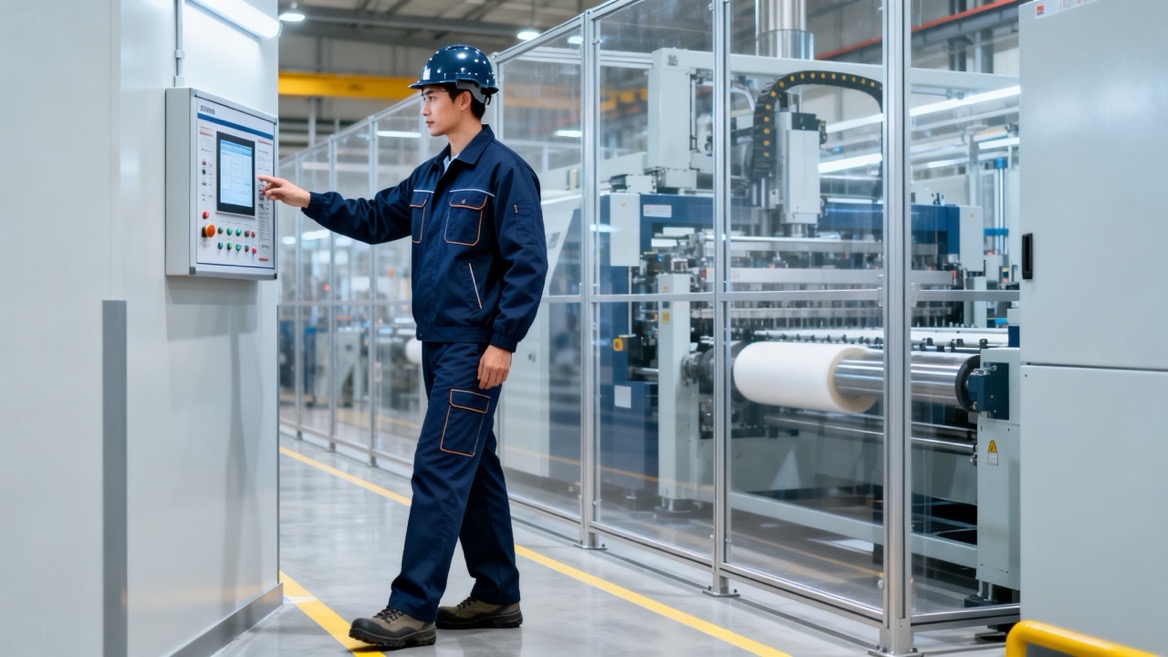
Do not assess a jacket in isolation.
Managers may also wear safety footwear, helmets, gloves, or other required equipment. Clothing must fit and function alongside those items.
Additional pockets and oversized garments are not automatically improvements. They can create bulk or interfere with equipment. The right design provides enough freedom for the task without unnecessary loose material.
Terms such as "heavy-duty" and "premium" provide little purchasing value unless they connect to measurable requirements.
A stronger specification identifies:
- Fabric composition and weight.
- Relevant strength and abrasion requirements.
- Seam construction.
- Reinforcement locations.
- Zipper and fastening quality.
- Dimensional stability after laundering.
More reinforcement is not always better. Extra layers can increase weight and stiffness. Reinforce the areas that need it rather than adding bulk throughout the garment.
An industrial management uniform may look excellent when new but lose its professional appearance after repeated washing.
Potential problems include shrinkage, seam puckering, fading, and different appearance changes between jacket and trousers.
ISO 15797 provides procedures for evaluating workwear intended for industrial laundering. It is a testing framework—not a universal guarantee that every garment will survive every laundry process.
Ask suppliers to identify the tested procedure, number of cycles, drying method, and acceptance criteria. Where necessary, validate the garments using the actual laundry process intended for the uniform program.
This is the most consequential distinction in the comparison.
A sturdy fabric does not establish flame resistance. Reflective decoration does not establish high-visibility compliance. A long-sleeved jacket does not establish chemical protection.
For U.S. workplaces, OSHA requires employers to assess hazards, select suitable personal protective equipment where necessary, and ensure appropriate fit.
Other markets have their own requirements. Overseas buyers should define the destination market and applicable obligations before approving product specifications.
Job title does not remove exposure.
A production manager entering a hazardous area may require protective clothing even if the visit is brief. Conversely, an office-based manager should not receive an unnecessarily heavy garment simply because the company operates a factory.
ISO 13688 addresses general requirements for protective clothing, including ergonomics, sizing, compatibility, and marking. It does not independently establish protection against every workplace hazard.
The practical rule is simple: determine required protection first, then develop the uniform's appearance around it.
Yes. Industrial management uniforms can look polished without imitating conventional business tailoring.
A restrained design may use:
- Coordinated jacket and trouser colors.
- Clean lines and controlled pocket proportions.
- Subtle branding.
- Consistent trims.
- A size range that fits the actual team.
Avoid confusing professionalism with stiffness or excessive decoration. On a production site, a clean, well-fitting uniform can communicate preparedness and operational involvement.
Traditional suits remain useful when formal presentation is the priority. A management team may therefore need more than one clothing option rather than a single outfit for every setting.
Instead of asking every manager to wear the same clothing everywhere, define garments by activity.
| Management activity | Practical starting point |
|---|---|
| Office administration without production access | Traditional suit or office-appropriate clothing |
| Routine production supervision | Coordinated men’s work suit |
| Customer tour through operational areas | Polished workwear plus required protective equipment |
| Formal presentation outside the facility | Traditional suit |
| Inspection involving identified hazards | Hazard-appropriate protective clothing |
| Mixed office and production responsibilities | A coordinated, multi-garment wardrobe |
This is a planning framework, not a substitute for site-specific rules.
Its commercial advantage is flexibility. Brands and wholesalers can develop related products for different roles while retaining consistent colors, branding, and visual identity.
A lower unit price does not necessarily produce a lower uniform-program cost.
Compare purchase price alongside cleaning, repairs, replacements, and administration.
A useful calculation is:
Cost per wear=(Purchase cost + cleaning cost + repair cost)/Actual wears before replacement
For illustration, consider two hypothetical options:
- Work suit: $80 purchase cost plus $120 cleaning and repair cost across 100 wears.
- Traditional suit: $140 purchase cost plus $160 cleaning and repair cost across 75 wears.
The illustrative costs are $2.00 and $4.00 per wear respectively.
These figures are not market benchmarks or product claims. They show why purchasing teams should compare garments over the same service period using their own operating data.
Include replacement availability in the assessment. A uniform that cannot be reordered consistently may create additional coordination costs.
A controlled trial can reveal issues that photographs and fabric samples miss.
Include different body sizes and relevant management roles. Test with people who perform the actual tasks.
Measure key garment dimensions and document fit, appearance, pocket usability, and equipment compatibility.
Use realistic working activities and the proposed cleaning process. Record the number of wear days and wash cycles.
Review movement, shrinkage, seam appearance, fastenings, color consistency, and wearer feedback.
Adjust patterns, materials, or construction before approving bulk production.
This workflow is a proposed purchasing method, not a claim about completed customer trials. Protective performance still requires the applicable technical evaluation; wearer satisfaction alone cannot verify it.
For overseas brands, wholesalers, and manufacturers, the comparison becomes valuable when it produces a clear development specification.
An OEM inquiry to Shanghai Youti Clothing Co., Ltd. should identify:
1. Target market and management roles.
2. Workplace activities and exposure conditions.
3. Whether garments are ordinary uniforms or protective clothing.
4. Preferred fabric characteristics and appearance.
5. Cleaning process.
6. Size range and fit expectations.
7. Branding and labeling requirements.
8. Required testing and documentation.
9. Order quantities and delivery expectations.
Confirm commercial terms, available materials, production capabilities, and testing arrangements directly rather than assuming them.
An attractive drawing does not define an executable garment.
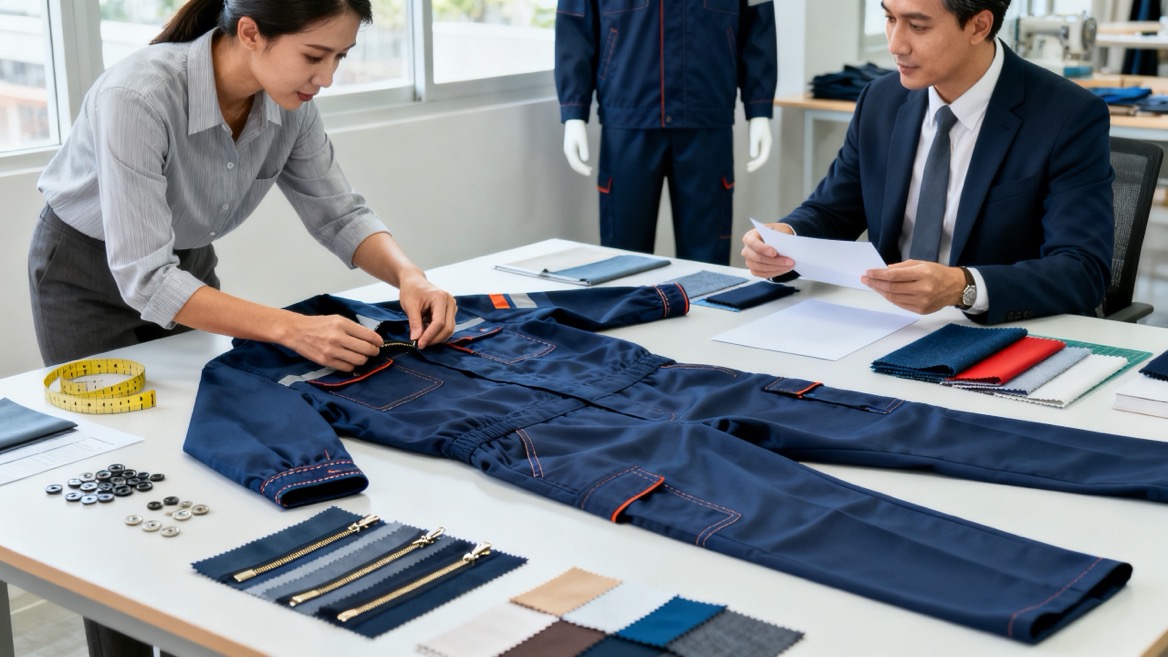
The approval package should include measurements, tolerances, construction details, material references, trim specifications, label content, and an approved sample.
If protective performance is claimed, confirm that the supporting evidence applies to the relevant garment configuration. Changes to materials or construction may require further evaluation.
For industrial management teams with regular production-floor responsibilities, men's work suits are usually the more practical starting point.
Traditional suits remain appropriate for formal, low-exposure business settings. Teams that move between those environments may benefit most from a coordinated wardrobe.
For an OEM project, prepare a role-based specification before requesting quotations. Contact Shanghai Youti Clothing Co., Ltd. with your target market, working conditions, preferred design, cleaning requirements, and order expectations to discuss sample development and confirm the proposed production scope.
Yes, when the design matches their tasks and site requirements. Managers exposed to identified hazards may need specific protective clothing rather than ordinary workwear.
Possibly, where site rules and the hazard assessment permit it. Formal appearance alone does not establish suitability for operational areas.
There is no universal choice. Select materials according to movement, cleaning, appearance, durability, and any required protective performance.
No. Laundry testing evaluates behavior under specified cleaning procedures. Hazard-specific protective claims need appropriate additional evidence.
Not necessarily. A consistent visual identity can use different garments for office work, production supervision, and activities requiring protection.
Request a detailed specification, representative samples, applicable test documentation, agreed quality criteria, and confirmed commercial terms.
1. Occupational Safety and Health Administration. "29 CFR 1910.132—General Requirements." Primary source for workplace hazard assessment, PPE selection, and proper fit.
[Read the OSHA regulation]. [osha]
2. Occupational Safety and Health Administration. "1910 Subpart I, Appendix B—Nonmandatory Compliance Guidelines for Hazard Assessment and Personal Protective Equipment Selection." Supports the task- and exposure-based selection approach.
[Read the assessment guidance]. [osha]
3. National Institute for Occupational Safety and Health. "Protective Clothing and Ensembles." Explains hazard-based selection, fit, comfort, and the limitations of protective ensembles.
[Read the NIOSH guidance]. [cdc]
4. International Organization for Standardization. "ISO 13688:2013—Protective Clothing: General Requirements." Supports the discussion of ergonomics, sizing, compatibility, and marking.
[View the ISO standards information]. [iso]
5. ANSI Webstore. "DS/EN ISO 15797:2018—Textiles: Industrial Washing and Finishing Procedures for Testing of Workwear," adopting ISO 15797:2017. Supports the distinction between standardized laundry testing and broader performance claims.


