
Views: 210 Author: Youti Clothing Publish Time: 2026-08-13 Origin: Site


Content Menu
● Why Customer-Facing Uniform Choice Matters
● Polo Shirt vs Dress Shirt: Core Differences
● When a Polo Shirt Is the Better Corporate Uniform
>> Polo shirts create an approachable service image
>> Polo shirts support movement and warm conditions
>> Polo shirts provide strong branding visibility
● When a Dress Shirt Is the Better Corporate Uniform
>> Dress shirts communicate authority and attention
>> Woven construction creates a cleaner silhouette
>> Dress shirts are adaptable across corporate hierarchy
● Corporate Uniform Selection by Industry
● A Practical Decision Framework for Buyers
● Fabric and Construction Details That Affect Performance
>> Polo shirt specifications to review
>> Dress shirt specifications to review
● Build a Uniform System, Not Just a Garment Order
● OEM Considerations for Polo Shirts and Dress Shirts
● Create a Uniform That Represents Your Brand
● FAQ
>> 1. Is a polo shirt professional enough for customer-facing staff?
>> 2. Should customer service staff wear polo shirts or dress shirts?
>> 3. What is the best fabric for a corporate polo shirt?
>> 4. What is the best fabric for a corporate dress shirt?
>> 5. Can polo shirts and dress shirts be used in the same uniform program?
>> 6. Where should a company logo be placed on a uniform shirt?
>> 7. How should buyers test a uniform before bulk production?
For customer-facing teams, a uniform does more than create a consistent appearance. It influences first impressions, employee comfort, brand recognition, and how confidently staff interact with customers. The choice between a polo shirt and a dress shirt should therefore be based on the role, work environment, brand position, and daily movement—not simply on which garment looks more formal.
At Shanghai Youti Clothing Co., Ltd., we support overseas brands, wholesalers, and uniform buyers with OEM apparel development for polo shirts, dress shirts, work uniforms, and related corporate clothing. From fabric selection and sample development to logo application and bulk production, the best results come from treating a uniform as a practical brand system rather than a basic promotional item.
This guide compares polo shirts vs dress shirts for customer-facing staff, helping businesses select a uniform that looks appropriate, performs reliably, and remains comfortable through a full shift.

A customer usually notices employees before they notice product details, service procedures, or interior design. A clear, well-fitted uniform tells visitors who can help them. It also communicates the expected service level.
The right corporate uniform should achieve four outcomes:
- Make staff immediately identifiable.
- Match the business's service positioning.
- Support movement, temperature control, and all-day comfort.
- Maintain a consistent appearance after repeated washing.
A luxury property agency, private bank, hotel reception, and legal-services firm may require the refined structure of a dress shirt. By contrast, a retail associate, exhibition representative, technical sales team, café worker, or field-service coordinator may gain more from the flexibility of a branded polo shirt.
The real question is not, "Which garment is better?" It is: Which garment helps this specific employee represent the brand more effectively?
Although both garments can be used for corporate uniforms, their construction, visual language, and practical performance are very different.
| Feature | Polo Shirt | Dress Shirt |
|---|---|---|
| Fabric construction | Usually knitted, such as pique, jersey, or interlock | Usually woven, such as poplin, Oxford, twill, or stretch shirting |
| Collar | Soft rib collar or self-fabric collar | Structured collar with collar stand |
| Front opening | Short button placket, usually two or three buttons | Full-length button front |
| Sleeves | Typically short sleeve; long-sleeve options available | Long sleeve is standard; short sleeve is also possible |
| Formality level | Smart casual to business casual | Business professional to formal |
| Mobility | Naturally flexible due to knit construction | Depends on pattern, fabric stretch, and fit allowance |
| Best logo method | Embroidery, print, woven badge, heat transfer | Embroidery, discreet woven label, tonal logo, custom cuff or collar detail |
| Common industries | Retail, trade shows, hospitality, logistics, service teams | Finance, hotels, real estate, aviation, reception, premium sales |
A polo shirt sits between a T-shirt and a traditional shirt. It looks more polished than casual knitwear because of its collar and placket, but it remains easy to wear in active settings.
A dress shirt is more structured. Its woven fabric, full button front, cuffs, and collar create a sharper silhouette. This makes it ideal when authority, precision, and polished presentation are central to the customer experience.
A corporate polo shirt is often the stronger choice for teams that stand, walk, lift, demonstrate products, work outdoors, or move between indoor and outdoor areas.
A polo shirt can make staff look professional without appearing overly formal or distant. This is useful in businesses where employees need to start conversations easily and make customers feel comfortable.
Typical applications include:
- Retail stores and showroom teams.
- Trade-show and event staff.
- Restaurant hosts, café teams, and casual hospitality staff.
- Technical support teams and installers.
- Logistics coordinators and warehouse reception teams.
- Automotive service advisers.
- Sports, fitness, and recreation facilities.
- Outdoor sales and promotional teams.
For example, a kitchen-equipment brand exhibiting at an international trade fair may choose navy performance polos with a small embroidered logo. The look is clean and branded, while the team can set up displays, greet buyers, and move around the venue comfortably.
Knitted fabrics generally provide more natural flexibility than conventional woven shirting. This matters when staff bend, reach, carry samples, walk large floors, or work long shifts.
For warm climates and active roles, consider:
- Cotton pique for a classic textured appearance.
- Cotton-polyester blends for improved shape retention.
- Polyester performance fabric for moisture management.
- Stretch pique for greater recovery and mobility.
- Mesh-knit panels for high-heat or physically active teams.
Fabric weight also matters. A lightweight polo may feel better in tropical retail settings, while a heavier pique can provide a more substantial, premium hand feel for cooler indoor environments.
A polo offers several visible branding positions without making the uniform look crowded:
- Left chest embroidery.
- Right chest staff-name embroidery.
- Sleeve logo or flag detail.
- Back-neck print.
- Contrast tipping on the collar and cuffs.
- Custom buttons, inner neck tape, or side labels.
For businesses with bold, recognizable colors, a polo shirt can carry brand identity effectively. A contrast collar stripe or matching placket detail can reinforce a visual identity while staying suitable for daily wear.
A dress shirt is usually the better choice when customers expect a higher degree of formality, trust, discretion, or service precision.
The structure of a dress shirt naturally creates a more formal impression. A crisp collar, clean placket, and tailored fit can signal that an employee represents a professional service environment.
Dress shirts work especially well for:
- Hotel reception and concierge teams.
- Financial services and insurance offices.
- Real-estate agents and property consultants.
- Corporate reception desks.
- Luxury retail and jewelry sales.
- Airline ground staff.
- Premium restaurant management teams.
- Client-facing sales representatives.
- Showroom consultants selling high-value products.
A tailored white or light-blue dress shirt with a discreet embroidered logo can be particularly effective for premium brands. It allows the employee to look refined while keeping the brand presentation understated.
A dress shirt is generally more suitable when the uniform must be tucked in, paired with tailored trousers, worn beneath a blazer, or coordinated with a tie, scarf, vest, or name badge.
Key design elements include:
- Collar shape: point, spread, button-down, or mandarin collar.
- Cuff style: single-button, adjustable cuff, or French cuff for special hospitality roles.
- Placket: standard, concealed, or contrast-detail placket.
- Pocket: no pocket for a cleaner premium look, or chest pocket for practical roles.
- Fit: regular, tailored, slim, or relaxed.
- Hem: straight hem for untucked wear or curved hem for tucking in.
A high-quality dress shirt should have sufficient ease across the back and armhole. An overly slim pattern may look sharp in a fitting room but become restrictive during a full working day.
A smart uniform program can use dress shirts to distinguish customer-facing levels without losing visual consistency. For example:
- Front-desk staff wear a white dress shirt with navy trousers.
- Supervisors wear a light-blue dress shirt with a blazer.
- Managers wear a white shirt with a different collar trim or embroidered title.
- Event staff wear matching dress shirts with removable branded accessories.
This approach helps customers recognize who is available for support while giving senior team members a slightly elevated appearance.
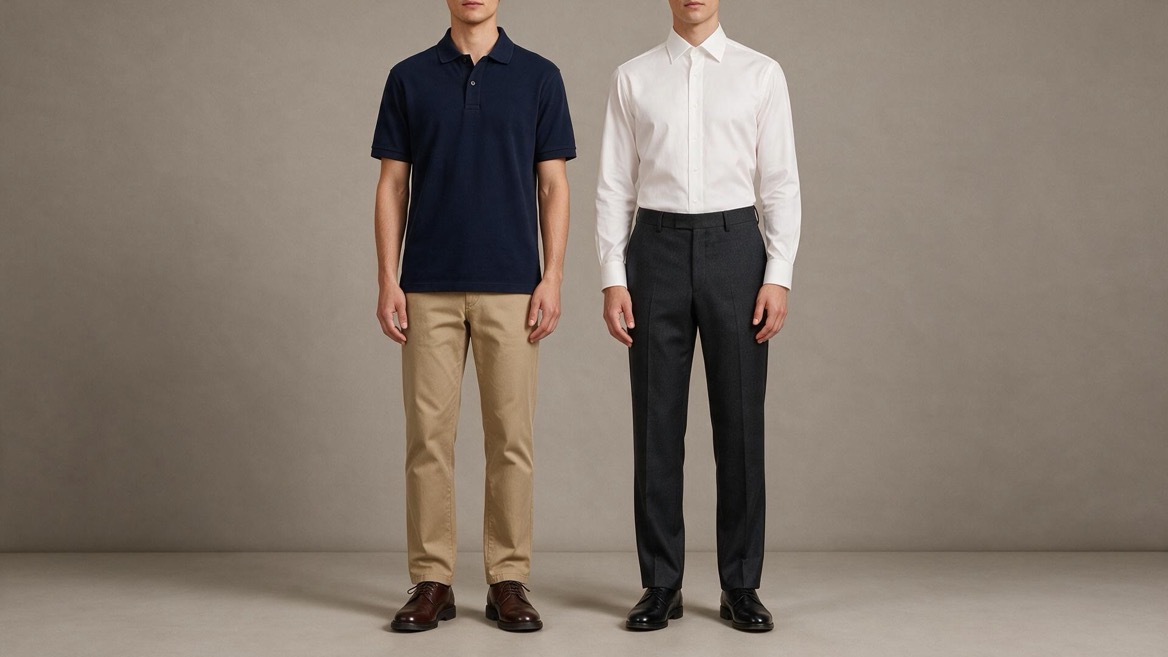
Different customer environments create different expectations. The following guide can help buyers make a faster initial decision.
| Customer-Facing Setting | Recommended Uniform | Why It Works |
|---|---|---|
| Luxury hotel reception | Dress shirt | Refined, structured, and suitable for blazers or scarves |
| Casual restaurant or café | Polo shirt | Approachable, easy to wash, and comfortable during active shifts |
| Real-estate sales office | Dress shirt | Supports credibility during client consultations and property viewings |
| Consumer-electronics showroom | Polo shirt or dress shirt | Polo for product demonstrations; shirt for premium consultant roles |
| Automotive dealership | Polo shirt for service teams; dress shirt for sales consultants | Separates active and formal customer roles |
| Trade-show booth | Polo shirt | Brand visibility, mobility, and all-day comfort |
| Banking or legal reception | Dress shirt | Matches a formal trust-led environment |
| Logistics customer counter | Polo shirt | Durable and practical for mixed office-and-operational duties |
| Premium retail boutique | Dress shirt | Complements a polished, high-value retail atmosphere |
| Medical-device sales team | Dress shirt | Professional during appointments, presentations, and distributor meetings |
In many cases, the strongest choice is not one garment for everyone. A role-based uniform system allows a business to combine polo shirts and dress shirts under the same color and branding standards.
Before developing a custom corporate uniform, evaluate the operational reality of the team. Avoid choosing solely from a catalog image or a competitor's visual style.
Use the following five-step process.
1. Map the employee's actual workday.
Identify how much time staff spend standing, walking, travelling, meeting clients, working outdoors, or performing physical tasks.
2. Define the intended customer perception.
Decide whether the business needs to feel formal, premium, energetic, accessible, technical, creative, or relaxed.
3. Choose fabric based on climate and care needs.
Test whether the uniform will face heat, humidity, air conditioning, repeated industrial washing, food stains, or heavy daily wear.
4. Create a size and fit strategy.
Request a complete size run or representative samples. A uniform that fits one manager may not fit a diverse team.
5. Test branding before bulk approval.
Confirm logo size, thread color, placement measurements, backing material, and visual balance on the actual garment—not only on digital artwork.
This process reduces the risk of ordering a uniform that looks good at approval stage but fails in day-to-day use.
For an OEM buyer, fabric and construction choices determine whether a corporate uniform looks professional after one month or after one hundred washes.
When sourcing corporate polos, ask suppliers about:
- Fabric composition and GSM weight.
- Pique, jersey, interlock, or performance-knit construction.
- Shrinkage and colorfastness testing.
- Collar recovery after washing.
- Placket reinforcement.
- Side vents and hem finish.
- Rib quality for collar and cuffs.
- Embroidery backing and stitch density.
A low-quality collar can curl or lose shape quickly. This is one of the fastest ways for a polo uniform to look worn out. For customer-facing use, choose a collar with stable rib construction and appropriate reinforcement.
For dress shirts, assess:
- Fabric composition and yarn quality.
- Poplin, Oxford, twill, dobby, or stretch-woven construction.
- Collar interlining and collar stability.
- Stitch density and seam durability.
- Button quality and attachment method.
- Shrinkage control.
- Wrinkle resistance or easy-care finishing.
- Fit consistency across sizes.
For service uniforms, cotton-polyester or cotton-stretch blends can offer a practical balance between comfort, easy maintenance, and presentation. Pure cotton may feel excellent, but it often requires more ironing and may not be the most efficient solution for high-turnover workwear programs.

The best corporate uniforms are designed as coordinated systems. They allow employees to adapt to different duties, temperatures, and customer situations while maintaining a unified brand appearance.
A practical modular program could include:
- Short-sleeve polo shirt for active or warm-weather roles.
- Long-sleeve dress shirt for formal meetings and reception.
- Matching trousers or skirts in a consistent neutral color.
- Lightweight jacket, vest, or blazer for layered presentation.
- Apron, scarf, tie, cap, or name badge for role-specific identification.
For example, a hospitality group could use charcoal trousers across all roles. Café staff wear branded polos; reception staff wear dress shirts and neck scarves; supervisors add a matching blazer. The business achieves consistency without forcing every employee into the same garment.
This approach also helps buyers manage seasonal replenishment. Instead of replacing an entire uniform range, they can reorder specific components according to staff needs and inventory use.
For overseas brands, wholesalers, and uniform distributors, the supplier's development process is as important as the garment design.
Shanghai Youti Clothing Co., Ltd. can support a structured OEM workflow for corporate shirts and polos, including fabric sourcing, pattern development, sample making, logo customization, production coordination, quality inspection, and export-oriented packaging.
Before confirming an order, prepare a clear product specification package containing:
- Technical drawing or reference image.
- Fabric composition, color, and target weight.
- Size chart and grading requirements.
- Logo artwork in editable format.
- Embroidery, print, label, and packaging requirements.
- Quantity by style, color, and size.
- Target sample approval date and delivery window.
- Quality requirements and inspection standards.
The more specific the brief, the easier it is to achieve consistent results across sampling and bulk production. This is especially important when polo shirts and dress shirts must match an established brand color palette.
The right choice between a polo shirt and a dress shirt depends on what customers need to feel when they meet your team. Choose polos when comfort, mobility, and approachable branding lead the experience. Choose dress shirts when structure, trust, and elevated presentation matter most.
Shanghai Youti Clothing Co., Ltd. helps international buyers develop custom polo shirts, dress shirts, and coordinated corporate uniform programs for their markets. Contact our team with your design concept, target fabric, logo artwork, size requirements, and expected order quantity to begin your OEM sampling project.
Yes. A well-fitted polo shirt in a stable fabric with clean embroidery can look highly professional in retail, hospitality, exhibitions, technical services, and business-casual workplaces. It is less suitable where a tie, blazer, or formal client presentation is expected.
Choose based on the role and customer expectation. Polo shirts suit active, approachable, and casual service environments. Dress shirts suit formal reception, premium sales, financial services, and high-trust professional settings.
Cotton-polyester pique is a common choice because it balances breathability, durability, and shape retention. For hotter or more active environments, moisture-managing performance knits may be more suitable.
For regular workwear, cotton-polyester blends and cotton-stretch woven fabrics are often practical choices. They can provide a cleaner appearance with lower maintenance than pure cotton.
Yes. This is often the most practical solution. Polo shirts can serve operational or casual-facing staff, while dress shirts support reception, management, and client-meeting roles. Shared colors, logo placement, and trousers can create a consistent identity.
The left chest is the most common and recognizable position. Sleeve embroidery, back-neck printing, custom buttons, collar tipping, and woven labels can add branding without overwhelming the garment.
Request pre-production samples and a size run where possible. Test the garment during normal work activities, after washing, and under the actual lighting and temperature conditions where employees will wear it.
1. [Jos. A. Bank — Men's Polo Shirt Guide: Fit, Fabric, and How to Wear It] [josbank]
2. [Alibaba Apparel — Customer Service Uniform Guide: How to Choose Right] [apparel.alibaba]
3. [ZOOKS — Top Corporate Uniform Ideas for Employees] [zooks]
4. [Cargo Crew — Corporate Uniform Trends Shaping Modern Businesses] [cargocrew.com]
5. [Shanghai Youti Clothing Co., Ltd. — Company Overview] [ipcompany.en.alibaba]
6. [Youti Clothing — Corporate Workwear Manufacturing Overview] [work-jacket]


