
Views: 282 Author: Youti Clothing Publish Time: 2026-08-15 Origin: Site


Content Menu
● T-Shirt vs Polo Shirt: The Quick Answer
● Why Uniform Choice Influences Brand Visibility
● T-Shirt Brand Visibility for Company Uniforms
>> Large Print Areas Create Stronger Visual Impact
>> Better for Bold Colors and Campaign Graphics
>> T-Shirt Limitations for Professional Branding
● Polo Shirt Brand Visibility for Professional Teams
>> The Collar Signals a More Premium Position
>> Embroidery Can Improve Logo Perception
>> Polo Shirt Limitations for Large Graphics
● T-Shirt vs Polo Shirt for Different Industries
● How to Choose the Best Uniform for Brand Visibility
>> 1. Where Will Customers See Employees?
>> 2. What Must the Uniform Communicate?
>> 3. How Often Will Employees Wear and Wash It?
>> 4. Which Decoration Method Fits the Artwork?
>> 5. Will Employees Actually Want to Wear It?
● Expert Uniform Strategy: Use Both Garment Types
● Logo Placement Recommendations
● Which One Delivers Better Brand Visibility?
● FAQ
>> 1. Are polo shirts more professional than T-shirts for company uniforms?
>> 2. Which shirt gives a company logo more space?
>> 3. Should a company logo be embroidered or printed?
>> 4. What is the best logo position on a company uniform?
>> 5. What fabric is best for company uniform shirts?
>> 6. Can we use the same logo on T-shirts and polo shirts?
>> 7. How can we reduce uniform costs without weakening brand presentation?
Choosing between a T-shirt and a polo shirt for company uniforms is not simply a question of style. It affects how employees represent the business, how clearly customers notice the brand, and whether the garment fits the work environment.
For many organizations, T-shirts offer the largest and most flexible branding area, especially for campaigns, events, logistics teams, and promotional work. Polo shirts usually create a more polished and premium brand impression, making them a strong choice for customer-facing teams, sales staff, hospitality, and professional service businesses. The right option depends on where employees work, how customers interact with them, and what the logo needs to communicate.
At Shanghai Youti Clothing Co., Ltd., we work with overseas brands, wholesalers, and garment businesses on custom T-shirt and polo shirt production. From an apparel manufacturing perspective, the strongest uniform programs do not choose a garment only because it is inexpensive or fashionable. They match the fabric, decoration method, logo location, color, and expected wear conditions to a clear brand purpose.

A custom T-shirt generally provides better visibility for bold artwork, large slogans, event messages, and back prints. Its flat front and back panels can support larger print areas with fewer design restrictions.
A custom polo shirt usually provides better visibility for a refined company identity. The collar, placket, and left-chest position make a small embroidered logo look intentional and professional, even when the branding is subtle.
| Brand visibility factor | T-Shirt | Polo Shirt |
|---|---|---|
| Best for large logos | Excellent | Limited by placket and collar area |
| Best decoration method | Screen printing, DTG, DTF, heat transfer | Embroidery, small transfer print |
| Professional appearance | Casual to smart-casual | Smart-casual to professional |
| Large back branding | Excellent | Good, but often less common |
| Employee comfort in active work | Excellent with suitable fabric | Good, especially in pique or performance fabric |
| Suitable for customer-facing teams | Depends on business setting | Excellent |
| Suitable for events and promotions | Excellent | Good for premium events |
| Perceived brand value | Flexible | Often higher |
| Cost control for bulk orders | Often easier | Usually higher because of collar, placket, and construction |
The key point is simple: T-shirts maximize message size; polo shirts maximize perceived professionalism.
Company uniforms turn employees into visible brand touchpoints. A customer may see a staff member before seeing a storefront sign, vehicle graphic, brochure, or website. The uniform must therefore make the business easy to recognize while still being comfortable enough for employees to wear confidently.
Research on organizational attire has found that uniforms can influence perceptions and judgments of employees and organizations. In practical terms, a coordinated uniform can make a team appear more identifiable, more consistent, and more prepared for customer interaction.
However, visibility is not only about making a logo bigger. A highly visible uniform can still fail if the logo is hard to read, the garment looks uncomfortable, the color fades quickly, or the decoration method does not suit the fabric.
A strong branded uniform should achieve four things:
- Immediate recognition from a reasonable customer distance.
- Clear logo reproduction without distorted text or fine details.
- Appropriate appearance for the employee's role and workplace.
- Durability through repeated washing and daily use.
The greatest advantage of a T-shirt uniform is its open decoration space. A standard crew-neck T-shirt has a broad, uninterrupted front panel and back panel. This allows brands to use a large center-chest print, oversized front artwork, a prominent back logo, campaign wording, QR codes, or sponsor information.
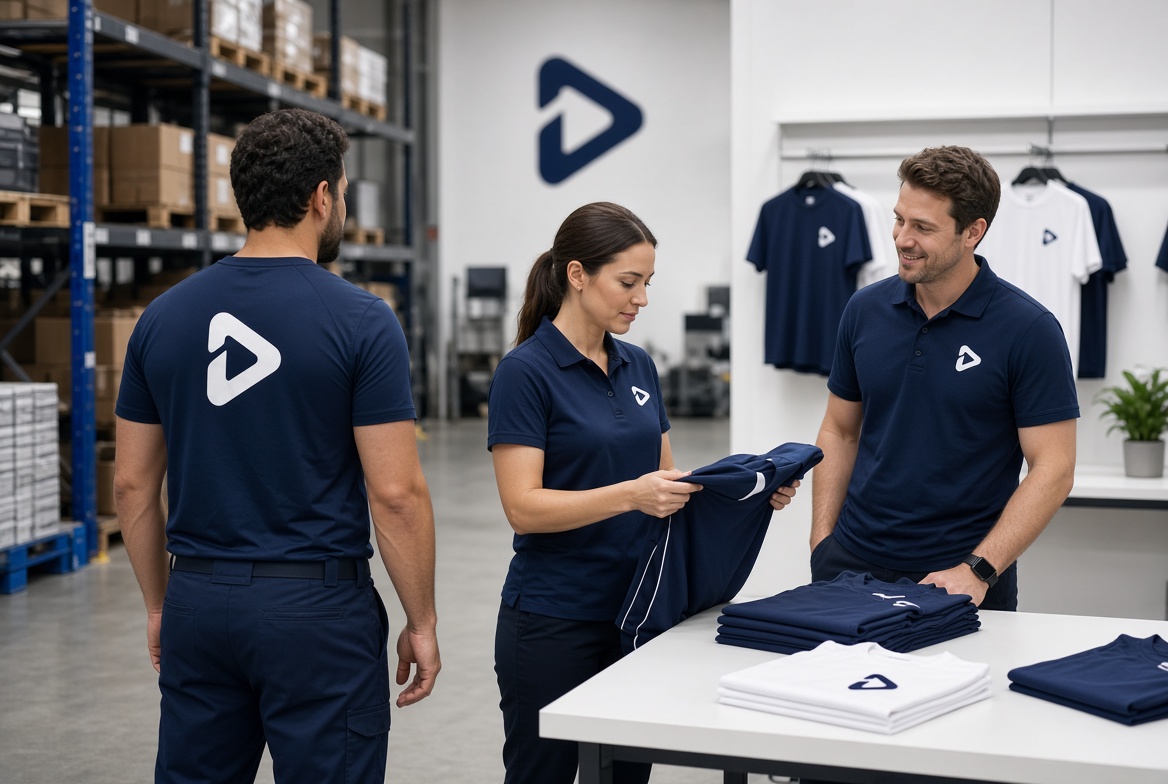
For companies that need employees to be recognizable from a distance, a large back print can be particularly useful. Delivery teams, warehouse workers, exhibition staff, festival crews, cleaning teams, installers, and promotional staff often benefit from this format.
A large front design can commonly occupy an area around 9 × 12 inches, while full-back graphics may use approximately 12 × 14 inches depending on garment size and the selected print process.
This makes a T-shirt especially useful when the uniform must communicate more than a logo. For example:
- A food-delivery brand may need a large logo plus a short service message.
- A construction supplier may include a company name, job title, and phone number.
- A trade-show team may need a campaign slogan that is readable across an exhibition aisle.
- A sports event organizer may need sponsor logos on the back.
T-shirts are highly adaptable for color-driven branding. A brand can choose a garment color that matches its visual identity and add contrasting artwork for fast recognition. Black T-shirts with white or bright-color prints are popular for retail, entertainment, fitness, and streetwear-inspired companies. White or light-color T-shirts work well for clean, fresh, and approachable branding.
Screen printing remains a practical option for larger orders with bold artwork and limited colors. Direct-to-film printing can support detailed, multi-color designs and can work across many fabric types. Digital direct-to-garment printing can be useful for cotton-rich garments and detailed artwork, particularly for smaller quantities or variable designs.
For high-impact printing, do not treat every area of the shirt equally. The center chest is effective for a prominent graphic, while the upper back and full back are valuable for visibility when employees face away from customers.
A T-shirt can appear too casual for some industries. In a high-end retail showroom, hotel reception area, corporate sales meeting, financial service setting, or premium automotive dealership, a basic tee may not convey the desired level of formality.
This does not mean T-shirts are unsuitable. The result depends on the entire garment specification:
- Heavyweight cotton or cotton-blend fabric can look more structured.
- A clean, fitted silhouette can elevate the appearance.
- A small left-chest logo can create a quieter branded look.
- A coordinated overshirt, jacket, or apron can add a professional layer.
- Premium neck rib, reinforced shoulder tape, and neat stitching improve perceived quality.
The most common mistake is using a low-cost promotional T-shirt as a long-term staff uniform. If employees wear it every day, the garment needs fabric stability, colorfastness, comfortable sizing, and decoration that survives frequent laundering.
A polo shirt sits between a casual T-shirt and a formal button-up shirt. Its collar and placket give it more structure, which is why many companies choose polo uniforms for staff who meet customers directly.
For brand visibility, the polo shirt's value is not usually a huge graphic. Its value is consistent, credible presentation. A neatly embroidered logo on the left chest can make a team look coordinated without appearing overly promotional.
This is particularly effective for:
- Retail associates
- Sales representatives
- Hospitality employees
- Restaurant supervisors
- Golf and leisure businesses
- Property management teams
- Automotive service advisors
- Technology installers
- Trade-show account managers
A left-chest logo is normally around 3 to 4 inches wide. On polos, embroidery is commonly preferred because it creates texture, dimension, and a more durable premium appearance.
Embroidery can add visual authority to a polo shirt, but the artwork must be prepared correctly. Fine lines, tiny letters, complex gradients, and very small icons may not reproduce well in thread.
For a readable embroidered logo, simplify when necessary:
- Use bold letterforms rather than thin typography.
- Remove tiny taglines from the chest logo.
- Avoid extremely narrow gaps between letters.
- Use solid logo colors that contrast with the garment.
- Create an embroidery-specific version of the brand mark.
Industry production guidance often recommends keeping left-chest logos under 4 inches wide and allowing sufficient clearance from seams, collars, and plackets.
A polo can also use a secondary logo on the sleeve or upper back. This is an effective approach when a brand wants discreet front branding plus additional visibility from side or rear angles.
The polo placket creates a decoration challenge. A large center-front design can be interrupted by buttons, the collar opening, and the shirt's natural movement. This is why polos are usually better for compact branding than oversized graphics.
A large printed logo may also reduce the refined look that makes a polo attractive in the first place. If the business needs a message that can be read from far away, a T-shirt often offers more practical space.
Polo shirts can also cost more to manufacture because they use more components and construction operations, including the collar, placket, buttons, side vents, and sometimes ribbed cuffs. The final cost varies based on fabric weight, yarn type, collar construction, embroidery stitch count, order quantity, labels, packaging, and quality requirements.
| Industry or work situation | Better option | Why |
|---|---|---|
| Trade shows and promotional events | T-Shirt | Large graphics and slogans attract attention in busy spaces |
| Retail store floor | Polo Shirt | Creates a tidy, approachable, customer-ready look |
| Warehouse and logistics | T-Shirt | Comfortable, breathable, easy to identify with large back print |
| Restaurant front-of-house | Polo Shirt | More structured appearance while remaining practical |
| Construction and installation | T-Shirt or performance polo | Choose based on climate, safety layers, and customer contact |
| Corporate sports events | Polo Shirt | Polished team appearance and excellent left-chest branding |
| Product launches | T-Shirt | Ideal for campaign graphics, limited editions, and social-media visuals |
| Cleaning and maintenance teams | T-Shirt | Practical for frequent washing and clear back identification |
| Sales visits and showroom service | Polo Shirt | Strengthens confidence and brand consistency |
| Fitness, wellness, and casual retail | T-Shirt | Supports energetic, lifestyle-oriented branding |
Before placing a custom apparel order, ask these five questions.
If customers usually see employees at a distance, prioritize large back logos, high-contrast colors, and simple visual messaging. A T-shirt is often the more effective option.
If customers interact face-to-face at close range, a polo with a clean left-chest embroidered logo may create a stronger impression.
A logo-only identity can work well on a polo shirt. A campaign, event name, service line, social handle, or sponsor group needs more space and is usually better suited to a T-shirt.
Keep the main message focused. A uniform is not a brochure. Customers should understand the company name or core message within a few seconds.
For everyday uniforms, prioritize fabric performance. Cotton provides a soft, natural hand feel. Polyester offers durability and moisture management. Cotton-polyester blends balance comfort, color retention, and practicality.
For polo shirts, common options include cotton pique, CVC pique, polyester pique, and moisture-wicking performance fabrics. For T-shirts, options range from lightweight promotional jersey to heavyweight combed cotton and functional polyester interlock.
Use the decoration method to support the logo, not the other way around.
| Artwork requirement | Recommended option |
|---|---|
| Large one- to three-color graphic | Screen printing |
| Full-color artwork or detailed gradients | DTF or DTG, depending on fabric and order needs |
| Small premium chest logo | Embroidery |
| Names, numbers, or variable employee data | DTF, heat transfer, or other variable decoration method |
| Small logo on performance polo | Embroidery or carefully tested transfer print |
For polo embroidery, make sure the logo is digitized specifically for thread. For T-shirt printing, supply vector artwork whenever possible, such as AI, EPS, PDF, or SVG, and confirm print dimensions before bulk production.
A uniform becomes more visible when employees wear it correctly and confidently. Poor fit, scratchy labels, stiff printing, collar distortion, and heat retention all reduce employee acceptance.
Offer a practical size range. Consider men's, women's, unisex, and extended sizing where appropriate. Test one or more pre-production samples before confirming the full order.
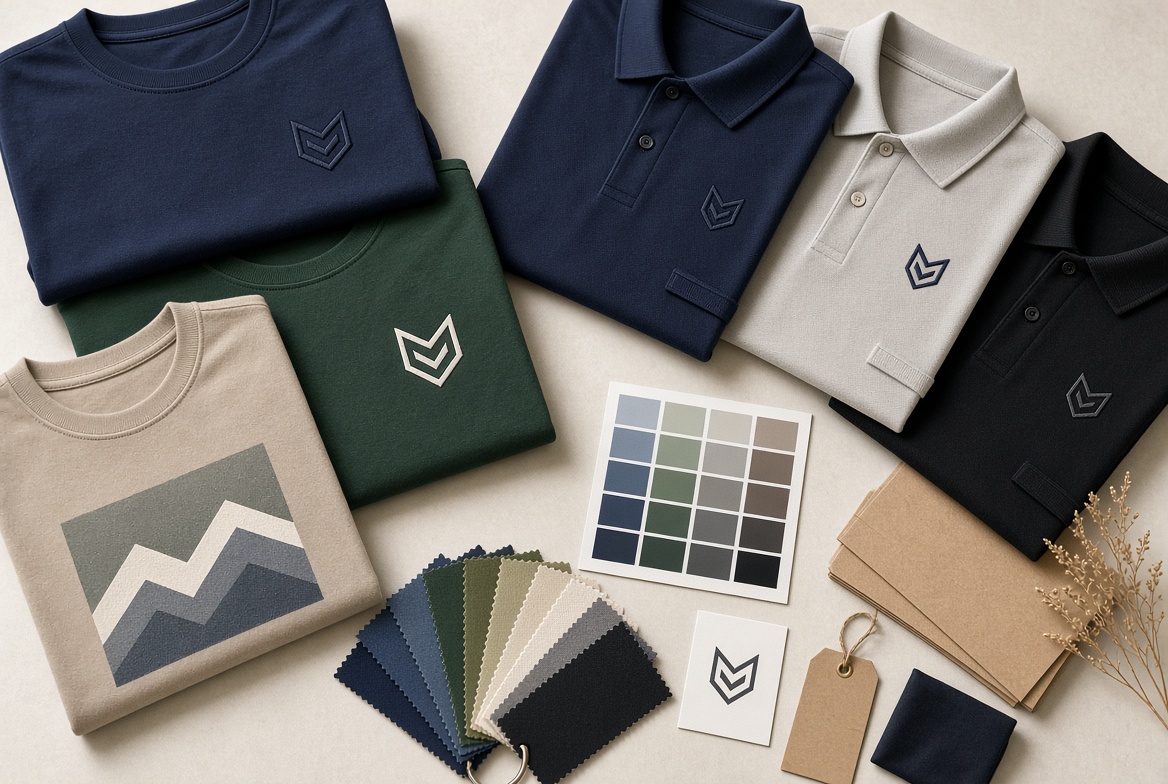
The best choice is sometimes not T-shirt or polo shirt. It is a coordinated uniform system.
Many growing businesses use:
- Polo shirts for sales staff, supervisors, front-desk teams, and client visits.
- T-shirts for events, warehouse work, installation teams, campaigns, and internal activities.
- Matching brand colors across both garments.
- Consistent logo placement so customers recognize the brand across roles.
- A shared color palette for embroidery, printing, labels, and packaging.
For example, a home-appliance company could give showroom consultants navy polos with a small white embroidered logo. Its delivery and installation crew could wear navy performance T-shirts with the same front logo and a larger white logo on the back. Customers receive a consistent brand signal, while each employee gets clothing appropriate to the job.
This approach also helps organizations control inventory. The company can keep one approved logo system while selecting different garments for different seasons, job functions, and budgets.
For most company uniforms, the following layout works well:
| Placement | Best use | Recommended garment |
|---|---|---|
| Left chest | Primary logo, professional identification | Polo shirt or T-shirt |
| Center chest | Campaign artwork or bold brand statement | T-shirt |
| Full back | Large company name, service message, event branding | T-shirt |
| Upper back | Secondary identity, website, team designation | T-shirt or polo shirt |
| Sleeve | Secondary logo, country flag, department mark | Polo shirt or T-shirt |
| Back neck | Subtle premium mark | T-shirt or polo shirt |
A left-chest logo typically sits about 3 inches below the collar area and should remain modest in size for balanced branding. Avoid placing artwork too close to the polo placket, because buttons and seams can interrupt the logo and affect comfort.
Choose a T-shirt for company uniforms when your priority is maximum visual impact, large logos, promotional messaging, workforce identification, and flexible graphic decoration.
Choose a polo shirt for company uniforms when your priority is a polished, professional, customer-facing image with a refined embroidered logo.
For many brands, the most effective solution is a mixed uniform program. Use polos to build trust in close customer interactions, and use T-shirts to create recognition in active, high-visibility, or promotional environments.
Shanghai Youti Clothing Co., Ltd. can support your OEM program from fabric selection and sizing development to custom colors, logo decoration, labels, packaging, and production inspection. Send us your logo file, target quantity, preferred fabric, and intended application to develop a uniform solution that makes your brand easier to recognize and more credible in daily use.
In most customer-facing settings, yes. A polo shirt's collar and embroidered chest logo typically create a more structured and polished appearance. However, a premium fitted T-shirt can still work well for modern retail, fitness, creative, technology, and event teams.
T-shirts provide more uninterrupted front and back space for large prints. They are usually the better choice for oversized graphics, full-back logos, slogans, event messages, and sponsor branding.
Use embroidery for small, simple logos when you want a textured and premium appearance, especially on polo shirts. Use printing for large, detailed, multi-color, or gradient artwork, especially on T-shirts.
The left chest is the most widely used position for a professional company logo. For greater distance visibility, add a large back logo or upper-back company name, especially on T-shirts.
The best fabric depends on the role. Cotton or cotton-rich blends work well for comfort and everyday wear. Polyester and performance blends are suitable for active teams, warm environments, and moisture-management needs. Pique knit is a common choice for polos because it provides texture and structure.
Yes. Create a consistent logo system, but use different artwork versions when needed. A simplified embroidery version may work best on the polo chest, while a larger full-color version can be used on the T-shirt back or center front.
Use a limited color palette, standardize logo placements, select one core fabric per garment type, and reserve complex decoration for key positions. Sampling before bulk production also reduces costly errors in color, size, and logo placement.
1. [Uniformity: The Effects of Organizational Attire on Judgments and Attributions]
2. [Effects of Employees' Uniform on Company Image and Employee and Customer Perceptions]
3. [T-Shirt Design Placement Guide — Printful]
4. [A Guide to Industry Standard for Screen Print Placements and Dimensions]
5. [T-Shirt Logo Placement Guide — T-Shirt Elephant]
6. [Custom Apparel Logo Placement Guidance — Underground Shirts]


