
Views: 255 Author: Youti Clothing Publish Time: 2026-10-13 Origin: Site


Content Menu
● Safety Vest vs Safety Jacket: The Main Differences
● Winter Warmth: Why a Safety Jacket Usually Wins
>> Sleeves and Insulation Support a Complete Cold-Weather System
>> Wind and Moisture Change the Comparison
● High-Visibility Performance: Is a Jacket Always Safer?
>> Visibility Class Matters More Than the Product Name
>> Winter Layers Must Not Hide Visibility Features
● Comfort and Mobility During Construction Work
>> When a Safety Vest Offers Better Flexibility
>> When a Safety Jacket Offers Better Practicality
● Choosing Winter Workwear by Construction Scenario
● An Overlooked Risk: Sweating Before a Low-Activity Task
● A Five-Step Field Trial Before Bulk Ordering
>> 2. Compare Complete Outfits
>> 4. Collect Structured Feedback
● OEM Specifications for Winter Safety Vests and Jackets
● Durability and Total Cost: Look Beyond Unit Price
● Develop Winter Construction Workwear Around the Job
● FAQs
>> Is a Safety Jacket Better Than a Safety Vest in Winter?
>> Can Construction Workers Wear a Safety Vest Over a Winter Coat?
>> Does Reflective Tape Make a Jacket Compliant?
>> Are All High-Visibility Jackets Waterproof?
>> How Should Buyers Choose the Right Insulation?
>> Can Logos Be Added to Winter Safety Workwear?
A safety vest vs safety jacket comparison for winter construction comes down to two questions: can workers be seen, and can they stay warm without losing mobility? For prolonged exposure to cold, wind, or rain, an appropriately specified high-visibility safety jacket is usually the stronger choice. A safety vest remains useful when worn over suitable winter layers, particularly for active workers or teams moving between indoor and outdoor areas.
Protection depends on the complete clothing system—not simply whether the outer garment has sleeves.
For overseas brands, wholesalers, and manufacturers sourcing from Shanghai Youti Clothing Co., Ltd., the practical goal is to develop workwear around actual site conditions. Visibility, insulation, weather resistance, fit, and maintenance should guide an OEM specification before styling or branding.
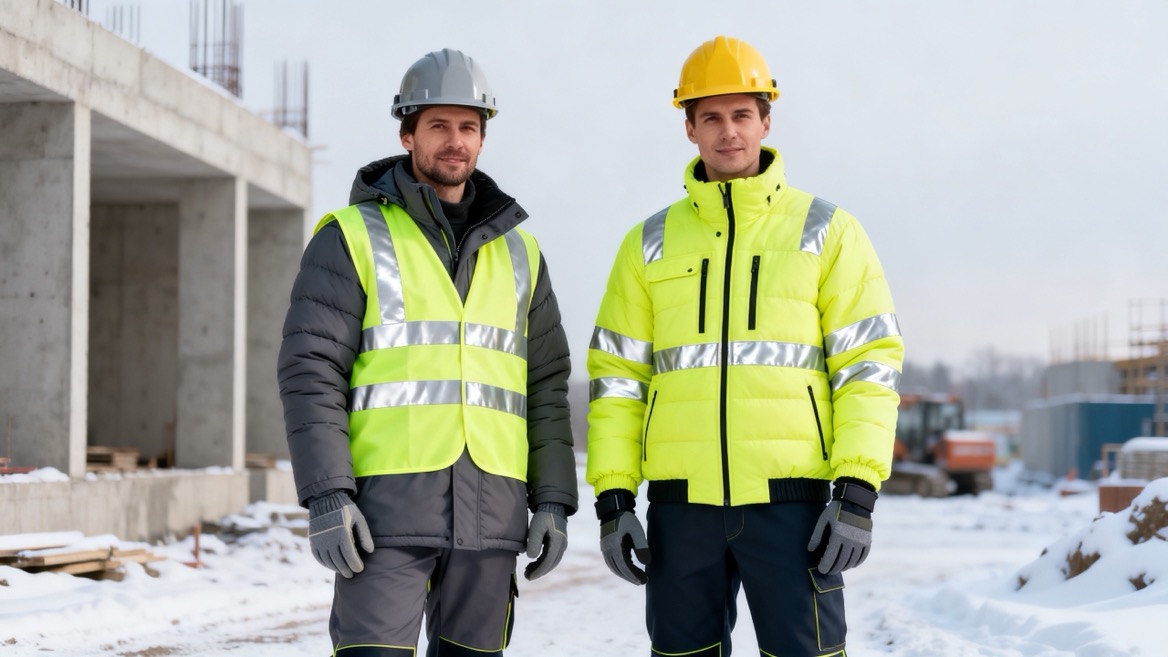
In this article, "safety vest" means a high-visibility sleeveless garment, while "safety jacket" means a high-visibility jacket intended for construction work. Not every safety jacket is insulated, waterproof, or suitable for winter.
| Comparison factor | Safety vest | Winter safety jacket |
|---|---|---|
| Primary function | Adds conspicuity over other clothing | Combines conspicuity with specified weather protection |
| Insulation | Usually limited; depends on underlying layers | Can include insulation or a removable liner |
| Arm protection | Relies on garments underneath | Covers the torso and arms |
| Wind and rain | Usually requires separate protective outerwear | Can provide protection when appropriately constructed |
| Mobility | Lightweight, with minimal sleeve restriction | Depends on cut, fabric, and insulation bulk |
| Temperature adjustment | Easy to remove or change between tasks | Benefits from ventilation and adjustable layering |
| Purchasing cost | Often lower per garment | Often higher, but may replace a separate outer layer |
| Best winter application | Variable conditions and layered systems | Sustained outdoor exposure |
Neither garment automatically meets a required visibility class. Buyers must verify the finished product's label, documentation, and suitability for its intended market.
A standard reflective vest adds visibility, not comprehensive cold protection. Workers still need suitable clothing underneath.
An insulated safety jacket combines upper-body coverage with a thermal layer. This can simplify dressing for outdoor work, especially where workers stand still, operate equipment, or wait between tasks.
However, the thickest jacket is not automatically the best. Cold-weather guidance emphasizes matching clothing to temperature, wind, wetness, activity, and exposure duration.
From a workwear specification perspective, I would assess the full shift rather than choose insulation from the morning temperature alone.
Wind increases cooling, while wet clothing can reduce insulation and accelerate heat loss. Sweat matters as well as rain.
For winter construction workwear, assess:
- Outer-fabric resistance to wind and water.
- Seam construction and any required seam sealing.
- Cuff, collar, and hem adjustment.
- Ventilation during strenuous tasks.
- Compatibility with moisture-managing base layers.
A mesh safety vest over an unsuitable sweatshirt will not solve a cold-weather problem. Equally, a heavily insulated jacket that traps excessive perspiration can become uncomfortable when activity slows.
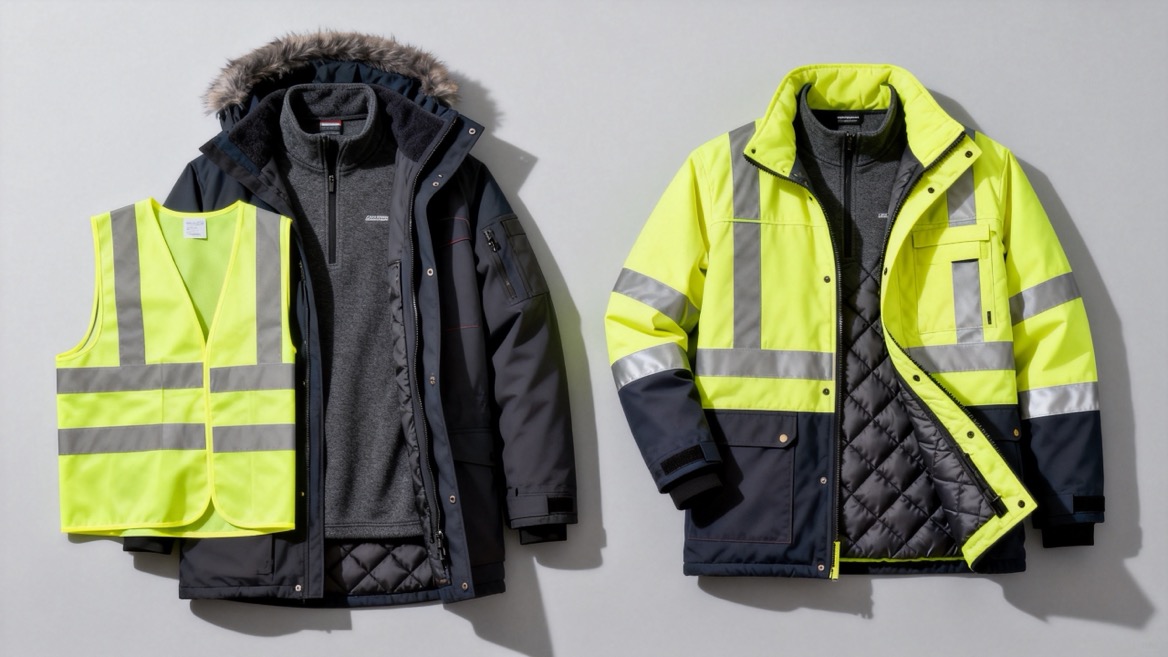
A safety jacket is not automatically more conspicuous than a safety vest.
High-visibility standards address garment design and the performance and coverage of conspicuous materials. Fluorescent backgrounds help workers contrast with their surroundings in daylight. Retroreflective material improves conspicuity when illuminated, such as by vehicle headlights.
For international sourcing, specifications may reference ANSI/ISEA 107 for the US market or EN ISO 20471 for relevant European applications. These frameworks should not be treated as interchangeable.
Select the applicable type and class through the site's risk assessment and purchasing requirements. Do not infer compliance from color, reflective tape, or a supplier's product title.
A certified vest can lose practical effectiveness if workers cover it with an ordinary coat. A jacket can also become less conspicuous when its visible areas are obscured by equipment, dirt, or unsuitable customization.
Check the clothing system as actually worn:
1. Put on the normal base and insulating layers.
2. Add the intended outer garment.
3. Fit harnesses, tool belts, and other equipment.
4. Check visibility from different directions.
5. Confirm that movement does not create substantial obstruction.
For an OEM collection, assess logo placement early. Large decorative panels should not be added without reviewing their effect on the finished garment's compliance.
A safety vest over appropriate winter clothing can work well for workers who frequently change environments.
Examples include teams moving between a heated workshop and an outdoor loading area, or workers whose activity levels vary substantially during a shift.
A vest also separates visibility from insulation. The worker can change the underlying layer while retaining a suitable high-visibility outer garment.
The limitation is important: the vest must fit over winter clothing without excessive looseness, and the underlying system must provide adequate weather protection.
A winter safety jacket reduces the number of separate upper-body garments needed to combine visibility and weather protection.
However, poor fit can create problems. Tight shoulders may restrict reaching. Bulky sleeves may interfere with gloves. An oversized hem can interfere with equipment.
For sample evaluation, I would prioritize task-based fitting over appearance:
- Reach overhead.
- Bend and squat.
- Climb representative steps.
- Operate zippers while wearing gloves.
- Check collar and hood compatibility with required PPE.
These are proposed evaluation steps, not a substitute for a formal workplace assessment.
The following examples illustrate selection logic. They are not reports of measured customer outcomes.
| Construction scenario | Practical starting point | What still needs verification |
|---|---|---|
| Long outdoor shifts with limited movement | Insulated high-visibility jacket | Thermal suitability, visibility requirements, and fit |
| Active work in dry, variable conditions | Vest over adjustable winter layers | Moisture management and outermost visibility |
| Rain, wet snow, or persistent wind | Weather-protective high-visibility jacket | Water resistance, seams, ventilation, and insulation |
| Frequent indoor–outdoor movement | Flexible layered system with vest or removable-liner jacket | Ease of adjustment without losing protection |
| Work near moving vehicles in poor light | Garment meeting the assessed visibility requirement | Applicable class, coverage, and PPE compatibility |
There is no universal temperature at which every worker should switch from a vest to a jacket. Work intensity and weather exposure can change the answer substantially.
One useful way to compare a safety vest and safety jacket is to examine transitions between tasks.
Imagine a worker carrying materials, then standing outside while equipment is repositioned. Heavy insulation may feel comfortable initially but become excessive during carrying. Moisture can accumulate before the worker becomes less active.
Cold-weather guidance supports layered clothing, moisture management, and adjusting clothing to conditions.
For buyers, this suggests evaluating more than insulation thickness:
- Can workers release excess heat without removing essential visibility?
- Is the insulating layer removable?
- Are adjustments manageable with gloves?
- Does the system allow damp clothing to be replaced?
A versatile winter jacket may offer better value than a heavier jacket with fewer adjustment options. Alternatively, a vest-based system may suit highly variable tasks when the layers underneath remain appropriate.
A structured wearer trial can reveal issues that fabric swatches and product photographs cannot.
Record expected temperature ranges, wind, precipitation, shift duration, vehicle interaction, and activity patterns.
Separate visibility requirements from thermal requirements. Both must be addressed.
Trial the vest over the proposed winter layers and the jacket over its intended base layers.
Comparing a vest alone with an insulated jacket gives an incomplete picture.
Include hard hats, gloves, safety footwear, harnesses, and other equipment required for the task.
Check that garments and PPE do not interfere with each other.
Ask wearers to rate warmth, sweating, reach, sleeve comfort, pocket access, closure operation, and ease of adjustment.
Record the conditions alongside each response.
Follow the prescribed care instructions, then reassess fit, closures, seams, and visible material condition.
A small wearer trial is useful for usability decisions. It does not establish standards compliance or replace laboratory testing.
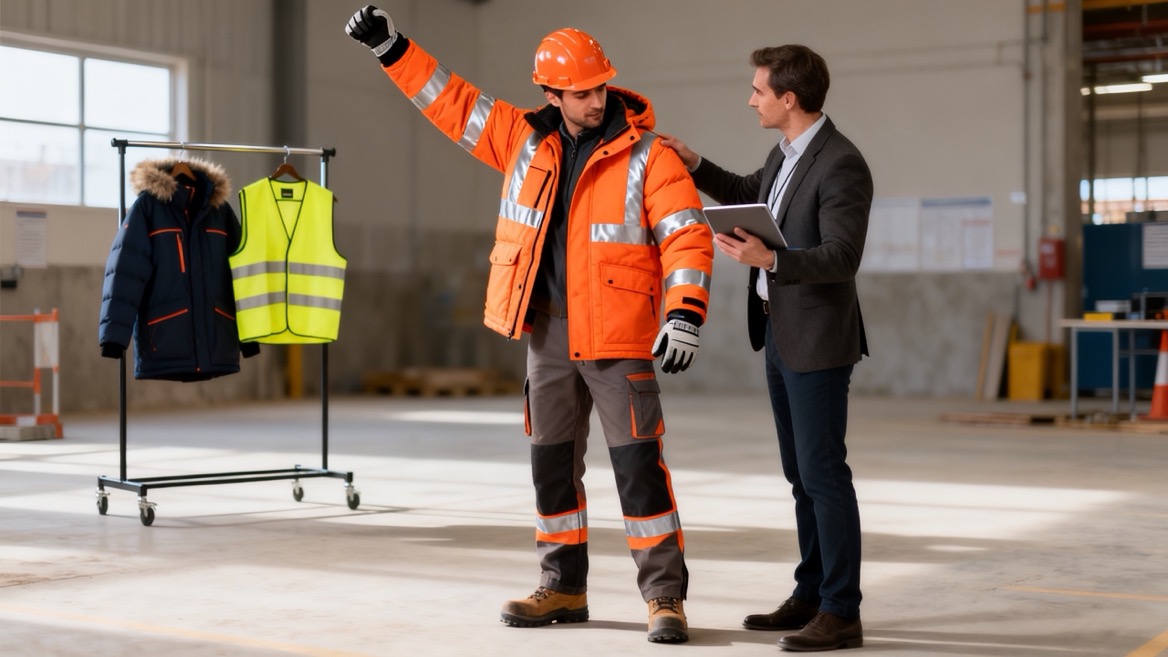
For overseas buyers working with Shanghai Youti Clothing Co., Ltd., a clear technical brief helps turn a general product idea into an assessable garment.
| Specification area | Information to define |
|---|---|
| Target market | Destination, applicable requirements, and required visibility classification |
| Garment system | Standalone jacket, removable-liner design, or vest-over-layer system |
| Materials | Shell fabric, lining, insulation, and reflective components |
| Weather performance | Intended wind, rain, and cold protection, with supporting test requirements |
| Fit | Size range, winter-layer allowance, and task-related movement |
| Branding | Logo dimensions and placement subject to compliance review |
| Care | Washing instructions, drying limits, and any documented maintenance restrictions |
| Documentation | Applicable test reports, product identification, and conformity documentation |
Material-level evidence should not be confused with proof that the completed garment meets every applicable requirement.
Changes to tape layout, fabric panels, sizing, or branding may affect the finished design. Establish how such changes will be reviewed before production approval.
The company's role here is as an OEM sourcing partner; specific certifications, production capabilities, and performance claims should be confirmed for the proposed product rather than assumed.
A safety vest often has a lower initial purchase price. However, it may require a separate weather-protective coat.
A winter safety jacket may consolidate functions, but repair, cleaning, and replacement costs can be higher.
Compare complete systems using:
- Initial clothing cost per worker.
- Cleaning requirements.
- Expected wear conditions.
- Repair and replacement arrangements.
- Seasonal versatility.
- Availability of replacement sizes or components.
Do not assume a longer service life without evidence. Mud, abrasion, washing, and damage can affect garment condition.
Follow care instructions and inspect workwear regularly. Damaged or heavily soiled visibility materials require attention; replacement decisions should follow manufacturer guidance and the employer's safety procedures.
For most prolonged outdoor winter construction work, an appropriately specified safety jacket is the better starting point. For variable conditions, a safety vest over suitable layers can offer valuable flexibility.
Contact Shanghai Youti Clothing Co., Ltd. with your destination market, site conditions, required visibility classification, size range, branding artwork, and expected order quantity. Request an OEM specification review and samples for wearer evaluation before approving bulk production.
Usually, for sustained outdoor exposure to cold, wind, or rain. A properly specified jacket combines visibility with weather protection. A vest remains useful over suitable winter layers, particularly where activity and temperature vary.
Yes, provided the vest fits properly, remains visible, and meets the assessed requirements. The complete outfit must allow safe movement and work with other PPE. Wearing a non-high-visibility coat over the vest can obscure it.
No. Tape alone does not demonstrate compliance. The relevant standard may address material performance, visible areas, garment design, and other requirements. Verify the finished product and supporting documentation.
No. High visibility and water protection are separate properties. Ask for the specified weather performance, garment construction details, and supporting evidence rather than relying on appearance or descriptive terms.
Consider weather, exposure duration, activity, layering, and wearer feedback. Avoid assigning suitability from insulation weight alone. A garment's construction and the complete clothing system also affect practical performance.
Yes, but branding must be reviewed against the garment's applicable requirements. Logo placement and dimensions should be agreed before approval, especially where they could cover or replace conspicuous material.
1. Occupational Safety and Health Administration. ["Winter Weather: Preparedness."] Guidance on cold-weather training, layered clothing, wind and rain protection, and staying dry. [osha]
2. Canadian Centre for Occupational Health and Safety. ["Cold Environments—Control Measures."] Guidance on temperature, wind, wetness, activity, exposure, and clothing selection. [ccohs]
3. Health and Safety Executive. ["High Visibility Clothing."] Guidance on lighting, weather, background contrast, fit, recognized standards, and compatibility with other PPE. Its historical standards discussion should not replace verification of current market requirements. [hse.gov]
4. Health and Safety Executive. ["Personal Protective Equipment at Work: Guidance on Regulations," L25.] Guidance on high-visibility clothing selection, inspection, cleaning, and seasonal suitability. [books.hse.gov]
5. Professional Clothing Industry Association Worldwide. ["Why Choosing the Right High-Vis Safety Clothing Is Important."] Industry discussion of risk-based selection and recognized high-visibility standards. [pciaw]


