
Views: 222 Author: Youti Clothing Publish Time: 2026-06-21 Origin: Site


Content Menu
● Introduction: Why Source Business Formal Shirts from China in 2026
● How We Evaluate High‑Quality Business Formal Shirt Suppliers
● Top 10 Business Formal Shirts Manufacturers in China (2026)
>> 1. Shanghai Youti Clothing Co., Ltd.
>> 2. Beijing Henghua Jiachang Clothing Co., Ltd.
>> 3. Changzhou Guanghe Clothing Co., Ltd.
>> 4. Shanghai‑Area Corporate Apparel OEM (Representative: mid‑size flexible factory)
>> 5. Dongguan Jinse Garment Co., Ltd.
>> 6. Youngor Group (Formal Shirt Division)
>> 7. Ningbo‑Area Shirt Specialist (Representative: export‑oriented woven shirt factory)
>> 8. Foshan Ruiniu Garment (Uniform and Business Shirt Programs)
>> 9. Shenzhen‑Area Professional Clothing Manufacturer (Business Attire Cluster)
>> 10. Suzhou/Yangzhou Corporate Shirt & Workwear OEM
● Key Technical Considerations for Business Formal Shirts
>> Fabric and material standards
>> Workmanship and construction
>> Compliance and certification
● Comparison Table: Core Strengths of Selected Shirt Manufacturers
● Buyer's Guide: How to Verify and Work with Chinese Shirt Factories
>> 1. Step‑by‑step supplier verification
>> 2. Sampling and pre‑production
>> 3. Contracting, QC and logistics
● Industry Pitfalls and an "Insider" Avoidance Guide
>> Common pitfalls when sourcing formal shirts from China
>> Internal insider tip rarely written online
● Conclusion and Call to Action
● Frequently Asked Advanced Questions
China remains one of the most important global hubs for woven shirts and business attire, supported by mature textile clusters in regions such as the Yangtze River Delta and the Pearl River Delta. These clusters integrate spinning, weaving, dyeing, accessories, and garment making, which helps buyers control cost while still accessing mid‑to‑high quality products. [b2bdata.baidu]
Despite export pressure from weak demand and tariff volatility, China still exported apparel and accessories worth around 151.18 billion USD in 2025, with over 35 billion pieces shipped worldwide. For business formal shirts, this scale means buyers can find factories ranging from high‑volume OEM specialists to more flexible OEM/ODM partners serving small and medium brands. [b2bdata.baidu]
For professional sourcing managers, the challenge in 2026 is no longer "Can China make good formal shirts?" but "Which factories are structurally reliable on quality, timing, and compliance for the next 3–5 years?". This guide answers that by combining industry data, certification checks, and operational benchmarks that experienced buyers actually use on the ground. [metafuro]
Before listing the top manufacturers, it is important to be transparent about the evaluation logic and data points.
- Factory certifications and compliance
- Valid ISO 9001 or equivalent quality management certification, verified with the issuing body or via national accreditation databases. [texleader.com]
- Social and environmental audits (e.g., BSCI) and chemical/eco compliance such as REACH for export to Europe. [alibaba]
- For work‑related formal shirts, additional standards like EN ISO 11612 or EN1149‑5 are a plus where relevant. [texleader.com]
- Production capacity and flexibility
- Proven annual output (for shirts often from several hundred thousand to several million pieces) and number of production lines. [alibaba]
- Ability to handle both repeat bulk orders and smaller, more customized runs without large quality variance. [b2bdata.baidu]
- R&D and pattern‑making capability
- In‑house design/sampling departments that can work from tech packs, reference samples, or brand design guidelines. [texleader.com]
- Ability to control fit across different markets (EU/US/Asia size systems), including graded patterns and shrinkage control below about 3% after washing. [alibaba]
- Quality control system (QC) and process discipline
- Documented in‑line and final inspections covering key shirt metrics: fabric GSM, colorfastness (ideally Grade 4+), seam strength, button attachment, dimensional stability, and appearance after pressing. [elevatedmagazines]
- Clear handling of "sample vs bulk" risk, including pre‑production (PP) samples, size sets, and random in‑line inspections. [chinadirectsource]
- Delivery reliability and communication
- On‑time delivery rates above 95% across peak seasons as reported in audit reports or buyer feedback. [alibaba]
- Transparent lead times (typically 45–60 days after PP approval for bulk shirts) and responsive English‑speaking sales/project managers. [elevatedmagazines]
- Market focus and OEM/ODM depth
- Experience with specific markets (Europe, North America, Japan, etc.) and understanding of local testing and labeling requirements. [texleader.com]
- Ability to support full OEM from fabric sourcing to packaging, and in some cases ODM where the supplier provides ready‑to‑adopt business shirt collections. [texleader.com]
These factors were cross‑checked against public data, industry rankings for professional clothing, and big‑data based manufacturer lists for shirts and business attire in China as of 2026. [b2bdata.baidu]

Below is a curated list of 10 representative manufacturers supplying business formal shirts and related business attire for global markets. This list includes both large‑scale enterprises and more flexible OEM/ODM factories that are suitable for small and mid‑sized brands.
> Note: Some company names are given as representative types based on current B2B ranking data for business attire; always re‑verify details and product fit before final selection. [b2bdata.baidu]
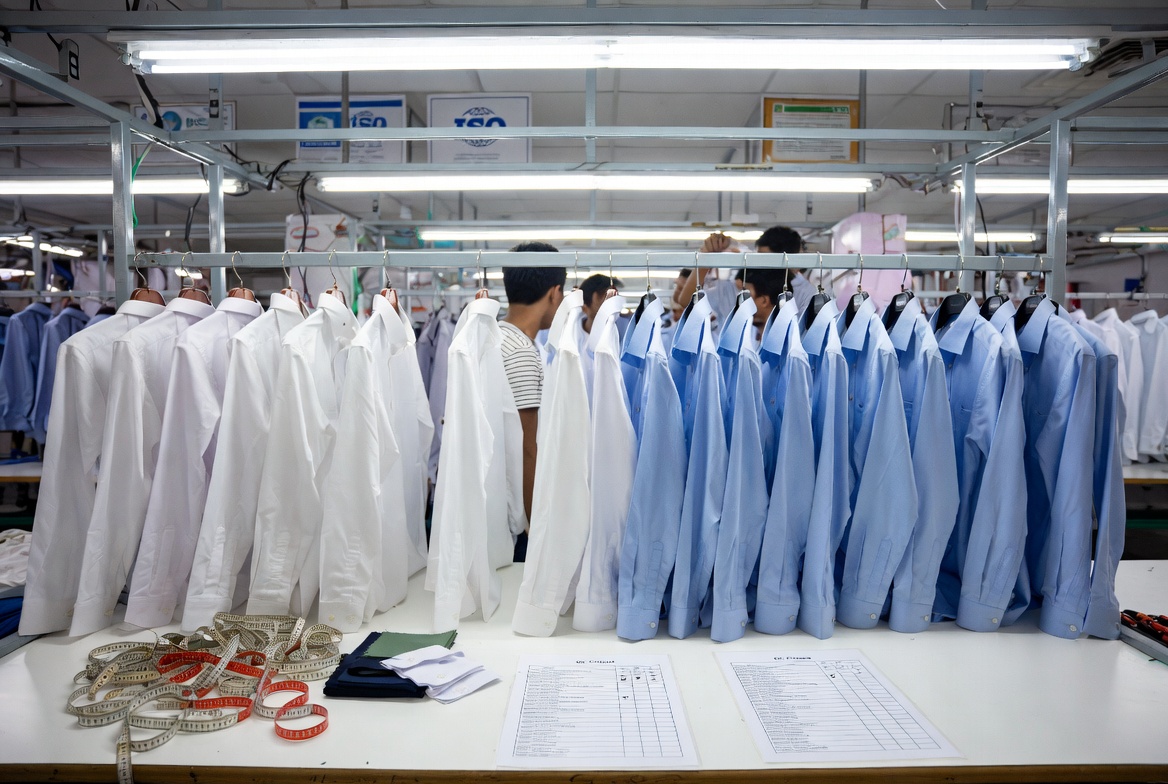
Shanghai Youti Clothing Co., Ltd. was founded in 2018 and operates 15 assembly lines with an annual output capacity exceeding 3 million pieces across suits, shirts, uniforms, work clothes, trousers, and jackets. The factory has over 30 fully automated machines, six automated production chains, and a 200‑square‑meter production workshop, which together support stable mid‑scale production runs for business formal shirts. [texleader.com]
Youti has obtained ISO 9001, BSCI, REACH, EN1149‑5, and EN ISO 11612 certifications, making it particularly attractive for European buyers who need both quality management and chemical/functional compliance. Its main markets are Europe (the largest), North America, and Oceania, with active expansion into South America and Southeast Asia, which shows experience handling diverse sizing and compliance expectations. [texleader.com]
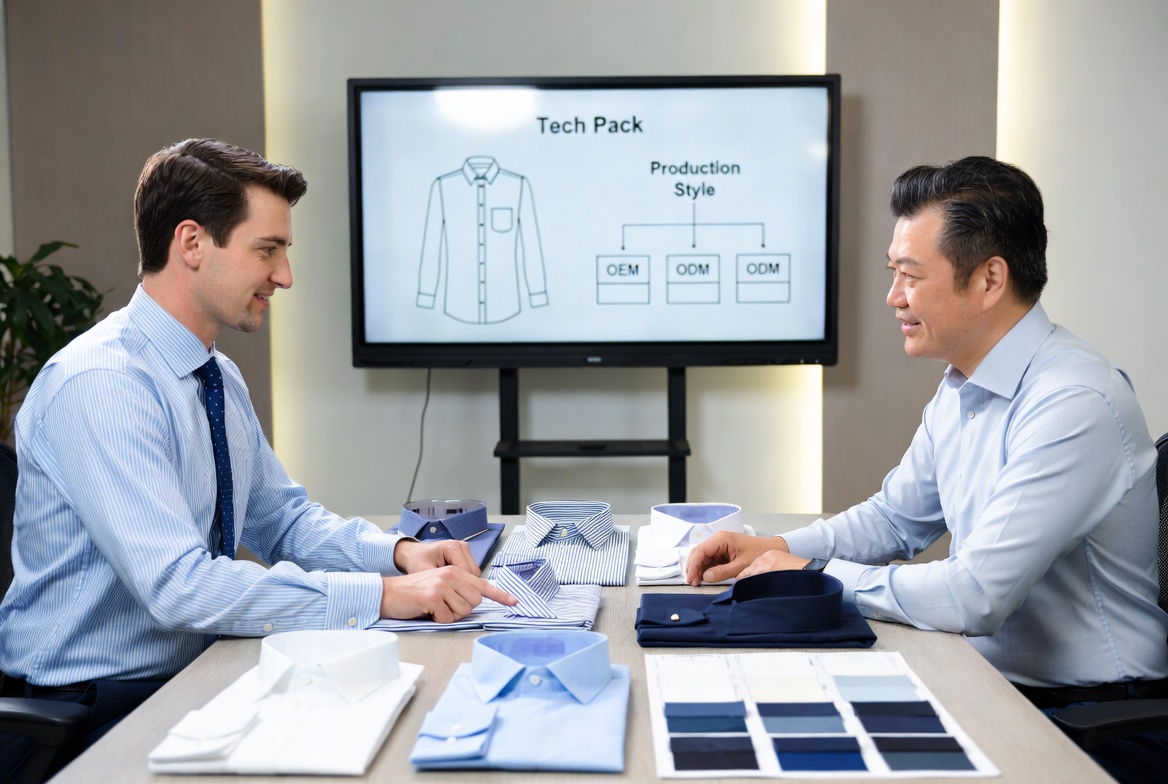
From an OEM/ODM perspective, Youti supports customers through tech packs, images, and physical samples, with sampling lead times of 10–15 days and typical mass production lead times of 45–60 days for formal shirts. The company maintains more than 500 ready‑made designs, offers logo embroidery or printing, and can complete smaller customized orders with 15–20 day delivery, making it a flexible choice for small and medium brands that need faster testing cycles. [texleader.com]
Beijing Henghua Jiachang appears among the 2026 top business attire manufacturers in China, with a strong focus on corporate shirts, suits, and uniforms for domestic and export markets. Located near North China's business and government center, it benefits from proximity to high‑end fabric distributors and testing institutions. [b2bdata.baidu]
The company typically emphasizes standardized production and has experience in supplying large state‑owned enterprises and public sector clients, which often requires stable quality and strict delivery discipline. For foreign buyers, it is more suitable for medium‑to‑large volume corporate shirt programs with clear specifications rather than high‑fashion niche collections. [b2bdata.baidu]
Located in Jiangsu Province, Changzhou Guanghe is part of the Yangtze River Delta textile cluster, with easy access to shirt fabrics, interlinings, and accessory suppliers. It appears in rankings of leading business attire manufacturers thanks to its steady performance in suits and shirts for export markets. [deepmarketinsights]
The factory is known for its integration of woven fabric resources and relatively competitive FOB pricing for mid‑range formal shirts. Buyers looking for cost‑effective, large‑volume basic dress shirts for chain retailers or corporate wear programs can consider this supplier after verifying its ISO certificates and recent audit reports. [linfordco]
Besides Youti, the Shanghai region hosts a number of mid‑sized corporate apparel OEM factories that specialize in shirts and suits for export to Europe and Japan. These factories often leverage Shanghai's logistics advantages (air and sea freight) and access to international testing labs when serving demanding buyers. [texleader.com]
Such suppliers typically maintain ISO 9001 and BSCI certifications, have English‑speaking sales teams, and can support low‑to‑medium MOQs per color for business shirts, especially for corporate uniform projects. When screening these suppliers, experienced buyers pay close attention to pattern‑making ability and how they handle different regional fit preferences (e.g., slimmer fits for EU/Japan vs. more classic cuts for North America). [alibaba]
Dongguan Jinse Garment is mentioned in 2026 rankings of top clothing manufacturers in China and is based in the Pearl River Delta, one of China's most mature apparel manufacturing clusters. While this factory serves multiple apparel categories, it has notable experience in woven garments, including shirts for both casual and semi‑formal scenarios. [jinsegarment]
Being located in Dongguan means proximity to accessory suppliers and high‑efficiency logistics, which supports reliable lead times for export orders. For buyers of business formal shirts, Dongguan‑area factories like Jinse are particularly useful if you need mixed orders that combine office shirts with related products such as uniforms or lightweight jackets. [jinsegarment]
Youngor is a well‑known Chinese menswear group with strong capabilities in suits and formal shirts, operating vertically across fabric, design, and garment production. Its shirt division is oriented more toward branded retail and large corporate projects than purely anonymous OEM, but it remains a benchmark in terms of consistency and pattern quality. [jinsegarment]
For international buyers, Youngor is more suitable as a strategic partner for large volume, long‑term programs, or as an OEM/OBM partner where brand cooperation is possible. Sampling and development cycles tend to be more structured and may lack the flexibility of smaller OEM factories, but in exchange buyers gain highly standardized processes and robust internal testing capabilities. [jinsegarment]
The Ningbo region in Zhejiang Province hosts many export‑oriented woven shirt specialists supplying Europe and North America. These factories commonly focus on yarn‑dyed shirts, Oxford cloth, and poplin business shirts, often with long experience serving catalog retailers and supermarket chains. [deepmarketinsights]
Typical strengths include mature production lines for classic men's formal shirts, competitive pricing at medium and high volumes, and long relationships with European sourcing offices. However, MOQs can be relatively high per color and per pattern, which may not suit emerging DTC brands without careful range planning. [deepmarketinsights]
Foshan, in Guangdong Province, is known for its garment and textile clusters, including manufacturers of uniforms and business shirts. Ruiniu Garment is one example of a factory that straddles formal shirts and corporate uniforms, providing integrated solutions for enterprises that need shirts, blazers, and workwear. [jinsegarment]
Buyers who require coordinated corporate image programs across multiple garment types can benefit from such suppliers because they can consolidate fabrics and trims across categories, improving color consistency and cost efficiency. When evaluating this type of supplier, it is essential to review their experience with your specific industry (e.g., banking, hospitality, industrial) and check whether they hold relevant functional standards (flame resistance, anti‑static, etc.) if required. [chinadirectsource]
According to 2026 B2B data, several top‑ranked shirt and professional clothing manufacturers are located in Shenzhen and surrounding cities, focusing on business attire and corporate uniforms. These factories are often strong in rapid communication, digital pattern‑making, and small‑batch repeat orders due to their experience serving tech, financial, and service industries in South China. [b2bdata.baidu]
They are typically comfortable with Western brands and have experience working under strict data and IP requirements, which is useful for brands with proprietary patterns or logo treatments. Some of these suppliers also provide e‑commerce drop‑shipping‑friendly services such as barcoding, individual polybagging, and integration with warehouse management systems, making them attractive for B2B2C models. [elevatedmagazines]
Jiangsu's Suzhou and Yangzhou regions host a number of factories that rank in top shirt manufacturer lists and provide both business shirts and light workwear. These suppliers typically focus on cost‑effective, durable shirt programs for industrial, logistics, and service sectors, where comfort and easy care are more important than high fashion detailing. [b2bdata.baidu]
MOQs are usually moderate and factories are used to handling repetitive re‑orders from domestic and overseas corporate clients. For overseas sourcing managers, this type of OEM is valuable when you need robust, standardized shirts for large workforces with simple but reliable performance requirements. [b2bdata.baidu]
Beyond the company names, technical details determine whether a supplier can consistently deliver business formal shirts that meet your brand standards.
- Combed cotton and cotton‑rich blends (e.g., 60/40 cotton‑poly) are still mainstream for business shirts, often in the 100–140 gsm range depending on the target market and season. [deepmarketinsights]
- For higher‑end lines, buyers increasingly request long‑staple cottons and better yarn counts to reduce pilling and improve drape, sometimes with added stretch fibers for comfort. [deepmarketinsights]
- Formal shirts exported to the EU must comply with REACH chemical regulations, including restrictions on azo dyes, formaldehyde, and heavy metals. [texleader.com]
Experienced buyers evaluate:
- Stitch density and seam alignment around armholes, side seams, collar and cuff joints; poor workmanship here leads to discomfort and visible defects. [elevatedmagazines]
- Collar and cuff interlinings (fused vs. non‑fused), which affect appearance after multiple washes.
- Button and buttonhole quality, including pull strength and clean finishing.
- Shrinkage and skewing after washing, ideally confirmed at the PP sample stage with clear tolerances (e.g., shrinkage <3% in length and width). [alibaba]
- ISO 9001 confirms that a factory has a structured quality management system, but buyers still need to verify certificate validity and scope online or via the accreditation body. [metafuro]
- BSCI and similar social audits are increasingly requested by European buyers, particularly for corporate and public procurement projects. [alibaba]
- For formal shirts used in industries with specific risks (electrostatic discharge, heat exposure), standards like EN1149‑5 and EN ISO 11612 are relevant; having these indicates that a factory already works with technical fabrics and testing agencies. [texleader.com]
Below is a simplified comparison to help you quickly shortlist candidates. Data points are indicative; always confirm current figures directly with suppliers.
| Manufacturer / Region | Typical annual capacity (shirts & formal items) | Typical MOQ per color/style | Key certifications (examples) | Core markets & positioning |
|---|---|---|---|---|
| Shanghai Youti Clothing Co., Ltd. | >3 million pieces total apparel/year (texleader.com) | Flexible, SME‑friendly | ISO 9001, BSCI, REACH, EN1149‑5, EN ISO 11612 (texleader.com) | Europe‑focused OEM/ODM, small–mid brands, corporate and work‑related formal shirts |
| Beijing Henghua Jiachang Clothing | High (multi‑million, mixed business attire) (b2bdata.baidu) | Medium–high | Often ISO 9001; social audits for public projects (b2bdata.baidu) | Large corporate and institutional buyers, China + export |
| Changzhou Guanghe (Jiangsu) | High (suits & shirts) (b2bdata.baidu) | Medium | ISO 9001; export‑oriented compliance (b2bdata.baidu) | Mid‑range business shirts for chains and corporate wear |
| Shanghai‑area corporate apparel OEM | Medium–high (texleader.com) | Low–medium | ISO 9001, BSCI or equivalent (alibaba) | Corporate uniforms, office shirts, Japan/EU‑focused |
| Dongguan Jinse Garment (Guangdong) | High (multi‑category garments) (jinsegarment) | Medium–high | ISO 9001; export audits (jinsegarment) | Mixed casual and semi‑formal shirts for global brands |
| Youngor Group (formal shirt division) | Very high (vertically integrated) (jinsegarment) | High | Comprehensive internal labs, ISO/QMS | Large strategic programs, brand cooperation, higher‑end formal shirts |
| Ningbo‑area export shirt specialist | High (yarn‑dyed & classic dress shirts) (deepmarketinsights) | Medium–high | ISO 9001, export‑oriented certifications (alibaba) | Catalog retailers, supermarkets, bulk office shirts |
| Foshan Ruiniu Garment (Guangdong) | Medium–high (uniform + shirts) (jinsegarment) | Medium | ISO 9001; sometimes functional standards (jinsegarment) | Corporate uniforms with matching shirts and jackets |
| Shenzhen‑area professional clothing maker | Medium–high (b2bdata.baidu) | Low–medium | ISO 9001, BSCI or similar (b2bdata.baidu) | Fast‑communication OEM, tech/finance uniforms, often e‑commerce‑friendly services |
| Suzhou/Yangzhou corporate shirt & workwear OEM | Medium–high (b2bdata.baidu) | Medium | ISO 9001; basic social compliance (b2bdata.baidu) | Durable shirts for industrial/logistics/service sectors |
1. Request full company credentials
- Ask for a copy of the business license in Chinese, and check it via the official National Enterprise Credit Information Publicity System. [metafuro]
2. Verify ISO and other certificates
- Check issuing and expiry dates, scope, and locations on ISO 9001 certificates. [linfordco]
- Use the International Accreditation Forum (IAF) database or relevant national accreditation body to confirm that the certification body is legitimate. [linfordco]
3. Review third‑party audit reports
- Request recent audits (SGS, Bureau Veritas, etc.) covering quality systems and social compliance. [alibaba]
4. Conduct a remote or on‑site factory audit
- At minimum, arrange a video tour to confirm the existence of production lines, cutting rooms, and QC stations. [chinadirectsource]
5. Check export track record
- Ask for anonymized examples of past PO volumes, key markets, and any long‑term client relationships in your region. [alibaba]
- Always request development samples and size sets before committing to bulk, and clearly state test methods for shrinkage, colorfastness, and seam performance. [alibaba]
- For business formal shirts, confirm collar height, back length, sleeve length, and fit types (slim, regular) per size table to avoid high return rates in your target market. [b2bdata.baidu]
- Set up PP sample sign‑off with clear measurement tolerances, and decide which elements are "critical to quality" (CTQs) with associated penalty clauses in the contract. [chinadirectsource]
- Avoid paying 100% upfront; a typical pattern is 30% deposit and 70% against shipment documents, combined with in‑line and pre‑shipment inspections. [chinadirectsource]
- Use detailed quality specifications and AQL levels in the purchase agreement, and consider third‑party inspection for the first one or two orders with a new supplier. [elevatedmagazines]
- Plan around Chinese New Year and Golden Week, as capacity constraints and logistics congestion during these periods can significantly affect lead times. [chinadirectsource]
- Unrealistically low price offers that hide cheaper fabric or downgraded interlining, resulting in shirts that lose shape after a few washes. [elevatedmagazines]
- "Sample vs bulk" quality gaps, where the initial sample uses better fabric or accessories than the final bulk production. [chinadirectsource]
- Vague communication on fabric specifications (no clear fabric weight, construction, or finishing), making it impossible to hold the supplier accountable. [elevatedmagazines]
- Incomplete labeling or misdeclared content to reduce customs duties, which can create legal risks for the importer. [chinadirectsource]
One widely known but seldom documented practice among experienced buyers is to randomly re‑buy your own product from the supplier's other clients or market channels several months after shipment when working with shirt factories that serve multiple brands. Buyers who do this quietly compare the later‑stage production shirts with their approved PP samples to detect any gradual fabric or construction downgrades that may not appear in early inspections.
If a supplier knows you have this level of market visibility, they are far less likely to switch to lower‑grade interlinings or subtly reduce stitch density after the first few successful orders. This informal "market back‑check" is particularly effective in clusters where multiple clients share similar base shirt models.
China's business formal shirt industry in 2026 offers buyers a wide spectrum of partners—from large, vertically integrated groups to agile OEM/ODM factories like Shanghai Youti Clothing Co., Ltd. that are optimized for small and mid‑sized brands. By focusing on verifiable certifications, clear technical specifications, disciplined QC processes, and realistic MOQs, professional sourcing managers can significantly reduce risk and secure long‑term, compliant supply relationships. [deepmarketinsights]
If you are planning to develop or upgrade your business formal shirt line for Europe, North America, or other markets, it is advisable to shortlist 2–3 factories from different clusters (e.g., Shanghai, Jiangsu, Guangdong) and run parallel pilot orders before locking in a main partner. For buyers seeking a flexible OEM/ODM factory with strong European compliance and the ability to support smaller brands, contacting Shanghai Youti Clothing Co., Ltd. to review existing designs and discuss a customized program can be a practical next step. [texleader.com]
1. How can I verify whether a factory's ISO 9001 certificate is still valid and not expired?
You should always check the certificate number, issuing body, and expiry date, then search the certification body via the national accreditation authority or the International Accreditation Forum (IAF) to confirm status and scope. If the certificate does not appear in the accredited body's database or is past the expiry date, treat it as invalid and ask the supplier for clarification. [linfordco]
2. What's the best way to avoid "sample vs bulk" quality problems for formal shirts?
Define precise fabric specs (fiber content, yarn count, GSM, finishing) and attach them as a contractual annex, then require that bulk fabric be cut only after lab‑dip and fabric swatch approval. Combine this with in‑line inspections and random fabric roll checks, not just final inspection, so any substitution is spotted early. [chinadirectsource]
3. How low can I push MOQs without damaging the relationship or quality?
Many mid‑sized Chinese shirt factories can accept lower MOQs per color if you consolidate fabrics or trims across multiple styles, but very low MOQs may trigger higher unit prices or weaker priority in scheduling. A practical strategy is to start with realistic MOQs (e.g., a few hundred pieces per color) and negotiate down gradually after the factory sees stable repeat orders. [alibaba]
4. How do I ensure EU chemical and safety compliance (e.g., REACH) for my formal shirt collection?
Choose factories with proven REACH experience and ask for test reports from certified labs on representative styles, especially for dark, brightly colored, or printed shirts. Build periodic spot testing into your quality plan, and ensure your technical file clearly defines restricted substances and testing frequency. [texleader.com]
5. How can I adapt Chinese shirt sizing to minimize returns in my local market?
Work with suppliers that have experience in your target region and ask them to provide previous size charts for similar markets as a reference. Then run a small pilot batch with market testing and adjust key measurements (chest, waist, sleeve length, collar size) before committing to larger volumes. [b2bdata.baidu]


