
Views: 251 Author: Youti Clothing Publish Time: 2026-08-10 Origin: Site


Content Menu
>> 1. Shanghai Youti Clothing Co., Ltd.
>> 2. Taian BOWINS Garment Co., Ltd.
>> 8. Suzhou Workwear Cluster Suppliers
>> 9. Shanghai-Area Industrial Uniform Manufacturers
>> 10. Specialized FR and High-Visibility Workwear Suppliers
>> Specify the garment correctly
>> Avoid the sample-to-bulk trap
>> Use the "hidden second supplier" test
>> Verify certificates properly
>> 1. How can I confirm that an ISO certificate has not expired?
>> 2. What is the most reliable way to detect fabric substitution in bulk production?
>> 3. Does every casual work uniform need CE marking?
>> 4. How do I distinguish a factory from a trading company?
>> 5. What lead time should I expect for custom casual work clothes?
China remains a major sourcing base for casual work clothes because buyers can access fabric mills, trim suppliers, embroidery and printing services, pattern development teams, and export logistics within connected manufacturing clusters. For brands, wholesalers, and industrial-uniform distributors, the key benefit is not simply a lower garment price—it is the ability to develop, test, revise, and scale a product with fewer supply-chain handoffs.
The global workwear market is projected to grow from USD 24.05 billion in 2026 to USD 31.63 billion by 2030, with demand supported by durable, multi-functional, branded, and protective work garments. China's workwear market was estimated at USD 2.18 billion in 2023 and is forecast to reach USD 3.07 billion by 2030.
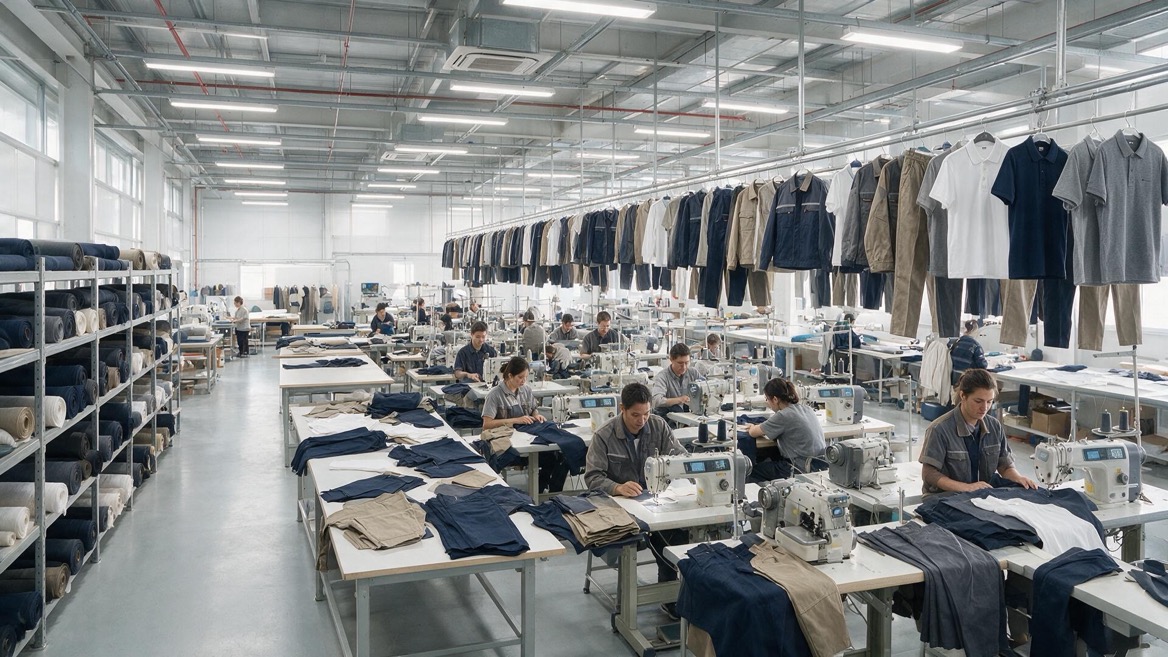
A capable casual work clothes manufacturer should be assessed through evidence rather than brochure claims. This shortlist uses the following buyer-oriented criteria:
- Category fit: Experience with uniforms, work jackets, shirts, trousers, polo shirts, coveralls, or functional outerwear.
- Product development: Ability to work from tech packs, reference samples, measurement charts, artwork, and buyer-approved material standards.
- Quality process: Incoming-fabric checks, in-line inspection, measurement control, final inspection, and documented corrective action.
- Production stability: Clear sampling timeline, realistic bulk lead time, capacity planning, and transparent communication during peak season.
- Export readiness: Familiarity with packaging, labeling, carton marks, shipping documents, and destination-market requirements.
- Compliance evidence: Active management-system certificates and product-specific test reports where needed.
For everyday casual uniforms, buyers should prioritize fabric composition, GSM, shrinkage, colorfastness, seam strength, pilling resistance, and logo durability. For protective products, the technical requirement is different: a supplier must provide test evidence for the exact finished garment, not merely show a generic fabric certificate.
China's Yangtze River Delta and Pearl River Delta clusters are particularly useful for buyers needing fast access to woven fabrics, knitwear, outerwear, printing, embroidery, trims, and export ports. Shanghai also offers a practical coordination advantage for overseas buyers requiring multi-language communication and consolidated shipment planning.
Founded: 2018
Location: Shanghai
Focus: Uniforms, work clothes, suits, shirts, trousers, jackets, polo shirts, and customized business apparel
Main markets: Europe, North America, Oceania, with growth in South America and Southeast Asia
OEM/ODM scope: Tech-pack, picture, or physical-sample development; embroidery, printing, private labeling, and packaging customization
Shanghai Youti Clothing is a practical option for overseas brands and wholesalers that need casual work clothes with a more tailored, brand-oriented appearance. Its product range covers corporate uniforms and work garments alongside formalwear, allowing buyers to develop coordinated collections such as work shirts, jackets, trousers, polos, and outer layers through one supplier.
The company states that it operates 15 assembly lines, has more than 30 automated machines and six automated production chains, with declared annual output exceeding 3 million pieces. It also states that it provides 10–15 day sampling and 45–60 day bulk lead times for customized projects; ready-made designs with logo application may have shorter quoted lead times.
For small and mid-sized brands, its value lies in flexibility: buyers can begin with a technical package, visual reference, or original sample rather than arriving with a fully developed production file. Its stated certifications include ISO 9001, BSCI, REACH, EN 1149-5, and EN ISO 11612; buyers should request the current certificate, scope, issuing body, facility address, and product-specific reports relevant to their order.
Best suited for: Buyers seeking cost-conscious OEM development, business-casual uniforms, flexible communication, and deeper support for custom logos, fabrics, fits, and packaging.
Founded: 2007
Location: Taian, Shandong
Focus: Functional workwear, outdoor clothing, high-visibility garments, protective clothing, and technical outerwear
Main markets: North America, Europe, Australia, and other export markets
OEM/ODM scope: Fabric development, functional garment design, private-label production, and technical workwear customization
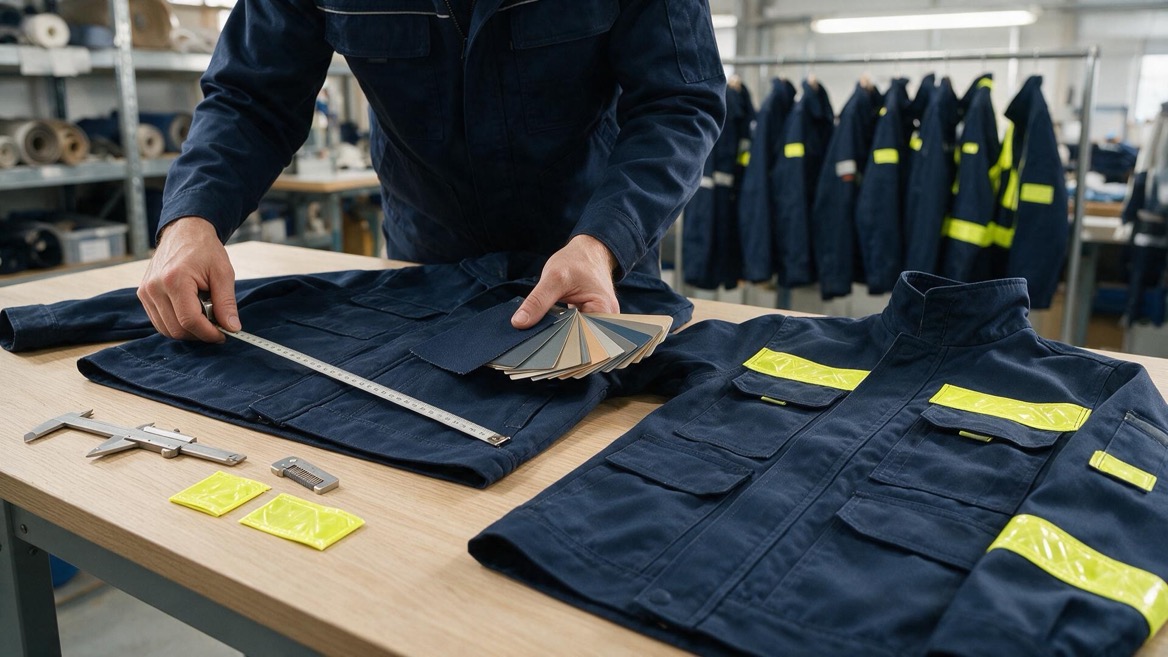
BOWINS Garment is a stronger candidate when a casual work-clothes project overlaps with outdoor performance, waterproofing, high visibility, insulation, or heavier-duty industrial use. The company states that it has an ISO 9001:2015-certified 24,000 m² facility in Taian and a production site in Cambodia, with annual capacity stated at approximately 2 million sets.
Its publicly stated certification portfolio includes ISO 9001:2015, BSCI, OEKO-TEX, and other compliance-related credentials. It also presents high-visibility and protective garment programs. Buyers sourcing safety garments should still verify whether test reports apply to the final garment design, reflective tape placement, fabric color, trims, and intended risk category.
Best suited for: Distributors and brands requiring functional jackets, high-visibility garments, outdoor-inspired workwear, or technical work uniforms.
Founded: 2003
Location: Dongguan, Guangdong
Focus: Custom apparel, women's apparel, uniforms, structured garments, and private-label production
Main markets: International fashion brands, start-ups, and private-label buyers
OEM/ODM scope: Pattern development, samples, labels, trims, custom packaging, and small-to-mid-volume production
Hongyu Apparel is a relevant option for buyers whose casual work-clothes collection needs stronger styling, fit development, or fashion-oriented detailing. While it is not exclusively an industrial-workwear supplier, its custom apparel capabilities can suit hospitality uniforms, retail staff apparel, office-casual uniforms, and branded servicewear.
The company states it was founded in 2003. Buyers should confirm its experience with workwear-specific construction such as bartacks, double-needle seams, reinforced stress points, industrial-wash performance, and repeat-order color consistency before choosing it for demanding uniforms.
Best suited for: Hospitality, retail, service-sector, and lifestyle-workwear brands that need customized silhouettes and brand presentation.
Founded: Public founding year should be confirmed directly
Location: Guangzhou, Guangdong
Focus: Activewear, performance apparel, sportswear, and functional garments
Main markets: International activewear and private-label brands
OEM/ODM scope: Performance-fabric sourcing, apparel development, private labels, printing, and customized production
YOTEX Apparel's performance-apparel background can be useful for casual work-clothes collections designed around comfort, stretch, moisture management, lightweight construction, or mobility. This may include delivery-team polos, active service uniforms, warehouse shirts, flexible work trousers, and modern branded crewwear.
Public information identifies the company as a Guangzhou-based custom garment manufacturer focused on activewear and performance apparel. Before committing, buyers should validate whether the factory's construction methods and fabric-testing routine match the abrasion, laundering, and colorfastness requirements of daily workwear.
Best suited for: Modern service uniforms, mobility-oriented workwear, performance polos, lightweight jackets, and stretch work apparel.
Founded: 2004
Location: Dongguan, Guangdong
Focus: Leisurewear, athletic wear, streetwear, and custom apparel
Main markets: International private-label apparel buyers
OEM/ODM scope: Full-package garment development, custom manufacturing, labeling, packaging, and brand support
Lezhou Garment describes itself as an all-in-one custom clothing manufacturer established in 2004, with a focus on leisure, athletic, and streetwear. Its relevance to casual work clothes is strongest where a buyer wants contemporary uniforms rather than traditional industrial garments—for example, branded crew jackets, retail uniforms, modern work overshirts, corporate polos, or casual trousers.
The supplier should be asked to demonstrate experience with durable workwear fabrics, industrial washing, reinforced seams, and production controls for long-term repeat orders.
Best suited for: Lifestyle-led uniforms, branded casual work collections, retail teams, and promotional staff apparel.
Founded: 1995, according to company-profile information; the supplier also describes 20+ years of production experience
Location: Fujian
Focus: Custom apparel, private-label garments, shirts, sportswear, jackets, and sample development
Main markets: Global brands, wholesalers, and start-up labels
OEM/ODM scope: Pattern making, grading, fabric sourcing, sample making, embroidery, printing, private labeling, and bulk production
Yaroad Clothing is positioned as a full-service custom clothing manufacturer with broad development capabilities. Its published service scope includes pattern making, grading, fabric sourcing, private labels, embroidery, printing, and bulk production. That breadth can be useful to buyers creating multi-item casual workwear lines involving shirts, lightweight jackets, polos, trousers, and branded outerwear.
However, its public founding-year references vary across sources. Buyers should ask for the Chinese business license and confirm the legal entity name, registered address, and manufacturing location before onboarding.
Best suited for: Buyers building varied private-label workwear collections and requiring support from pattern development through finished packaging.
Founded: 2010, according to industry-listing information
Location: Ningbo, Zhejiang
Focus: Casual apparel, children's wear, and multi-category private-label manufacturing
Main markets: Export buyers in multiple consumer markets
OEM/ODM scope: Casual garment development, custom labels, bulk production, and multi-category sourcing
AEL Apparel is typically considered by buyers seeking broad casualwear manufacturing rather than specialized protective workwear. It may be relevant for uniforms in retail, cafés, events, customer-service teams, and promotional operations where fit, color, branding, and price structure matter more than hazard protection.
One industry listing describes AEL Apparel as founded in 2010 in Ningbo and focused on casual and children's apparel. Buyers should treat capacity and certification details as order-specific until confirmed through current factory documents and a third-party audit.
Best suited for: Light-duty uniforms, promotional apparel, staff T-shirts, polos, sweatshirts, and casual branded garments.
Founded: Varies by individual factory
Location: Suzhou and surrounding Jiangsu manufacturing areas
Focus: Corporate uniforms, polos, work jackets, promotional apparel, embroidery, and printing
Main markets: Domestic corporate buyers and export sourcing channels
OEM/ODM scope: Cut-and-sew manufacturing, logo embroidery, printing, basic packaging, and uniform programs
Suzhou is not a single manufacturer, but it is a useful sourcing cluster for buyers who need to compare several uniform factories within one region. Local suppliers often combine garment sewing with embroidery, printing, and relatively fast turnaround for basic uniforms and branded work apparel.
The key purchasing rule is to identify the actual production site. Do not accept a sales office, showroom, or trading-company address as proof of manufacturing capability. Request a live video walk-through of cutting, sewing, finishing, inspection, and packing areas.
Best suited for: Buyers sourcing standard polos, T-shirts, jackets, promotional uniforms, and logo-applied staff garments.
Founded: Varies by individual factory
Location: Shanghai and neighboring Yangtze River Delta cities
Focus: Industrial uniforms, warehouse apparel, logistics uniforms, servicewear, and corporate workwear
Main markets: Europe, North America, Asia-Pacific, and domestic enterprise buyers
OEM/ODM scope: International size grading, pattern adaptation, private labels, export documentation, and shipment coordination
The Shanghai-area supply base is useful for procurement teams that value international communication, proximity to major export logistics, and coordination across multiple material or accessory vendors. Suppliers in this region often serve industrial uniforms, warehouse apparel, logistics clothing, and corporate workwear.
This group should be viewed as a sourcing category rather than a single business. Buyers should create a comparable request-for-quotation package and send it to several factories, using the same tech pack, fabric requirements, inspection standard, and commercial terms.
Best suited for: Importers needing logistics support, multi-country shipment planning, and coordinated custom-uniform programs.
Founded: Varies by individual factory
Location: Shandong, Jiangsu, Zhejiang, Guangdong, and other textile clusters
Focus: Flame-resistant clothing, high-visibility garments, arc-rated clothing, industrial coveralls, and protective uniforms
Main markets: Energy, construction, mining, oil and gas, utilities, and industrial distributors
OEM/ODM scope: Protective garment development, technical documentation, test coordination, logo application, and tender support
This category is relevant only when the garment is intended to protect against a defined workplace risk. For example, high-visibility apparel may require EN ISO 20471 testing, while flame-resistant clothing may require EN ISO 11612, IEC 61482, NFPA 2112, or another standard determined by the destination market and hazard assessment.
For the European Union, CE marking is relevant to personal protective equipment placed on the market under Regulation (EU) 2016/425; it is not a generic quality label for ordinary casual uniforms. RoHS usually applies to electrical and electronic equipment, so it should not be treated as a standard requirement for normal work clothes unless the garment contains an applicable electronic component.
Best suited for: Buyers with clearly defined occupational-safety requirements and the ability to validate product-specific technical documentation.
| Supplier / Supplier Type | Product Focus | Declared or Typical Capacity | MOQ Position | Publicly Stated Compliance Evidence |
|---|---|---|---|---|
| Shanghai Youti Clothing | Uniforms, work clothes, business-casual apparel | 3 million+ pieces/year declared | Quote-specific; suitable for custom projects | ISO 9001, BSCI, REACH, EN 1149-5, EN ISO 11612 stated by supplier |
| Taian BOWINS Garment | Functional, outdoor, high-visibility, technical workwear | Approx. 2 million sets/year declared | Usually project-dependent | ISO 9001:2015, BSCI, OEKO-TEX and other claims stated publicly |
| Hongyu Apparel | Custom apparel and styled uniforms | Not publicly confirmed | Request quote by style | Confirm current documents directly |
| YOTEX Apparel | Performance apparel and stretch-oriented workwear | Not publicly confirmed | Request quote by style | Confirm current documents directly |
| Lezhou Garment | Leisurewear and casual private-label apparel | Not publicly confirmed | Request quote by style | Confirm current documents directly |
| Yaroad Clothing | Multi-category custom apparel | Not publicly confirmed | Request quote by style | Confirm current documents directly |
| AEL Apparel | Casual apparel and light-duty uniforms | Not publicly confirmed | Request quote by style | Confirm current documents directly |
| Suzhou cluster suppliers | Basic uniforms, polos, logo apparel | Factory-specific | Often flexible for standard items | Factory-specific |
| Shanghai-area suppliers | Industrial and corporate uniforms | Factory-specific | Factory-specific | Factory-specific |
| FR / high-visibility specialists | Protective workwear | Factory-specific | Usually higher due to certified materials | Product-specific tests are essential |
Capacity, MOQ, and certification statements should never be copied into a purchase order without document review. A factory may have a valid management-system certificate but lack certification for the specific garment, fabric, reflective tape, or protective performance your project requires.
A vague request such as "durable work jacket" produces inconsistent quotations. Your request should define:
- Fiber composition and allowed tolerance, such as 65% polyester / 35% cotton
- Fabric weight in GSM
- Fabric construction, such as twill, ripstop, canvas, fleece, pique, or softshell
- Color standard, preferably Pantone or approved lab dip
- Measurement chart and permitted tolerances
- Stitch density, seam type, bartacks, and reinforcement points
- Logo process, position, size, color, and washability requirement
- Packaging, carton marks, barcode labels, and country-of-origin label
- Test requirements, inspection level, and acceptable defect threshold
For daily casual work clothes, 65/35 poly-cotton twill is common because it balances comfort, crease resistance, drying speed, and abrasion resistance. Higher-cotton constructions can improve hand feel but may shrink more; heavier polyester content can improve durability but may reduce breathability. The right choice depends on climate, job activity, laundering frequency, and price target.
The most common sourcing failure is not an obviously poor sample. It is a bulk order that looks similar but uses lower-grade fabric, substituted trims, weaker thread, less dense embroidery, or a different dye lot.
Use this control sequence:
1. Approve a development sample for silhouette and construction.
2. Approve a pre-production sample made with bulk-approved fabric and trims.
3. Approve a size set across the full size range.
4. Seal fabric swatches, trims, logo artwork, and the approved sample.
5. Require final inspection against the sealed reference before balance payment.
A rarely discussed risk is that a supplier may show you one factory during the audit but subcontract peak-season production elsewhere. The practical control is to require written disclosure of all outsourced processes—including fabric dyeing, printing, embroidery, washing, and sewing—and to state that no production-site substitution is permitted without written approval.
For a new supplier, place a controlled pilot order across several sizes or colorways instead of jumping from samples to a large annual order. This exposes how the supplier manages material delays, grading errors, color corrections, and communication under real production pressure.
For ISO 9001 or similar management-system certificates:
- Match the legal company name with the Chinese business license.
- Match the certified address with the actual production address.
- Check the certificate scope; "trading" or "sales" is not equivalent to garment manufacturing.
- Confirm the certificate number, expiry date, certification body, and accreditation.
- Search the certificate through, which provides certificate status and related details for accredited certification records.
For protective clothing, request the complete report for the finished garment or the relevant material system—not a cropped image or unrelated report. Check the report date, test standard, sample description, color, fabric construction, trim details, and laboratory identity.
For new relationships, avoid 100% advance payment. A typical structure may include a deposit, a milestone linked to pre-production approval or in-process inspection, and a balance linked to final inspection and shipping documents. The exact arrangement depends on the order value, relationship history, and agreed Incoterms.
Build time buffers for fabric booking, lab dips, sample approval, testing, peak-season production, port congestion, customs clearance, and destination-market labeling changes. If the garments are essential to a workforce rollout, maintain safety stock for core items and proven sizes.
Ask for the full certificate and verify the certificate number, company name, certified address, scope, certification body, status, and expiry date. Search the issuing body's database and IAF CertSearch. A certificate may be valid but still apply to a different site or business activity, so address and scope matching are essential.
Seal the approved bulk-fabric swatch, state the exact fiber composition and GSM in the purchase order, and conduct random bulk-fabric testing before or during production. At minimum, compare fiber content, GSM, color, shrinkage, colorfastness, and pilling performance with the approved sample. Include a remedy clause for unapproved substitutions.
No. CE marking is relevant when the garment qualifies as personal protective equipment under applicable European Union rules. Ordinary office, retail, hospitality, warehouse, or service uniforms do not automatically require CE marking. Protective claims should be based on a documented hazard assessment and the applicable product standard.
Request the Chinese business license, factory address, production-line video, equipment list, employee information, recent audit report, and production schedule. Ask for a live video call during working hours that covers cutting, sewing, finishing, inspection, and packing—not only a showroom. A trading company may still be useful, but it should disclose its role and the real production site.
For a new custom program, allow time for development samples, material approval, pre-production approval, and bulk manufacturing. Shanghai Youti Clothing states a 10–15 day sample period and 45–60 day bulk lead time for customized orders, while actual schedules vary by fabric availability, decoration method, quantity, and season. Buyers should lock fabric booking and approvals early, then include a contractual delivery window and defined response process for delays.
For buyers sourcing flexible OEM casual work clothes, start with a detailed tech pack, one target price range, projected annual volume, and your destination market. Shanghai Youti Clothing can be considered for brands seeking uniforms and workwear with customized development support, coordinated communication, and scalable private-label production.
- [China National Bureau of Statistics] — official national statistical data portal. [stats.gov]
- [China workwear market outlook] — market-size and forecast reference. [grandviewresearch]
- [Workwear Market Report 2026] — global market forecast and industry trends. [researchandmarkets]
- [EU Regulation 2016/425 on personal protective equipment] — CE-marking framework for applicable PPE. [eur-lex.europa]
- [IAF CertSearch] — certificate-status verification resource. [iafcertsearch]


