
Views: 228 Author: Youti Clothing Publish Time: 2026-10-05 Origin: Site


Content Menu
● Introduction: Why Source Chef Coats from China?
● Selection Criteria: How This Supplier Shortlist Was Developed
>> 1. Product Relevance and Development Capability
>> 2. Quality-Control Transparency
>> 3. Capacity and Delivery Credibility
● The List: 10 Chinese Chef-Coat Manufacturing Candidates
>> 1. Shanghai Youti Clothing Co., Ltd.
>> 2. Beijing Duomilai Garments & Attire Co., Ltd. / CHECKEDOUT
>> 4. Shandong Teller Textile Co., Ltd.
>> 5. Qingdao E-Song Apparel & Accessories Co., Ltd.
>> 6. Shanghai Zhengxing Clothing Co., Ltd.
>> 7. Wuhan Corhunter Garment Co., Ltd.
>> 8. Guangzhou Jinhui Clothing Co., Ltd.
>> 9. Guangzhou Profound Garment Co., Ltd.
>> 10. Hanzhou (Guangzhou) Clothing Industry Co., Ltd.
● Supplier Comparison: Capacity, MOQ, and Compliance Evidence
● Technical Buyer's Guide: What Makes a Reliable Chef Coat?
>> Specify Materials Beyond "Premium Fabric"
>> Control Construction and Fit
>> Use the Right Compliance Framework
● Common Procurement Pitfalls—and How to Avoid Them
>> Pitfall 1: An Approved Sample Made from Different Fabric
>> Pitfall 2: Confusing Listed Output with Available Capacity
>> Pitfall 3: Comparing Incompatible MOQs
>> Pitfall 4: Approving Appearance Without Laundry Testing
● An Overlooked Sourcing Trap: Test the Finished Garment, Not Just the Fabric
● Factory Verification, Sampling, and Logistics
>> Verify the Contracting and Manufacturing Entities
>> Follow a Controlled Sample Sequence
>> Compare Landed Cost, Not Just Unit Price
● Conclusion: Select a Repeatable Manufacturing Partner
● FAQs
>> 1. How Can I Check Whether a Factory's ISO Certificate Has Expired?
>> 2. Does an OEKO-TEX-Certified Fabric Automatically Make the Chef Coat Certified?
>> 3. How Should Buyers Resolve Conflicting Capacity Claims?
>> 4. Can a Supplier Manufacture Exact Copies of Chef Works Designs?
>> 5. What Should a Buyer Do When the Sample Passes but Bulk Goods Fail?
China offers a broad sourcing base for chef coats, restaurant uniforms, and private-label hospitality apparel. For international brands, wholesalers, and manufacturers, the opportunity extends beyond competitive production costs: buyers can access fabric development, pattern engineering, embroidery, packaging, and export support within established textile supply chains.
However, choosing a long-term supplier requires more than comparing photographs and unit prices. A chef coat must maintain its fit, appearance, and functionality through repeated wear and laundering. Procurement teams therefore need to evaluate material consistency, construction quality, production capacity, compliance documentation, and delivery reliability.

China's advantage lies in the depth of its textile and garment supply chain. Buyers can source woven fabrics, ventilation panels, sewing threads, buttons, embroidery, and finished garments through interconnected manufacturing networks.
Shaoxing's Keqiao textile hub supports extensive fabric sourcing, while Guangzhou's Zhongda market connects fabric and accessory suppliers with nearby apparel manufacturers. These clusters give procurement teams access to different development models, from stock-fabric sampling to larger custom-material programs.
Recent export reporting also demonstrates the scale of the sector. Fibre2Fashion reported that China's textile and apparel exports reached $293.77 billion in 2025, down 2.42% from the previous year. This figure covers the overall textile and apparel industry—not chef coats specifically. It should not be interpreted as the size of China's chef-uniform market.
A separate analysis based on China Customs statistics reported apparel exports of $137.81 billion during January–November 2025. Woven garment export volume increased 4.3%, while average export prices decreased 8.8%. For buyers, this combination reinforces the importance of checking whether a lower quotation reflects improved efficiency or a reduced material specification.
The practical sourcing question is therefore not simply, "Which factory is cheapest?" It is, "Which supplier can reproduce an approved chef coat consistently at a commercially workable cost?"
This is an editorial sourcing shortlist, not an independently audited ranking of China's largest or highest-performing chef-coat factories.
Shanghai Youti Clothing Co., Ltd. appears first because this guide is prepared for its website. That placement is a publishing decision, not proof that it outperforms every other supplier.
The assessment uses publicly available manufacturer pages and supplier profiles. Company-reported figures remain claims until buyers verify them through documentation, factory checks, and production trials.
Priority goes to companies with documented chef-uniform products or relevant uniform-development services.
A suitable supplier should explain how it manages:
- Pattern development and size grading.
- Fabric selection and substitution control.
- Branding, labels, and packaging.
- Sample revisions.
- Repeat-order consistency.
General garment experience can be useful, but it does not automatically demonstrate chef-coat expertise.
Procurement teams should request actual inspection forms, not just statements about "strict quality."
Useful evidence includes incoming fabric checks, measurement records, in-line inspection reports, needle-control procedures, and final inspection results.
Annual output across all clothing categories is not the same as available chef-coat capacity.
Buyers should distinguish owned production from subcontracted production and ask how much capacity can be allocated to their specific style during the required delivery window.
Certificates must match the legal company, manufacturing location, product scope, and validity period.
ISO 9001 concerns a quality-management system. OEKO-TEX STANDARD 100 addresses harmful-substance testing within its certified article scope. Neither automatically guarantees durability, fit, or suitability for industrial laundering.
The right supplier depends on order size and product complexity. A factory suited to a large distributor may be unsuitable for a small brand developing several colors in limited quantities.
The profiles below identify those distinctions and flag missing information rather than assigning invented scores.
Shanghai Youti offers a relevant starting point for brands seeking coordinated apparel development and production support.
- Founded: 2018.
- Location: Shanghai.
- Reported markets: Europe is its largest market; North America and Oceania are also identified as core markets.
- OEM scope: Production from technical documents, images, and physical samples; embroidery and printing; fabric-selection advice and sampling.
- Reported manufacturing resources: A 2,500-square-meter workshop, more than 300 machines and equipment sets, and six sewing lines.
- Reported annual output: More than 1.4 million garments across its product range.
Its value proposition is the combination of development support, broad uniform manufacturing, and a dedicated project-management approach. The company describes separate design and development, sampling and production, and quality-inspection functions.
For small and medium-sized brands, those services may reduce coordination work when developing custom chef coats alongside shirts, trousers, and other hospitality garments. Its website states sampling lead times of 10–15 working days and bulk production lead times of 45–60 working days.
Youti is worth evaluating as a potentially cost-effective OEM partner, but that positioning should be tested through comparable quotations and samples. A low chef-coat MOQ and chef-specific production capacity are not publicly established on the reviewed page.
Its website lists ISO 9001, BSCI, REACH, EN 1149-5, and EN ISO 11612 credentials. Buyers should request the underlying certificates, audit reports, and test documents. These references should not be treated as interchangeable certifications or assumed to cover every chef-coat design.
CHECKEDOUT has a more directly chef-focused public product presentation than many general uniform suppliers.
- Brand established: 1995, according to its website.
- Headquarters: Beijing.
- Reported market reach: More than 50 countries; the reviewed evidence does not establish the leading destinations.
- OEM scope: Chef uniforms developed from customer samples and requirements.
- Core strength: A dedicated culinary-apparel range, including chef coats and aprons.
Its product descriptions emphasize wash-resistant fabrics and designs intended for kitchen use. This makes it a relevant candidate for distributors seeking a specialist culinary-uniform collection rather than a broad workwear catalog.
The main verification task is to establish the contracting legal entity, ownership of proposed designs, and current factory capacity. A product page mentions monthly output exceeding 5,000 pieces, but buyers should not interpret a single listing as a verified, company-wide capacity statement.
Anbu Safety combines chef-uniform supply with a broader safety-workwear offering.
- Chef-uniform supply history: Since 2008, according to its website.
- Reported export destinations: The United States, Germany, the United Kingdom, France, Austria, the Middle East, and Africa, among others.
- OEM scope: Custom chef coats, kitchen uniforms, colors, logos, and branded packaging.
- Published usual MOQ: 1,000 pieces per style.
- Core strength: Consolidated sourcing for uniform distributors carrying multiple workwear categories.
The published MOQ makes Anbu more relevant to established wholesale programs than very small trial collections.
Its page also references EN 11612 and UL credentials for coveralls. Buyers should not transfer those claims to ordinary chef coats without product-specific evidence. Confirm which documents apply to the exact garment being purchased.
Teller combines fabric and garment production, making it a useful candidate for buyers who want closer material-development involvement.
- Founded: 2014.
- Location: Rizhao, Shandong.
- Reported markets: Japan, the United States, Europe, Russia, and the Middle East.
- Development scope: Design, development, production, and export of workwear and uniforms.
- Reported monthly capacity: 40,000 woven garments and 10,000 knitted garments.
- Core strength: A combined fabric-and-garment business with chef-jacket products.
Its chef-uniform catalog includes a 215 GSM long-sleeve chef jacket with mesh construction, providing a concrete starting point for discussing fabric weight and ventilation.
Teller states that production follows the ISO 9001 quality system. That statement should be supported by a current certificate covering the relevant legal entity and manufacturing site before it is described as verified certification.
E-Song is relevant to importers purchasing both culinary and healthcare uniforms.
- Reported manufacturing history: Producing uniforms since 2014; confirm legal incorporation separately.
- Location: Shandong.
- Reported markets: The United States and Australia; a marketplace profile also identifies Europe.
- OEM/ODM scope: Design support, fabric selection, logos, labels, and packaging.
- Core strength: Medical and chef-uniform development, including stretch-fabric options.
Its public materials mention polycotton-spandex and twill chef-uniform designs. This makes it worth evaluating for collections requiring mobility alongside a conventional professional appearance.
Capacity needs particular attention. Its website states 300,000 units per month, a September 2026 release states 200,000, and a marketplace profile states 100,000. These figures may reflect different dates or production scopes, but the discrepancy is unresolved. Buyers should request a dated breakdown of owned and subcontracted capacity rather than selecting the largest number.
Zhengxing is a candidate for buyers seeking coordinated restaurant and hospitality uniforms.
- Established: 2004, according to a supplier profile.
- Location: Shanghai.
- Listed markets: Domestic China, Europe, North America, Oceania, and other regions.
- Product focus: Workwear and restaurant or bar uniforms, including chef jackets.
- Core strength: A hospitality-uniform offering that can be evaluated alongside broader staff apparel.
Its public chef-jacket category supports inclusion in an initial sourcing shortlist. However, the reviewed evidence does not establish a current chef-coat MOQ, dedicated production capacity, or verified certification portfolio.
Buyers should ask which operations occur in-house, whether pattern development and grading are available, and how custom labels and embroidery are managed. OEM and ODM responsibilities should be written into the quotation rather than inferred from a broad uniform catalog.
Corhunter primarily presents itself as a tactical and technical-workwear manufacturer, while also listing chef uniforms.
- Founded: 2007.
- Location: Wuhan, Hubei.
- Reported facility: A 5,000-square-meter factory.
- Main geographic markets: Not established in the reviewed company page.
- OEM/ODM scope: Customization from drawings and samples.
- Core strength: Broad uniform development and stated support for small custom orders.
Corhunter may suit distributors consolidating several uniform categories with one supplier. Its website explicitly describes support for small-order customization, although it does not publish a binding chef-coat MOQ.
Because its main specialization is not culinary apparel, buyers should require chef-specific samples and laundering tests. Technical-workwear experience is useful, but it does not replace evidence of comfortable chef-coat fit and suitable kitchen-uniform construction.
Jinhui has a substantial publicly visible chef-uniform catalog.
- Founding year: Not confirmed in the reviewed sources.
- Location: Tianhe District, Guangzhou.
- Listed main market: Domestic China.
- OEM/ODM scope: Custom-logo chef uniforms and broader uniform production.
- Core strength: Chef coats offered alongside school, medical, security, and general work uniforms.
- Listing-level MOQ examples: Approximately 50–100 pieces for selected chef-uniform products.
Those product-level MOQs make Jinhui worth contacting for smaller catalog-based orders. However, a listed MOQ does not automatically apply to custom-dyed fabric, exclusive patterns, or a full private-label collection.
The company profile describes more than 15 years of team expertise. That is not a verified incorporation date. Overseas buyers should also confirm export execution, destination-market documentation, and the legal company name used on the contract.
Profound offers broad apparel development rather than a chef-uniform-only specialization.
- Founded: 2010.
- Location: Guangzhou.
- Reported markets: North America, Europe, Saudi Arabia, and other overseas regions.
- OEM/ODM scope: Product development, manufacturing, and related export support.
- Core strength: Supporting small and medium-sized apparel brands.
- Chef-coat relevance: Marketplace listings include custom chef uniforms.
Its experience may be relevant to brands developing design-led hospitality collections that combine chef jackets, casual shirts, trousers, and branded apparel.
Nevertheless, its main public categories are casual garments. Buyers should verify recent chef-coat production rather than assume that general jacket expertise covers industrial-laundry requirements. Selected chef-coat listings show MOQs of 100–200 pieces, depending on the product.
Hanzhou is another candidate for coordinated hospitality and general uniform programs.
- Founding year: Not confirmed in the reviewed sources.
- Location: Guangzhou.
- Listed main market: North America.
- OEM/ODM scope: Custom chef coats, embroidery, and broader uniform products.
- Core strength: A chef-and-hotel-uniform category within a wider apparel offering.
Its catalog includes short-sleeve chef jackets and customized hotel-restaurant uniforms. That product coverage makes it suitable for an initial quotation comparison.
Before shortlisting it for production, buyers should verify the relationship between the named company, factory references in its profile, and the actual production address. Dedicated capacity, current certifications, and custom-program MOQs remain to be confirmed.
The figures below are company-reported or listing-level information. They are not independently verified production commitments.
| Supplier | Published capacity information | Chef-coat MOQ evidence | Certification or compliance evidence reviewed |
|---|---|---|---|
| Shanghai Youti | More than 1.4 million garments annually; all categories | Not published on reviewed page | Lists ISO 9001, BSCI, REACH and protective-clothing standards; verify scope and documents. |
| CHECKEDOUT / Duomilai | One listing states more than 5,000 pieces monthly | Confirm by style | No current certificate independently verified in this review. |
| Anbu Safety | Not established in reviewed page | Usually 1,000 pieces per style | References coverall credentials; not automatic chef-coat coverage. |
| Shandong Teller | 40,000 woven and 10,000 knitted garments monthly | Confirm by style and fabric | States production follows ISO 9001; request certificate. |
| E-Song | Conflicting claims of 100,000, 200,000 and 300,000 units monthly | A release states 300 pieces/style/color using its fabric | Current capacity and certificate scope require clarification. |
| Shanghai Zhengxing | Not established | Not established | No current certificate independently verified. |
| Wuhan Corhunter | Reports 5,000 m² factory; unit output not established | States small-order support; numerical MOQ unconfirmed | General quality-management claim; request supporting records. |
| Guangzhou Jinhui | Not established | Selected listings: 50–100 pieces | Listing badges do not establish product certification. |
| Guangzhou Profound | Not established in reviewed official page | Selected chef listings: 100–200 pieces | No current chef-specific certification verified. |
| Hanzhou Guangzhou | Not established | Confirm by specification | No current certificate independently verified. |
A supplier with incomplete public information is not necessarily unsuitable. However, missing information increases the documentation work needed before placing an order.
"Premium polycotton" is not an enforceable purchasing specification.
Your technical pack should define:
- Fiber composition.
- Fabric weight and tolerance.
- Weave or knit structure.
- Color reference and shade tolerance.
- Required washing conditions.
- Dimensional-change limits.
- Colorfastness requirements.
- Performance requirements for mesh, elastic, and other secondary materials.
Teller's published 215 GSM chef jacket illustrates why weight should be stated numerically. However, fabric weight alone does not prove comfort or durability; the finished garment still needs testing under the intended use conditions.
For a new program, ask suppliers to quote several clearly specified fabric options. Compare tested samples rather than relying on "Grade A" terminology that has no defined meaning in the purchase contract.
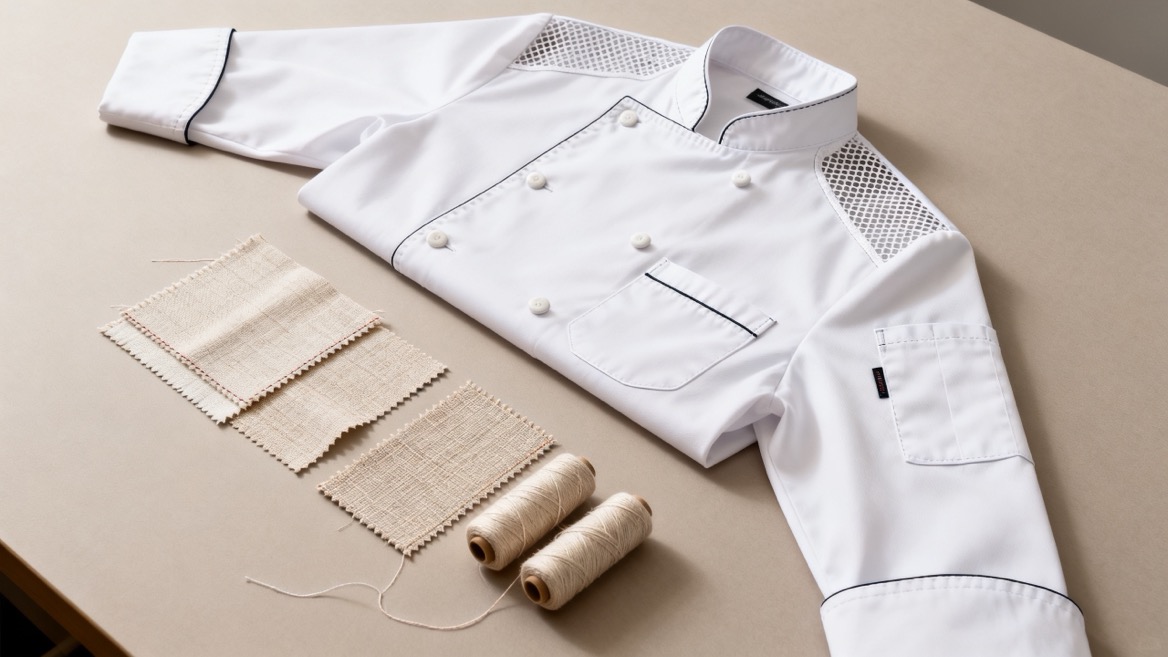
Include measurable construction requirements:
- Seam type and stitch density.
- Reinforcement at pocket openings and other stress points.
- Button or snap attachment requirements.
- Collar shape and finished dimensions.
- Sleeve opening and mobility requirements.
- Measurement tolerances by size.
- Logo position and embroidery backing.
- Clean finishing around ventilation panels.
Treat these as buyer-defined requirements. Their acceptance limits should match the intended garment, wearer, and laundry process rather than being copied from an unrelated product.
Ordinary chef coats should not automatically be marketed as CE-certified products.
European guidance states that CE marking applies only where relevant harmonized rules require it; where no such requirement applies, the marking must not be used. A garment sold as protective equipment requires a separate assessment from an ordinary hospitality uniform.
RoHS concerns electrical and electronic equipment. It is generally not the appropriate certification target for a conventional chef coat without electronic components.
OEKO-TEX STANDARD 100 is more directly relevant to harmful-substance assurance for textiles. Verify the certificate number and article scope through the official Label Check rather than assuming a fabric certificate covers the finished garment.
Likewise, treat REACH documentation as evidence against applicable chemical requirements, not as a universal quality badge.
A sample can look satisfactory while the production quotation leaves room for material substitution.
Specify the approved fabric code, supplier or mill where appropriate, composition, weight, finish, and color. Require written approval before any substitution.
A factory's total annual output does not establish its ability to deliver your order next month.
Request a dated production plan showing material arrival, cutting, sewing, finishing, inspection, and shipment milestones. Clarify which stages will be subcontracted.
A low MOQ may apply only to stock colors or existing designs.
Ask for separate minimums covering:
- Stock-fabric garments.
- Custom-dyed fabrics.
- Exclusive patterns.
- Embroidered logos.
- Woven labels.
- Individual packaging.
A visually attractive sample is not sufficient for a repeat-use uniform program.
Run the approved sample through the intended laundry process. Recheck measurements, seams, closure security, color, embroidery, and overall appearance.
One useful procurement safeguard is to test component compatibility.
A chef coat combines shell fabric, mesh, thread, interlining, labels, embroidery, and closures. A satisfactory shell-fabric report does not prove that the complete garment will behave consistently after washing.
Specify a finished-garment laundering trial before bulk approval. Measure the shell and inspect panel junctions, collar shape, embroidery areas, and closures afterward.
This recommendation is a risk-control method, not a claim that any supplier listed here has experienced such failures. Its purpose is to close the gap between fabric approval and finished-product approval.
Request the Chinese business license, legal company name, production address, and bank-beneficiary details.
Then establish who performs pattern development, cutting, sewing, embroidery, finishing, and packing. If subcontracting is permitted, identify the approved sites in writing.
A practical sequence is:
1. Prototype sample for design and construction review.
2. Fit sample for measurements and mobility.
3. Size-set samples for grading approval.
4. Pre-production sample using approved materials and trims.
5. Laundered sample for performance review.
6. Pilot production and inspection before scaling.
Retain an approved reference sample and revision-controlled technical pack. Record every change rather than relying on email descriptions such as "same as last time."
Make quotations commercially comparable by defining the delivery term and what it includes.
Confirm sample charges, fabric-development costs, branding, testing, inspection, packaging, freight, insurance, and destination charges as applicable. Ask a customs broker to confirm garment classification and current import treatment for the destination.
Build the launch schedule around material approval, production, inspection, and transit—not only the quoted sewing lead time.
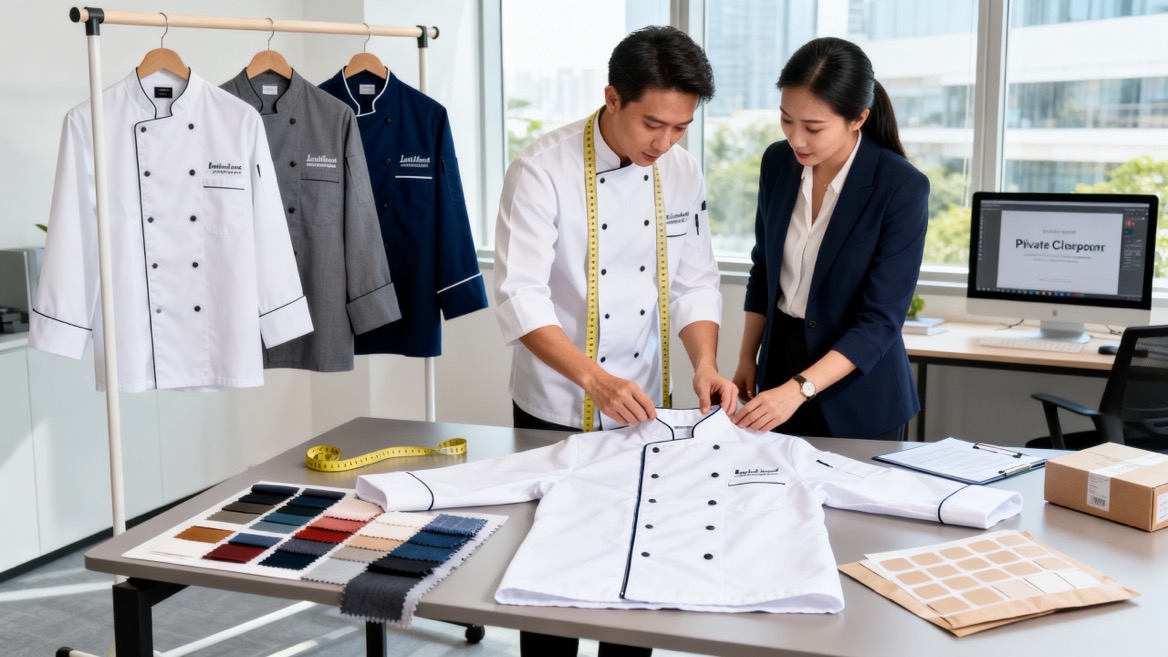
A useful chef-coat shortlist must distinguish specialist culinary suppliers from broader uniform and apparel manufacturers. It must also separate published claims from verified production capability.
Shanghai Youti Clothing Co., Ltd. offers documented development, sampling, customization, and project-management services that make it a relevant first candidate for private-label uniform programs. Its reported resources and export-market coverage provide a basis for further evaluation—not a substitute for sample approval and document verification.
For your next chef-coat project, send Youti a technical pack, intended order quantities, target markets, size breakdown, branding requirements, and laundry conditions. Request a specification-based quotation, sample schedule, proposed materials, and supporting compliance documents before confirming production.
Search the legal company name or certificate number in IAF CertSearch. Review the status, standard, scope, site information, issuing certification body, and accreditation details.
IAF's verification guidance distinguishes active, suspended, withdrawn, and expired certificates. If information is missing or inconsistent, contact the issuing certification body directly rather than accepting a PDF at face value.
No. Verify whether the certificate covers the fabric only or the finished article.
OEKO-TEX explains that certified articles are assessed within their defined scope, and finished-product claims require attention to their components. Buttons, labels, thread, embroidery, and other inputs should not be ignored. Check the number through the official verification service.
Ask for a dated explanation that separates owned-factory output, subcontracted capacity, product categories, shifts, and currently available production slots.
Then verify the proposed order allocation through a production schedule and factory assessment. E-Song's differing public figures illustrate why capacity should be clarified rather than accepted as a single headline number.
Do not assume that it can do so lawfully. Chef Works is a distinct brand, and reporting describes its designs as proprietary.
For private-label sourcing, develop your own technical pack and branding. If genuine branded products are required, seek documented authorization through the appropriate brand channel. A supplier's photograph or verbal assurance does not establish authorization.
Define the response before production starts.
The contract should connect acceptance to the approved sample, technical pack, test requirements, and inspection procedure. It should also state how nonconforming goods will be handled: rework, replacement, retesting, shipment delay, or another agreed remedy.
Require written root-cause analysis and corrective action before accepting the next batch. Do not approve shipment simply because the order is already packed.
- Shanghai Youti company information: [https://www.work-jacket.com/aboutus.html] [work-jacket]
- CHECKEDOUT brand information: [https://www.checkedoutchef.com/] [checkedoutchef]
- CHECKEDOUT OEM product information: [https://www.checkedoutchef.com/high-quality-china-chef-coat-product/] [checkedoutchef]
- Anbu chef-uniform services and MOQ: [https://www.anbusafety.com/chef-uniform-supplier/] [anbusafety]
- Shandong Teller company profile: [https://www.tellertex.com/aboutus.html] [tellertex]
- Shandong Teller chef-uniform catalog: [https://www.tellertex.com/supplier-408005-chef-uniform] [tellertex]
- E-Song company information: [https://www.e-songuniforms.com/about-us/] [e-songuniforms]
- E-Song September 2026 company-issued release: [https://www.einpresswire.com/article/941378858/top-medical-uniform-and-chef-uniform-manufacturer-in-china-e-song-apparel-on-fabrics-and-customization] [einpresswire]
- Shanghai Zhengxing supplier profile: [https://zxgarment.goldsupplier.com/about.html] [zxgarment.goldsupplier]
- Wuhan Corhunter company information: [https://www.corhunter-garment.com/about-us] [corhunter-garment]
- Guangzhou Jinhui company profile: [https://jinhuiclothing.en.made-in-china.com/company-Guangzhou-Jinhui-Clothing-Co-Ltd-.html] [jinhuiclothing.en.made-in-china]
- Guangzhou Profound company information: [https://www.profoundgarment.com/about-us/] [profoundgarment]
- Hanzhou chef-and-hotel-uniform catalog: [https://chinaxinyu.en.made-in-china.com/product-group/qbcfKdMuyLVF/Chef-and-Hotel-Uniforms-1.html] [chinaxinyu.en.made-in-china]
- China's 2025 textile and apparel export reporting: [https://www.fibre2fashion.com/news/trade-news/china-s-textile-apparel-exports-down-2-42-in-2025-307889-newsdetails.htm] [fibre2fashion]
- January–November 2025 apparel-export analysis based on China Customs data: [https://www.texleader.com.cn/en/news-35339.html] [texleader.com]
- China National Textile and Apparel Council participant page and 2024–2025 responsibility-report listing: [https://unglobalcompact.org/what-is-gc/participants/2072-China-National-Textile-and-Apparel-Council-CNTAC-] [unglobalcompact]
- European Union official CE-marking guidance: [https://europa.eu/youreurope/business/product-rules-compliance/general-product-compliance/ce-marking/index_en.htm] [europa]
- European Commission official RoHS guidance: [https://environment.ec.europa.eu/topics/waste-and-recycling/rohs-directive_en] [environment.ec.europa]
- International Accreditation Forum certificate-verification guidance: [https://iaf.nu/en/certsearch/] [iaf]
- IAF CertSearch: [https://www.iafcertsearch.org/] [iafcertsearch]
- OEKO-TEX STANDARD 100 and verification guidance: [https://www.oeko-tex.com/en/our-standards/oeko-tex-standard-100/] [oeko-tex]
- Chef Works official brand website: [https://www.chefworks.com/] [chefworks]


