
Views: 292 Author: Youti Clothing Publish Time: 2026-07-02 Origin: Site


Content Menu
● Introduction: Why China for Custom Workwear
● How We Evaluated Top Suppliers
● Key Technical Factors in Custom Workwear
● China's Industrial Clusters and Workwear Advantage
● Top 10 Custom Workwear Manufacturers in China (2026)
>> 1. Shanghai Youti Clothing Co., Ltd.
>> 2. Taian BOWINS Garment Co., Ltd.
>> 3. Shanghai Changwei Industrial Co., Ltd.
>> 4. Linyi Bangneng Labor Protection Products Co., Ltd.
>> 5. Disheng Group (Workwear Division)
>> 6. BOWINS (Alternative Workwear Unit)
>> 7. Jihua Group (State‑Linked Workwear and PPE)
>> 8. Giuseppe (Giuseppe Workwear)
>> 9. Additional Regional Cluster Suppliers
>> 10. OEM-focused Trading–Factory Hybrids
● Supplier Snapshot Table: Capacity, MOQ, and Certifications
● Common Procurement Pitfalls in Custom Workwear
● An Insider "Hidden" Trap: The Fabric Mill Switch
● Buyer's Guide: Verifying Factories and Managing Risk
>> Step 1: Desktop Screening and Certification Checks
>> Step 2: Sampling Strategy Beyond the "Golden Sample"
>> Step 3: Factory Audit and Process Verification
>> Step 4: Production Monitoring and AQL Inspections
>> Step 5: Logistics and Post‑Shipment Risk Management
● Why Shanghai Youti Clothing Is Relevant for Mid‑Size Buyers
● FAQs from Real Procurement Projects
China remains one of the world's dominant bases for industrial apparel and workwear, supported by a mature textile cluster network and deep upstream fabric capacity. Apparel manufacturing revenue is forecast around USD 156.3 billion in 2026, with over 10,000 above-scale apparel businesses serving both domestic and export markets. [ibisworld]
For procurement managers, this ecosystem translates into broad fabric options, competitive pricing, and factories that can handle both high-volume tenders and low-MOQ custom runs. At the same time, intense competition and margin pressure mean buyers must pay close attention to compliance, long-term reliability, and transparent quality control when selecting partners. [workwearsolutions]
We selected the following manufacturers using criteria that mirror how experienced sourcing managers and internal audit teams screen factories.
- Certifications and Compliance: Priority to factories with valid ISO 9001 quality systems and, where relevant, safety standards like EN ISO 20471 (high-vis) or EN ISO 11612 (flame resistant), supported by traceable third‑party reports. [haiyuanworkclothes]
- Production Capability and Stability: Consideration of annual capacity, typical lead times (often 30–60 days), AQL inspection practices, and ability to support repeat orders with consistent quality. [sunsirs]
- OEM/ODM Engineering Strength: Evaluation of in-house pattern development, CAD systems, fabric R&D, and willingness to support small and mid-size brands with customization rather than only large institutional contracts. [work-jacket]
- Track Record and Export Markets: Focus on factories founded at least several years ago with visible export footprints in Europe, North America, and Asia-Pacific, and public references or case studies where available. [bwworkwear]
- Cost–to–Value Balance: We did not simply rank by lowest FOB price; instead, we looked at lifetime garment cost, factoring in durability, warranty policies, and after‑sales support. [workwearsolutions]

Technical decisions in custom workwear directly impact safety, durability, and compliance obligations for your brand or organization.
- Fabric and Performance Grades: For general uniforms, buyers often specify 65/35 poly‑cotton at 220–260 gsm, while heavy-duty industrial wear can run 300–350 gsm with ripstop or canvas structures; FR garments rely on inherent FR fibers or treated cotton blends certified to relevant standards. [haiyuanworkclothes]
- Process and Construction Standards: Critical operations include double-needle stitching in stress zones, bar-tacks on pocket openings, reinforced crotch and knee panels, and pre‑shrunk fabrics (Sanforized) to control dimensional change under industrial laundering. [workwearsolutions]
- Environmental and Chemical Compliance: Many buyers now require OEKO‑TEX or equivalent testing to control formaldehyde, azo dyes, and heavy metals, particularly for EU markets where REACH obligations apply. [haiyuanworkclothes]
- Visibility and Protection: High-visibility garments must meet luminance and retroreflective performance standards (for example EN ISO 20471), while anti-static or arc‑flash categories require specialized fabric constructions and stricter documentation. [workwearsolutions]
China's strength in workwear comes from layered industrial clusters that combine yarn spinning, weaving, dyeing, and garment cutting within a few hours' logistics radius. East China alone accounts for over one‑third of national home-textile and related fabric revenues, a proxy for the manufacturing concentration serving workwear and industrial textiles. [newway-apparel]
These clusters allow factories to source diverse fabrics quickly, consolidate small dye-lot orders, and manage parallel production lines for uniforms, safety wear, and niche industrial garments. For international buyers, it means access to a deep bench of mills and sewing plants that can be swapped in or out through a lead factory, provided contracts and QC frameworks are clearly defined. [newway-apparel]
The companies below are organized for practical sourcing: mix of large state‑linked groups, export‑oriented OEM specialists, and flexible factories geared towards emerging brands. [b2bdata.baidu]
Shanghai Youti Clothing Co., Ltd. focuses on uniforms and work clothes OEM, with a strong positioning around high cost–performance and deep technical support for small to mid‑sized brands. The company emphasizes flexible MOQs, responsive communication, and OEM customization that integrates pattern engineering, fabric advice, and branding elements like reflective tapes and corporate colors. [work-jacket]
Core advantages include experience in industrial work jackets, coveralls, and high‑visibility garments, along with structured QC covering fabric inspection, in‑process checks, and final AQL‑based inspections. Youti's export markets span Europe and other regions, making it a suitable "anchor plus challenger" partner for buyers who want to diversify beyond a single large state‑owned group while maintaining reliable capacity. [work-jacket]
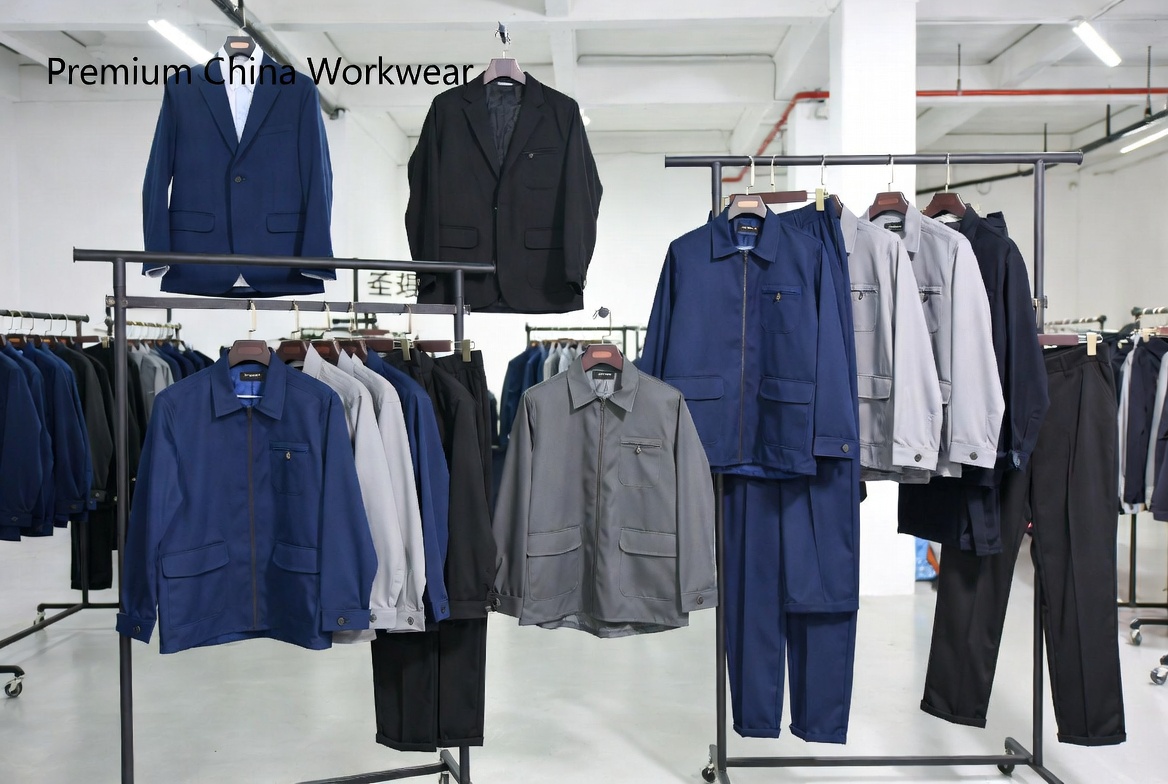
BOWINS is known as an OEM–focused manufacturer supplying workwear, outdoor garments, and protective clothing for over a decade, with a particular focus on Europe and North America. The company typically works with medium to high volumes, supporting professional buyers who need custom designs and consistent repeat runs rather than sporadic small orders. [bwworkwear]
Key strengths include integrated pattern development, automated cutting, and documented QC processes, backed by ISO-based management systems and third‑party inspection experience. Buyers often use BOWINS as a primary vendor for core styles while leveraging more flexible factories for niche or seasonal lines. [bwworkwear]
Shanghai Changwei is listed among the leading work clothes manufacturers in China rankings for 2026, recognized for its capacity in industrial uniforms and protective wear. The company services domestic institutional contracts and export clients, with a focus on heavy‑duty workwear, reflective safety garments, and multi‑pocket utility designs. [b2bdata.baidu]
Its advantages include relatively high annual capacity and experience with government tenders, which usually implies stricter documentation and acceptance testing. For international buyers, Changwei can serve as a stable high‑volume partner, particularly where consistent re‑orders and strict delivery windows are critical. [b2bdata.baidu]
Linyi Bangneng specializes in labor protection products, supplying work clothes and associated PPE items for a broad industrial client base. The company's portfolio covers basic uniforms, overalls, and some protective garments geared towards construction, logistics, and light manufacturing sectors. [b2bdata.baidu]
Bangneng's competitive edge lies in its integration of garments with related protective products, which can simplify vendor management for buyers seeking bundled contracts. Typical MOQs and lead times fit medium‑scale orders; buyers should clarify testing protocols for any high‑risk safety categories at the contract stage. [b2bdata.baidu]
Disheng Group appears in several workwear supplier shortlists and has built a diversified apparel and protective clothing business. Its workwear division caters to industrial clients with uniforms, coats, and coveralls across a range of fabric weights and finishes. [bwworkwear]
As a group-level player, Disheng offers robust financial backing and multi‑plant capacity, which can be valuable for multi‑country rollouts. However, large groups may prioritize major accounts, so smaller brands should negotiate clear service levels and flexibility before committing. [bwworkwear]
Some workwear rankings explicitly distinguish a BOWINS-branded workwear unit from broader garment operations, highlighting its OEM/ODM focus for industrial and outdoor wear. This unit typically provides pattern customization, logo and trim integration, and coordinated product families (jackets, trousers, vests) for corporate programs. [work-jacket]
For buyers, this specialization can simplify collection design and ensure visual consistency across product lines. Expect mid‑range MOQs and structured sampling procedures, including proto, size sets, and pre‑production samples before mass production. [bwworkwear]
Jihua Group is frequently cited among China's top labor protection and workwear suppliers, often supplying uniforms, protective clothing, and related equipment to domestic institutions. The group manages multiple factories and business units, giving it extensive capacity and experience in large‑scale government contracts. [bwworkwear]
For overseas procurement managers, Jihua can be a strategic partner for high‑volume, multi‑site deployments, provided procurement teams are ready to navigate more formal bureaucratic structures. Buyers should align on documentation, testing standards, and language of contracts early in the process. [bwworkwear]
Giuseppe is referenced as a workwear supplier with a focus on design-forward but functional uniforms and industrial apparel. The company's exports target markets that value both aesthetics and durability, such as service sectors, logistics, and light industry. [bwworkwear]
Its OEM offering emphasizes styling and branding, making it a candidate for brands that want to differentiate through cut and appearance rather than purely through technical features. This orientation can be useful for customer-facing uniforms where brand image is as important as protection. [bwworkwear]
Beyond headline names, buyers often source from medium-size factories embedded in textile hubs in Jiangsu, Zhejiang, Shandong, and Guangdong, where workwear and protective clothing clusters sit close to weaving and dyeing mills. These factories may not appear on global rankings but support export clients through trading companies or B2B platforms. [sunsirs]
Such suppliers can offer aggressive pricing and flexible MOQs, especially in periods of industry overcapacity; however, vetting is critical, as quality systems and compliance vary widely. Buyers should insist on full documentation, third‑party audits, and trial orders before scaling volumes. [haiyuanworkclothes]
China also has a tier of hybrid entities that combine trading capabilities with partial in-house production, coordinating outsourced lines for peak loads while maintaining their own sewing lines for key accounts. These companies, often headquartered in coastal cities, can be effective single points of contact for multi‑factory sourcing strategies. [newway-apparel]
They are particularly relevant for brands needing multiple fabric types or categories (for example regular uniforms plus FR or high‑vis) without managing several direct factory relationships. The trade‑off is that buyers must build strong visibility into sub‑contracting arrangements and enforce clear responsibility for compliance and recalls. [newway-apparel]
The table below summarizes typical positioning of key suppliers; actual figures should be verified directly in RFQs and technical agreements. [haiyuanworkclothes]
| Supplier | Typical Annual Capacity (garments) | Typical MOQ Range (pcs/style) | Noted Certifications / Compliance Focus* |
|---|---|---|---|
| Shanghai Youti Clothing Co., Ltd. | Mid (hundreds of thousands) | Low–mid (from ~200–300) | ISO-style QC systems, export to EU/overseas, documentation support. (work-jacket) |
| Taian BOWINS Garment Co., Ltd. | Mid–high | Mid (300–600+) | ISO 9001-type systems, third‑party inspections for EU/NA buyers. (bwworkwear) |
| Shanghai Changwei Industrial Co., Ltd. | High | Mid–high | Institutional tender compliance, safety garment standards. (b2bdata.baidu) |
| Linyi Bangneng Labor Protection Products | Mid | Mid (300–800) | Labor protection focus, basic safety documentation. (b2bdata.baidu) |
| Disheng Group (Workwear unit) | High | Mid–high | Group-level quality systems, export documentation. (bwworkwear) |
| BOWINS (specialized workwear unit) | Mid–high | Mid | OEM/ODM engineering, structured sampling and QA. (work-jacket) |
| Jihua Group | Very high | High (institutional scale) | Government-aligned safety and quality standards. (bwworkwear) |
| Giuseppe | Mid | Mid | Design-forward uniforms, brand-focused compliance. (bwworkwear) |
\* Always request up-to-date certificates and test reports; data above reflects typical positioning rather than legally binding declarations. [workwearsolutions]
Industrial workwear failures often emerge months after deployment, making up‑front controls critical. Several recurring traps have been documented by sourcing experts and industry blogs. [workwearsolutions]
- Fake or Expired Certificates: Suppliers may share outdated EN certificates or "test reports" that do not cover ongoing production, especially for FR or high‑vis lines. [workwearsolutions]
- Material "Bait and Switch": Fabric downgrades such as substituting combed cotton with carded yarn, adding cheap polyester, or shaving gsm by 5–10% are common under price pressure. [workwearsolutions]
- Dimensional Instability: Skipping proper pre‑shrinking or heat setting leads to garments shrinking dramatically after industrial washing, undermining sizing and wearer comfort. [workwearsolutions]
- "Golden Sample" vs. Bulk: Factories sometimes produce an excellent sample using premium fabric, then outsource bulk to cheaper sub‑contractors with lower-grade materials and weaker QC. [workwearsolutions]
- Chemical Non‑Compliance: Non‑visible issues such as excess formaldehyde, banned azo dyes, or heavy-metal contamination can trigger customs problems and brand risk. [workwearsolutions]
A widely acknowledged but rarely documented practice is the "fabric mill switch" that occurs after buyers approve lab-dip and test results from a specific mill.
In this scenario, the garment factory shows certificates and test reports from a reputable mill for initial samples, then quietly moves bulk orders to a cheaper mill with similar color but lower performance metrics to recover margin. Unless the buyer links every bulk shipment to batch-specific fabric transaction certificates and conducts random destructive testing, this mill switch often goes undetected until failures arise in the field. [haiyuanworkclothes]
To counter this, advanced buyers tie payment terms and vendor rating scores to fabric-lot traceability, requiring mill names and lot numbers on packing lists and spot‑testing fabrics from incoming containers. [haiyuanworkclothes]
A structured sourcing process can dramatically reduce risk and lifetime cost. The steps below reflect practices used by experienced procurement teams in industrial sectors. [haiyuanworkclothes]
- Cross-Check Registration: Verify the factory's business license and registration through official Chinese enterprise databases or governmental portals. [haiyuanworkclothes]
- Confirm ISO and Safety Certificates: Request complete ISO 9001/14001 certificates, EN or ANSI reports (for example EN ISO 20471), and check validity dates and issuing bodies; look for inconsistencies like mismatched company names. [workwearsolutions]
- Multi‑Stage Sampling: Use an initial proto sample, then a full size set, and finally a sealed pre‑production sample that is signed off by both parties and stored for comparison. [haiyuanworkclothes]
- Fabric and Trim Control: Specify yarn type, gsm, finishing, shrinkage limits, and reflective tape brands in the technical package, and ensure samples are tested in accredited labs before approving bulk. [haiyuanworkclothes]
- On‑Site or Remote Audits: Assess cutting, sewing, and finishing lines, as well as in‑house labs or reliance on external labs; verify that QC processes match what is written in the manuals. [haiyuanworkclothes]
- Sub‑Contractor Mapping: Ask the factory to disclose any sub‑contractors and set clear rules on which operations can be outsourced, plus inspection and approval rights for those sites. [workwearsolutions]
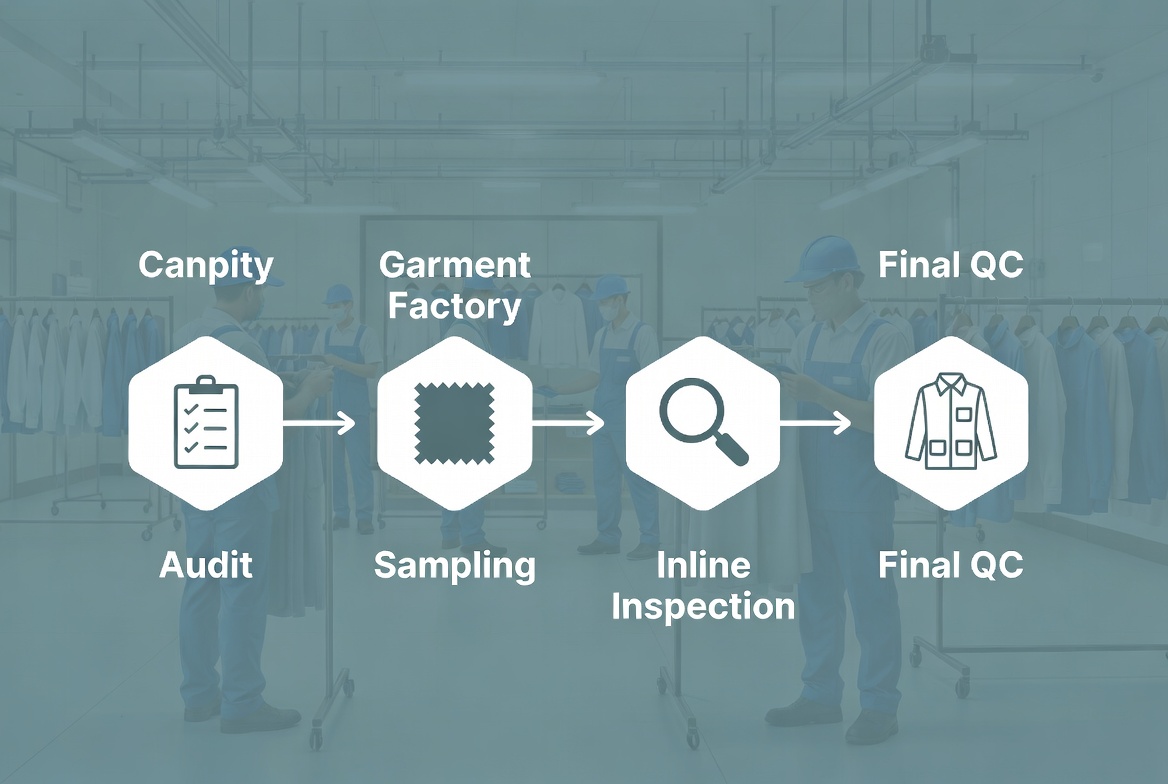
- Inline and Final Inspections: Define AQL levels (for example Critical 0, Major 2.5, Minor 4.0, a common practice) and ensure third‑party or buyer inspectors perform checks at critical stages. [newway-apparel]
- Performance Testing on Bulk: For high‑risk categories (FR, high‑vis, anti‑static), conduct random testing of bulk shipments, not just rely on pre‑production test reports. [workwearsolutions]
- Packaging and Labeling: Confirm that packaging protects garments from moisture and mechanical damage and that labeling meets destination-country requirements. [haiyuanworkclothes]
- Defect and Recall Procedures: Include clauses on defect thresholds, remedial actions, and shared cost of field recalls or replacements, supported by clear communication channels. [haiyuanworkclothes]
In practice, many procurement managers mix one or two large-volume factories with at least one more flexible partner to handle pilot programs, regional rollouts, or high-mix/low-volume lines. Shanghai Youti Clothing fits this second role well, offering competitive pricing, responsive engineering support, and willingness to work with smaller MOQs compared to typical high‑volume state‑linked groups. [work-jacket]
Youti's focus on uniforms and work clothes means its team is familiar with the nuances of industrial wear, including reflective requirements, fabric performance, and branding consistency. For emerging brands or regional distributors, this combination of flexibility and technical know‑how can reduce time‑to‑market and improve communication efficiency across sample revisions and repeat orders. [work-jacket]
These questions reflect common issues raised by experienced buyers when sourcing workwear from China. [workwearsolutions]
1. How can I verify whether a factory's ISO 9001 certificate is still valid?
Ask for a full‑page certificate copy, then cross-check the certificate number and company name on the issuing certification body's website or an accredited database; verify expiry dates and any suspension notices. [haiyuanworkclothes]
2. What is the best way to ensure my FR garments comply with the latest EN or NFPA standards?
Require test reports from accredited labs linked to your exact fabric and garment construction, specify the standard and edition in the contract, and conduct periodic re‑testing of bulk shipments rather than relying solely on initial reports. [workwearsolutions]
3. How do I detect fabric "bait and switch" before it hits my warehouse?
Implement incoming fabric testing (gsm, fiber content, tensile strength, shrinkage) on at least a statistical sample of each batch, and tie payment terms to passing test results and documentation consistency. [workwearsolutions]
4. What MOQs should I expect for customized workwear from Chinese factories?
For mainstream fabrics and classic designs, many factories will work from roughly 200–600 pieces per style, but special fabrics (for example custom-dyed FR or laminated fabrics) may push MOQs above 1,000 pieces due to mill minimums. [newway-apparel]
5. How can I manage sub‑contracting risk without blocking my supplier's flexibility?
Require written disclosure of all sub‑contractors, limit critical operations (like seam sealing or FR assembly) to approved sites, and reserve the right to audit and test products from those locations. [haiyuanworkclothes]
1. Sunsirs. "China's Garment Industry Shows Growth in Early 2026." https://www.sunsirs.com/uk/detail_news-32305.html
2. IBISWorld. "Apparel Manufacturing in China Industry Analysis, 2016–2031." https://www.ibisworld.com/china/industry/apparel-manufacturing/197/
3. Haiyuan Work Clothes. "China Wear-Resistant Workwear Procurement Guide: 2026 Edition." https://haiyuanworkclothes.com/blog/china-wear-resistant-workwear-procurement-guide-2026-editio/
4. Workwear Solutions. "Top 5 Procurement Traps: Avoiding the 'Invisible' Failures in Workwear Sourcing." https://workwearsolutions.net/top-5-procurement-traps-avoiding-the-invisible-failures-in-workwear-sourcing/
5. NewWay Apparel. "Activewear Manufacturing in China Statistics Guide 2026." https://www.newway-apparel.com/blog/activewear-manufacturing-in-china-market-statistics-guide-low-moq-economics-2026.html
6. Shanghai Youti Clothing Co., Ltd. "Top 10 Workwear Manufacturers in China." https://www.work-jacket.com/top-10-workwear-manufacturers-in-china.html
7. Shanghai Youti Clothing Co., Ltd. "About Us – Uniforms and Work Clothes OEM." https://www.work-jacket.com/aboutus.html
8. BWW Workwear. "Best 5 Workwear Suppliers in China." https://www.bwworkwear.com/best-5-workwear-suppliers-in-china/
9. Baidu B2B Data. "2026 Top 10 Work Clothes Manufacturers in China Ranking." https://b2bdata.baidu.com/en/rank/k/all-area/workwear


