
Views: 222 Author: Youti Clothing Publish Time: 2026-06-23 Origin: Site


Content Menu
● Introduction: Why Source Waiter Uniforms from China?
● How We Select Top Waiter Uniform Manufacturers
>> 1. Factory experience and certifications
>> 2. Product and R&D capabilities for waiter uniforms
>> 3. QC processes and on‑time delivery
>> 4. OEM/ODM service depth and communication
● Technical Essentials of High‑Quality Waiter Uniforms
>> 1. Fabric types and performance
>> 2. Construction and workmanship
>> 3. Compliance and certifications: what matters
● Top 10 Waiter Uniform Manufacturers in China (2026 Expert Shortlist)
>> 1. Shanghai Youti Clothing Co., Ltd. – Flexible OEM Partner for Growing Hospitality Brands
>> 2. Guangzhou Elite Uniforms – Hospitality and Hotel Program Specialist
>> 3. Shenzhen UniPro Apparel Co., Ltd. – Modern Design‑Driven Uniform Maker
>> 4. Hangzhou Corporate Wear Co., Ltd. – Corporate and Hospitality Uniform Programs
>> 5. Dongguan‑Based Hospitality Workwear Factory (project‑oriented OEM)
>> 6. Ningbo Workwear Cluster Supplier – Cost‑Effective Large Volume Producer
>> 7. Fujian Hospitality and Workwear Supplier – Strong on Launderable Uniforms
>> 8. Chengdu‑Area Uniform Producer – Regional Program Provider with Western China Reach
>> 9. Qingdao‑Region Apparel Manufacturer – Export‑Focused Workwear Production
>> 10. Online‑Verified Waiter Uniform Manufacturers on B2B Platforms
● Comparison Table: Key Parameters of Representative Suppliers
>> Table: Representative Waiter Uniform Supplier Profiles in China
● Buyer's Guide: How to Source Waiter Uniforms from China Safely
>> 1. Verify certifications and factory claims
>> 2. Define technical specifications in writing
>> 3. Sampling, PP samples, and size sets
>> 4. Quality control and inspections
● Common Pitfalls and an Insider "Red‑Flag" Checklist
>> Typical pitfalls when sourcing waiter uniforms
>> Insider tip: "Pattern lock‑in" risk that rarely appears online
● Conclusion and Call to Action
● FAQ: Advanced Questions Real Buyers Ask
China is one of the world's largest workwear and uniform production bases, supported by integrated textile clusters in provinces such as Zhejiang, Jiangsu, Guangdong, and Shandong. These regions combine fabric mills, dyeing houses, trims suppliers, and garment factories in a tightly integrated supply chain, which helps buyers control lead times and cost. [grandviewresearch]
According to recent workwear market data, China's overall workwear segment is projected to grow from about 2.18 billion USD in 2023 to over 3.07 billion USD by 2030, with a CAGR around 5%, indicating sustained investment in production capacity and quality systems. At the same time, the global waiter uniform segment alone is estimated at roughly 1.6 billion USD in 2024 and expected to reach 2.5 billion USD by 2033, growing at around 4.5% from 2026 onward. These figures show that specialized hospitality workwear, including waiter uniforms, is no longer a low‑priority niche but a strategic category for many Chinese manufacturers. [linkedin]
For international restaurant chains, hotel groups, and catering companies, sourcing waiter uniforms from China offers access to a wide range of fabric technologies, patterning options, and compliance frameworks (ISO 9001, BSCI, REACH, EN standards, etc.) at a competitive price point. However, the market is fragmented, and the quality gap between top‑tier OEM/ODM factories and generic traders can be substantial, which makes supplier selection critical. [made-in-china]
To identify reliable Chinese manufacturers for waiter uniforms, this guide uses a pragmatic evaluation framework similar to how professional sourcing managers and brand owners assess suppliers in real projects. [easyimex]
- Operating history and scale: Years in operation, number of assembly lines, and annual capacity (pieces/year) are basic indicators of stability and scalability.
- Management systems: ISO 9001 for quality management is a baseline for process standardization and traceability. [china-clothing-manufacturer]
- Social and environmental compliance: BSCI audits and chemical compliance such as REACH are increasingly requested by European and North American buyers. [en.sidaier]
A credible factory should be able to share valid certificates, recent third‑party audit reports, and lab test reports on request. [china-clothing-manufacturer]
- Fabric engineering: Use of breathable blends (e.g., polyester‑cotton), stain‑resistant finishes, wrinkle‑resistant treatments, and colorfastness appropriate for frequent industrial laundering. [made-in-china]
- Pattern and ergonomics: Shoulder mobility, side slits or pleats, and fit grading for diverse body types to keep service staff comfortable during long shifts.
- Sampling and pattern development speed: For hospitality brands that iterate designs regularly, sample lead times of 10–15 days and structured sampling departments are important.
Factories with dedicated design and development departments generally respond better to detailed tech packs, custom trims, and brand‑specific fit blocks.
For B2B buyers, consistency matters more than one‑off excellence. Key signals include:
- Multi‑stage QC (incoming fabric inspection, inline inspection, final AQL checks) managed by an independent quality team.
- Documented SOPs for handling size spec deviations, color shade variation, and customer complaints.
- Realistic delivery windows for bulk orders, typically 45–60 days after sample approval for many Chinese uniform manufacturers.
- Ability to work from detailed tech packs, reference samples, or even rough sketches and convert them into graded patterns and PP samples.
- Dedicated project managers, 24‑hour response windows, and transparent execution with clear milestones from sampling to shipment.
- Willingness to support smaller or growing brands with flexible MOQ and phased development rather than focusing exclusively on massive orders.
The factories shortlisted below reflect a balance of these criteria, with a deliberate focus on those able to serve international hospitality brands and distributors over the long term. [chilat]
A professional waiter uniform must align aesthetics, durability, comfort, and compliance. Below are the key technical aspects that experienced buyers typically specify.
- Core blends: Polyester‑cotton and polyester‑viscose blends are widely used for waiter shirts, vests, and trousers, combining strength with comfort and easy care. [made-in-china]
- Colorfastness and shrinkage: Lab tests commonly check colorfastness to washing, rubbing, and perspiration, as well as dimensional stability after repeated laundering. [en.sidaier]
- Stain and wrinkle resistance: Finishes that resist oil and wine stains and reduce ironing time can significantly lower lifetime ownership cost for restaurants.
For mid‑ and high‑end hospitality projects, it is common to request fabric testing reports aligned with EN or ISO standards, especially when uniforms must meet internal HSE or corporate guidelines. [en.sidaier]
- Seam integrity: Key stress points such as armholes, side seams, and crotch seams should use reinforced stitching and appropriate stitch density.
- Button and accessory security: Bar‑tacks, lock‑stitching, and suitable thread quality prevent failures during service.
- Pattern balance: Proper sleeve pitch, collar stand height, and hem shaping are crucial so that waiters can reach overhead, carry trays, and bend without pulling.
High‑volume factories serving uniform programs typically use automated cutting and standardized production lines to reduce variability between batches.
For waiter uniforms, buyers more often reference general workwear standards, quality management, and chemical safety rather than CE for PPE‑grade gear. Typical references include:
- ISO 9001 for quality management systems. [china-clothing-manufacturer]
- BSCI or similar social audits for factory working conditions.
- REACH‑related chemical compliance, especially for European importers, to control restricted substances in dyes and finishes. [en.sidaier]
If waiter uniforms are used in specific risk environments (e.g., banquet kitchens or flambe service near open flames), buyers may also request clothing aligned with EN ISO 11612 or EN1149‑5 standards as part of broader workwear procurement. [en.sidaier]
Below is an expert‑oriented, practical shortlist of manufacturers and specialized suppliers that are suitable starting points when sourcing waiter uniforms from China. Some are dedicated uniform brands, others are broader workwear specialists with strong waiter uniform lines.
> Note: Public data on individual companies' waiter uniform volumes is limited, so the focus is on verifiable capabilities, workwear or uniform specialization, and export track record. [chilat]
Shanghai Youti Clothing Co., Ltd. is a rapidly developing apparel manufacturer established in 2018, operating 15 assembly lines with more than 30 automated machines and an annual output exceeding 3 million pieces. The company maintains dedicated design & development, sampling, business management, and after‑sales quality inspection departments, which helps control the full cycle from pattern development to shipment. [chilat]
Youti's portfolio covers suits, shirts, uniforms, work clothes, trousers, and jackets, making it well suited for restaurants and hotels that need coherent staff image programs across front‑of‑house and back‑of‑house roles. The factory holds ISO 9001, BSCI, REACH, EN1149‑5, and EN ISO 11612 certifications, and exports extensively to Europe, North America, and Oceania, with annual revenue of roughly 5–10 million USD. For buyers of waiter uniforms, Youti is particularly attractive due to its sampling time of 10–15 days, typical bulk delivery of 45–60 days, and its willingness to support both mid‑sized and growing brands with custom designs, logo embroidery or printing, and flexible order planning. [chilat]
For hospitality chains rolling out or refreshing concepts in multiple regions, Youti's end‑to‑end service—collaborative design planning, transparent execution with a dedicated project manager, and multi‑stage quality inspections—offers a pragmatic balance between cost, responsiveness, and compliance.
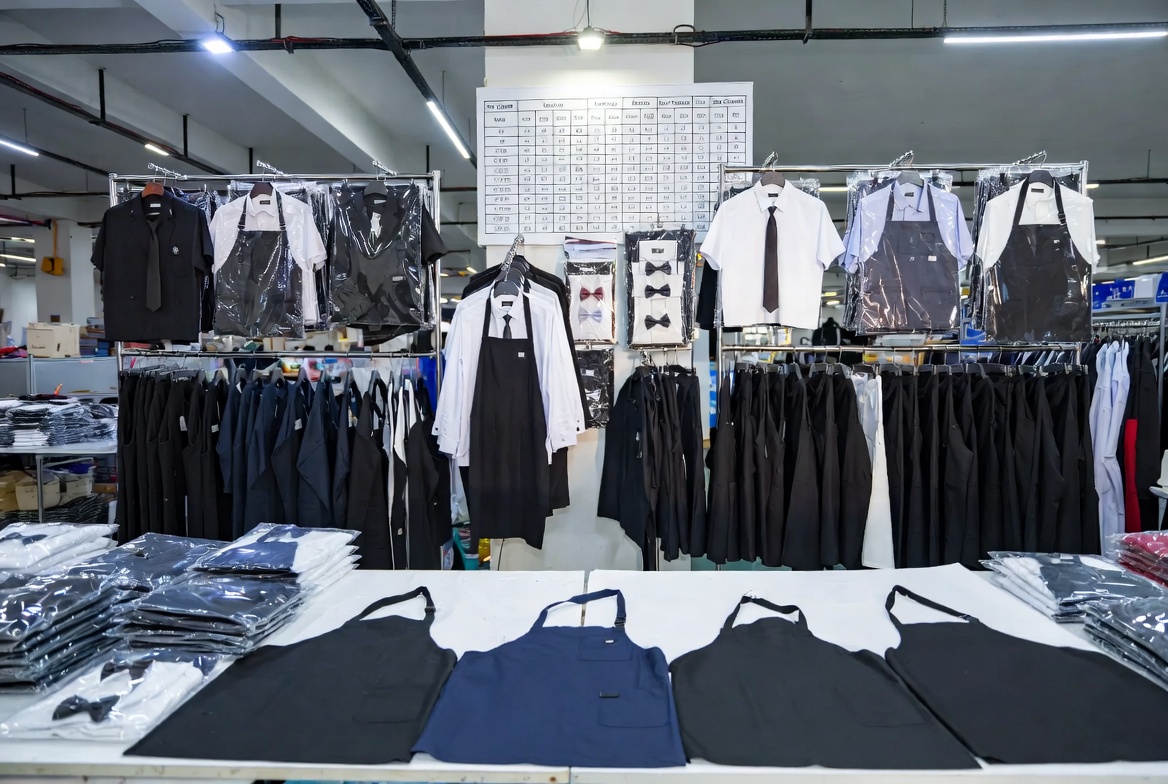
Guangzhou Elite Uniforms is widely referenced as one of the prominent Chinese uniform suppliers focusing on hotel, restaurant, and airline uniforms, including waiter and hostess attire. Located in the Pearl River Delta, it benefits from proximity to mature fabric and trim ecosystems in Guangdong, enabling shorter sampling and replenishment cycles. [made-in-china]
The company typically offers a broad style catalog and supports OEM customization with embroidered or woven branding for international distributors and chain operators. Buyers appreciate its experience in matching specific brand concepts and interior design to uniform color palettes and detailing, which is useful when aligning waiter uniforms with overall brand identity. [chilat]
Shenzhen UniPro Apparel Co., Ltd. focuses on contemporary uniform design for service, corporate, and retail sectors, including modern waiter and cafe uniforms. Operating in Shenzhen gives it easy access to international design influences and digital communication channels, which many overseas buyers value for efficient collaboration. [chilat]
UniPro is known for its emphasis on up‑to‑date silhouettes, slim fits, and casual‑smart styling, making it suitable for boutique hotels, cafes, and lifestyle restaurants targeting younger clientele. The company offers both OEM and ODM services, and buyers typically use it when they need fast trend‑aligned updates to their waiter uniform collections rather than classic, conservative styling. [chilat]
Hangzhou Corporate Wear Co., Ltd. is recognized in various industry lists as a major producer of corporate and hospitality uniforms, including waiter, reception, and housekeeping lines. Based in eastern China's textile belt, it benefits from close integration with local fabric mills and dye houses. [chilat]
The company offers comprehensive program management, including style book creation and long‑term replenishment planning, which can be important for large hotel or restaurant chains that roll out uniforms across multiple properties. Typical strengths include structured tailoring, color consistency across repeated orders, and the ability to manage multiple uniform categories within a group tender. [chilat]
Several Dongguan factories identified in workwear and uniform directories offer OEM waiter uniform production with strong cutting and sewing capacity, backed by experience in export‑grade workwear. These factories often grew out of broader garment or industrial workwear businesses and later added hospitality lines. [made-in-china]
Buyers typically choose Dongguan manufacturers when they prioritize stable mass production, tight delivery schedules, and cost optimization for medium to large volumes. These factories can be a good fit for distributors and wholesalers who bring their own designs and primarily need reliable execution plus basic compliance. [made-in-china]
Ningbo and surrounding areas in Zhejiang province host a dense cluster of knitwear and woven workwear suppliers, many of which ship waiter and restaurant uniforms via B2B platforms and direct export. These suppliers usually focus on high‑volume orders with competitive pricing and use standardized fabric bases, such as common poly‑cotton blends in classic hospitality colors. [made-in-china]
For buyers needing simple, timeless waiter shirts, trousers, and aprons at volume, these Ningbo‑area factories can be effective, especially when combined with robust third‑party inspection and clear product specs. However, procurement managers should pay particular attention to fabric testing and QC to avoid quality drift over repeated orders. [easyimex]
Fujian hosts a number of workwear and uniform manufacturers known for durable, launderable garments for industrial and service sectors. Some of these manufacturers maintain product lines targeted specifically at hotels and restaurants, with a focus on uniforms that can withstand frequent industrial washing without significant color fading or shape loss. [made-in-china]
These suppliers can be attractive for buyers operating central laundry systems or outsourcing to industrial laundries, where wash counts and life‑cycle cost matter more than fashion details. The trade‑off is that styling may be more conservative, so many buyers provide their own designs and use the factory primarily for its production and fabric‑performance expertise. [en.sidaier]
In western China, including the Chengdu area, regional uniform manufacturers increasingly serve hotels, restaurants, and entertainment venues as these markets grow. These factories often combine local B2B service with export capability, using common suiting and shirting fabrics sourced from larger coastal hubs. [made-in-china]
For overseas buyers, Chengdu‑area suppliers can be an option when seeking alternative capacity beyond the coastal clusters, particularly for staggered sourcing strategies or regional Asia‑Pacific distribution. However, communication responsiveness and export process experience can vary, so reference checks and trial orders are advisable. [made-in-china]
The Qingdao region in Shandong province is a long‑established export hub for garments, including workwear and uniforms. Factories here often have strong relationships with European and Japanese buyers and may be particularly reliable in pattern accuracy, measurement tolerances, and packaging standards. [made-in-china]
When sourcing waiter uniforms, buyers often rely on Qingdao‑area manufacturers for classic tailoring (vests, trousers, waistcoats) and meticulous finishing, especially where fit consistency and precise grading are crucial. Lead times can be comparable to other coastal clusters, with emphasis on steady, repeatable quality. [made-in-china]
Finally, a practical category is the group of verified Chinese waiter uniform suppliers listed on major B2B platforms under categories such as "Waiter Uniform" or "Restaurant Uniform." These suppliers range from small specialist factories to larger integrated manufacturers, and many have on‑platform audits, transaction histories, and review systems. [made-in-china]
Procurement managers should treat B2B platform verification as a starting point only, combining it with independent checks on certifications, capacity, and QC systems. Nonetheless, this channel is valuable for discovering niche or region‑specific suppliers, especially for specialized concepts or low‑volume, high‑customization projects. [easyimex]
Below is a simplified comparison of representative supplier types, using public data and typical ranges. It is designed as a starting framework; buyers should validate exact figures with each supplier.
| Supplier / Type | Est. annual capacity (pieces) | Typical MOQ (pieces/style) | Key certifications / audits | Notable strengths for waiter uniforms |
|---|---|---|---|---|
| Shanghai Youti Clothing Co., Ltd. | >3,000,000 | 300–600 (OEM, flexible) | ISO 9001, BSCI, REACH, EN1149‑5, EN ISO 11612 | Strong OEM/ODM, structured sampling, EU‑focused compliance, mid‑volume hospitality programs |
| Guangzhou Elite Uniforms (hospitality specialist) | Mid–high, multi‑line (chilat) | 300–800 (chilat) | Factory quality system, export to hotels (chilat) | Complete hotel & restaurant uniform sets, styling aligned with hospitality brands (chilat) |
| Shenzhen UniPro Apparel Co., Ltd. | Mid‑scale (chilat) | 200–500 (chilat) | General export certifications (chilat) | Trend‑driven waiter and cafe uniforms, modern fits for lifestyle brands (chilat) |
| Hangzhou corporate wear producer | High, corporate focus (chilat) | 500–1,000 (chilat) | Corporate program experience (chilat) | Multi‑site roll‑outs, consistent color/fit for large hospitality groups (chilat) |
| Dongguan workwear OEM | High volume (chilat) | 500–1,500 (made-in-china) | ISO 9001 or similar (varies) (made-in-china) | Cost‑optimized mass production, robust cutting & sewing for standard styles (made-in-china) |
| Ningbo cluster supplier | High volume (made-in-china) | 300–1,000 (made-in-china) | Platform audits, basic QA (made-in-china) | Simple, classic waiter garments, competitive pricing for distributors (made-in-china) |
*Note: MOQs and capacities are indicative ranges derived from typical workwear suppliers in these clusters; always confirm up‑to‑date figures directly.* [chilat]
- Check ISO 9001 authenticity: Use the issuing certification body's online database and, where available, cross‑check via the IAF or related accreditation portals. Verify the certificate scope (e.g., "manufacturing of uniforms and workwear") and site addresses to ensure the actual production facility is covered. [china-clothing-manufacturer]
- Confirm social and chemical compliance: Ask for most recent BSCI or equivalent audit reports and chemical test reports aligned with REACH or your destination market requirements. [en.sidaier]
For high‑stakes or multi‑year contracts, combine document checks with third‑party audits or remote factory tours.
Industry experience shows that many sourcing issues arise from incomplete or ambiguous specifications. For waiter uniforms, your spec package should include: [easyimex]
- Detailed fabric specs (fiber content, weight, weave/knit type, performance finishes).
- Measurement charts with tolerances and grading rules.
- Stitching requirements, accessories (buttons, zippers), logo methods (embroidery, print), and placement.
- Compliance requirements (e.g., ISO/BSCI, REACH, internal brand standards).
All key points should be summarized in a written purchase agreement or technical annex, not only in email threads. [easyimex]
- Request development samples to align on design, then pre‑production (PP) samples made on bulk fabric to validate fit, construction, and color before bulk starts.
- For waiter uniforms, size sets are particularly important because teams often include different age groups and body types; ensure grading matches your market's size expectations.
- For new suppliers, it is reasonable to require 1–2 iterative sample rounds before final PP approval, especially for complex designs or high‑visibility venues.
Shanghai Youti Clothing Co., Ltd., for example, offers 10–15 days sampling lead time and 45–60 days for mass production, which fits typical timelines for chain roll‑outs when planned correctly.
- Implement inline and pre‑shipment inspections—using either internal teams or third‑party inspectors—to verify stitching, measurements, labeling, and packing against your AQL standard. [youtube]
- For recurring programs, capture QC data and feedback to refine tolerances and process controls rather than treating each order as a one‑off.
Skipping pre‑shipment inspections is a common sourcing mistake that can result in receiving off‑spec or inconsistent uniforms, especially with new suppliers. [youtube]
- Discuss incoterms (FOB, CIF, DAP, etc.) and clearly assign responsibilities for freight, insurance, customs documents, and HS codes. [youtube]
- For time‑sensitive projects, consider splitting shipments—first batch by air, balance by sea—to mitigate schedule risk.
- Ensure packing is optimized for both transportation safety and on‑site distribution (e.g., size‑sorted cartons labeled by location or team).
Industry practitioners often see the same issues repeating across projects: [youtube]
- Over‑focusing on unit price: Chasing the lowest price often leads to compromises in fabric quality, stitching, and post‑sale support.
- Under‑specifying fabrics: Vague terms like "poly‑cotton shirt fabric" without GSM, finish, and test requirements invite suppliers to downgrade materials.
- No written contract or unclear change control: Verbal agreements about quality or delivery are difficult to enforce when issues arise. [easyimex]
- Outgrowing a supplier without noticing: A factory that was ideal at 2,000 pieces per season may struggle at 50,000 if capacity and systems are not upgraded. [youtube]
A lesser‑discussed but important issue in uniform sourcing is pattern lock‑in at the factory level. In many projects, the supplier develops and refines the pattern blocks and grading for waiter uniforms across several seasons. Over time, the uniforms fit staff well, and the buyer becomes dependent on that specific fit.
If the buyer has never requested graded patterns or measurement blueprints in a transferable format, shifting to a new factory can mean starting from scratch on fit, leading to staff dissatisfaction, returns, and extra sampling costs. Experienced procurement teams therefore:
- Negotiate up‑front that they will receive detailed measurement charts, grading rules, and at least base size patterns (even if IP ownership remains with the supplier for bespoke designs).
- Maintain an internal "fit reference library" so that if they must switch factories, they can benchmark new samples against historical, well‑accepted fits.
This practice adds a small amount of administrative work but substantially reduces supplier‑dependency risk and is particularly important for long‑running waiter uniform programs.
China's mature textile clusters, combined with an expanding workwear market and deep OEM/ODM experience, make it a strategic sourcing base for waiter uniforms for restaurants, hotels, and catering groups worldwide. The challenge is not finding suppliers, but selecting those with the right balance of quality systems, R&D capability, and long‑term reliability. [linkedin]
Factories such as Shanghai Youti Clothing Co., Ltd. illustrate how mid‑scale, flexible manufacturers with ISO 9001, BSCI, and REACH compliance can support both established and emerging brands through responsive sampling, structured QC, and project‑based collaboration. By combining a clear technical specification, disciplined certification verification, and proactive QC planning, professional buyers can significantly reduce risk and build stable waiter uniform programs that support brand image and operational efficiency. [china-clothing-manufacturer]
If you are planning a new waiter uniform project or reviewing your current suppliers, consider shortlisting 2–3 manufacturers from this guide—including a flexible OEM partner like Shanghai Youti Clothing Co., Ltd.—and running a structured sampling and pilot order process to validate fit, quality, and communication before committing to multi‑year contracts. [made-in-china]
Q1: How can I verify whether a factory's ISO 9001 certificate is genuine and still valid?
A1: First, identify the issuing certification body and search its public database using the certificate number and company name. Check that the scope covers garment manufacturing and that the site address matches the production facility. Then, confirm that the certificate is issued under an accredited body recognized by national accreditation structures (such as CNAS in China) and that the expiry date extends beyond your planned order period. For high‑risk projects, combine these checks with an independent audit or on‑site verification. [china-clothing-manufacturer]
Q2: How do I prevent fabric downgrade between the first and second orders?
A2: Lock the fabric specification with full details (fiber content, GSM, finishing, color code, and lab test results) in your contract and require that any change requests be approved in writing. Use random fabric testing for key parameters—especially colorfastness, shrinkage, and tear strength—on repeat orders, and compare results to the original baseline reports. [easyimex]
Q3: What is a reasonable sampling and production lead time for waiter uniforms?
A3: For experienced factories, development samples and first prototypes typically take 7–15 days, with pre‑production samples shortly thereafter, depending on fabric availability. Bulk production for standard waiter uniforms generally runs 45–60 days after PP sample approval, although complex multi‑style programs may require more time. [made-in-china]
Q4: How can I ensure color consistency across waiter shirts, vests, and aprons from different factories?
A4: Use standardized color systems (such as Pantone references) and provide physical color swatches whenever possible. Require lab dips and bulk shade approvals for each fabric type, and specify allowable shade variation in ΔE terms or visually defined ranges. For critical programs, consolidating fabric sourcing through a single mill, even when garments are sewn at different factories, can significantly improve consistency.
Q5: When does it make sense to move from a smaller flexible factory to a larger one?
A5: Key signals include frequent capacity bottlenecks, decreasing responsiveness, and a sharp increase in QC issues as your volume grows. When annual demand reaches a level that strains the supplier's lines or requires multiple overlapping production windows, it is time to benchmark alternative factories with higher capacity and more robust systems, even if it means a modest price increase. [youtube]
- China workwear market outlook and revenue projections – Grand View Research / similar market studies for 2023–2030. [grandviewresearch]
- Global waiter uniform market sizing and growth forecast, 2024–2033. [linkedin]
- ISO 9001 certificate verification guidance and certification body databases. [china-clothing-manufacturer]
- Practical sourcing risk guides for buyers importing from China. [youtube]
- Workwear and textile compliance guidance for REACH and related standards. [en.sidaier]


