
Views: 228 Author: Youti Clothing Publish Time: 2026-10-12 Origin: Site


Content Menu
● How We Selected These Waitress Clothes Manufacturers
● Why Source Waitress Clothes from China?
>> A Broad Apparel Supply Base
>> Recent Trade Data: Scale Without Assuming Unlimited Demand
● Comparison Table: Capacity, MOQ, and Certification Evidence
● The Top 10 Waitress Clothes Manufacturers in China to Evaluate
>> 1. Shanghai Youti Clothing Co., Ltd.
>> 2. Guangzhou Boshi Apparel Co., Ltd.
>> 3. Guangzhou ING Garment Co., Ltd.
>> 4. Guangzhou Kangkai Apparel Co., Ltd.
>> 5. Guangzhou Yuchen Clothing Co., Ltd.
>> 6. Guangzhou Care Uniform Co., Ltd.
>> 10. Guangzhou Shengli Clothing Co., Ltd.
● Technical Specifications That Matter More Than Catalog Photos
>> Specify Fabric Performance, Not Just Fiber Names
>> Evaluate the Entire Garment
>> Understand What Compliance Claims Actually Mean
● Buyer's Guide: From Supplier Verification to Delivery
>> 1. Verify the Business and Production Site
>> 2. Send the Same Technical Package to Every Candidate
>> 3. Separate Sampling into Approval Stages
>> 4. Confirm Real Capacity and Lead Time
>> 5. Plan Logistics and Replenishment Together
● Insider Buying Trap: The Beautiful Sample That Cannot Be Reordered
● Choose the Factory That Can Support the Second Order
>> 1. How Can We Verify Whether a Supplier's ISO 9001 Certificate Has Expired?
>> 2. Does an OEKO-TEX-Certified Fabric Mean the Finished Uniform Is Certified?
>> 3. How Should We Interpret a Supplier's Low MOQ?
>> 4. How Can We Prevent Bulk Garments from Differing from the Approved Sample?
>> 5. How Do We Protect a Uniform Program That Will Need Reorders for Several Years?
Choosing a waitress clothes manufacturer is not simply a question of finding an attractive blouse or a low-priced apron. For restaurant groups, uniform distributors, and private-label brands, the real challenge is securing consistent fabrics, reliable sizing, repeatable colors, and dependable replenishment.
China remains an important sourcing base for these requirements. Statista's apparel industry overview, updated in September 2025, identifies China as the world's largest apparel manufacturer and exporter. Its value to hospitality buyers extends beyond garment assembly to the availability of fabric sourcing, garment development, decoration, and export services.
However, manufacturing scale does not automatically translate into a suitable supplier relationship. A factory experienced in industrial coveralls may not be the right partner for fitted restaurant dresses. Likewise, a supplier offering small quantities of stock uniforms may require substantially larger orders for exclusive fabrics.
This guide evaluates ten China-based suppliers with relevant uniform, hospitality, or coordinated apparel capabilities. It explains their potential applications, identifies information that still requires verification, and outlines a practical purchasing process.
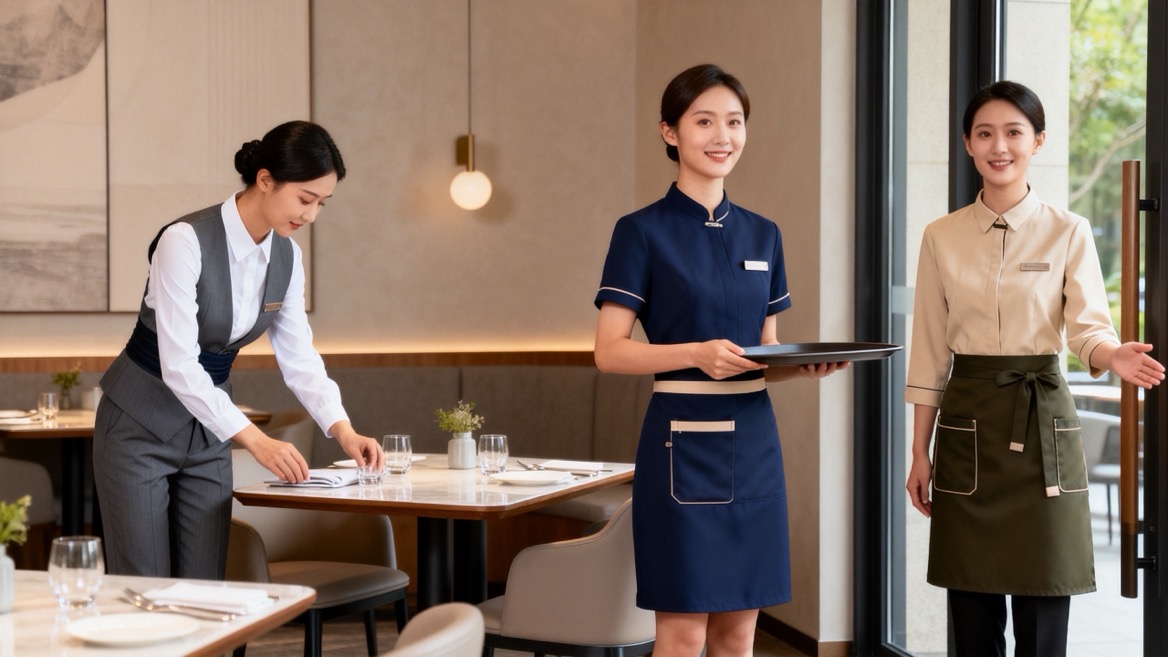
The most useful measure of supplier quality is repeatability: whether an approved sample can be reproduced consistently across sizes, production runs, and replacement orders.
The following framework can help procurement teams assess that capability.
| Evaluation area | Suggested weighting | Evidence to request |
|---|---|---|
| Product suitability and development | 25% | Relevant waitress uniforms, pattern-making support, fabric recommendations, size grading |
| Production and quality control | 25% | Factory walkthrough, production records, inspection procedures, defect corrective actions |
| Compliance and traceability | 20% | Current certificates, applicable test reports, fabric and trim traceability |
| Delivery and replenishment | 15% | Capacity reservation, material lead times, repeat-order procedures |
| Commercial and communication fit | 15% | Clear quotations, customization terms, sampling milestones, documented responses |
These are proposed purchasing weights, not published audit scores for the companies below.
A strong supplier should also explain which activities take place in its own facility and which are subcontracted. Embroidery, printing, washing, and even cutting or sewing may involve additional sites. Buyers should approve that production structure before placing an order.
Restaurant uniform programs often combine woven blouses, trousers, waistcoats, dresses, aprons, and branded accessories. China's broad apparel supply base makes it possible to investigate these categories within a relatively connected sourcing network.
The shortlist below illustrates that concentration: several suppliers operate in Guangzhou, while Shanghai Youti serves overseas uniform buyers from Shanghai. This geographic concentration can simplify supplier visits, although factory location alone does not establish product quality.
A 2025 apparel export analysis published by Textile Leader, citing China Customs, reported Chinese apparel exports of US$137.81 billion during January–November 2025, down 4.4% year on year.
The same analysis reported that woven apparel export volume increased 4.3%, while average export unit prices declined 8.8%. Knitwear showed a similar divergence between shipment volume and unit prices. These are broad apparel statistics—not a separate measurement of waitress clothes—but they provide useful context for understanding pricing pressure in the supply chain.
For buyers, the implication is not that every quotation should fall. Rather, unusually aggressive pricing deserves closer scrutiny: confirm that fabric composition, weight, finishing, and construction have not changed.
The table distinguishes garment output from sales volume and product-specific order quantities from full-custom minimums.
"Not established" means the sources reviewed did not provide sufficient evidence; it does not mean the supplier lacks the capability or credential.
| Manufacturer or supplier | Establishment information | Public capacity information | Public MOQ information | Certification evidence and limitations |
|---|---|---|---|---|
| Shanghai Youti Clothing Co., Ltd. | 2018 | Reports over 1.4 million pieces annually; six sewing lines | Not publicly specified | Lists ISO 9001, BSCI, REACH, EN 1149-5, and EN ISO 11612; verify document type, validity, and scope |
| Guangzhou Boshi Apparel Co., Ltd. | Reports 1998 | Not established | Not established | Current relevant certificates not established |
| Guangzhou ING Garment Co., Ltd. | Profile lists 2011 | Reports a subsidiary factory with over 100 workers; unit output undisclosed | Some hospitality listings show 100 pieces or sets | Current relevant certificates not established |
| Guangzhou Kangkai Apparel Co., Ltd. | Several profiles list 2010; an older directory lists 2005 | Reports Guangzhou/Hunan operations; unit output undisclosed | Not established | Current relevant certificates not established |
| Guangzhou Yuchen Clothing Co., Ltd. | Profile lists February 13, 2015 | Not established | Not established | Current relevant certificates not established |
| Guangzhou Care Uniform Co., Ltd. | A directory lists 2018; confirm legally | Not established | Not established | Current relevant certificates not established |
| CHECKEDOUT / Duomilai | Brand reports 1995 | Reports annual sales exceeding seven million pieces; not verified factory capacity | Not established | Current relevant certificates not established |
| Anbu Safety | Reports operations since 2008 | Not established | Usually 1,000 pieces per style | Protective-coverall credentials mentioned; do not transfer them to waitress garments |
| KlenidiSuit | Website states uniform manufacturing since 2007 | Not established | Guide discusses 200–499 pieces per style as a common structured-uniform range; quotation required | Current relevant certificates not established |
| Guangzhou Shengli Clothing Co., Ltd. | Profile lists legal establishment in 2012; some marketing pages reference 2006 | Not established | Website advertises 50 sets for custom suits; confirm hospitality styles | Current relevant certificates not established |
Sources for the comparison: supplier corporate pages and public profiles.
A practical caution: an advertised MOQ of 50 sets or 100 pieces may apply to an existing fabric and pattern. It should not be interpreted as approval for custom weaving, exclusive dyeing, or unrestricted size and color combinations.
Shanghai Youti is a relevant starting point for overseas buyers seeking coordinated professional clothing rather than a single off-the-shelf uniform.
Founded in 2018, the company reports a 2,500-square-meter production workshop, more than 300 machines and equipment units, six sewing lines, and annual output exceeding 1.4 million pieces. Its portfolio includes shirts, suits, uniforms, workwear, trousers, and jackets.
Its published service structure includes design and development, sampling and production, quality inspection, and after-sales support. Buyers can submit technical documents, images, or physical samples. Logo customization is available through embroidery or printing.
- Main markets: Europe is identified as its largest market, with North America and Oceania also described as core markets.
- OEM scope: Sample-based development, fabric selection support, coordinated garment production, and branding.
- Published timing: Sampling in 10–15 working days and bulk production in 45–60 working days.
- Potential purchasing fit: Small and medium-sized brands seeking development support and a direct project communication structure.
For a waitress clothes program, its combination of shirt, tailoring, and uniform capabilities could support matching front-of-house collections.
The commercial case should be evaluated through total development cost, responsiveness, and repeat-order consistency—not an unsupported claim of the lowest price. Although its published services suggest customization flexibility, buyers should confirm MOQ by style, color, fabric, and size allocation.
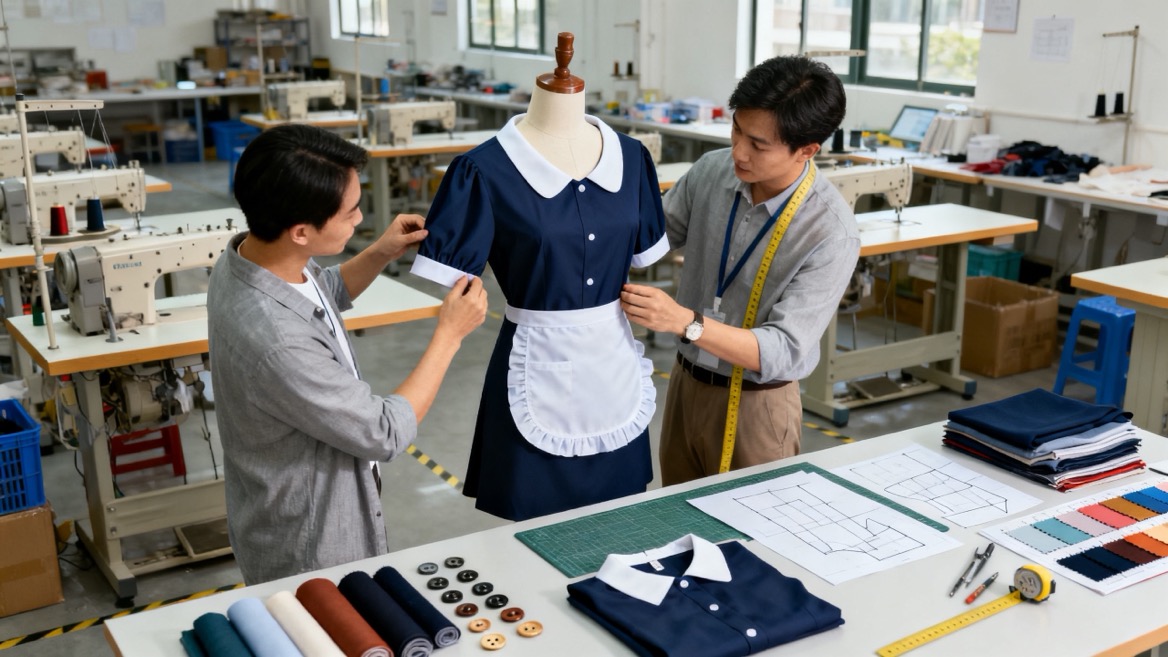
Guangzhou Boshi reports establishment in 1998 and describes a business covering research, development, production, and marketing.
Its public product portfolio includes hotel uniforms, work uniforms, shirts, business suits, and other professional clothing. The company reports exports to more than 20 countries and regions, including the United States, Russia, Spain, Australia, Japan, and markets in the Middle East and Southeast Asia.
- Core strength: A broad professional-uniform portfolio.
- Main markets: Multiple overseas regions, as reported in its company profile.
- Customization scope to discuss: Coordinated hotel and restaurant garments, branded shirts, and business-style uniform components.
- Potential purchasing fit: Distributors combining hospitality uniforms with other occupational apparel.
Ask for current female front-of-house samples. A broad uniform catalog does not, by itself, demonstrate expertise in fitted dresses, bust shaping, or consistent women's size grading.
Guangzhou ING's supplier profile lists establishment in 2011 and describes a wholly owned subsidiary factory with more than 100 experienced workers and a professional design department.
Its hospitality listings include restaurant uniform dress shirts, waiter jackets, chef garments, and uniform waistcoats. Some listings advertise minimums of 100 pieces or 100 sets, depending on the product.
- Core strength: Relevant restaurant garments across woven and knitted categories.
- Main markets: Export-market proportions are not clearly established in the reviewed profile.
- Customization scope to discuss: Dress shirts, waistcoats, jackets, fabric options, and coordinated branding.
- Potential purchasing fit: Buyers looking for a defined restaurant capsule rather than a large multi-category rollout.
Before ordering, clarify whether each advertised minimum applies per design, color, or total purchase order. Request a sample made from the intended bulk fabric.
Kangkai's public profiles describe custom clothing production and operations associated with Guangzhou and Hunan. Several profiles list establishment in 2010, while an older textile directory gives 2005. Buyers should resolve that discrepancy against the legal business license.
The company publishes restaurant staff uniform products alongside a broader custom apparel offering.
- Core strength: Custom clothing development and a restaurant-uniform product presence.
- Main markets: A reliable current geographic breakdown was not established.
- OEM scope to discuss: Custom staff garments, branded workwear, and coordinated uniform pieces.
- Potential purchasing fit: Buyers willing to qualify a multi-location production structure.
The priority is identifying the actual production site. Confirm which facility will cut, sew, inspect, and pack the order, and whether any work will be transferred during peak demand.
A public manufacturer profile lists Guangzhou Yuchen's establishment as February 13, 2015, and categorizes the business as both a manufacturer/factory and trading company.
Its published hospitality offering includes waiter, hotel, and restaurant uniforms.
- Core strength: A directly relevant hospitality product category.
- Main markets: Not established from the reviewed source.
- OEM scope to verify: Pattern modification, fabric sourcing, logo application, and private labeling.
- Potential purchasing fit: Buyers evaluating Guangzhou-based options for restaurant uniform development.
Because the profile indicates a combined manufacturing and trading model, establish which garments are made in-house. Request production evidence for the specific waitress blouse, dress, or apron being quoted rather than relying on unrelated product photographs.
Guangzhou Care publishes a broad occupational-apparel portfolio covering medical, security, school, and corporate uniforms. Hospitality garments also appear in public marketplace results.
A third-party directory lists establishment in 2018 and identifies the Middle East among its markets; these details require confirmation against current company records.
- Core strength: Breadth across occupational uniform categories.
- Main markets: Middle East reported in a directory; broader distribution requires confirmation.
- OEM scope to verify: Restaurant garment development, brand labeling, fabric selection, and size grading.
- Potential purchasing fit: Uniform distributors seeking another candidate for multi-category sourcing.
Its inclusion is exploratory rather than an endorsement of specialist waitress-clothing expertise. Ask for recent hospitality production samples and evidence that the factory can reproduce the required women's fit.
CHECKEDOUT states that it was established in 1995 and is headquartered in Beijing. Its website reports exports to more than 50 countries and annual sales exceeding seven million pieces.
The site also publishes waiter and waitress uniform offerings alongside its chefwear and apron ranges. The reported sales figure should not be treated as independently verified manufacturing capacity.
- Core strength: Hospitality-sector focus, particularly chef uniforms and aprons.
- Main markets: Broad international exports; a relevant product page highlights America and Europe.
- Customization scope: Personalized restaurant garments and branded hospitality clothing.
- Potential purchasing fit: Distributors coordinating front-of-house and kitchen apparel.
Confirm the contracting entity, factory location, and private-label terms. For tailored waitress dresses or blouses, request dedicated samples rather than assuming chefwear experience guarantees equivalent fit development.
Anbu Safety states that it has supplied chef uniforms since 2008 and exports to more than 30 countries, including the United States, Germany, the United Kingdom, France, and markets in the Middle East and Africa.
Its published OEM offering includes custom chef uniforms, logo application, and associated work clothing. The company states that its usual minimum is 1,000 pieces per style.
- Core strength: Workwear and kitchen-uniform sourcing.
- Main markets: Europe, the United States, the Middle East, and Africa.
- OEM scope: Customized kitchen garments, colors, branding, and packaging.
- Potential purchasing fit: Larger coordinated hospitality orders with substantial kitchenwear content.
This is a conditional candidate for a waitress clothes program. Confirm front-of-house pattern-making capability before requesting a quotation. Protective-coverall credentials mentioned on its website should not be assumed to cover restaurant blouses, dresses, or aprons.
KlenidiSuit's website states that it has provided suit and uniform OEM manufacturing since 2007. It publishes a dedicated restaurant and food-and-beverage uniform category.
Its buying guide describes 200–499 pieces per style as a common order range for structured uniforms, but that is guidance rather than a binding factory MOQ.
- Core strength: Structured professional clothing and coordinated hospitality uniforms.
- Main markets: Described broadly as worldwide; country-level distribution is not established.
- OEM scope: Suit and uniform development, including restaurant and food-and-beverage apparel.
- Potential purchasing fit: Formal dining concepts using waistcoats, jackets, and tailored separates.
Verify the legal manufacturing entity and factory address before payment. Ask how its tailored garments perform after the intended laundering process, not only how they look when first pressed.
Shengli's corporate and supplier pages describe custom apparel manufacturing, including suits, shirts, trousers, and hotel uniforms.
Its manufacturer profile lists legal establishment on March 13, 2012, while some marketing text references 2006. That distinction should be resolved during qualification.
- Core strength: Tailored business clothing and coordinated apparel.
- Main markets: International brands, importers, wholesalers, and corporate teams; geographic proportions are not disclosed.
- OEM/ODM scope: Design development, sampling, material selection, private labeling, and bulk production.
- Potential purchasing fit: Formal restaurant concepts requiring coordinated tailoring.
The website advertises a 50-set minimum for custom suits. Confirm whether that applies to the proposed waitress uniform collection and whether mixed styles or colors can be combined.
"Polyester-cotton" is not a complete specification. Two fabrics with the same fiber composition can differ in opacity, drape, recovery, pilling, and wash stability.
A useful request for quotation should define:
- Fiber composition and acceptable tolerance.
- Fabric construction and finished weight.
- Intended washing and drying process.
- Shrinkage and dimensional-change requirements.
- Colorfastness expectations.
- Opacity, stretch, and recovery requirements.
- Approved fabric code and substitution restrictions.
Treat these as agreed purchasing requirements rather than universal industry thresholds. A lightweight café blouse and a heavily laundered banquet uniform need different specifications.
Ask suppliers to demonstrate the proposed waitress clothes during movement:
1. Reach forward to simulate table service.
2. Raise both arms to assess sleeve and armhole restriction.
3. Bend and sit to check coverage.
4. Load apron pockets with typical work items.
5. Inspect blouse fronts for gaping.
6. Repeat the assessment after laundering.
Seam reinforcement, button security, pocket placement, and embroidery backing should all be addressed in the approved sample.
Ordinary waitress uniforms generally do not require CE marking merely because they are sold in Europe. The European Commission distinguishes ordinary textile products from categories such as personal protective equipment that fall under legislation requiring CE marking. CE is not a generic environmental certificate.
Likewise, do not use "RoHS certified" as a default requirement for ordinary non-electronic clothing. Relevant textile questions concern chemical restrictions, fiber labeling, product safety, and any special performance claims.
REACH-related evidence should address applicable chemical restrictions and the actual materials supplied. A general statement on a website is not equivalent to complete evidence for every fabric, trim, and color.
OEKO-TEX STANDARD 100 concerns testing for harmful substances. Its certificate or label can be checked through the official verification tool, but it does not establish garment fit, wash durability, or general quality.
For European sales, fiber-composition labeling also requires attention, including language requirements in the countries where products are made available to consumers.
Request the business license, legal company name, registered address, factory address, and bank beneficiary information.
Where names differ, obtain a written explanation before payment. Confirm whether the supplier owns the production facility or manages outsourced manufacturing.
Include garment drawings, measurement charts, fabric requirements, branding files, size quantities, packaging instructions, target markets, and delivery expectations.
Comparable inputs produce more meaningful quotations. Otherwise, the cheapest offer may simply exclude requirements included elsewhere.
A practical development sequence is:
1. Prototype for design and construction.
2. Fit sample for measurements and movement.
3. Size set for grading consistency.
4. Pre-production sample using approved bulk materials.
5. Production inspection against the sealed reference.
Agree which stage authorizes production. An early prototype should not silently become the final standard.
Ask what capacity is available during the required production window—not merely the factory's annual output.
Break the schedule into material procurement, sampling approval, bulk cutting, sewing, finishing, inspection, and shipment handover. Confirm how delays in fabric or trim approval affect the delivery date.
Define the named delivery place, transport responsibility, insurance arrangements, customs documentation, and importer responsibilities.
Request carton dimensions and gross weights before comparing freight options. Keep the first rollout date separate from the replacement-order plan: a successful launch is not enough if matching uniforms become unavailable six months later.
One easily overlooked risk is approving a sample without locking the underlying fabric source.
The first garment may use an available stock fabric. A later order may use a visually similar replacement with different shrinkage, shade, stretch recovery, or surface feel. Even when the fiber percentage remains unchanged, the replacement may no longer match existing uniforms.
Build a repeat-order control file containing:
- Fabric mill or approved supply source.
- Fabric article number and construction.
- Finished weight and finishing process.
- Approved color standard and shade tolerance.
- Trim and thread references.
- Retained fabric and garment samples.
- Written approval requirements for substitutions.
An additional precaution is to wash the blouse, apron, and trousers together during testing. A coordinated uniform program needs to remain coordinated in service, not merely on the supplier's presentation table.
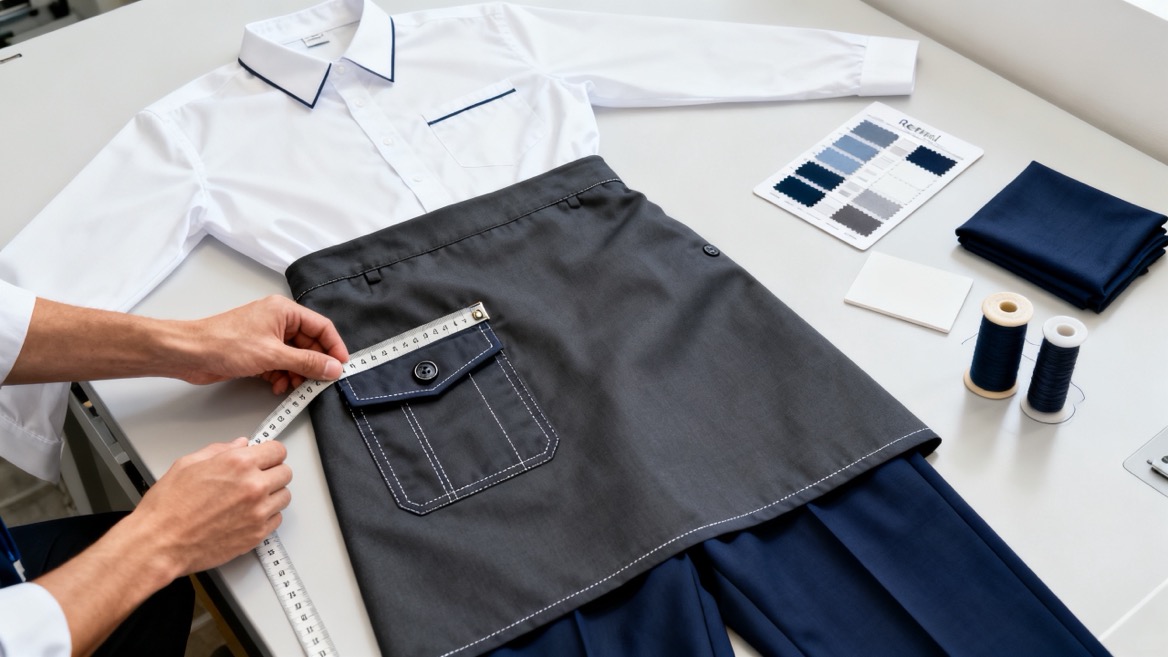
The most suitable waitress clothes manufacturer is the one whose product capability, development process, order quantities, and documentation match the purchasing program.
Shanghai Youti is worth evaluating for coordinated professional clothing and sample-based OEM development. Other suppliers on this shortlist offer different starting points, from broad occupational uniforms to hospitality aprons, kitchenwear, and formal tailoring. Their suitability should be established through product-specific sampling and verification—not assumed from a company description.
To begin a sourcing discussion with Shanghai Youti Clothing Co., Ltd., send garment references, target fabrics, size quantities, branding requirements, destination market, and expected delivery date. Request a written proposal covering MOQ, sampling, material approval, quality checkpoints, and repeat-order arrangements.
Request the complete certificate, including its number, legal holder, certified sites, scope, issuing body, and validity dates.
Search the known company name or certificate ID through IAF CertSearch where applicable, and confirm unresolved details directly with the issuing certification body. Check whether garment manufacturing at the proposed site is included. A valid certificate for another company or activity is not sufficient.
Not automatically. A fabric certificate should not be presented as proof that every component of a finished garment is covered.
Check the certificate holder, product scope, validity, and whether the claim applies to the fabric or finished article. Use the official label-check service rather than relying only on a screenshot.
Ask for separate minimums for existing designs, new patterns, stock fabrics, custom colors, embroidery, and private-label packaging.
Also clarify whether MOQ applies per style, color, or fabric batch. A low advertised minimum may be commercially useful without applying to every customization option.
Seal the approved pre-production garment and fabric swatch, record measurements and tolerances, and prohibit unapproved material substitutions.
Inspect during production as well as before shipment. The purchase agreement should define what happens when material composition, sizing, or construction differs from the approved standard.
Agree on pattern ownership, fabric continuity, color references, minimum repeat quantities, and procedures for discontinued materials.
Keep a controlled technical package and retain samples from each shipment. Ask for advance notice of fabric changes rather than discovering a substitution after a replacement order arrives.
- China Chamber of Commerce for Import and Export of Textiles: publishes textile and apparel trade-market statistics, including January–June 2025 export tables. [ccctexpo.com]
- China National Textile and Apparel Council: national industry organization identified in the United Nations Global Compact participant directory. [unglobalcompact]
- European Commission, Textiles Ecosystem: explains the distinction between ordinary textiles and products requiring CE marking. [single-market-economy.ec.europa]
- Your Europe, Textile Labels: official guidance on fiber-composition labeling and language requirements. [europa]
- OEKO-TEX Label Check: official certificate and label verification service. [oeko-tex]
- IAF CertSearch: verification resource for accredited management-system certifications. [f1.iafcertsearch]


