
Views: 288 Author: Youti Clothing Publish Time: 2026-09-14 Origin: Site


Content Menu
● Why Source Women Formal Suits From China?
● How We Screened These Manufacturers
>> What technical buyers should inspect
● Top 10 Women Formal Suit Manufacturers in China
>> 1. Shanghai Youti Clothing Co., Ltd.
>> 4. Wenzhou Chenjie Clothing Technology Co., Ltd.
>> 5. BOSINNO
>> 6. Baoxiniao
>> 8. OMJ Apparel / Dongguan Xingmai Apparel
>> 9. Lancai International Trading Limited
>> 10. Dongguan Benta Shangpin Clothing Co., Ltd.
● Buyer's Guide: How to Source Women Formal Suits Safely
>> 1. Do not compare quotations before aligning specifications
>> 2. Test the suit as a system
>> 3. Verify certifications correctly
>> 5. Build realistic lead times
● Common Women Formal Suit Sourcing Problems
>> Weak or incompatible interlining
>> Inconsistent colour between blazer and trouser
>> Underestimated freight and landed cost
● An Industry Insider Tip: Check the "Hidden Structure" Before You Approve
● FAQ
>> 1. How can I verify that an ISO 9001 certificate has not expired?
>> 2. What MOQ should I expect for a custom Women Formal Suit order?
>> 3. Should I choose polyester-viscose-elastane or wool-blend fabric?
>> 4. How do I prevent a blazer from bubbling after delivery?
>> 5. Is a BSCI or SMETA report enough for compliance?
China remains a major sourcing base for Women Formal Suit programs because buyers can access a broad fabric supply chain, specialised tailoring capacity, private-label development support, and production options ranging from small brand launches to large corporate-uniform rollouts. For procurement teams, however, the right supplier is not necessarily the one with the lowest quotation—it is the one that can reproduce the approved fit, fabric hand feel, construction standard, and delivery commitment consistently across repeat orders.
This guide is designed for brand owners, wholesalers, corporate-uniform buyers, and sourcing managers looking for a long-term OEM partner for women's blazers, trousers, skirt suits, waistcoats, and coordinated businesswear. It evaluates manufacturers by their disclosed capabilities, product focus, compliance credentials, order flexibility, and suitability for different purchasing scenarios.
China's apparel and accessories exports reached approximately US$151.18 billion in 2025. While export value declined year on year, export volume increased, underlining the country's continuing manufacturing depth and supplier ecosystem. The same industry data noted growth in casual-suit exports, a relevant signal for buyers sourcing modern businesswear, smart-casual tailoring, and uniform-style suit programs.
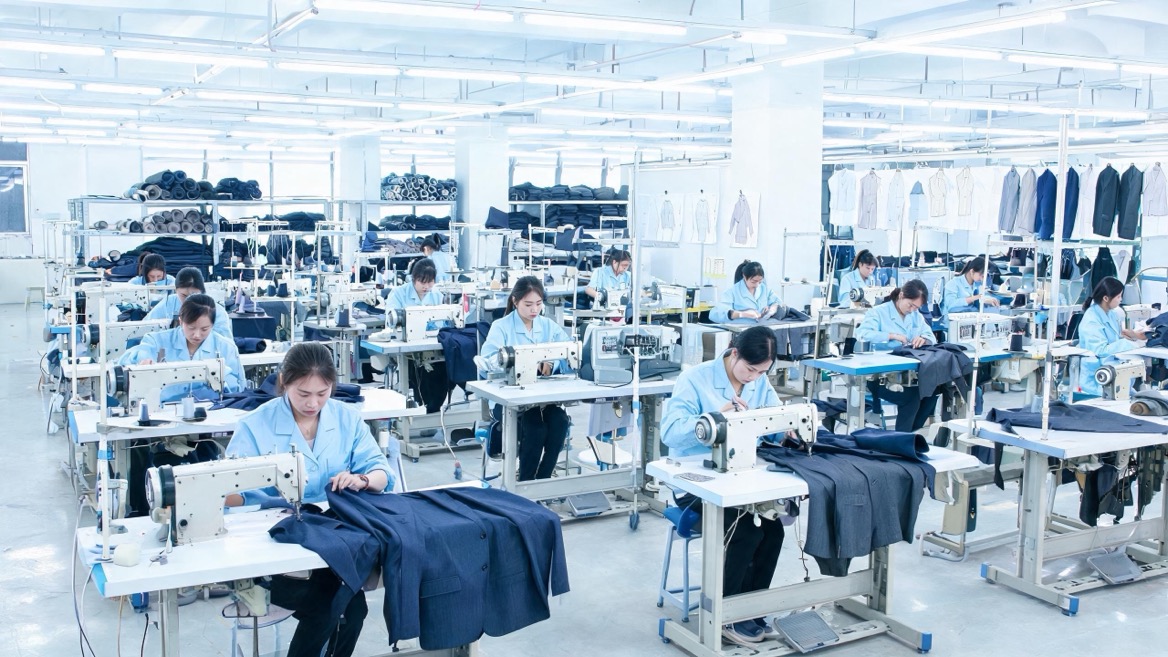
Women's formal suits require more than basic sewing capability. A commercial-quality blazer must balance silhouette, comfort, durability, and repeatability. China's advantage is not limited to garment assembly: buyers can access woven fabric mills, lining suppliers, shoulder-pad factories, interlining specialists, button and zipper suppliers, embroidery providers, testing laboratories, and export logistics providers within one connected sourcing ecosystem.
For formalwear and corporate tailoring, several manufacturing regions have distinct strengths:
| Manufacturing area | Typical strength | Suitable Women Formal Suit programs |
|---|---|---|
| Shanghai and surrounding Yangtze River Delta | Export coordination, professional apparel, quality management, fabric access | Corporate uniforms, business suits, shirts, tailored workwear |
| Ningbo, Zhejiang | Woven apparel, tailored garments, export-oriented factories | Blazers, office suits, trousers, structured separates |
| Wenzhou, Zhejiang | Traditional suit-making and made-to-measure know-how | Higher-end suits, tailored jackets, premium OEM/ODM |
| Humen and Dongguan, Guangdong | Fast development cycles and women’s fashion supply chain | Fashion blazers, contemporary officewear, lower-MOQ collections |
| Shandong | Large-scale garment production and export experience | Volume programs, uniform contracts, structured tailoring |
China's garment sector includes 13,745 enterprises above the designated size, with annual operating income for the sector reported at RMB 1.11 trillion in 2025. This scale does not make every supplier appropriate for a formal-suit project, but it does create a deep pool of specialised material, production, and inspection resources.
For overseas buyers, the most practical benefit is supplier choice. A startup label can find a development-oriented manufacturer willing to support limited seasonal runs, while a uniform distributor can work with a factory that has multiple sewing lines, documented quality procedures, and stable bulk-production planning.
A credible supplier shortlist should not be based solely on marketplace rankings, website design, or a low FOB quote. The manufacturers below were selected based on publicly disclosed information and their apparent relevance to women's tailored apparel, businesswear, OEM production, or related formalwear categories.
- Product relevance: The factory should have a clear connection to suits, blazers, businesswear, woven garments, workwear, uniforms, or women's fashion tailoring.
- OEM/ODM depth: Preference was given to suppliers that describe support for custom fabrics, labels, logos, patterns, sizing, samples, and bulk manufacturing.
- Production capability: Available information on workshop size, sewing lines, workforce, annual output, or stated capacity was reviewed where disclosed.
- Quality and compliance: ISO 9001, BSCI, SMETA, OEKO-TEX®, REACH, GRS, ISO 14001, and related claims are useful screening signals—but buyers should independently validate current certificates.
- Export-market familiarity: Suppliers serving Europe, North America, Oceania, or other international markets may better understand packaging, labelling, restricted-substance requirements, and export documentation.
- Suit-specific technical fit: A factory making basic knitwear may not be suitable for a structured women's blazer. Tailoring experience, woven-fabric handling, interlining application, pressing quality, and measurement control matter.
- Commercial fit: A large manufacturer may be ideal for repeat volume but unsuitable for a 150-piece launch. Conversely, a low-MOQ fashion factory may not be the best choice for a 50,000-piece uniform tender.
For a Women Formal Suit program, procurement teams should define the following before requesting quotations:
- Shell fabric composition, such as polyester-viscose-elastane, wool-polyester, wool-blend, Tencel™ blend, recycled polyester blend, or linen blend.
- Fabric weight in grams per square metre, often around 220–300 gsm for many all-season woven suit programs, depending on silhouette and destination climate.
- Construction type: fused, semi-structured, half-canvas-inspired, or more tailored construction.
- Interlining specification for front panels, collar, lapel, pocket welts, waistband, and hem.
- Shoulder-pad thickness and sleeve-head construction.
- Lining composition, lining coverage, and breathability requirements.
- Shrinkage, colourfastness, pilling, seam slippage, tensile strength, and dimensional-stability targets.
- AQL inspection level, measurement tolerances, and acceptable defect definitions.
- Country-specific chemical requirements, especially for EU-bound goods.
For European sales, chemical compliance is often more relevant than product safety marks. CE and RoHS are generally not standard garment certifications for women's suits. Buyers should instead focus on applicable requirements such as REACH restricted substances, fabric chemical testing, labelling rules, fibre-composition requirements, and any brand-specific restricted-substance list. Suppliers may hold ISO 9001 for quality management, BSCI or SMETA for social-audit programs, and OEKO-TEX® or GRS at material level, but those documents do not replace a product-specific compliance plan.
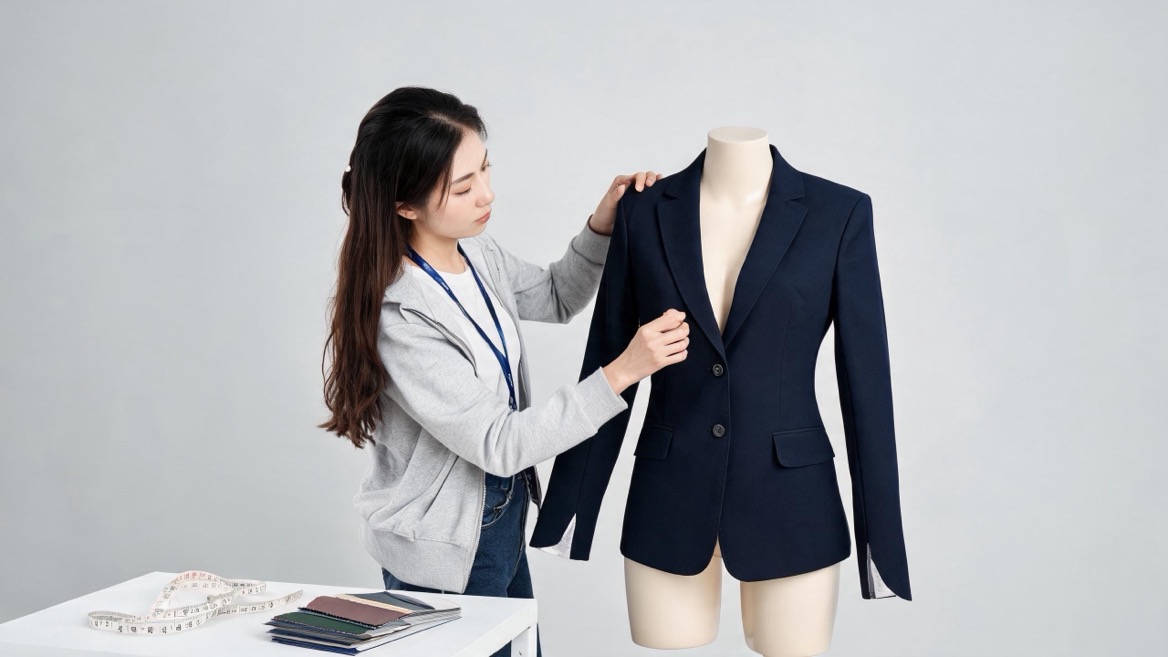
The following table presents disclosed or indicative information. "Verify" means the buyer should request current documentary proof before placing an order.
| Manufacturer | Established | Main Women Formal Suit focus | Indicative capacity / MOQ | Disclosed certifications or compliance | Best suited for |
|---|---|---|---|---|---|
| Shanghai Youti Clothing Co., Ltd. | 2018 | Business suits, corporate apparel, uniforms, shirts, workwear | 6 sewing lines; 1.4M+ pieces/year; flexible MOQ discussion | ISO 9001, BSCI, REACH, EN 1149-5, EN ISO 11612 disclosed | SMEs, uniform distributors, professional apparel programs |
| Hunan Palette Garment | 1993 | Business suits and tailored suit production | Approx. 4M suits/year cited in industry listings; verify | Verify current certificates | Large-volume suit programs |
| Shandong Aoshi Garments | 1956 | Suits and tailored apparel | Some styles reportedly from about 20 pieces; verify | Verify current certificates | Small-to-mid-size tailored suit orders |
| Wenzhou Chenjie Clothing Technology Co., Ltd. | Not publicly specified | Suit, shirt, overcoat, professional attire | 5,000+ sqm factory and 8,000 sqm warehouse disclosed | Verify current certificates | Suit-focused OEM/ODM and tailored collections |
| BOSINNO | 40+ years disclosed | MTM, RTW, wholesale suit manufacturing | 600,000 annual capacity disclosed | Sustainable-production claims; verify scope | Premium tailoring and custom suit programs |
| Baoxiniao | Not publicly specified on page reviewed | Women’s business suits, blazers, work attire | Low MOQ and 7–15 day production claim; verify order basis | Verify current certificates | MTM-style, private-label businesswear |
| H&FourWing | 15+ years disclosed | Ladies’ suits, women’s office sets | Up to 1,000 pieces stated; verify per style | Verify current certificates | Boutique women’s formalwear brands |
| OMJ Apparel / Dongguan Xingmai Apparel | 2003 | OEM/ODM women’s apparel, fashion garments | MOQ from 50 pieces stated for some categories; verify for suits | ISO 9001, OEKO-TEX, GOTS, BSCI, GRS claims; verify | Startups and flexible fashion development |
| Lancai International Trading Limited | 2006 | Women’s fashion, OEM/ODM, private label | 3,000 sqm; 2,000+ new styles/year disclosed | BSCI, SMETA, ISO 9001, OEKO-TEX claims; verify | Fashion-led women’s blazer and coordinated-set programs |
| Dongguan Benta Shangpin Clothing Co., Ltd. | 1998 | Fashion garments, jackets, suits, trousers | 8,000+ sqm and 300+ workers disclosed | ISO 9001, ISO 14001, ISO 45001, BSCI claims; verify | Fashion brands needing broader garment categories |
Shanghai Youti Clothing Co., Ltd. is a practical option for buyers sourcing professional apparel rather than purely trend-driven women's fashion. Founded in 2018, the company operates a 2,500-square-metre workshop with more than 300 sets of machinery, six sewing lines, and an annual output stated at over 1.4 million pieces. Its product portfolio includes suits, shirts, uniforms, workwear, trousers, jackets, and related professional garments.
For a Women Formal Suit buyer, Youti's strongest position is its combination of businesswear focus, project-management support, and willingness to work from technical packs, images, and physical reference samples. This makes the factory especially relevant for corporate-uniform companies, regional distributors, workwear brands expanding into office apparel, and small-to-medium-sized labels that need more detailed OEM communication than a high-volume factory may offer.
Youti states that its internal structure includes Design & Development, Business Management, Sampling & Production, After-sales, and Quality Inspection functions. It also discloses ISO 9001, BSCI, REACH, EN 1149-5, and EN ISO 11612 certifications. Buyers should request the latest certificate files, issuing bodies, scope statements, factory address coverage, and validity dates during onboarding.
Core strengths
- Suit, shirt, uniform, and workwear capabilities under one supplier relationship.
- Support for custom orders based on technical documents, images, and physical samples.
- Dedicated project communication and a multi-stage quality-inspection approach.
- Flexible, SME-friendly OEM orientation rather than a one-size-fits-all volume model.
- Stated sample lead time of 10–15 working days and bulk lead time of 45–60 working days, subject to fabric availability, approval cycles, and order complexity.
- Europe is identified as its largest market, with North America and Oceania also described as important markets.
Recommended use case
A buyer launching a women's corporate-blazer and trouser program could use Youti for initial pattern refinement, branded embroidery or printing, custom size charts, coordinated shirts, and repeat uniform replenishment. It is particularly suitable when the buyer values communication speed, flexible OEM development, and a supplier able to manage formalwear together with related professional clothing.
Hunan Palette Garment is often referenced in suit-manufacturing sourcing lists for its high-volume business-suit and bespoke-suit capabilities. Industry listings cite a production scale of approximately 4 million suits per year, although buyers should confirm the current capacity, women's tailoring allocation, and seasonal availability directly with the manufacturer.
Core strengths
- Potential fit for large suit programs requiring repeat production.
- Experience associated with business-suit manufacturing.
- Suitable initial candidate for wholesalers, uniform contractors, and large retail programs.
Buyer caution
Large nominal capacity does not automatically guarantee a fit for women's tailoring. Ask for women's blazer samples, full measurement specifications, photos of internal construction, pressing standards, and evidence that the factory can control size grading across your target demographic.
Shandong Aoshi Garments is associated with suit production and has been listed in sourcing references as serving international markets including the United States, Europe, Australia, and Africa. Some industry listings indicate that selected orders may start around 20 pieces, but MOQs should always be confirmed based on fabric, colour, construction, and custom-trim requirements.
Core strengths
- Potentially attractive for smaller tailored-suit programs.
- Suit-oriented manufacturing profile.
- International-market orientation.
Recommended use case
This manufacturer may suit an importer, made-to-measure retailer, or specialty wholesaler testing several women's formal suit fits before committing to scale. Request a pre-production sample for each fit block—not simply one sample in one size.
Wenzhou Chenjie Clothing Technology positions itself as a suit-focused supplier offering OEM, ODM, made-to-measure, wholesale, and bespoke production. It discloses more than 30 years of OEM/ODM experience, a factory exceeding 5,000 square metres, and an 8,000-square-metre warehouse. Its stated range includes suits, professional attire, shirts, overcoats, and down jackets.
Wenzhou has a long association with suit manufacturing, and this regional specialisation can be useful when the buyer's main concern is tailored construction rather than broad fashion-category development.
Core strengths
- Clear suit and professional-attire orientation.
- Relevant for buyers requiring tailored jackets, matching trousers, and more formal silhouettes.
- Potential fit for made-to-measure or semi-custom commercial models.
Recommended use case
Consider Chenjie when your product brief requires a more structured jacket, custom lapel treatment, internal finishing requirements, or a refined businesswear aesthetic. Verify women-specific pattern-development resources and request comparative samples in your preferred construction levels.
BOSINNO presents itself as a custom suit manufacturer with more than 40 years of experience, serving made-to-measure, ready-to-wear, and wholesale custom-suit programs. It reports an annual capacity of 600,000 units and promotes an approach that combines traditional tailoring with intelligent production.
Core strengths
- Long-term suit-specialist positioning.
- MTM, RTW, and wholesale manufacturing options.
- Potential suitability for premium or technically demanding tailoring projects.
Recommended use case
BOSINNO may be appropriate for a brand positioned above entry-level corporate uniforms—especially where fit, tailoring details, and customization are central to the product proposition. Buyers should confirm whether the stated capacity includes women's garments, which factory handles women's blocks, and the specific construction offered at each price level.
Baoxiniao markets custom women's business suits, blazers, and work attire for brands, factories, and procurement agents. Its public materials mention OEM/ODM support, private-label services, low-MOQ options, plus-size availability, and an advertised production range of 7–15 days, which should be clarified as it may refer to selected styles, standard materials, or sample/stock-based programs rather than fully customised bulk production.
Core strengths
- Dedicated women's businesswear messaging.
- Suitable for buyers interested in custom blazers, workwear, and private-label programs.
- Potential relevance for expanded sizing and made-to-measure-inspired requirements.
Buyer caution
A fast quoted lead time can be realistic only when fabrics, linings, trims, patterns, and approvals are ready. Ask the supplier to distinguish clearly between sample lead time, stock-fabric lead time, and fully custom fabric bulk-production lead time.
H&FourWing is a Ningbo-based women's clothing manufacturer that specifically markets ladies' suits and women's office sets. The company states it has operated for more than 15 years and mentions manufacturing capability of up to 1,000 pieces, though this should be clarified by style, month, and production line.
Core strengths
- Women's formalwear relevance rather than only men's suiting.
- Ability to work with officewear fabrics such as polyester-spandex blends.
- Potentially appropriate for smaller, fashion-conscious formalwear collections.
Recommended use case
This supplier may fit a boutique brand seeking coordinated women's blazer-and-trouser sets, officewear capsules, or seasonal designs with moderate production quantities. Buyers should verify fabric-testing support, colour continuity, and whether the supplier can maintain consistency across repeat orders.
OMJ Apparel identifies itself as a Dongguan, Humen-based OEM and ODM manufacturer established in 2003. It advertises low MOQs beginning from 50 pieces for certain garment categories and lists ISO 9001, OEKO-TEX, GOTS, BSCI, GRS, and SGS-related claims. The supplier should provide current documents and clarify which certification applies to the factory, which applies to materials, and which applies to a particular production site.
Core strengths
- Low-MOQ positioning for early-stage brands.
- Women's clothing development orientation.
- Broad material and sustainability-related claims, subject to verification.
- Located in Humen, a major women's-fashion development cluster.
Recommended use case
OMJ may be relevant for a new brand testing women's blazers, fashion suits, or casual-formal sets in multiple colourways. It may be less appropriate for a buyer that requires highly traditional, heavily structured suit construction; request a tailored blazer sample before proceeding.
Founded in 2006 in Humen, Dongguan, Lancai specialises in women's fashion, casualwear, and activewear OEM/ODM production. Its public information states that it operates a 3,000-square-metre facility, develops more than 2,000 new styles annually, and holds or works with BSCI, SMETA, ISO 9001, and OEKO-TEX-related compliance systems.
While not solely a suit manufacturer, Lancai is relevant for buyers developing fashion-oriented Women Formal Suit collections, particularly relaxed blazers, contemporary tailored sets, women's occasionwear, and coordinated collections.
Core strengths
- Strong product-development cadence for fashion brands.
- In-house design capacity and high annual new-style output.
- Humen location with strong access to women's apparel materials and sample-development resources.
- Publicly disclosed attention to inline checks, final AQL inspection, and traceable reporting.
Recommended use case
Lancai is likely better suited to a brand requiring seasonal fashion updates and fast design translation than to a traditional uniform company purchasing one standard suit style for several years.
Dongguan Benta Shangpin Clothing was established in 1998 and is located in Humen, Dongguan. Public directory information states that the company has an 8,000-square-metre factory, more than 300 workers, and OEM/ODM experience across men's and women's apparel. Its product categories include suits, trousers, jackets, fashion garments, and other apparel. It lists ISO 9001, ISO 14001, ISO 45001, and BSCI credentials, which should be independently checked for current status and scope.
Core strengths
- Longer operating history than many newer fashion factories.
- Broader garment-category coverage, including suits and trousers.
- Potential ability to support a brand across blazer, trouser, outerwear, and casualwear programs.
- Relevant environmental, occupational, quality, and social-compliance claims subject to audit.
Recommended use case
Benta Shangpin may fit brands that need a single supplier for a wider women's wardrobe rather than only a formal suit. For a highly tailored suit program, assess the actual jacket construction and pressing quality through physical samples.
A US$20 blazer and a US$45 blazer may look similar in an online photo, but they can be built very differently. The price difference may come from fabric quality, fabric weight, interlining, lining, labour content, button type, seam allowance, pressing time, packaging, inspection standard, or order quantity.
Before asking for a price, provide a complete tech pack that includes:
- Front, back, and interior technical sketches.
- Fabric composition, weight, weave, stretch requirement, and target hand feel.
- Colour standard, preferably Pantone reference plus physical fabric swatch.
- Measurement chart and grading rules.
- Construction requirements for lapel, collar, shoulder, sleeves, vents, pockets, waistband, and hem.
- Labelling, hangtag, logo, barcode, packaging, and carton-mark requirements.
- Inspection standard and acceptable measurement tolerances.
- Delivery destination, Incoterm, and target ex-factory date.
A common sourcing mistake is approving only the shell fabric or one single sample. Women's formal suit performance depends on the interaction of the outer fabric, lining, fusible interlining, shoulder pad, sleeve head, thread, buttons, and pressing process.
A robust sample evaluation should include:
- Try-on testing across at least three sizes.
- Seated and arm-raise movement testing.
- Lapel roll and collar gap evaluation.
- Pocket opening and welt alignment.
- Sleeve pitch and shoulder balance.
- Post-dry-cleaning or wash testing, depending on care instructions.
- Pilling, abrasion, colourfastness, and shrinkage testing where relevant.
- Inspection after at least 24 hours on a hanger, because some fusing defects and shape issues become more visible after resting.
A certificate image in a quotation deck is not sufficient proof. A supplier may hold a valid certificate for another production site, an expired audit, or a scope that does not cover the product or facility in question.
Use this verification procedure:
1. Request the full certificate—not a cropped logo or screenshot.
2. Check the legal company name, factory address, certificate number, validity date, audit body, and scope.
3. Confirm that the factory address matches the actual production site.
4. Search the issuing certification body's official database where available.
5. Ask whether subcontracting will occur and whether every facility has been approved.
6. Include your compliance and restricted-substance requirements in the purchase order and supplier agreement.
7. Arrange independent pre-shipment inspection and, for high-risk programs, a social or technical factory audit.
A well-managed OEM project typically follows this sequence:
1. Development sample: Checks design interpretation, silhouette, and general construction.
2. Fit sample: Confirms measurements, grading, comfort, and body balance.
3. Size-set sample: Confirms the grading across key sizes.
4. Pre-production sample: Uses approved bulk fabric, trims, labels, and final workmanship.
5. Top-of-production sample: Taken from the actual production line to verify that bulk output matches approval.
6. Pre-shipment inspection: Checks quantity, appearance, workmanship, measurements, packaging, and carton marks before shipment.
For a women's suit program, do not skip the size-set sample when selling across multiple sizes. A blazer that fits well in size S may show poor sleeve pitch, bust ease, hip ease, or lapel balance when graded to XL or plus sizes.
For a fully customised Women Formal Suit order, lead time includes more than sewing. It may include fabric development, colour lab dips, fabric booking, pattern development, sample approvals, trim sourcing, production scheduling, inline inspection, final inspection, carton packing, customs documentation, and freight booking.
Shanghai Youti, for example, states 10–15 working days for sampling and 45–60 working days for bulk production. Treat this as a planning reference only; actual timing depends on specification complexity, fabric availability, approval speed, seasonality, and order size.
A safer purchase plan includes time buffers for:
- Fabric shade approval.
- Lab-dip and bulk-colour variation.
- Sample corrections.
- Chinese public holidays.
- Port congestion or vessel schedule changes.
- Third-party inspection rework.
- Customs or destination-market documentation issues.
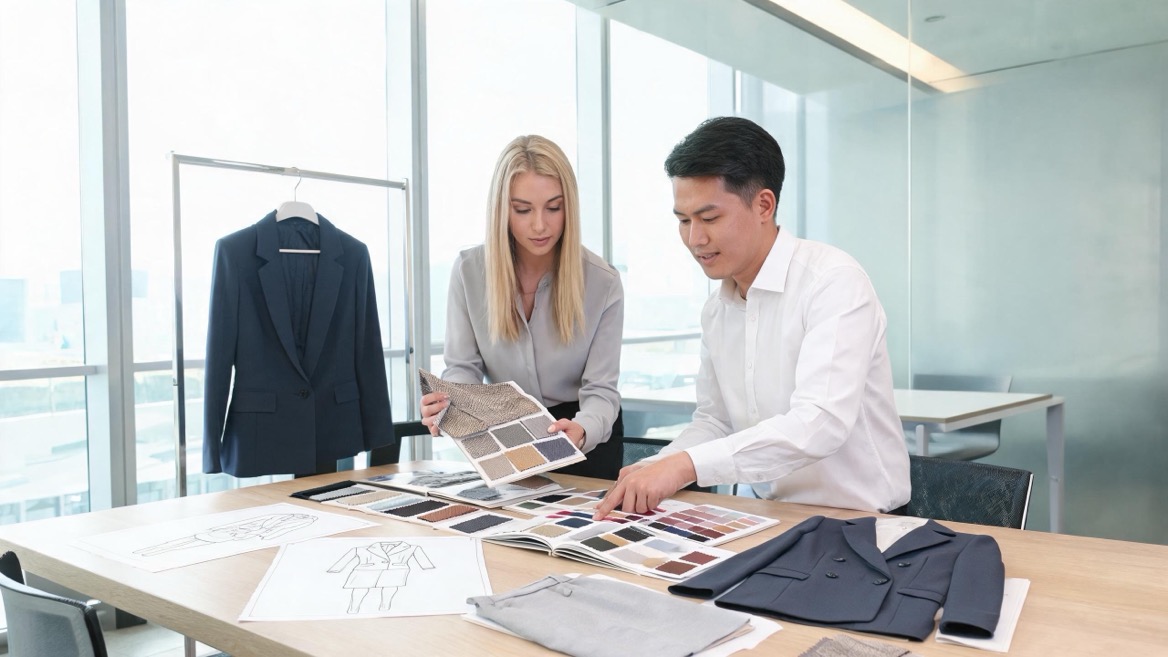
The most costly problem is not always visible at first inspection. A supplier may quote based on a high-quality polyester-viscose-elastane fabric but use a lower-weight, less stable alternative in bulk. The jacket may then lose shape, pill faster, shine at stress points, or show poor recovery after sitting.
How to avoid it: Seal an approved bulk fabric cutting or swatch, specify composition and weight tolerance in writing, retain a counter-sample, and require bulk fabric inspection before cutting.
A blazer may look acceptable immediately after pressing but develop bubbling, delamination, wrinkling, or a stiff unnatural chest after wear or cleaning. This often results from poor interlining selection or inconsistent fusing temperature, pressure, and dwell time.
How to avoid it: Request a fusing test report where appropriate, inspect the jacket after rest time, conduct cleaning or heat-aging tests, and approve the internal construction—not only the exterior appearance.
Women's tailoring requires more than scaling every measurement evenly. Shoulder width, bust, waist, hip, sleeve bicep, armhole, back length, and dart position may need different grading rules.
How to avoid it: Provide your own grading rules or approve a full size set. Ask for measurement reports for every key size.
Matching pieces can show tone differences when cut from different fabric lots or when one component receives different finishing treatment.
How to avoid it: Require the blazer, trousers, skirt, and waistcoat for each colour to use the same approved bulk lot whenever possible. Include a colour-difference tolerance and inspection procedure in your quality agreement.
A low FOB quotation does not include all costs. Buyers may later face unexpected freight, destination handling, import duty, customs brokerage, storage, relabelling, or quality-claim costs.
How to avoid it: Compare suppliers on a landed-cost basis. Request carton dimensions, gross weight, HS-code recommendation, Incoterm, port of loading, and packaging details before choosing a supplier.
One rarely discussed issue in women's suit sourcing is that two blazers can share the same outer fabric, colour, measurements, and visible styling—but perform completely differently because of what is inside.
Ask every shortlisted factory to provide a construction map or inside-out sample showing:
- Front-body interlining coverage.
- Lapel interlining specification.
- Collar stand and under-collar treatment.
- Shoulder pad thickness and density.
- Sleeve-head roll.
- Chest-piece or chest-support material, if used.
- Pocket reinforcement.
- Hem tape or reinforcement.
- Lining attachment method.
- Fusing process controls.
This is particularly important when a supplier is transitioning from casualwear to formal tailoring. A fashion-jacket factory can make an attractive sample, yet may not have stable fusing, pressing, and shaping procedures for a commercial women's blazer. Reviewing the hidden structure early can prevent a costly bulk-order failure.
Selecting a China-based Women Formal Suit manufacturer requires a structured evaluation of tailoring capability, materials control, fit development, compliance documentation, communication quality, and production reliability. A supplier that can make a good showroom sample is not automatically prepared to deliver consistent production across colours, sizes, and repeat orders.
For buyers seeking professional apparel, business suits, uniforms, shirts, and related OEM programs, Shanghai Youti Clothing Co., Ltd. is a relevant first supplier to evaluate. Its disclosed six sewing lines, annual output of more than 1.4 million pieces, certification claims, formalwear and uniform product range, and 10–15 working-day sampling window make it particularly relevant for small and medium-sized brands, uniform distributors, and buyers that require flexible communication and deeper custom-development support.
Before committing, send a detailed tech pack, request a construction-focused sample, validate all certification documents, approve a size set, and use an independent pre-shipment inspection. This process protects your brand, reduces avoidable quality claims, and creates a stronger foundation for long-term sourcing.
Ready to develop a women's blazer, trouser suit, or corporate-uniform collection? Prepare your tech pack, target quantity, destination market, fabric requirement, and delivery timeline—then request a sample and manufacturing assessment from Shanghai Youti Clothing Co., Ltd.
Ask the manufacturer for the complete ISO 9001 certificate, then verify the legal company name, production-site address, certificate number, scope, issue date, and expiry date. Check the issuing certification body's official directory if available. Also confirm that the certified site is the actual sewing and finishing factory, not only a trading company or headquarters. If the supplier will use subcontractors, request documentation for those facilities as well.
MOQ depends on fabric choice, number of colours, construction, custom trims, and whether the factory can use stock materials. A development-oriented supplier may accept 50–300 pieces per style under limited conditions, while a larger tailored-suit factory may require higher volumes for custom fabric and efficient production. The critical question is not only total MOQ but also MOQ per colour, per fabric, and per size ratio.
Polyester-viscose-elastane is commonly chosen for corporate uniforms and mid-market businesswear because it can offer durability, easier care, wrinkle resistance, and cost control. Wool blends may provide better breathability, drape, and premium perception, but usually require higher material budgets and more careful care instructions. Choose based on target price, climate, care expectations, and brand position—not simply fabric composition.
Specify the interlining system in the tech pack, request a fused-panel test, and review samples after resting rather than only immediately after pressing. Test the garment after the intended care process. In bulk production, inspect early production pieces and ask for evidence of fusing machine parameters and routine adhesion checks. Bubbling is easier and cheaper to correct before mass cutting than after shipment.
No. A social audit addresses workplace and social-compliance conditions under a specific audit framework, but it does not confirm that your women's suits meet chemical, labelling, product-performance, or destination-market requirements. Buyers should use a complete compliance package that covers factory audit status, product testing, restricted substances, fibre labels, country-of-origin marking, packaging requirements, and purchase-order quality clauses.
- [General Administration of Customs of the People's Republic of China]
- [China National Textile and Apparel Council]
- [China National Garment Association]
- [OEKO-TEX® certification information]


