
Views: 255 Author: Youti Clothing Publish Time: 2026-10-06 Origin: Site


Content Menu
● Hi Vis Vest vs Hi Vis Jacket: The Main Differences
>> Why Garment Names Can Mislead Buyers
● How High-Visibility Clothing Works in Extreme Weather
>> Fluorescent Fabric Supports Daytime Visibility
>> Retroreflective Tape Supports Visibility Under Headlights
>> Sleeve Bands Help Drivers Recognize Human Movement
● Which Provides Better Visibility in Rain, Fog, Snow, and Heat?
>> Heavy Rain: A Weatherproof Hi Vis Jacket Usually Offers the Better System
>> Fog: Better Coverage Helps, but Clothing Has Limits
>> Snow and Cold: A Jacket Often Reduces Layering Problems
>> Extreme Heat: A Vest May Be the More Appropriate Choice
● Compare Performance Classes Before Comparing Styles
>> ANSI/ISEA 107: Match the Type and Class to the Application
>> EN ISO 20471: Check the Finished Garment or Approved Combination
● Three Overlooked Factors That Can Change the Result
>> 1. Rated Coverage Is Not Always Exposed Coverage
>> 2. Branding Can Reduce the Compliance Margin
>> 3. Weather Protection and Visibility Require Separate Evidence
● A Practical Five-Step Wear Trial Before Bulk Purchasing
● Illustrative Industry Scenarios: Why the Best Choice Changes
>> Road Maintenance During a Wet Night Shift
>> Loading Operations During a Hot Afternoon
● OEM Purchasing Checklist for Brands and Wholesalers
● Care and Replacement Affect Both Vests and Jackets
● Choose a Garment System, Not Just a Product Name
>> Is a hi vis jacket always more visible than a hi vis vest?
>> Can I wear a hi vis vest over a waterproof jacket?
>> Is every hi vis jacket waterproof?
>> Is Class 3 compulsory whenever the weather is bad?
>> Can a vest and trousers provide Class 3 visibility?
>> Does reflective tape work without any light?
When comparing a hi vis vest vs hi vis jacket in extreme weather, a properly specified jacket usually provides better overall visibility in cold, wet conditions. Its sleeves create additional space for fluorescent fabric and retroreflective bands, while suitable weather protection helps workers keep the garment closed and correctly positioned. However, a jacket is not automatically safer simply because it covers more skin.
The deciding factor is the garment's verified performance, visible material coverage, and suitability for the actual task. A compliant vest worn over suitable weatherproof clothing can outperform an incorrectly specified jacket.
For overseas brands, wholesalers, and manufacturers sourcing uniforms and work clothes, this distinction matters. From the OEM purchasing perspective of Shanghai Youti Clothing Co., Ltd., the useful question is not simply "vest or jacket?" It is: "Which garment system keeps workers conspicuous, comfortable, and appropriately protected throughout their shift?"
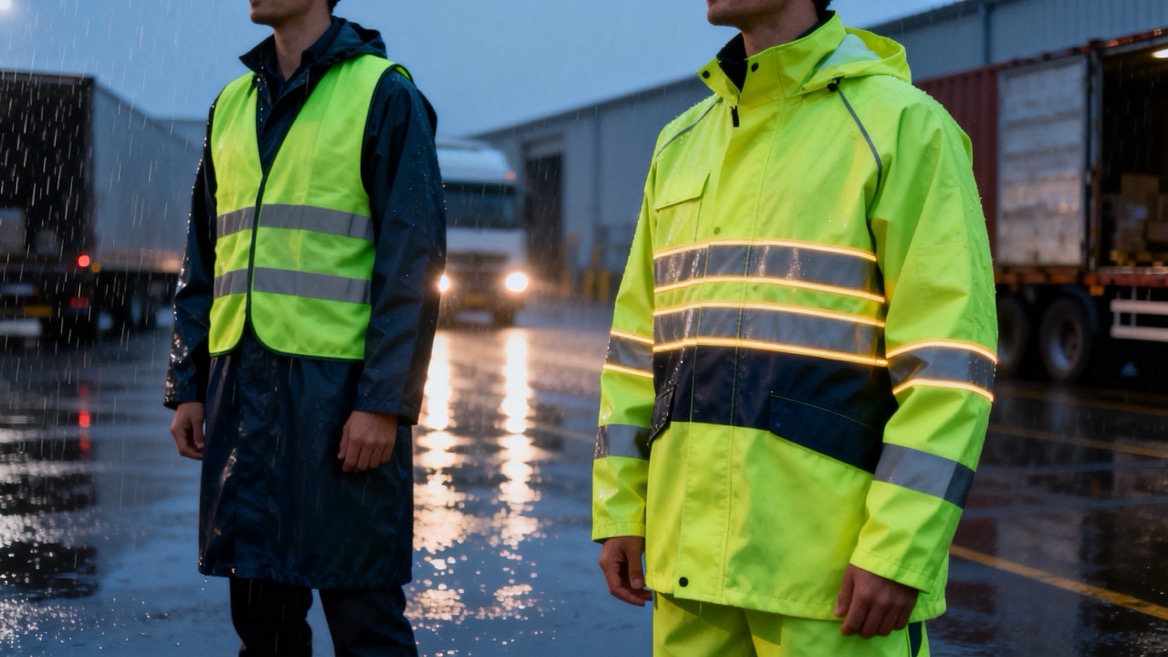
A hi vis vest typically provides torso coverage without sleeves. A hi vis jacket covers the torso and arms, but its insulation, waterproofing, and breathability vary considerably between products.
| Comparison factor | Hi vis vest | Hi vis jacket |
|---|---|---|
| Visibility coverage | Primarily the torso | Torso and arms |
| Movement recognition | Limited arm-related visual cues | Sleeve bands can highlight arm movement |
| Rain protection | Usually requires a separate weatherproof layer | Available with tested rain protection |
| Cold-weather use | Fits over appropriate insulating layers | Can combine visibility and insulation |
| Hot-weather comfort | Generally easier to ventilate | Depends on fabric, construction, and workload |
| Layering flexibility | Easily moved between outer garments | Often serves as the outermost layer |
| Purchasing priority | Fit, coverage, closure, and layering | Coverage, weather performance, and thermal comfort |
These are typical design differences, not guarantees. A lightweight hi vis jacket may offer little rain protection, while a vest can be part of a carefully selected protective ensemble.
Product names such as "safety vest," "winter jacket," or "reflective workwear" do not establish compliance.
Before comparing quotations, ask for the applicable standard, performance class, garment identification, size range, and supporting documentation. A bright color and reflective-looking trim are not sufficient evidence of protective performance.
Understanding visibility helps explain why sleeves, garment placement, and weather conditions matter.
Fluorescent background material helps workers stand out during daylight and transitional lighting conditions.
Its effectiveness depends partly on contrast with the surroundings. Fluorescent yellow-green is not automatically the best choice everywhere. Vegetation, equipment colors, and background clutter can influence whether another permitted color creates stronger contrast.
More fabric alone is not enough. The material must meet the relevant color and performance requirements.
Retroreflective material returns light toward its source. It helps drivers detect workers when headlights illuminate the garment.
It does not generate light independently. Consequently, reflective workwear cannot guarantee detection in darkness without a suitable light source, behind an obstruction, or inside a vehicle's blind spot.
Reflective bands on moving limbs provide clues that an observed shape is a person.
This principle is commonly called biomotion. It explains an important jacket advantage: reflective sleeves can make arm movement recognizable in ways that torso-only markings cannot.
Nevertheless, bending, carrying materials, or wearing equipment can obscure either garment. The complete working posture matters.
For prolonged outdoor work in heavy rain, a suitably rated waterproof hi vis jacket is generally the more practical choice.
It combines visible coverage with protection against water penetration. Keeping the visibility layer outside the rain-protection system also reduces the chance that workers will accidentally conceal it.
Specify more than a "waterproof" marketing claim. Evaluate:
- Fabric and seam performance.
- Closure and storm-flap construction.
- Hood adjustment and compatibility.
- Water-vapor resistance or breathability evidence.
- Reflective material performance after relevant conditioning tests.
A vest over a non-hi-vis raincoat remains an option when the resulting arrangement meets the assessed visibility requirement. However, the raincoat's unmarked sleeves do not become compliant reflective sleeves simply because a vest covers the torso.
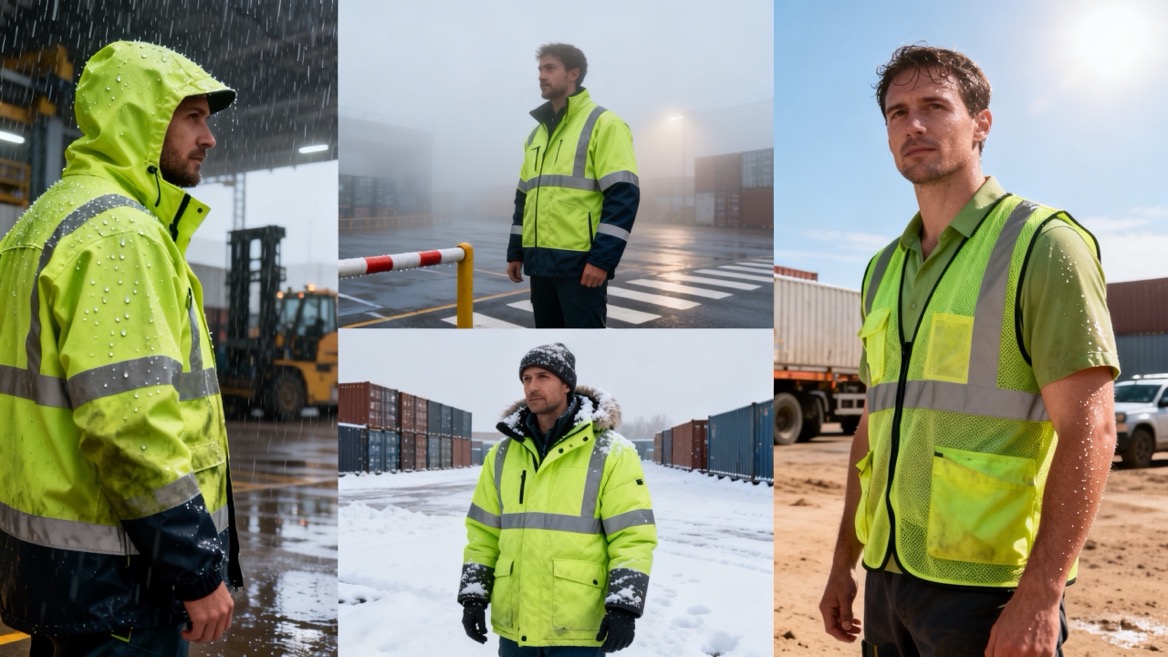
In fog, prioritize the required garment class, visible coverage, and worksite controls rather than assuming that one product creates a dependable viewing distance.
A jacket with reflective sleeve bands can offer useful recognition advantages. However, no responsible supplier should promise that a jacket remains visible from a fixed distance in every fog condition.
If visibility deteriorates substantially, the response may require changes to vehicle movement, pedestrian access, lighting, or whether work continues. Clothing is only one part of the safety system.
A suitable hi vis winter jacket can combine visibility with insulation and protection appropriate to the conditions.
This is useful when workers would otherwise put an ordinary winter coat over their safety vest. Once concealed, the vest cannot perform its intended warning function.
A vest can still work well when worn over the outermost winter layer. Check that it closes correctly without stretching, riding up, or restricting movement.
Remove accumulated snow when safe to do so, because covered fabric and reflective bands cannot contribute fully to visibility.
Extreme weather also includes heat.
For physically demanding work in hot conditions, an unnecessarily heavy jacket can impose additional thermal load. A correctly specified lightweight vest may provide a better balance of visibility and comfort.
Where greater coverage is required, consider an appropriately compliant lightweight sleeved garment instead of assuming that a bulky jacket is the only alternative.
The practical aim is to provide the necessary visibility without creating avoidable discomfort that encourages workers to open or remove the garment.
ANSI/ISEA 107 distinguishes application types as well as performance classes. Type R addresses roadway-related applications, while other types serve different work environments.
Under the 2020 edition, the usual Type R material minimums are:
| Material requirement | Type R Class 2 | Type R Class 3 |
|---|---|---|
| Background material | 775 square inches | 1,240 square inches |
| Retroreflective material | 201 square inches | 310 square inches |
Specified background-area allowances apply to the smallest offered garment size. These allowances do not reduce the listed retroreflective minimums.
Class 3 upper-body garments also require retroreflective bands around sleeves. A conventional sleeveless vest should therefore not be treated as a standalone Class 3 garment merely because its front panel looks large.
EN ISO 20471 also establishes classes based on material coverage and design requirements.
| Minimum visible material | Class 2 | Class 3 |
|---|---|---|
| Fluorescent background | 0.50 m² | 0.80 m² |
| Retroreflective material | 0.13 m² | 0.20 m² |
Class 3 requires torso coverage and, at minimum, sleeves or full-length trouser legs incorporating retroreflective bands.
An approved garment combination can achieve Class 3. However, buyers should verify the documented combination rather than assume that any vest and trousers qualify together.
For either standard, confirm the edition and requirements applicable to the destination market and customer specification.
A backpack, tool belt, harness, or carried package can conceal otherwise compliant material.
Review the worker from the front, back, and sides while performing representative tasks. A photograph of an unobstructed garment on a mannequin does not show how it functions during loading, bending, or climbing.
Additional lower-body visibility may be useful where upper-body coverage is repeatedly blocked.
Large logos, dark panels, and decorative features can reduce the qualifying fluorescent area.
This is particularly important in smaller sizes, where there may be less available area to begin with. Approve branding placement before finalizing the garment's material-area calculation.
A tested fabric does not establish that every customized garment made from it meets the intended class.
High visibility does not automatically mean waterproof, insulated, flame resistant, or suitable for every occupational hazard.
Evaluate each claimed protective function separately. For European rainwear specifications, EN 343 is relevant to rain protection, while EN ISO 20471 addresses visibility.
Avoid comparing rainwear classifications or breathability figures without checking the standard edition, test method, and meaning of the reported result.
Laboratory evidence and design assessment are essential. A controlled wear trial can identify usability problems that documents alone may miss.
This process is a purchasing recommendation, not a replacement for certification.
1. Map the working conditions. Record lighting, weather, vehicle movement, exposure duration, and typical tasks.
2. Assemble the complete outfit. Include the intended layers, footwear, helmet, harness, and carried equipment.
3. Check closure and movement. Ask wearers to bend, reach, and perform representative activities in a controlled environment.
4. Review exposed visibility. Examine whether outer layers, pockets, equipment, or posture obscure important material.
5. Record acceptance criteria. Document fit problems, thermal discomfort, obstructed bands, and required design changes.
Do not conduct visibility trials by exposing workers to live traffic. Use controlled arrangements and competent supervision.
The following examples illustrate selection logic; they are not customer case studies or measured performance claims.
A buyer assessing roadside maintenance may favor a suitably compliant hi vis rain jacket with reflective sleeves and compatible trousers.
The reasoning combines night-time recognition, prolonged rain exposure, and potential obstruction of torso markings during work. The final class and ensemble must still follow the task assessment and applicable requirements.
A buyer assessing physically demanding loading work may select a lightweight hi vis vest where its class and coverage are appropriate.
The priority is adequate conspicuity without unnecessary thermal burden. Vehicle-pedestrian separation remains essential, regardless of the garment chosen.

A useful sourcing brief should define the finished product, not merely request "reflective workwear."
Include:
- Destination market and applicable standard edition.
- Required type, class, and protective functions.
- Size range and intended layering allowance.
- Fluorescent material and reflective-tape specifications.
- Logo dimensions and placement.
- Rain-protection and comfort requirements.
- Washing instructions and documented durability.
- Supporting reports linked to the relevant materials and garment design.
For Shanghai Youti Clothing Co., Ltd., this creates a clearer starting point for OEM discussions with overseas brands, wholesalers, and manufacturers.
Certification status, test evidence, and production capabilities should be confirmed for the specific proposed product rather than assumed from a supplier's general business description.
A dirty or damaged jacket can lose its practical advantage over a clean, correctly worn vest.
Inspect fluorescent areas, reflective bands, seams, and closures before use. Follow the garment's care instructions and documented washing limits.
Replace garments when damage, contamination, fading, or reflective deterioration compromises their intended performance. A stated wash limit is not permission to keep using a visibly defective garment.
A hi vis jacket usually offers the stronger overall solution for cold, wet work when it combines the required visibility class, reflective sleeves, and verified weather protection. A vest remains valuable for hot conditions and flexible layering when its coverage is appropriate.
For your next OEM project, send Shanghai Youti Clothing Co., Ltd. your destination market, working conditions, target class, size range, branding artwork, and expected order quantity. Use these details to establish a product-specific specification and agree on the supporting documentation before bulk production.
No. A suitably compliant jacket often benefits from greater coverage and reflective sleeves, but class, material performance, condition, fit, and obstructions determine the actual comparison.
Yes, when the vest fits and closes properly over the outer layer and the complete arrangement meets the assessed visibility requirement. Check that equipment does not conceal its markings.
No. Some jackets provide visibility without meaningful rain protection. Request evidence supporting the specific weather-protection claim instead of relying on the product name.
Not universally. The required class depends on the applicable rules, customer specification, and risk assessment. Adverse weather is an important selection factor, not a universal standalone rule.
An appropriately documented combination can do so. Under EN ISO 20471, verify that the products are jointly certified for the claimed result; do not assume that separate ratings automatically combine.
Retroreflective tape needs incident light to return toward its source. It is not a self-powered light and cannot guarantee visibility in complete darkness.
1. Ireland's Health and Safety Authority — "High Visibility Clothing for Use Around Moving Vehicles," eight-page information sheet. Supports the EN ISO 20471 material-area figures, garment combinations, biomotion explanation, correct closure, branding considerations, care guidance, and limits associated with vehicle blind spots. [hsa]
2. 3M Personal Safety Division — "ANSI/ISEA 107-2020 Made Easier: A Quick Reference to the High-Visibility Safety Apparel Standard," December 2020. Supports the Type R Class 2 and Class 3 figures, smallest-size allowances, sleeve-band requirements, material testing, labeling, and distinction between material compliance and finished-garment compliance. This is a technical summary, not the complete standard or current legal guidance. [multimedia.3m]
3. UK Health and Safety Executive — "High Visibility Clothing." Supports task-based selection, weather and lighting considerations, comfort, fit, and compatibility with other protective clothing. Its older standard and legislation references are not used here as current compliance guidance. [hse.gov]
4. American National Standards Institute — "What You Need to Know about High-Visibility Safety Apparel (HVSA)," October 4, 2022. Supports risk-based selection and the general distinction between Class 2 and Class 3 coverage. [blog.ansi]
5. Werkvis — "3 Most Important Certifications for Hi-Vis Workwear," July 24, 2025. Provides supplementary industry context on the separate purposes of EN ISO 20471 visibility requirements and EN 343 rain-protection requirements. [werkvis]


