
Views: 289 Author: Youti Clothing Publish Time: 2026-07-13 Origin: Site


Content Menu
● How to Evaluate a High‑Quality Dress Shirt Supplier
● China's Role in Custom Dress Shirt Manufacturing
● Technical Essentials of Custom Dress Shirts
● Selection Criteria for This Top 10 List
● Top 10 Custom Dress Shirts Manufacturers in China (2026)
>> 1. Shanghai Youti Clothing Co., Ltd. – Flexible OEM Partner for Small & Mid‑Sized Brands
>> 2. Esquel Group – Vertically Integrated Shirt Giant
>> 3. Youngor Group – Leading Domestic Shirt Brand with OEM Capability
>> 4. Shenzhou International Group – Large Export‑Oriented Apparel Group
>> 5. Jiangsu‑Zhejiang Shirt Cluster OEM – Representative Mid‑Sized Specialist
>> 6. Ningbo Private‑Label Shirt Maker – EU/US‑Focused OEM
>> 7. Guangdong‑Shenzhen Shirt OEM – Fashion‑Forward Dress Shirts
>> 8. Shanghai‑Area Corporate & Uniform Shirt Factory
>> 9. Dongguan Multi‑Category OEM – Shirts Plus Jackets / Workwear
>> 10. Fujian Performance‑Fabric Shirt Manufacturer
● Snapshot: Capacity, MOQ, and Certifications
● Hidden Pitfalls and Insider "Avoidance Guide"
● Practical Buyer's Guide: From Verification to Delivery
>> 1. Verifying the Factory and Certifications
>> 2. Sampling and Product Development
>> 3. Production, QC, and Inspection
>> 4. Logistics and Documentation
● FAQs
China remains one of the most important production bases for woven shirts and formal dress shirts, combining large‑scale capacity with fine workmanship and mature export experience for Western brands. For sourcing managers, the key is no longer "finding the cheapest factory", but structuring a reliable, compliant supply chain partner that can support long‑term brand growth. [ibisworld]

Professional buyers typically assess far more than unit price when selecting custom dress shirt manufacturers. The following evaluation framework reflects how experienced procurement managers and sourcing offices shortlist long‑term partners in China. [sinospect]
- Factory certifications and compliance
- Valid ISO 9001 for quality management, and often ISO 14001 for environmental management in better‑run factories. [sunsirs]
- Social compliance (BSCI, Sedex) for EU/US markets, plus product‑level assurances such as OEKO‑TEX and REACH compliance for fabrics and trims in direct skin contact. [sunsirs]
- R&D and pattern‑making capability
- In‑house pattern room with CAD grading for US/EU/Asia size standards and fits (slim, regular, classic).
- Ability to develop brand‑specific collar constructions, interlinings, plackets, cuff styles, and yokes instead of relying solely on generic blocks.
- Quality control and process control
- Standardized incoming fabric tests (shrinkage, GSM, weaving defects, color fastness) and documented in‑line QC at key operations: collar setting, sleeve attachment, buttonhole, bar‑tack.
- Final AQL‑based inspection with traceable batch records for fabric lots, trims, and sewing lines, critical when handling claims or revisions.
- Delivery reliability and capacity planning
- Transparent production planning with realistic bulk lead time, typically 45–75 days after PPS approval depending on fabric and embellishment. [sunsirs]
- Ability to flex capacity in peak season via cluster‑based subcontracting under the main factory's QC system.
- Communication and service
- English‑speaking merchandisers who understand tech packs, grading tables, and testing protocols.
- Digital collaboration (online approvals of lab dips, digital prints, PPS comments) to shorten development cycles.
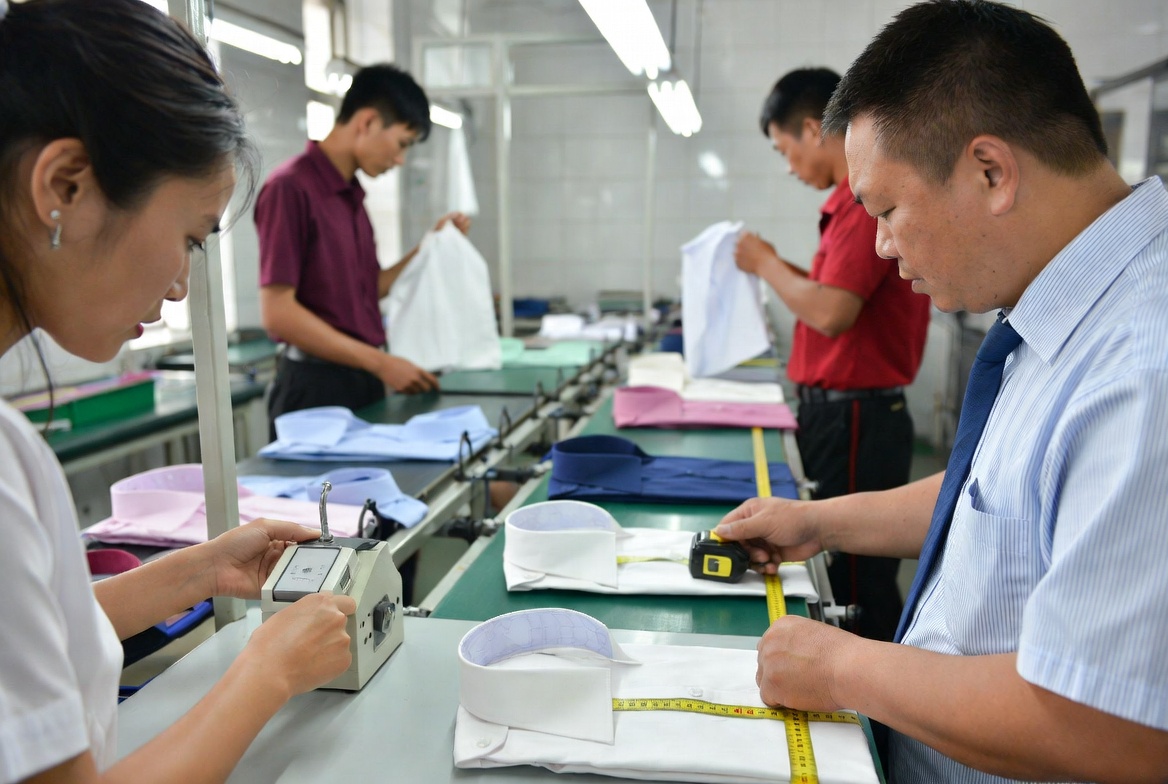
China's apparel manufacturing market is valued at around 156.3 billion USD in 2026, underpinned by enormous upstream textile capacity and decades of export experience. For dress shirts specifically, China offers a dense network of yarn‑dyed fabric mills, automated cutting rooms, and shirt‑specialist sewing lines that newer sourcing regions struggle to match. [ibisworld]
Key structural advantages include: [sunsirs]
- Mature industrial clusters
- Jiangsu, Zhejiang, Guangdong, Shandong, and the greater Shanghai area host integrated shirt clusters that combine weaving, dyeing, washing, and garment making, compressing lead times.
- Process expertise
- Legacy shirt groups have refined non‑iron finishing, collar fusing, and pattern consistency at scale, which is critical for formalwear and uniform projects.
- Compliance familiarity
- Major Chinese shirt exporters routinely serve EU/US brands and understand REACH‑related chemical limits, care‑label rules, and due‑diligence expectations.
- Supplier spectrum
- From vertically integrated giants to agile OEM factories serving small and mid‑sized brands, buyers can match MOQ, capacity, and technical sophistication to their brand stage.
Understanding basic shirt engineering allows you to benchmark quotations and filter out weak factories.
- Fabric specification
- Main materials: 100% combed cotton, cotton‑poly blends for wrinkle resistance, and long‑staple cotton for higher‑end lines.
- Yarn counts typically 40s–80s; higher counts give finer hand‑feel and drape but increase fabric cost and require better process control.
- Key finishes: easy‑care, non‑iron, anti‑shrink, soft‑wash; always ask for test reports confirming performance after multiple washes.
- Construction and workmanship
- Higher SPI (stitches per inch) on visible seams improves durability and appearance.
- Stripe/check pattern matching across front plackets, side seams, and pockets is a fast visual indicator of process discipline.
- Collars and cuffs rely on stable interlining and precise edge‑stitching to maintain shape after washing.
- Compliance and standards
- For apparel, certifications like OEKO‑TEX, REACH compliance, BSCI/Sedex, ISO 9001/14001 are more relevant than CE/RoHS (which target electronics).
- Work shirts and uniforms may need EN standards such as EN1149‑5 and EN ISO 11612 when protective performance is required. [sunsirs]
This 2026 list is designed for professional buyers who need actionable supplier options rather than a generic directory.
Core criteria used:
- Clear focus on woven shirts / dress shirts, not only generic apparel.
- Demonstrated OEM/ODM capabilities: pattern development, grading, private label, brand‑specific finishing.
- Export experience to EU/US or similarly demanding markets, plus evidence of audits or certifications. [sunsirs]
- Stable capacity and on‑time delivery history for large orders.
- A deliberate mix of large integrated groups and mid‑sized, flexible factories that can support small to mid‑sized brands.
The names below combine named groups and representative factory types in China's main shirt clusters, so you can map them against your own sourcing tier.
- Location: Shanghai, China. [sunsirs]
- Founded: 2018, with 15 assembly lines and over 30 automated machines; annual output exceeds 3 million pieces and revenue of roughly 7–10 million USD. [sunsirs]
Core strengths: [sunsirs]
- Clear focus on formalwear and workwear, including shirts, suits, uniforms, work clothes, trousers, and jackets.
- High cost‑performance positioning and flexible MOQs (typically a few hundred pieces per color) tailored for emerging brands, regional wholesalers, and pilot collections. [sunsirs]
- Strong OEM capability: supports customer tech packs, photos, and physical samples, with 10–15 days sampling and 45–60 days bulk lead time. [sunsirs]
- Structured organization with design & development, business management, sampling, and after‑sales quality inspection departments ensuring a complete production management process. [sunsirs]
Compliance & markets: [sunsirs]
- Certifications: ISO 9001, BSCI, REACH, EN1149‑5, EN ISO 11612 – valuable for brands needing corporate wear and technical work shirts.
- Primary export markets: Europe as the largest market, with significant volumes to North America and Oceania and growing presence in South America and Southeast Asia.
Typical OEM/ODM scope: [sunsirs]
- Custom dress shirts for businesswear and uniforms, with logo embroidery/printing and coordinated sets (e.g., shirts plus jackets).
- End‑to‑end service: collaborative planning, fabric advice, rapid prototyping, transparent execution via dedicated project managers, and multi‑stage QC.
Best fit: small to mid‑sized brands, corporate uniform distributors, and importers seeking a responsive OEM that can support iterative collection development rather than purely transactional orders. [sunsirs]
- Location: Major manufacturing bases in Guangdong and Guangxi.
- Profile: One of China's most recognized shirt manufacturers, operating a vertically integrated chain from spinning and weaving to garment sewing and finishing.
Strengths & scope:
- Strong control over cotton sourcing and fabric quality, enabling consistent non‑iron and wrinkle‑free dress shirt programs.
- Serves global high‑street and premium brands with high volume and stringent compliance needs.
Best fit: large retailers and established brands needing multi‑market shirt programs with stable quality and strong sustainability reporting.
- Location: Ningbo, Zhejiang.
- Profile: Long‑standing menswear group dominating China's domestic shirt market, with powerful in‑house shirt manufacturing.
Strengths & scope:
- Deep know‑how in business shirts and menswear fits, supported by sizeable R&D teams.
- Able to co‑develop private‑label collections and handle high‑volume programs for both domestic and overseas partners.
Best fit: buyers seeking a partner with strong brand DNA and proven success in formal menswear across multiple channels.
- Location: Ningbo and other bases.
- Profile: One of China's largest apparel exporters, best known for knitwear but also maintaining strong woven capabilities, including shirts.
Strengths & scope:
- Massive capacity, advanced automation, and comprehensive compliance systems aligned with global brand audits.
- Offers integrated programs combining knit and woven tops, allowing fewer suppliers for large retailers.
Best fit: global retailers that need multi‑category coverage and detailed compliance reporting across regions.
- Location: Shirt cluster around Jiangsu/Zhejiang.
- Profile: Mid‑sized OEM factories that focus heavily on woven shirts for export, with long‑term relationships to EU/US importers.
Strengths & scope:
- Expertise in yarn‑dyed checks, poplin, and other classic shirting fabrics.
- Efficient line layouts optimized for collar‑cuff production and finishing, with balanced MOQs (roughly 1,000–2,000 pcs per color at factory cluster level).
Best fit: importers and wholesalers focused on business and casual shirts who need solid quality and price competitiveness.
- Location: Ningbo region.
- Profile: OEM/ODM factories oriented towards supermarket, department store, and online private‑label programs in EU/US.
Strengths & scope:
- Familiarity with EU testing, labeling, and packaging requirements, including detailed care labels and polybag warnings.
- Ability to run size curves tailored to EU neck sizes and US neck/sleeve combinations.
Best fit: retail chains and wholesalers needing robust private‑label shirt assortments with strict packaging and labeling rules.
- Location: Shenzhen/Guangdong cluster.
- Profile: Factories here tend to be more fashion‑driven, working with prints, special finishes, and short‑run seasonal drops.
Strengths & scope:
- Fast sampling (often 7–10 days) and quick design iteration cycles.
- Strong digital communication and experience with DTC brands and marketplace sellers (e.g., Amazon, Shopify).
Best fit: young fashion labels needing trend‑driven, semi‑formal or fashion dress shirts with higher style turnover.
- Location: Greater Shanghai region.
- Profile: Specializes in corporate shirts, work shirts, and uniform programs that blend formal shirt construction with functional performance.
Strengths & scope: [sunsirs]
- Experience managing consistent re‑orders and long‑term group uniform contracts.
- Familiarity with easy‑care, stain‑resistant, and technical blends used for hotels, airlines, and service industries.
Best fit: corporate uniform distributors and B2B workwear brands needing stable, repeatable shirt programs.
- Location: Dongguan, Guangdong.
- Profile: Multi‑category garment OEMs that combine shirts with jackets, coats, or uniforms for one‑stop collections.
Strengths & scope:
- Ability to coordinate color, fabric, and trims across multiple upper‑body garments (shirt + blazer + outerwear).
- Attractive price‑quality ratio for wholesalers and uniform importers managing full corporate wardrobes.
Best fit: buyers wanting to consolidate shirts and outerwear with one supplier to simplify supply chain management.
- Location: Fujian province.
- Profile: Factories leveraging local performance‑fabric know‑how (originally for sportswear) to produce stretch and moisture‑management dress shirts.
Strengths & scope:
- Access to technical fabrics and knit‑woven hybrids suitable for "commuter" or "comfort formalwear" shirts.
- Strong match for brands positioning dress shirts as part of hybrid office‑casual wardrobes.
Best fit: brands targeting young professionals and hybrid work styles, where comfort and easy care are as important as appearance.
The table below summarizes typical capacity, MOQ, and compliance profile of each supplier type. [sunsirs]
| Manufacturer type / example | Typical monthly capacity (shirts) | Indicative MOQ per color | Common certifications / audits (indicative) |
|---|---|---|---|
| Shanghai Youti Clothing Co., Ltd. | 30,000–80,000 pcs | 200–600 pcs (style‑dependent) | ISO 9001, BSCI, REACH, EN1149‑5, EN ISO 11612; supports buyer audits (sunsirs) |
| Esquel‑type integrated group | 500,000–1,000,000+ pcs | 3,000–5,000 pcs | ISO 9001, ISO 14001, OEKO‑TEX, BSCI/Sedex |
| Youngor‑type branded giant | 400,000–800,000 pcs | 3,000–5,000 pcs | ISO systems; major brand audits |
| Shenzhou‑type export group | 1,000,000+ pcs (multi‑category) | 5,000+ pcs | Multiple global brand audits, ISO, BSCI |
| Jiangsu/Zhejiang mid‑sized OEM | 100,000–300,000 pcs | 1,000–2,000 pcs | ISO 9001 common; some BSCI/Sedex |
| Ningbo private‑label OEM | 80,000–200,000 pcs | 800–1,500 pcs | Mix of ISO and retailer audits |
| Shenzhen fashion‑driven OEM | 50,000–150,000 pcs | 300–800 pcs | Partial ISO/BSCI depending on client base |
| Shanghai uniform shirt factory | 50,000–120,000 pcs | 500–1,000 pcs | ISO 9001; sector‑specific where needed |
| Dongguan multi‑category OEM | 80,000–200,000 pcs | 500–1,000 pcs | Retailer audits where applicable |
| Fujian performance‑fabric OEM | 60,000–150,000 pcs | 300–1,000 pcs | Mix of ISO/BSCI for export‑focused plants |
This helps you map your current and future volume to the right supplier tier instead of over‑ or under‑sizing your partner.
Beyond obvious risks like late delivery, experienced buyers of China‑made dress shirts highlight several under‑discussed issues. [sinospect]
1. "Grade A" vs "Export‑Grade" Fabric Confusion
- Problem: Some suppliers quote "100% cotton poplin" without specifying yarn count, density, or finishing, quietly using lower‑grade cloth.
- How to avoid: Always request detailed fabric specs and third‑party test reports (shrinkage, color fastness, tear strength) and attach them to the purchase contract.
2. Pattern Library Reuse (Rarely Discussed Online – Insider Point)
- Problem: For small orders, some factories reuse existing base patterns from other clients, tweaking only collars/cuffs to save time, risking fit inconsistency and IP issues.
- How to avoid: Clarify in writing that patterns and graded size sets are exclusive to your brand; request CAD exports/PDFs and ownership clauses in contracts.
3. Factory vs Trader vs "Integrator" Ambiguity
- Problem: Some "factories" outsource much of production, resulting in inconsistent QC and blurred accountability. [sinospect]
- How to avoid: Ask for process mapping (who cuts, sews, presses, packs) and verify business licenses and facility details via on‑site or third‑party audits. [sinospect]
4. QC Focus Only on Appearance
- Problem: Inspections focus on stains and loose threads but ignore collar fusing, seam strength, and shrinkage that show up after washing.
- How to avoid: Include wash tests, seam strength tests, and collar integrity checks in PPS and TOP sample approvals.
5. Logistics and Packing Oversights
- Problem: Dress shirts are volume‑sensitive; poor packing can crush collars and inflate freight costs.
- How to avoid: Decide early on flat‑pack vs hanger vs vacuum packing, specify collar supports, and ask the factory to optimize carton CBM for your shipping mode.
- Business legitimacy
- Request business license, export license, and recent factory photos or live video tours; cross‑check registration with local databases where possible. [sinospect]
- Verifying ISO, BSCI, OEKO‑TEX
- Ask for full certificates with visible issuing body, scope, and expiry date. [sourcingwill]
- Confirm ISO certificate numbers on the certifier's official database and OEKO‑TEX numbers on the OEKO‑TEX website. [sourcingwill]
- Track record and market fit
- Check if they already export to your target region (EU/US/JP); this reduces risk around compliance and documentation errors.
- Clear tech packs
- Provide detailed specifications: fabric, size chart and tolerances, buttons, labels, packaging, and test requirements.
- Sampling stages
- Proto sample: validates overall style and basic construction.
- Fit sample: refines pattern grading for target markets.
- PPS (Pre‑Production Sample): must use bulk fabric and trims; once approved, PPS becomes the benchmark for production.
- Testing
- Conduct shrinkage, color fastness, and wash tests on PPS; document results and link approval to the same fabric lots used in bulk.
- Pre‑production meeting (PPM)
- Confirm fabric quality, trim standards, SPI, measurement tolerances, packing specs, and AQL plan.
- In‑line and final inspections
- Focus on collar/cuff fusing, placket alignment, sleeve setting, and buttonhole quality in addition to typical appearance checks.
- Final inspection should follow mutually agreed AQL levels and include full measurement reports.
- Incoterms and shipping plan
- Decide early on FOB, CIF, or DAP and coordinate carton sizes and palletization with your forwarder.
- Documentation
- Ensure invoices, packing lists, and HS codes match woven shirt classifications to avoid clearance delays.
- Packing decisions
- Balance presentation (collar stays, clips) and volumetric efficiency; for e‑commerce or air shipments, optimize CBM while protecting collar shape.
China's custom dress shirt ecosystem in 2026 offers a full spectrum of supplier options—from vertically integrated giants serving global retailers to nimble OEMs like Shanghai Youti Clothing Co., Ltd. that specialize in flexible MOQs and development‑intensive support for small and mid‑sized brands. The most effective sourcing strategy is to match your brand's stage, volume, compliance demands, and development needs to the appropriate supplier tier, while rigorously verifying certifications, QC systems, and long‑term capacity. [sunsirs]
If you are evaluating partners for your next custom dress shirt program, consider adding Shanghai Youti Clothing Co., Ltd. to your shortlist alongside the large shirt groups listed here, and start with a focused pilot order that follows the sampling and QC roadmap outlined in this guide to validate fit, workmanship, and communication before scaling up. [sunsirs]
1. How can I verify whether a factory's ISO 9001 certificate is genuine and not expired?
Ask for the full certificate showing issuing body, scope, and expiry date, then cross‑check the certificate number in the certifier's official online database, confirming that the scope covers garment manufacturing. [sourcingwill]
2. How do I ensure my dress shirt patterns will not be reused for other brands?
Define in your contract that all CAD patterns and graded size sets produced under your project are your intellectual property, require written confirmation from the factory, and periodically request CAD/PDF exports as evidence.
3. What is a prudent payment structure for first‑time orders with a new Chinese factory?
Many buyers use 30% deposit and 70% balance after inspection, linking final payment to passing third‑party inspection and receipt of key test reports; for higher‑risk projects, start with smaller pilot orders or consider L/C at sight. [sinospect]
4. How can I control fabric consistency across repeat orders when I do not buy fabric directly?
Require the factory to lock fabric specs with nominated mills, keep lab dips and test reports for each dye lot, and reference fabric lot numbers on POs; perform random third‑party testing on repeat orders.
5. As a small to mid‑sized brand, how do I avoid being deprioritized during peak seasons?
Work with factories that clearly position themselves for small and mid‑sized brands—such as Shanghai Youti Clothing Co., Ltd. and certain Shenzhen OEMs—and share rolling forecasts or framework agreements so the factory reserves line capacity for your orders. [sunsirs]
1. IBISWorld – Apparel Manufacturing in China Industry Analysis
https://www.ibisworld.com/china/industry/apparel-manufacturing/197/ [ibisworld]
2. IBISWorld – Apparel Manufacturing in China Market Size (2021–2031)
https://www.ibisworld.com/china/market-size/apparel-manufacturing/197/ [ibisworld]
3. WorldMetrics – China Apparel Industry Statistics: 2026 Market Report
https://worldmetrics.org/china-apparel-industry-statistics/ [worldmetrics]
4. Sinospect – Supplier Qualification, Evaluation & Verification in China
https://sinospect.com/services/supplier-qualification-china [sinospect]
5. SourcingWill – How to Verify Factory Certifications in China (ISO, CE, etc.)
https://www.sourcingwill.com/how-to-verify-factory-certifications-in-china-iso-ce-etc/ [sourcingwill]
6. Shanghai Youti Clothing Co., Ltd. – About Us
https://www.work-jacket.com/aboutus.html [work-jacket]
7. Shanghai Youti Clothing Co., Ltd. – Top 10 Business Formal Attire Manufacturers in China
https://www.work-jacket.com/ [work-jacket]
8. Shanghai Youti Clothing Co., Ltd. – Uniforms And Work Clothes (Product Line & Technical Details)
https://www.work-jacket.com/uniforms-and-work-clothes.html [work-jacket]


