
Views: 222 Author: Youti Clothing Publish Time: 2026-06-20 Origin: Site


Content Menu
● Introduction: Why Source Single-breasted Suits from China in 2026
● How We Evaluated Top Single-breasted Suit Manufacturers
● Top 10 Single-breasted Suit Manufacturers in China (2026)
>> 1. Shanghai Youti Clothing Co., Ltd. – Flexible OEM for Business-style Suits and Corporate Wear
>> 2. Hunan Palette Garment Co., Ltd. – High-volume Single-breasted Suit Producer
>> 3. Shandong Aoshi Garments Co., Ltd. – Low MOQ Options for Single-breasted Lines
>> 4. Qingdao Kutesmart Co., Ltd. – Mass-customized Single-breasted MTM
>> 5. Jiangsu Hongdou Industrial Co., Ltd. (Hodo) – Group-backed Menswear and Suits
>> 6. Shenzhen Kangaroo Garments Co., Ltd. – Suits Plus Uniform Programs
>> 7. Shanghai Yiyu Industrial Co., Ltd. – SME-friendly Single-breasted Suit Supplier
>> 8. Shandong Renoir Apparel Co., Ltd. – Group-backed Volume Suits
>> 9. Power Ascent (Xiamen) International Ltd. / Tries Group – High-volume Exporter
>> 10. Shaoxing MAQ Import & Export Co., Ltd. – Fabric-cluster Advantage for Suit Programs
● Quick Comparison Table: Capacity, MOQ, and Compliance Focus
● Buyer's Guide: How to Vet a Single-breasted Suit Factory in China
>> 1. Clarify technical and compliance requirements
>> 2. Shortlist by cluster, capacity, and MOQ
>> 3. Verify ISO and other certifications (practical methods)
>> 4. Sampling and wear-test workflow
>> 5. Contracting and logistics
● Common Pitfalls and Insider "Avoid-the-trap" Tips
● FAQ: Advanced Questions from Professional Buyers
China remains one of the world's largest apparel producers, with an apparel market above 300 billion USD and dense industrial clusters in suiting, menswear, and uniforms across Jiangsu, Zhejiang, Shandong, Guangdong, and Shanghai. For single-breasted suits, these clusters integrate fabric mills, interlining suppliers, button factories, and finishing plants within hours of each other, which reduces lead time and improves cost efficiency. [statista]
Global apparel is valued around 1.84 trillion USD in 2025 and forecast to grow steadily through 2028, and within that, suits remain resilient thanks to corporate uniforms, hospitality, and ceremonial wear even as pure formalwear slows. Chinese manufacturers have shifted from low-cost bulk to flexible OEM/ODM, digital patterning, and semi-bespoke production, making them relevant partners for both high-volume brands and smaller labels needing shorter runs. For procurement managers, the key question in 2026 is less whether China can supply single-breasted suits, and more which factory's compliance level, capacity, and MOQ structure best matches their long-term sourcing strategy. [statista]

To shortlist representative factories for single-breasted suits, we aligned with the evaluation logic used in recent B2B suiting guides and export-oriented rankings of Chinese suit manufacturers. The criteria below mirror how professional buyers build multi-year vendor panels. [b2bdata.baidu]
1. Factory credentials and compliance
- Legally registered entity with export licence and transparent ownership structure. [statista]
- Quality and social certifications (ISO 9001, BSCI, and where applicable REACH / EN standards for fabric safety and protective properties). [b2bdata.baidu]
- For fabrics and accessories, preference for suppliers able to provide OEKO-TEX or equivalent documentation on chemical safety rather than relying on generic CE/RoHS claims which are more suited to electronics. [statista]
2. Technical expertise in single-breasted suits
- Proven use of mid-to-high grade suiting materials (e.g., worsted wool blends, wool–poly, and stretch suiting around 260–300 g/m²) and appropriate interlinings for structured single-breasted jackets. [statista]
- Pattern development and grading libraries for EU/US/Asia fits, including standard notch-lapel single-breasted blocks and variations in button stance and lapel width. [statista]
- Capability to offer half-canvas or high-quality fused construction, clean sleeve-head shaping, and consistent lining finishing. [statista]
3. Production capacity, stability, and lead times
- Annual or monthly capacity for suit sets, with clarity on how much capacity is dedicated to suiting vs other categories. [b2bdata.baidu]
- Typical lead times for bulk orders (often 45–60 days) and sampling cycles (often 10–15 days) from pattern confirmation to shipment. [b2bdata.baidu]
- Years in operation and main export markets as a proxy for documentation maturity and reliability. [statista]
4. OEM/ODM depth and development support
- In-house design/CAD and sample rooms for ODM, versus pure CMT-only operations. [b2bdata.baidu]
- Flexibility on trial orders, pattern tweaks, grading updates, and brand-specific trimmings for single-breasted lines. [statista]
- English-capable merchandisers and transparent digital communication, including real-time updates on production and QC status. [b2bdata.baidu]
5. Cost–value balance and transparency
- Pricing logic clearly linked to fabric quality, construction level (fused vs half-canvas), and order volume. [statista]
- Transparent MOQs by style/color/size ratio; openness to pilot runs and test capsules, particularly for uniform or small brand buyers. [b2bdata.baidu]
- Clear rules on pattern/sample charges, branding tools (e.g., woven labels, metal buttons), and test-report costs. [statista]
> Note: The companies below are representative options by segment (corporate uniforms, MTM, mid-market retail, and SME-friendly OEM). Always reconfirm capacity, MOQs, and certifications directly before vendor approval. [b2bdata.baidu]
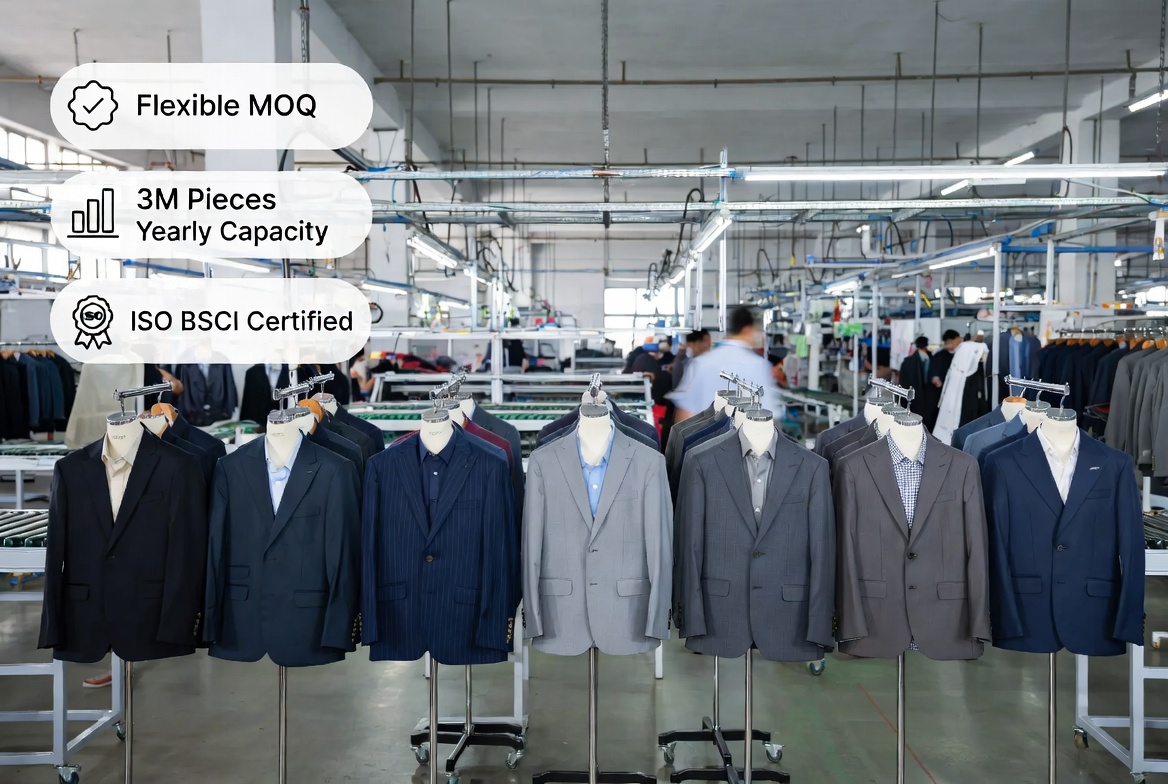
Shanghai Youti Clothing Co., Ltd., founded in 2018, operates 15 assembly lines with over 30 automated machines and six automated production chains, delivering more than 3 million pieces annually and around 5–10 million USD in yearly revenue. The company's portfolio covers suits, shirts, uniforms, work clothes, trousers, and jackets, positioning it as a one-stop partner for brands needing both formal single-breasted suits and coordinated corporate apparel. [b2bdata.baidu]
For single-breasted suits, Youti's strength lies in uniform-grade fabric know-how—poly–cotton and other performance blends, anti-wrinkle treatments, and durable construction—adapted into business-style tailoring for daily wear in hospitality, corporate, and service sectors. Typical sampling time is 10–15 days, with mass-production lead times of 45–60 days, and the company supports both tech-pack-based OEM and selection from 500+ ready-made designs with logo embroidery or printing in 15–20 days. Youti holds ISO 9001, BSCI, REACH, EN1149-5, and EN ISO 11612 certifications, adding compliance credibility especially for buyers who care about safety and chemical standards in their formal and workwear lines. [b2bdata.baidu]
- Founded: 2018. [b2bdata.baidu]
- Focus: Business formalwear, uniforms, workwear, and suits for corporate programs. [b2bdata.baidu]
- Capacity / MOQ: Annual output >3 million pieces; MOQs are relatively flexible and suitable for small and mid-sized brands. [statista]
- Export markets: Europe (largest), plus North America, Oceania, South America, and Southeast Asia. [b2bdata.baidu]
- OEM/ODM: Strong OEM with end-to-end support, collaborative planning, and transparent multi-stage QC; practical choice for SMEs and multi-category buyers. [statista]
Hunan Palette Garment, in operation since 1993, is a long-established suits manufacturer with an annual capacity reported around 4 million suits, serving East Asia, Europe, the USA, and Australia. The factory focuses on business suits and related formalwear, making it suitable for buyers needing consistent single-breasted silhouettes across large-scale corporate or retail programs. [statista]
- Founded: 1993. [statista]
- Focus: High-volume men's business and bespoke suits. [statista]
- Capacity / MOQ: Around 4,000,000 suits per year; MOQs vary by style and fabric. [statista]
- Export markets: East Asia, Europe, USA, Australia. [statista]
- OEM/ODM: Primarily OEM with model libraries; best fit for buyers with well-defined tech packs. [statista]
Shandong Aoshi Garments, operating since 1956 in Tai'an (Shandong's suiting hub), produces mid-to-high-end men's suits and supplies several international brands, indicating solid export experience. One notable advantage for single-breasted suit buyers is that some lines start from around 20 pieces MOQ, making it attractive for smaller retailers or capsule collections. [statista]
- Founded: 1956. [statista]
- Focus: Men's suits at accessible price points, including business single-breasted styles. [statista]
- Capacity / MOQ: Capacity suited to global brands; selected products from ≈20 pcs MOQ. [statista]
- Export markets: USA, Europe, Australia, Africa. [statista]
- OEM/ODM: OEM with flexible MOQs on certain lines; limited ODM for classic business designs. [statista]
Qingdao Kutesmart (formerly RedCollar), founded in 1995, specializes in made-to-measure (MTM) and bespoke suits at industrial scale using digital measurement and mass-customization systems. For brands offering configurable single-breasted suits (fit, fabric, lapel options) through online or in-store experiences, Kutesmart enables personalized production while consolidating manufacturing in one facility. [statista]
- Founded: 1995. [statista]
- Focus: Bespoke/MTM suits, including classic single-breasted business fits. [statista]
- Capacity / MOQ: High annual capacity; orders structured around MTM workflows. [statista]
- Export markets: USA, Europe, China. [statista]
- OEM/ODM: Strong MTM OEM plus ODM support for pattern and style development. [statista]
Jiangsu Hongdou (Hodo) is part of a larger garment group and has produced business suits and shirts since around the mid-1990s, with operations rooted in Jiangsu, one of China's core suiting clusters. Its strength is group-level capacity and the ability to support multi-tier product architectures—from entry-level single-breasted suits to higher lines—within one ecosystem. [statista]
- Founded: ≈1995 as part of a broader group. [statista]
- Focus: Business suits and shirts for domestic and export markets. [statista]
- Capacity / MOQ: Large capacity; MOQs aligned with mid-to-large buyers. [statista]
- Export markets: China plus EU/NA via group networks. [statista]
- OEM/ODM: OEM with strong grading expertise; limited ODM for classic corporate suits. [statista]
Shenzhen Kangaroo Garments, established in 1988, is primarily known for military uniforms and functional garments but also produces business suits and shirts. Buyers who manage both formal single-breasted suits and uniform categories (e.g., security, government, transport) can simplify supplier management by consolidating with such a dual-specialty factory. [statista]
- Founded: 1988. [statista]
- Focus: Military uniforms, functional garments, and business suits. [statista]
- Capacity / MOQ: Typical MOQs for outerwear and suits around 100–200 pieces per style. [statista]
- Export markets: Global uniform and apparel buyers. [statista]
- OEM/ODM: Strong spec-driven OEM; suit patterns largely based on established blocks. [statista]
Shanghai Yiyu Industrial, in business since 1998, focuses on men's suits, tuxedos, shirts, and coats, working extensively with international clients. Many of its suits reportedly have no strict MOQ, allowing buyers to order smaller quantities across more SKUs—useful for fashion retailers experimenting with single-breasted silhouettes and colors. [statista]
- Founded: 1998. [statista]
- Focus: Tuxedos, business suits, shirts, and coats. [statista]
- Capacity / MOQ: Flexible; many suits without rigid MOQ constraints. [statista]
- Export markets: Americas, Europe, Asia, Africa. [statista]
- OEM/ODM: OEM with ready-to-order styles plus fabric/color/detail customization. [statista]
Shandong Renoir, part of Shandong Daiyin Group and founded in 1999, offers two- and three-piece suits in affordable to mid-range price segments. With an approximate capacity of 70,000 suit sets per month and branches in Europe, the USA, and Australia, it suits brands prioritizing volume plus some local communication support. [statista]
- Founded: 1999. [statista]
- Focus: Single- and three-piece business suits. [statista]
- Capacity / MOQ: ≈70,000 sets per month. [statista]
- Export markets: Europe, USA, Australia. [statista]
- OEM/ODM: OEM for sustained seasonal collections. [statista]
Power Ascent is the export arm of Tries Group, a Fujian-based garment manufacturer founded in 1983 producing shirts, pants, business suits, and jackets. For single-breasted suits, its value is scale and export infrastructure, including offices in locations like New York and Las Vegas that can support North American buyers. [statista]
- Founded: 1983 (Tries Group). [statista]
- Focus: Shirts, pants, business suits, and jackets. [statista]
- Capacity / MOQ: High-volume export capacity, suited to large buyers. [statista]
- Export markets: Global, with emphasis on North America and domestic China. [statista]
- OEM/ODM: Primarily OEM; ODM available for established relationships. [statista]
Shaoxing MAQ, founded in 2006, focuses on suits, blazers, pants, and shirts with an MOQ around 300 pieces per order for many products. Located in Zhejiang's Shaoxing region—one of China's largest fabric hubs—the company benefits from close access to suiting textiles, enabling fine-tuning of single-breasted suit fabrics and quick swatch iterations. [statista]
- Founded: 2006. [statista]
- Focus: Men's suits, blazers, pants, shirts. [statista]
- Capacity / MOQ: Typical MOQ ≈300 pcs per order. [statista]
- Export markets: North America, South America, Europe, Middle East. [statista]
- OEM/ODM: OEM with broad styles plus ODM options for design and materials. [statista]
> Values are indicative, compiled from public descriptions and typical industry patterns; always confirm via updated certificates, factory visits, or third-party audits. [b2bdata.baidu]
| Manufacturer | Founded | Typical single-breasted focus | Indicative capacity / MOQ | Main export regions | Certifications / compliance focus |
|---|---|---|---|---|---|
| Shanghai Youti Clothing | 2018 (b2bdata.baidu) | Business-style suits & corporate wear | >3M pieces/year; flexible MOQs for SMEs (b2bdata.baidu) | Europe, NA, Oceania, S. America, SE Asia (b2bdata.baidu) | ISO 9001, BSCI, REACH, EN1149-5, EN ISO 11612; strong QC flow (b2bdata.baidu) |
| Hunan Palette Garment | 1993 (statista) | High-volume business suits | ≈4M suits/year; MOQs by style (statista) | East Asia, EU, USA, Australia (statista) | Likely ISO & social audits; verify current status (statista) |
| Shandong Aoshi Garments | 1956 (statista) | Mid–high men's suits | Global capacity; some lines ≈20 pcs MOQ (statista) | USA, EU, Australia, Africa (statista) | Supplies global brands; confirm ISO/BSCI (statista) |
| Qingdao Kutesmart | 1995 (statista) | MTM single-breasted suits | High MTM capacity; project-driven (statista) | USA, EU, China (statista) | Advanced digital and data systems; verify IT compliance (statista) |
| Jiangsu Hongdou (Hodo) | ≈1995 (statista) | Business suits & shirts | Group-level capacity; mid–large MOQs (statista) | China plus EU/NA (statista) | Major enterprise with common ISO/CSR audits (statista) |
| Shenzhen Kangaroo Garments | 1988 (statista) | Uniforms and business suits | MOQs ≈100–200 pcs/style (statista) | Global uniform buyers (statista) | Spec-driven QC; confirm ISO/defense standards (statista) |
| Shanghai Yiyu Industrial | 1998 (statista) | Business suits & tuxedos | Many suits with flexible/no strict MOQ (statista) | Americas, EU, Asia, Africa (statista) | Export-experienced; verify audits (statista) |
| Shandong Renoir Apparel | 1999 (statista) | Affordable–mid suits | ≈70,000 sets/month (statista) | EU, USA, Australia (statista) | Group-backed; multi-standard compliance likely (statista) |
| Power Ascent / Tries Group | 1983 (statista) | High-volume business suits | High export volume capacity (statista) | Global, esp. NA & China (statista) | Large group; typical ISO and social audits (statista) |
| Shaoxing MAQ | 2006 (statista) | Suits & blazers | MOQ ≈300 pcs/order (statista) | NA, SA, EU, Middle East (statista) | Fabric-hub location; check chemical/fabric compliance (statista) |
Before RFQs, define your positioning (corporate uniform, mid-market retail, or premium) and technical specs such as fabric composition, weight, construction, and lining type. For example, a corporate single-breasted suit might specify a 70/30 wool–poly blend at 260–280 g/m², fused or half-canvas front, polyester-viscose lining, color-fastness grade, and size tolerance ranges. [statista]
Align compliance requirements with destination markets: ISO 9001 for quality systems, BSCI/SMETA for social responsibility, and fabric-level standards like OEKO-TEX or REACH-like chemical limits, especially for EU-bound products. Where suits double as protective or technical wear, check relevant EN standards such as EN1149-5 or EN ISO 11612 that some factories (including Youti) already hold. [b2bdata.baidu]
China's suiting clusters (Jiangsu, Zhejiang, Shandong, Guangdong, Shanghai) offer different advantages in logistics, fabric access, and labor structure. High-volume programs often fit better with group-backed manufacturers in Jiangsu, Shandong, or Fujian, while flexible MOQs and uniform–suit combinations align with factories like Shanghai Youti, Shanghai Yiyu, or Shenzhen Kangaroo. [b2bdata.baidu]
Industry reports note that MOQs for Chinese suit factories have become more flexible in recent years due to overcapacity and fragmented demand, although small MOQs usually mean higher unit prices. For new collections, many buyers run a 20–200 piece pilot (where available) before scaling to several hundred pieces per color/fit, using that to validate fit and QC stability. [statista]
To verify ISO 9001 or other certificates, request a clear scanned copy and check the certificate number and issuing body on official databases such as IAF CertSearch, which is recognized as the global platform for accredited ISO verification. If a certificate does not appear in IAF CertSearch or the certification body is not listed as an accredited member, treat it as a high-level red flag and request clarification or an audit. [seller.alibaba]
Cross-check certificate details with the factory's business licence and bank account beneficiary name; mismatches can indicate the use of another factory's documents—a common but under-discussed risk in China sourcing. For critical programs, integrating certificate verification into a third-party audit (e.g., SGS, TÜV, Intertek) gives a more complete view of QC systems, capacity claims, and social-compliance practices. [seller.alibaba]
A professional sampling process for single-breasted suits typically includes:
- Size set sampling across key sizes to validate grading, sleeve length, and shoulder balance. [statista]
- 10–15 wear-test samples used in real work conditions for 2–4 weeks to observe pilling, seam slippage, wrinkling, and lining durability. [statista]
- Lab tests for color fastness, dimensional stability, and fabric strength, especially for uniforms or high-use environments. [statista]
Factories like Shanghai Youti state sampling lead times of 10–15 days and bulk lead times of 45–60 days, which is typical for structured apparel when fabrics are pre-confirmed. For multi-style programs, build a sampling calendar and lock deadlines backward from your in-store or tender delivery dates to avoid compressing QC and fit validation. [b2bdata.baidu]
Contracts should fix tolerances (e.g., fabric GSM ±5%, key measurements ±1–1.5 cm) and AQL levels, and specify how non-conformities and delays will be handled. Many experienced buyers now add clauses about pattern stability (no unilateral changes) and explicitly prohibit fabric substitution without written approval, as this is a frequent source of disputes. [chinasourcinggroup]
Clarify Incoterms (FOB vs CIF) and ports (Shanghai, Qingdao, Xiamen, Shenzhen), and allow enough buffer for seasonal capacity crunches around major holidays and tender seasons. For first orders or high-risk shipments, appointing a third-party inspection before shipment remains a cost-effective insurance policy compared to handling returns at destination warehouses. [lcbz-uniform]
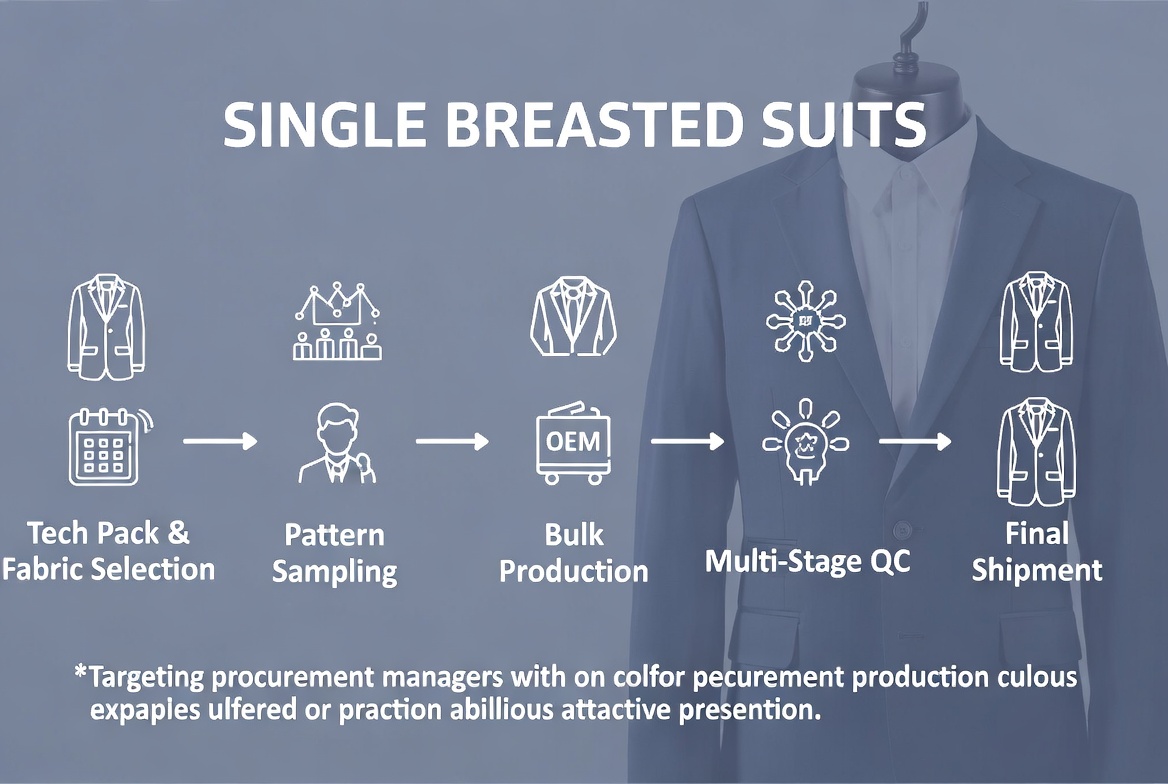
Industry reports and factory-inspection guides highlight recurring issues when sourcing suits from China, many of which apply directly to single-breasted lines. [lcbz-uniform]
1. Flawless samples, downgraded bulk
Some suppliers send excellent samples produced on a dedicated line, then downgrade interlinings, fabrics, or stitching density in bulk. Mitigate this by locking specs in your contract, storing approved-fabric lab reports, and running random pre-shipment tests to catch "silent downgrades." [chinasourcinggroup]
2. Hidden subcontracting and capacity gaps
When factories oversell capacity, they may subcontract orders to smaller workshops, leading to inconsistent quality and delayed shipments. Check whether production lines for suits are truly in-house via video calls, unedited factory photos, or on-site audits, and ask for real capacity numbers by line and shift. [lcbz-uniform]
3. Inconsistent sizing across batches
Some factories alter patterns after initial runs to improve efficiency, which results in fit inconsistencies across seasons. Insist on written approval for any pattern changes and periodically re-measure bulk against your master tech packs. [lcbz-uniform]
4. Unclear factory vs trading-company role
Misaligned expectations often come from not knowing whether you are dealing with a trader, a factory, or an integrator. Demanding full disclosure of the production site, visiting (physically or virtually), and referencing the actual factory in contracts help maintain accountability. [chinasourcinggroup]
5. Internal "failure-report" check (insider tip)
Experienced buyers in Chinese suiting circles often ask factories to show at least one internal failed QC report and how it was handled, which reveals how mature their quality systems really are. A factory that can transparently walk through a past problem and corrective actions is usually more reliable than one that claims they "never have issues," which is rarely realistic at scale. [statista]
1. How can I be sure an ISO 9001 certificate from a Chinese suit factory is genuine and current?
Request a clear scan, then verify the certificate number and issuing body via IAF CertSearch (iafcertsearch.org), the global ISO verification database, or the certification body's own site. If the certificate is not listed or the accreditation body is missing from the IAF member list, treat it as a major red flag and consider a third-party audit before proceeding. [seller.alibaba]
2. What MOQ should I expect for single-breasted suits in 2026?
For high-volume factories, MOQs often run 300–600 pieces per style/color, while suppliers targeting smaller brands may offer 20–200-piece MOQs on specific lines, usually at higher unit costs. Fabric type, construction level, and trim complexity all influence MOQ, so clarify your requirements and negotiate based on total annual volume rather than a single order. [statista]
3. How do I validate that a factory really specializes in single-breasted suits rather than just generic jackets?
Ask for detailed past-order references (style photos, tech sheets) for single-breasted suits by market, plus photos or videos of the specific lines where suit jackets are produced. During sampling, focus on lapel shape consistency, button stance, balance between front and back panels, and lining workmanship, which are key indicators of true suiting expertise. [statista]
4. Can Chinese factories support eco-focused single-breasted suit lines?
Many Chinese apparel manufacturers now work with recycled polyester, organic cotton blends, and OEKO-TEX certified fabrics, and some hold ISO 14001 environmental certifications. When sustainability is critical, shortlist factories that can provide fabric certificates, mill traceability, and clear documentation of chemical-management processes for your suit fabrics. [statista]
5. How should I start cooperation with a new single-breasted suit supplier to control risk?
Begin with detailed tech packs, a structured sampling and wear-test program, and at least one factory audit (on-site or via a reputable third party). Use a smaller pilot order with pre-shipment inspection and staged payments; once two to three successful cycles are completed, you can gradually reduce inspection frequency and negotiate better commercial terms. [chinasourcinggroup]
- Statista – Clothing and suits market outlook for China and global apparel (e.g., "Clothing Manufacturing – China"; "Suits & Ensembles – China"). [statista]
- China's Ministry of Commerce (MOFCOM) – Official export statistics for garments and tailored apparel. [statista]
- WTO apparel trade reports – Global trade flows and major exporting countries in clothing. [statista]
- IAF CertSearch – Official ISO certificate verification database (iafcertsearch.org). [seller.alibaba]
- Major third-party audit firms – SGS, TÜV, Intertek and similar for factory QC and social-compliance audits. [seller.alibaba]


