
Views: 258 Author: Youti Clothing Publish Time: 2026-09-24 Origin: Site


Content Menu
● What Is the Difference Between a Women's Black Business Suit and a Traditional Business Suit?
● Which Suit Creates a Stronger Professional Image?
>> When a Black Suit Looks Strongest
>> When a Traditional Business Suit Looks Strongest
● The Image Psychology Behind Black and Traditional Suit Colors
>> Key Fit Points for a Women's Business Suit
● Black Business Suit vs Traditional Business Suit by Industry
● Fabric Choice Changes the Professional Result
>> What Buyers Should Check Before Ordering
● How to Choose the Right Suit for Your Brand or Collection
● Common Mistakes That Weaken Professional Image
● Final Verdict: Which Suit Is Better?
● FAQs
>> 1. Is a black suit appropriate for a business meeting?
>> 2. Is navy or black more professional for women?
>> 3. What fabric is best for women's business suits?
>> 4. Should women's business suits be fitted or relaxed?
>> 5. Can a black business suit work as a corporate uniform?
>> 6. What makes a suit look expensive and professional?
>> 7. What should an OEM buyer prepare before developing women's suits?
A women's black business suit and a traditional business suit can both communicate authority, competence, and reliability. However, the stronger professional image depends less on choosing one category over the other and more on matching the suit's cut, fabric, formality, and styling to the business setting, audience, and wearer's role.
For brands, wholesalers, and uniform buyers, this distinction matters. A black women's business suit offers an immediately recognisable, sharp, and high-authority visual statement. A traditional business suit—often understood as a classic navy, charcoal, grey, or subtly patterned tailored suit—usually delivers greater versatility, warmth, and long-term workplace adaptability. The best choice is therefore not simply "black versus traditional." It is impact versus adaptability, with construction quality determining whether either option truly looks premium.

Before comparing professional image, it is important to define the two terms clearly.
A women's black business suit usually includes a black blazer paired with matching tailored trousers, a skirt, or occasionally a coordinating vest. It is designed to create a clean, unified silhouette. Black is visually direct, easy to style, and especially popular for formal meetings, client presentations, hospitality roles, legal environments, luxury retail, and corporate events.
A traditional business suit refers more broadly to classic professional tailoring. It often uses navy, charcoal, medium grey, dark brown, muted checks, pinstripes, or refined textures. The silhouette may include a single-breasted blazer, straight-leg trousers, a pencil skirt, or a conservative dress-and-jacket combination.
| Comparison Point | Women’s Black Business Suit | Traditional Business Suit |
|---|---|---|
| Core visual message | Authority, confidence, precision | Trust, stability, experience |
| Common colors | Solid black | Navy, charcoal, grey, subtle patterns |
| Best for | Formal meetings, leadership appearances, evening events | Daily office wear, client-facing roles, financial and professional services |
| Styling flexibility | Strong but can feel repetitive | Very high; easy to vary with shirts and accessories |
| Perceived tone | Powerful, polished, serious | Established, approachable, credible |
| Main risk | Can appear severe or overly formal | Can appear conservative or visually predictable |
| Manufacturing focus | Color consistency, clean structure, lint resistance | Fabric selection, tonal depth, pattern alignment, versatile fit |
From a garment-development perspective, these categories overlap. A black suit can also be traditional if it has a classic tailored cut, restrained detailing, and a professional fabric. Likewise, a navy suit can look highly contemporary when it uses a relaxed shoulder, wide-leg trouser, cropped blazer, or fashion-forward proportions.
The real difference lies in the message the wearer wants to send.
The short answer is this: a women's black business suit creates a stronger immediate authority signal, while a traditional business suit often creates a stronger long-term professional relationship signal.
Professional image is not created by color alone. People interpret clothing through context, expectations, culture, personal experience, role, and the overall condition of the outfit. Research on person perception shows that observers use dress to infer social status, identity, mental state, and aesthetic judgement. Clothing works alongside facial expression, body language, setting, and the observer's own assumptions rather than operating as an isolated signal.
In practical business situations, formal attire can influence perceptions of competence, intelligence, responsibility, reliability, and expertise. However, "professional" does not have one universal definition. What works in an international law firm, banking institution, hotel group, or board meeting may be too formal for a creative studio, technology company, or modern showroom.
A women's black business suit is particularly effective when the wearer needs visual authority quickly.
It can be the right choice for:
- Executive presentations
- Investor meetings
- Legal, financial, and consulting appointments
- Trade-show leadership teams
- Luxury retail environments
- Media interviews and formal photography
- Evening networking events
- Brand uniforms requiring a consistent, premium appearance
- Job interviews in highly formal industries
- Funeral, memorial, or serious ceremonial business settings
Black creates a visually uninterrupted line. When a blazer and trouser are well matched, the outfit can make the wearer look taller, more composed, and more deliberate. This is especially true when the jacket fits cleanly at the shoulder, the sleeve length is accurate, and the trousers break neatly over the shoe.
A black suit also simplifies styling. A white blouse, ivory silk shirt, pale blue shirt, fine-gauge knitwear, or restrained jewelry can create a professional contrast without disrupting the overall authority of the outfit.
That said, black should not be treated as an automatic shortcut to professionalism. A poor-quality black suit can expose construction weaknesses faster than many lighter shades. Shiny synthetic fabric, poor color consistency between jacket and trousers, visible lint, puckering seams, uneven lapels, or a tight fit will make the garment look less professional regardless of the color.
A traditional business suit is often more effective when professionalism needs to feel credible, experienced, and approachable rather than severe.
Navy and charcoal remain especially useful because they are formal enough for high-stakes environments but softer than black in daytime settings. They also work across seasons, cultures, and age groups.
A traditional business suit is often a stronger choice for:
- Daily office wear
- Corporate account management
- Financial services
- Business travel
- Buyer meetings
- B2B relationship management
- University, education, and public-sector roles
- International customer visits
- Sales teams that need to look polished but approachable
- Professional uniforms with frequent wear requirements
In one study involving 201 participants, formal attire significantly influenced perceptions of suitability and capability in professional roles. The study also found that attire-related judgements varied by role and gender, reinforcing an important point for brands: professional clothing should be developed for the actual workplace context rather than based on a generic idea of formality.
For a woman meeting a new client at 10 a.m., a charcoal or navy tailored suit may feel more balanced than solid black. It can still signal preparation and authority while creating a more open visual tone.
Color matters, but not in a simplistic way. It should never be treated as a universal code that guarantees a specific business outcome.
Black is commonly associated with seriousness, formality, restraint, and visual control. In professional clothing, it can support a commanding appearance because it reduces visual distraction and directs attention toward the face, posture, and garment shape. Black also works well for organizations that want a sleek, minimal, luxury-oriented identity.
However, black can sometimes create distance. In a client-service role, particularly during a first meeting, a fully black suit with a black blouse and black shoes may feel overly closed or intimidating. This does not mean black is inappropriate. It means the styling should be intentional.
A practical solution is to soften the black suit with one lighter element:
- White, cream, or soft blue shirt
- Fine silk scarf in a muted tone
- Pearl, gold, or silver minimal jewelry
- Camel, burgundy, or navy leather accessory
- Medium-tone blouse with a refined neckline
- Softly textured knit top for less formal settings
Traditional suit colors have a different advantage. Navy often communicates confidence and dependability. Charcoal feels serious without the starkness of black. Mid-grey can look intelligent and modern when paired with precise tailoring. Subtle pinstripes or micro-checks can reinforce an established business identity, especially in finance, legal services, and corporate management.
The most useful color strategy is not "black always means power." It is selecting the color that supports the desired relationship with the audience.
A well-fitted charcoal suit will create a more professional image than an ill-fitting black suit. For clothing brands and buyers, this is one of the most important development principles.
A suit must allow the wearer to move naturally while preserving a clean silhouette. If a blazer pulls across the bust, collapses at the shoulder, rides up when seated, or forms excess fabric at the waist, it reduces the sense of quality and confidence.
Shoulder line: The shoulder seam should sit close to the natural shoulder point. It should not overhang excessively or pull inward.
Bust and button stance: The jacket should close comfortably without horizontal tension lines. A well-positioned button stance supports proportion and comfort.
Waist shaping: The waist should create definition without restricting movement. Different markets may prefer a more fitted, straight, relaxed, or slightly oversized silhouette.
Sleeve length: Sleeves should generally end around the wrist bone, allowing a small amount of blouse or shirt cuff to show when appropriate.
Trouser rise: A mid-rise or high-rise tailored trouser often provides better comfort and a more stable professional silhouette.
Seat and thigh ease: Trousers should not pull when walking, sitting, or climbing stairs. Mobility is essential for office, travel, and event uniforms.
Hem length: Full-length trousers should work with the expected shoe height. Cropped or ankle-length styles should be intentionally designed rather than simply shortened.
Professional guidance on first impressions consistently emphasizes clothing that is clean, neatly pressed, comfortable, and well fitted. It also recommends choosing accessories that complement rather than distract from the overall outfit.
For OEM buyers, fit should be tested across the target market's body measurements—not merely on one sample size or one fit model.
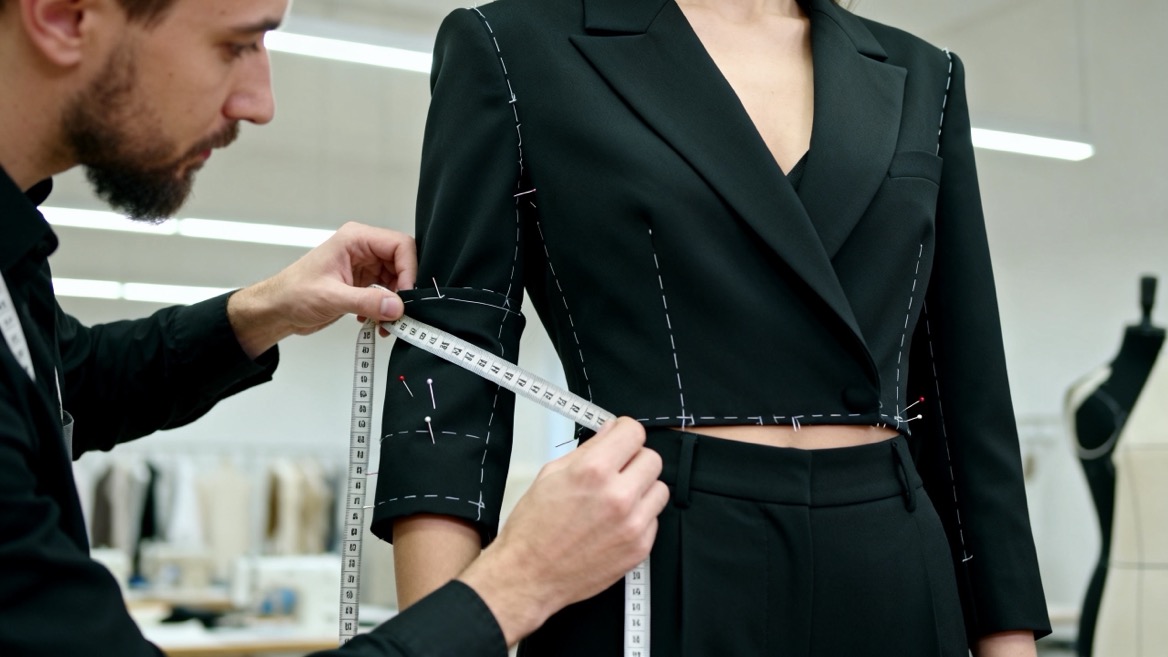
The strongest professional image changes by industry. A suit that looks correct in a law office may feel too rigid in a design agency. A uniform that works for a luxury hotel may not meet the durability needs of an exhibition sales team.
| Industry or Situation | Better Starting Choice | Why It Works |
|---|---|---|
| Law, banking, consulting | Black, charcoal, or navy formal suit | Signals authority, seriousness, and attention to detail |
| Corporate headquarters | Navy or charcoal traditional suit | Professional for daily use and easier to restyle |
| Luxury retail | Black business suit | Supports a polished, premium, brand-controlled appearance |
| Hospitality management | Black or deep navy suit | Creates visual consistency and refined service positioning |
| Technology and creative firms | Relaxed navy, grey, or modern black suit | Balances professionalism with contemporary culture |
| Trade shows and exhibitions | Black or dark navy suit with branded accents | Looks cohesive in photos and stands out against busy venues |
| Sales and client success teams | Navy or charcoal suit | Encourages trust and approachability during relationship building |
| Executive events | Black suit or sharply tailored dark traditional suit | Delivers stronger formality and leadership presence |
| International buyer meetings | Navy or charcoal traditional suit | Travels well across business cultures and daytime settings |
For organizations developing uniforms, consistency is as important as individual style. A team should not look identical in a restrictive way, but it should look coordinated. A well-planned collection may include black suits for formal events, navy suits for daily client work, and matching blouses, trousers, skirts, dresses, and outerwear for seasonal flexibility.
A black suit can look elegant in one fabric and inexpensive in another. The same is true for navy, charcoal, or grey tailoring.
For a premium women's black business suit, common fabric directions include:
- Wool or wool-blend suiting for structure, breathability, and refined drape
- Polyester-viscose-spandex blends for durability, easier care, and mobility
- Recycled polyester blends for collections with material-traceability goals
- Wool-polyester blends for frequent-wear uniforms
- Stretch woven fabrics for travel, sales, hospitality, and active office roles
- Seasonally adjusted blends for warm climates or cooler regions
1. Color fastness: Black garments should maintain depth after laundering, dry cleaning, or repeated wear.
2. Shade consistency: Jacket, trousers, skirt, vest, and replacement pieces must match reliably.
3. Pilling resistance: This is essential around sleeves, hips, inner thighs, and bag-contact areas.
4. Wrinkle recovery: Businesswear must look presentable after travel, sitting, and long meetings.
5. Stretch recovery: Elastic fibers should improve movement without causing bagging at knees, elbows, or the seat.
6. Lining quality: Breathable and smooth lining improves comfort, especially in fitted blazers.
7. Seam durability: Stress points such as armholes, pockets, crotch seams, and button areas need reinforced construction.
8. Pattern alignment: For checks, stripes, and textured fabrics, alignment at lapels, pockets, and seams signals craftsmanship.
From a manufacturing standpoint, black has a special quality-control challenge: slight differences in dye lots can become visible under showroom lighting, natural daylight, or flash photography. Brands should request approved lab dips, bulk fabric shade bands, and production inspection standards before confirming a large order.
The decision should begin with the wearer's job, customer interaction level, regional market, and brand positioning.
Use this simple decision process:
1. Define the business environment.
Is the garment for formal corporate offices, luxury retail, hospitality, trade events, sales teams, or daily commuting?
2. Identify the required emotional impression.
Do you want the wearer to look authoritative, approachable, creative, established, premium, modern, or highly uniformed?
3. Choose a core color strategy.
Select black when maximum formality and visual authority are priorities. Select navy or charcoal when versatility and relationship-building are equally important.
4. Develop the correct fit block.
Consider the target market's body shape, preferred ease, cultural expectations, and intended layering.
5. Choose a fabric for the usage cycle.
Daily-wear uniforms need durability, easy care, and wrinkle recovery. Premium executive collections may prioritize natural-fiber hand feel and drape.
6. Create a coordinated capsule.
A blazer should work with trousers, skirts, dresses, vests, and multiple blouse options. This increases wear frequency and collection value.
7. Test before bulk production.
Conduct fit reviews, wash tests, movement tests, color checks, and wearer trials before final approval.
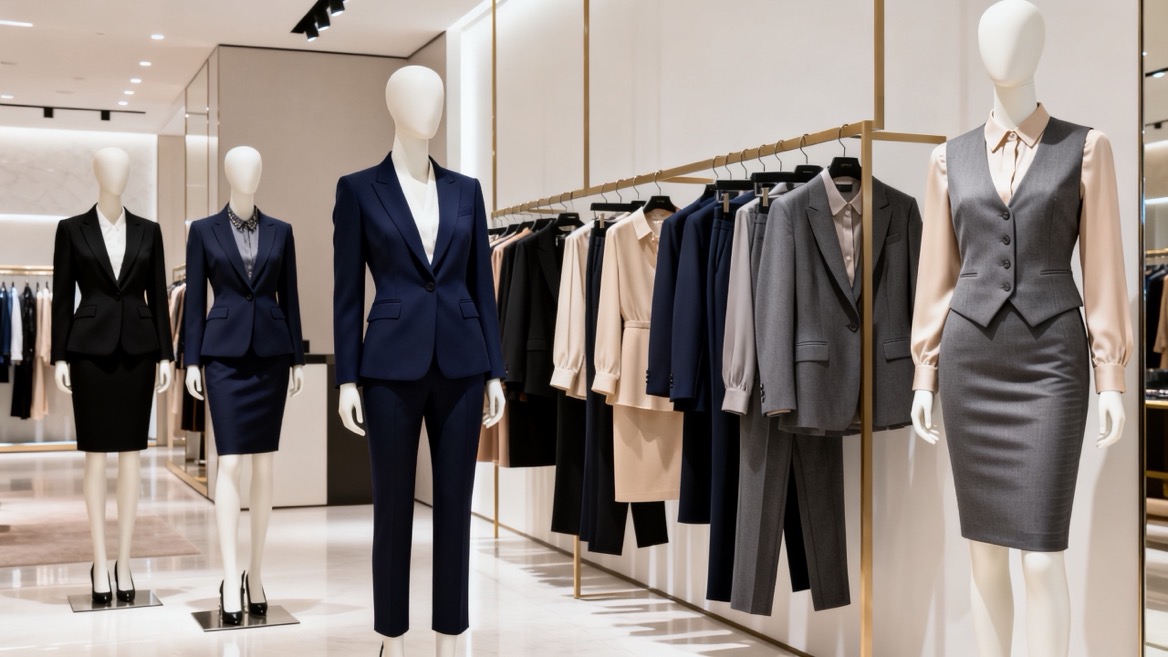
Imagine an international hotel group ordering uniforms for female front-office managers.
A full black business suit may look excellent in a high-end urban property, especially with a white blouse and subtle name badge. However, for a resort property with brighter interiors and warmer weather, a deep navy suit with breathable fabric may feel more welcoming, more comfortable, and more suitable for all-day wear.
Neither choice is automatically better. The better choice is the one that supports the guest experience, role demands, climate, and brand identity.
Even a premium suit can lose its effect if the execution is wrong.
Avoid these mistakes:
- Choosing black solely because it seems "more professional"
- Using overly shiny fabrics for corporate businesswear
- Selecting a blazer that is too tight through the bust or shoulders
- Using trousers that wrinkle heavily after sitting
- Ignoring regional differences in sizing and preferred silhouette
- Combining too many accessories with a formal black suit
- Making a uniform collection too severe for customer-facing roles
- Skipping bulk shade approval for black garments
- Treating women's tailoring as a smaller version of menswear
- Failing to offer trousers, skirts, and fit options for different wearer needs
A strong business suit must communicate more than formality. It should demonstrate comfort, competence, movement, and brand intention.
A women's black business suit creates the stronger immediate impression when authority, polish, visual discipline, and formality are the priority. It is especially effective for executive moments, luxury environments, legal or financial settings, and situations where the wearer needs to project confidence at first glance.
A traditional business suit creates the stronger all-round professional image for many daily business situations. Navy, charcoal, and refined grey tailoring are easier to wear repeatedly, easier to adapt across seasons, and often more approachable for long-term client relationships.
For most brands, the best solution is not choosing only one. Build a professional suit collection around both:
- Black suits for high-formality, luxury, leadership, and event use
- Navy and charcoal suits for daily corporate wear, travel, client meetings, and team uniforms
- Consistent fit blocks and quality standards across every colorway
Shanghai Youti Clothing Co., Ltd. supports international brands, wholesalers, and apparel businesses with OEM women's suit development. From fabric sourcing and fit development to color matching, sampling, private labeling, and bulk production, a reliable manufacturing partner helps turn a professional image concept into a consistent commercial product.
Ready to develop a women's black business suit or traditional business suit collection for your brand? Contact Shanghai Youti Clothing Co., Ltd. to discuss your target market, fabric requirements, sizing, private-label needs, and sample development plan.
Yes. A women's black business suit is appropriate for formal meetings, executive presentations, interviews, legal settings, luxury retail, and important client appointments. For daytime relationship-building meetings, pair it with a lighter blouse or softer accessory to create a more approachable look.
Both can look highly professional. Black generally appears more formal and commanding, while navy often feels more versatile, dependable, and approachable. The right choice depends on the industry, meeting type, and desired brand image.
Wool and wool blends are excellent for premium structure and breathability. Polyester-viscose-spandex blends are practical for uniforms because they offer durability, wrinkle resistance, ease of care, and stretch. The best fabric depends on climate, cost target, and wear frequency.
A suit should be tailored enough to look intentional but comfortable enough for movement. Modern professional collections often offer several silhouettes, such as slim tailored, classic straight, relaxed, and slightly oversized styles, to suit different markets and wearer preferences.
Yes. Black works particularly well for hospitality, luxury retail, management teams, events, and formal customer-facing roles. Buyers should focus on fabric durability, shade consistency, replacement-garment matching, and multiple fit options.
The most important factors are accurate shoulder fit, smooth lapels, clean seam construction, quality fabric, neat pressing, well-finished lining, durable buttons, precise trouser fit, and coordinated styling. Color alone does not create a premium result.
Prepare a tech pack or reference samples, target price, fabric preference, size chart, color standards, order quantity, labeling requirements, packaging needs, quality expectations, and delivery timeline. If these details are not final, an experienced manufacturer can help refine them during sampling.
1. Hester, N., & Hehman, E. "Dress Is a Fundamental Component of Person Perception." *Personality and Social Psychology Review*, 2023. Available at: [National Center for Biotechnology Information]
2. Raacke, J., & Bonds-Raacke, J. "Managing First Impressions at Conferences." *American Psychological Association*. Available at: [American Psychological Association]
3. Furnham, A., Chan, P. S., & Wilson, E. "What to Wear? The Influence of Attire on the Perceived Professionalism of Dentists and Lawyers." *Journal of Applied Social Psychology*, 2013. Available at: [National Center for Biotechnology Information]
4. Lookout Journal. "The Power of Professional Dress: Competence, Confidence, and Workplace Perception." 2024. Available at: [East Carolina University Lookout Journal]
5. Chang, Y., & Cortina, J. M. "What Should I Wear to Work? An Integrative Review of the Impact of Clothing in the Workplace." 2024. Available at: [APA PsycNet]


